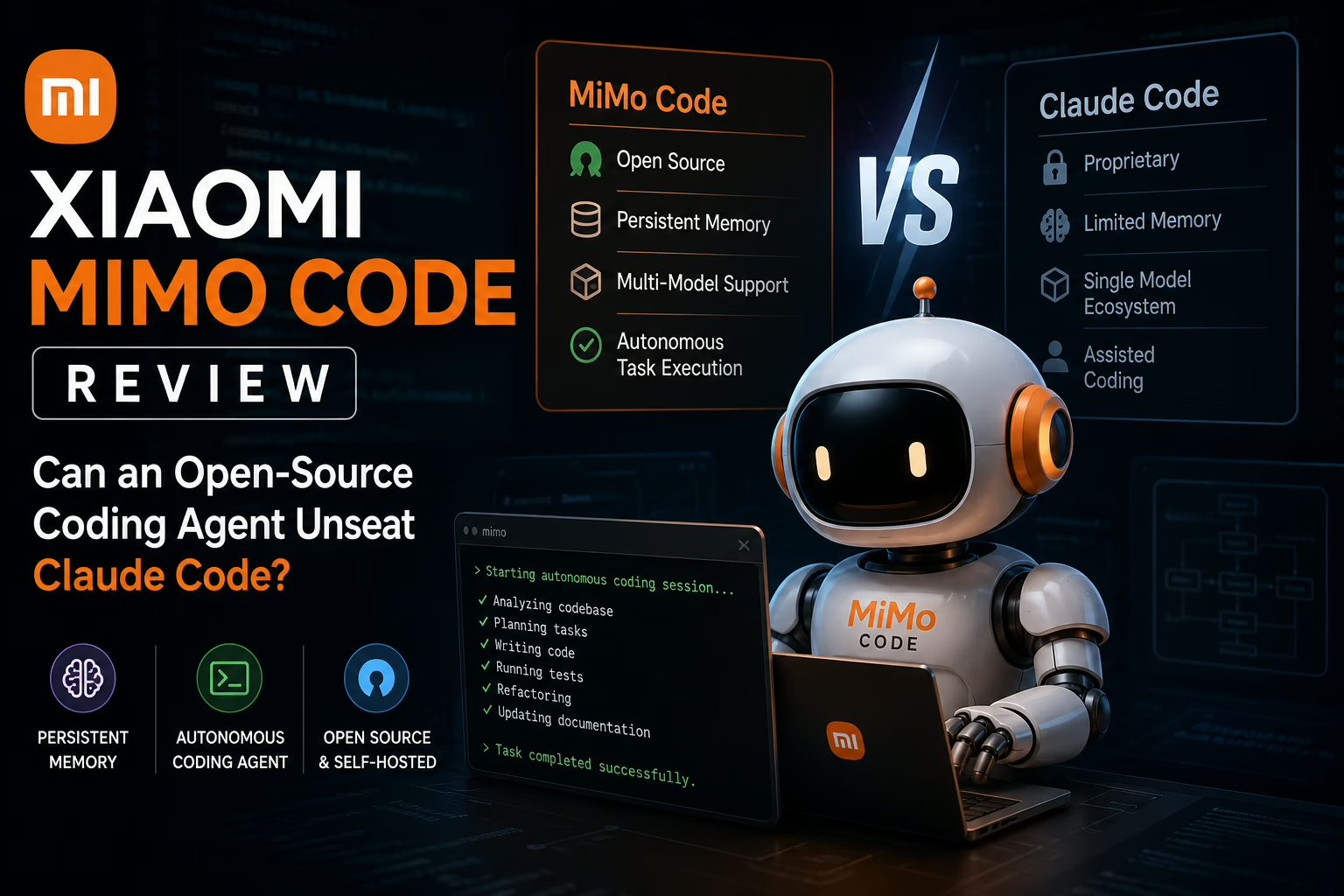
Xiaomi is not the company most developers think about when evaluating their software toolchain. The Beijing-based conglomerate built its brand on affordable smartphones and smart appliances, not developer infrastructure. Yet on June 10, 2026, its MiMo AI division quietly dropped something that immediately caught the attention of engineering teams well beyond China’s borders: MiMo Code V0.1.0, an MIT-licensed, terminal-native autonomous coding agent with a direct line of sight on Anthropic’s Claude Code.
The timing is deliberate. In 2026, the AI coding landscape is no longer about autocomplete. The race now belongs to agents—systems that don’t just suggest code but actually run terminals, execute test suites, resolve errors, manage Git branches, and loop autonomously until a task is done. Anthropic has held a commanding position in this space with Claude Code, a polished terminal-native agent deeply integrated with its own hosted infrastructure. The tradeoff for that polish is real: it’s expensive, closed, and tightly coupled to Anthropic’s cloud.
MiMo Code is built around the opposite set of assumptions. Forked from the OpenCode project, it is architecturally agnostic about which model does the reasoning. It runs locally. It stores state in SQLite. And for now, it comes bundled with a free tier of Xiaomi’s MiMo-V2.5, a multimodal Mixture-of-Experts model with a one-million-token context window that is, frankly, more capable than it has any right to be given the price point.
The harder question isn’t whether MiMo Code is interesting it clearly is. The harder question is whether a hardware company pivoting into developer tooling can build something that holds up under the pressure of real engineering work, or whether this is a well-funded open-source release that stalls at version 0.3.
Key Takeaways
- Long-Horizon Architecture: MiMo Code replaces naive context-window accumulation with a four-layer persistent memory system backed by SQLite FTS5, allowing it to maintain coherence through tasks exceeding 200 sequential execution steps.
- Meaningful Cost Savings: By supporting cheap, efficient models like DeepSeek and Kimi alongside Xiaomi’s own MiMo-V2.5-Pro, the platform meaningfully changes the economics of agentic coding—token costs drop by 40–60% compared to equivalent closed-source workflows.
- Frictionless Migration from Claude Code: Native compatibility with Claude Code tools, workflows, and Model Context Protocol (MCP) servers means switching doesn’t require rebuilding your toolchain from scratch.
- Early-Stage Caveats: V0.1.0 is exactly that: a first public release. It requires careful sandboxing, tolerates some model-compatibility friction, and occasionally gets stuck in execution loops that demand human intervention.
How We Got Here: The Shift from Autocomplete to Autonomous Agents
Understanding why MiMo Code matters requires appreciating how fast this space has moved—and how structurally different the current generation of tools is from what came before.
GitHub Copilot and the original OpenAI Codex were built around a deceptively simple idea: predict the next block of code given what’s already on screen. Useful, but fundamentally passive. They had no awareness of the broader codebase, no ability to execute the code they suggested, and no mechanism to detect when the output was wrong. The developer remained the operator; the model was the suggestion engine.
Cursor and Windsurf shifted that balance somewhat, introducing workspace-wide file search and multi-file editing within an IDE. Gemini Code Assist leaned on massive context windows to ingest entire repositories in a single pass. But the interaction model was still conversational: you prompt, it responds, you manually apply changes.
The Agentic Leap
The current generation tools like Claude Code, Devin, and now MiMo Code—operates on a categorically different architecture. The broader shift toward autonomous AI agents isn’t limited to software development. Similar concepts are emerging across research, automation, and productivity tools, as explored in our detailed guide to Manus AI. These are execution harnesses, not chat interfaces. Drop them into a terminal, give them a goal, and they loop:
[Goal Input] ──> [Plan Steps] ──> [Call Tools (Read/Write/Git)] ──> [Analyze Output/Errors] ──> [Loop/Iterate]
They read directory structures, write files, run bash scripts, interpret compiler errors, execute test suites, and commit to Git—all without pausing to ask for approval. The developer’s role shifts from line-by-line author to high-level systems architect: define the objective, review the diff.
That shift creates a new class of engineering challenges. State management becomes critical. A task that requires 300 sequential tool calls will eventually exhaust any fixed context window. How a system handles that constraint—whether it degrades gracefully or spirals into incoherence—is now one of the most important architectural questions in developer tooling.
MiMo Code’s answer to that question is what makes it worth examining seriously.
What MiMo Code Actually Is
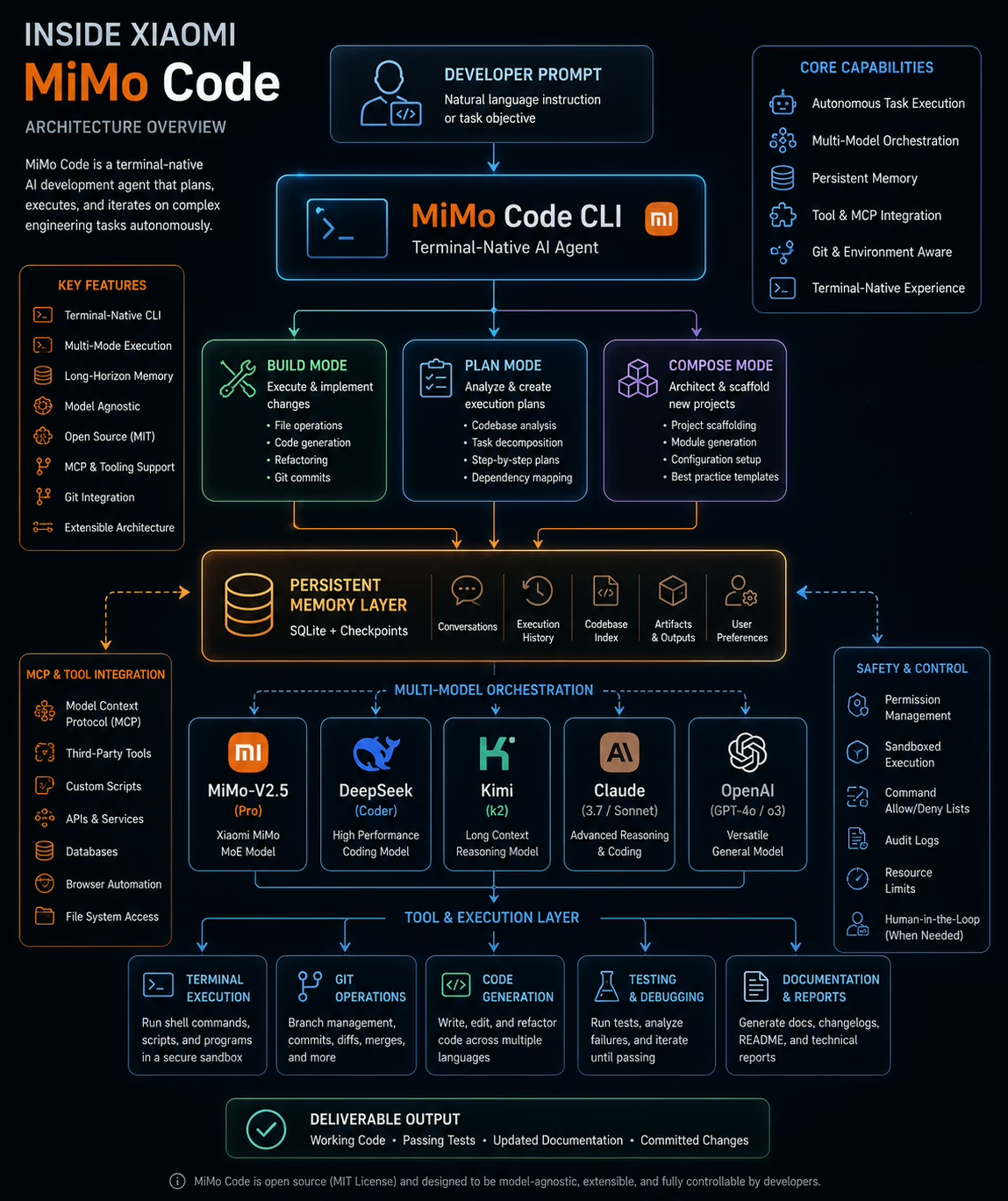
MiMo Code is a terminal-native AI development agent designed to execute complex, multi-step software engineering tasks. It is not an IDE plugin. It is not a browser-based chat interface. It is a CLI harness that lives in your terminal and interacts directly with your local file system, shell environment, and version control system.
                  ┌──────────────────────────────────────────────┐
                  │                 MiMo Code                    │
                  │   (Terminal-Native Open Source CLI Harness)  │
                  └──────────────────────┬───────────────────────┘
                                         │
        ┌────────────────────────────────┼────────────────────────────────┐
        ▼                                ▼                                ▼
┌──────────────┐                 ┌──────────────┐                 ┌──────────────┐
│  Build Mode  │                 │  Plan Mode   │                 │ Compose Mode │
│ (File/Git Ops)                 │ (Decomposition)                │(Full TDD Loop)
└──────────────┘                 └──────────────┘                 └──────────────┘
        │                                │                                │
        └────────────────────────────────┼────────────────────────────────┘
                                         ▼
                  ┌──────────────────────────────────────────────┐
                  │          Persistent Memory System            │
                  │     (SQLite FTS5 / Layered Markdown)         │
                  └──────────────────────┬───────────────────────┘
                                         │
        ┌────────────────────────────────┴────────────────────────────────┐
        ▼                                ▼                                ▼
┌──────────────┐                 ┌──────────────┐                 ┌──────────────┐
│ MiMo-V2.5-Pro│                 │DeepSeek /Kimi│                 │ Anthropic API│
│ (Default MoE)│                 │(Open-Source) │                 │(Closed-Source)
└──────────────┘                 └──────────────┘                 └──────────────┘
The practical distinction between a coding chatbot and MiMo Code is straightforward. A chatbot is stateless: it knows only what you paste in, and it returns text. MiMo Code is an execution environment. When you give it a task—say, “Migrate our auth system from JWT to cookies”—it breaks that instruction into a hierarchical subtask tree, invokes shell utilities, detects build failures, and modifies its approach in response to real runtime output.
Under the Hood
Three components make that work:
The CLI Harness is a heavily modified fork of OpenCode. It manages local file system access, executes terminal scripts safely within defined scopes, tracks running processes, and hooks directly into Git. This layer is where the MIT license lives, and it’s what teams can audit, fork, and extend.
The Multi-Agent Orchestrator is arguably the most architecturally interesting piece. Rather than routing every subtask to a single model call, MiMo Code spawns specialized subagents—a planner, a writer, a tester—each with structured lifecycles and explicit handoff protocols. The practical benefit is that a lightweight model can handle mechanical file edits while a more capable model handles architectural decisions, which has direct implications for cost.
The Open Model Layer is what separates MiMo Code most clearly from Claude Code. There is no coupling to any specific model provider. The harness can connect to OpenAI, Anthropic, DeepSeek, Kimi, GLM, or any locally-hosted model running an OpenAI-compatible endpoint. Out of the box, it connects to MiMo Auto, a limited-time free tier running on MiMo-V2.5-Pro—a 1-trillion parameter MoE model with 42 billion active parameters per token pass, specifically optimized for agentic code execution.
The Strategic Logic Behind Xiaomi’s Move
It’s worth taking the business rationale seriously, because it shapes what kind of product MiMo Code is and what kind of product it’s likely to become.
Chinese technology firms operate under persistent structural constraints when it comes to Western cloud infrastructure. US-based endpoints for OpenAI and Anthropic are subject to access restrictions that make them unreliable building blocks for domestic enterprise products. The response from Chinese AI companies has been consistent: build capable open or open-weights models domestically—DeepSeek and Kimi being the clearest examples—and develop tooling designed to run on those models efficiently.
By open-sourcing MiMo Code under the MIT license, Xiaomi establishes infrastructure in the global developer ecosystem while simultaneously insulating its users from the geopolitical fragility of cloud-API dependency. That’s a coherent strategy that also happens to benefit developers in Berlin, São Paulo, and Toronto who simply want to avoid paying Anthropic’s API rates.
The cost argument is not trivial. Agentic workflows are expensive by nature. A single complex refactoring session can require thousands of sequential model calls—each one consuming tokens as the agent reads files, analyzes errors, regenerates code, and re-verifies. On premier closed-source APIs, a sustained autonomous session can cost $10–$20 per hour. MiMo Code’s model-routing flexibility means you can run cheap models for mechanical tasks and expensive ones for reasoning-heavy decisions, dropping aggregate token costs by roughly 40–60% on comparable workloads.
The Four-Layer Memory System: Why It’s the Right Approach
Most current AI coding agents treat long context as the solution to state management. Need to remember that a file was edited three hundred steps ago? Just expand the context window. This works until it doesn’t—and in agentic workflows, it fails in specific, predictable ways. Older information gets deprioritized in attention calculations. The agent starts contradicting earlier decisions. It re-edits files it already modified. Costs balloon as the context grows heavier.
MiMo Code’s approach is more disciplined. It offloads state management to structured local storage, using a four-layer system backed by SQLite FTS5:
| Memory Layer | Filename | Scope & Function |
|---|---|---|
| Project Memory | MEMORY.md | Long-term repository knowledge: architecture descriptions, tech stack, code style rules. Persists across sessions. |
| Session Checkpoint | checkpoint.md | State snapshots of the current terminal session. When context fills, the agent bootstraps from this file rather than re-reading raw history. |
| Scratch Notes | notes.md | Temporary workspace for internal reasoning—draft patterns, transient error logs, intermediate calculations. |
| Task Progress Log | tasks/<id>/progress.md | Tree-structured execution log tracking nested task hierarchies (Task 1.1 → Subtask 1.1.1). |
When context limits approach, a background subagent performs compression: archiving older data into SQLite and retrieving it semantically only when a running task requires it. The model never sees a wall of historical terminal output—it sees a structured, curated summary of relevant state.
This is the right architecture for long-horizon tasks. Whether the implementation is robust enough to hold up in production-scale repositories is a different question, and one V0.1.0 only partially answers.
Memory Maintenance: /dream and /distill
Two commands address the longer-term problem of memory decay and bloat:
/dream runs weekly by default (or on demand). An isolated subagent reviews all historical development sessions, removes duplicate entries, verifies that documented file paths still exist, and condenses the output back into MEMORY.md. In practice, this prevents the project memory layer from becoming a historical archive rather than a useful operational document.
/distill is the more interesting one. It watches for recurring workflow patterns—the same sequence of grep calls, build commands, and file checks repeated across multiple sessions—and compresses them into reusable macro commands. If MiMo Code notices you consistently run a particular four-step validation sequence before committing, it creates a named skill command for it. That’s not just a convenience feature; it’s a mechanism for the agent to accumulate institutional knowledge about your specific workflow.
Three Execution Modes, Each for a Different Task Profile
The Tab key in the terminal cycles through three distinct agent behaviors. This is a small UX decision with real operational significance—it forces the developer to consciously choose the level of autonomy they’re granting the agent.
Build Mode is the narrowest. It handles targeted, mechanical modifications: single-file edits, dependency updates, Git commits under human review. This is the right mode for tasks where you have a clear, specific change in mind and want the agent to execute it without independent exploration.
Plan Mode is non-destructive by design. The agent reads the codebase extensively—crawling dependency graphs, mapping module relationships, identifying potential side effects of proposed changes—but writes nothing. The output is a structured plan for human review. For teams with strict code review requirements or unfamiliar legacy codebases, this is the mode that builds trust before granting broader autonomy.
Compose Mode is the full autonomous loop:
[Write Specification] ──> [Decompose into Tasks] ──> [Write Unit Tests] ──> [Generate Code] ──> [Run Test Suite] ──> [Debug Failures] ──> [Self-Verify]The loop repeats until the test suite passes. Then an independent internal judge model reviews the diff for performance regressions before surfacing the result for developer approval. On straightforward feature work in well-structured codebases, Compose Mode is impressive. On legacy systems with circular dependencies and missing test infrastructure, it struggles—more on that shortly.
Real-World Testing: What Actually Happened
Rather than benchmark against synthetic tasks, we ran MiMo Code through engineering scenarios that reflect actual production workloads.
Refactoring Legacy Node.js to TypeScript
We tasked the agent with migrating a legacy Express service handling user transactions into a structured TypeScript architecture with dependency injection. In Plan Mode, it correctly mapped the database models and flagged untyped middleware variables before touching a single file. Switching to Compose Mode, it generated TypeScript interfaces and worked through the migration systematically.
The multi-agent separation earned its keep here. A dedicated tester subagent caught syntax mismatches in compiler logs and fed them back to the writer subagent before the issues required human intervention—exactly the kind of closed-loop error recovery that distinguishes agents from glorified autocomplete.
The failure mode was also revealing. The legacy service had deep circular dependencies across several modules. When the agent hit those, it entered a three-step import resolution loop that didn’t resolve. It took a manual pause and an explicit file boundary declaration to break the cycle. This isn’t a surprising failure, but it illustrates why V0.1.0 shouldn’t be running unsupervised on complex legacy code.
Vue 2 to Vue 3 Migration
Migrating a front-end component library from Vue 2’s Options API to Vue 3’s Composition API is the kind of task that breaks long-horizon agents. It requires applying consistent transformation patterns across dozens of individual files without drifting from the established pattern as the session extends.
Over a 180-step terminal trajectory, MiMo Code performed well here. The persistent checkpoint system did what it was designed to do: the agent consistently referred back to checkpoint.md to verify it was applying the same composition API syntax to each component, maintaining consistency that basic LLM workflows typically lose around step 50.
Automated Memory Leak Detection in Python
We introduced a subtle memory leak into a FastAPI background worker pipeline—an unclosed database cursor inside an async context manager—and told the agent to find and fix it without any additional hints.
This one was genuinely impressive. MiMo Code installed psutil autonomously, spun up a local mock worker thread, monitored memory allocation across a series of requests, identified the unclosed cursor, wrote the fix, and verified it through a clean test run. No human guidance after the initial prompt. This is the use case the tool was designed for, and it delivered.
MiMo Code vs. Claude Code: What the Architecture Difference Actually Means
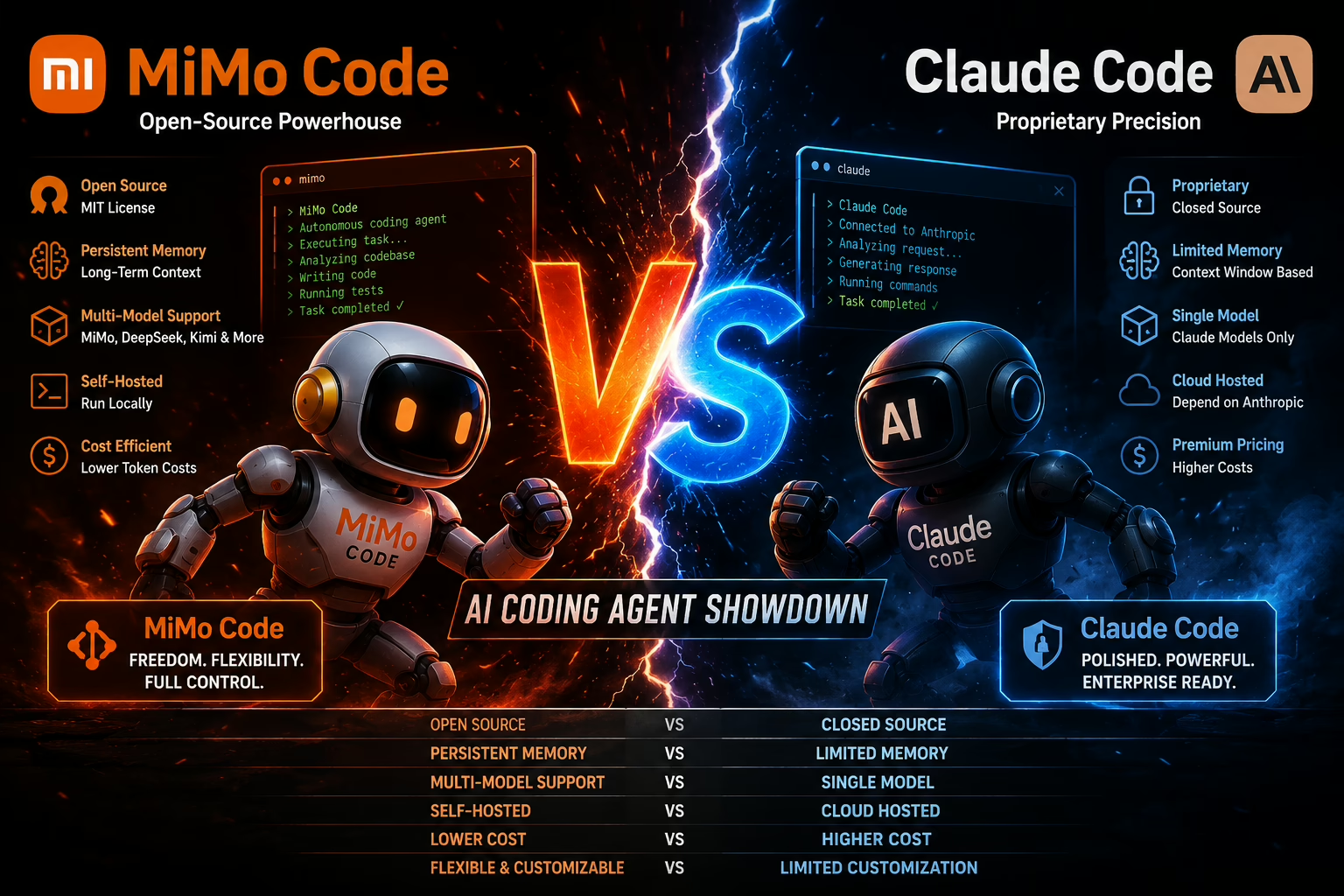
Both tools target the terminal. Both handle multi-step autonomous execution. The design philosophies are nearly opposite.
| Feature | Xiaomi MiMo Code V0.1.0 | Anthropic Claude Code (Beta) |
|---|---|---|
| Licensing | Open-source (MIT) | Closed-source (Proprietary) |
| Infrastructure | Decoupled; local CLI runtime | Coupled to Anthropic’s cloud |
| Model Compatibility | MiMo, DeepSeek, Kimi, OpenAI, Anthropic, local | Strictly Anthropic Claude models |
| Memory Architecture | Layered SQLite FTS5 + active maintenance commands | Context-window padding + basic rolling summarization |
| Deployment | Local, self-hosted, private cloud containerizable | Hosted API billing per execution |
| Max Execution Horizon | High success rates past 200 steps | Optimized for shorter sessions |
Claude Code’s strength is the model beneath it. Claude’s reasoning is genuinely excellent—contextually aware, precise in its formatting, and remarkably good at inferring intent from ambiguous instructions. Anthropic has spent years tuning its models for code, and that shows in the quality of individual outputs. The cost of that quality is architectural: Claude Code relies on linear context history, which means that as sessions grow, context grows, and costs escalate nonlinearly.
MiMo Code operates on the assumption that long-session coherence is a system problem, not a model problem. That’s a defensible position. The SQLite-backed memory architecture genuinely addresses a real limitation of context-window-only approaches, and Xiaomi’s internal evaluations—covering over 500 developers across hundreds of private repositories—back it up: on tasks under 200 steps, the two systems score comparably. Past 200 steps, MiMo Code’s success rate rises above 65%.
Those benchmarks are self-reported, which deserves some skepticism. But the architectural argument is sound, and the real-world testing is consistent with it.
Where MiMo Code cannot yet compete is in the quality of individual reasoning outputs, particularly on ambiguous or architecturally novel problems. When a task has a clear structure and well-defined success criteria, the scaffolding does most of the work. When a task requires genuine architectural judgment under uncertainty, the underlying model matters more—and Claude still has an edge.
MiMo Code vs. the OpenAI Codex Era: A Structural Comparison
The contrast with Codex isn’t really a feature comparison—it’s a philosophical one.
┌─────────────────────────────────────────────────────────────────────────┐
│                           PHILOSOPHICAL EVOLUTION                       │
├────────────────────────────────────┬────────────────────────────────────┤
│       OpenAI Codex Era (Past)      │     MiMo Code Era (2026)           │
├────────────────────────────────────┼────────────────────────────────────┤
│  • Passive, Inline Autocomplete    │  • Autonomous Agentic Loop         │
│  • Stateless Single-Turn Prompts   │  • Multi-Layer Persistent Memory   │
│  • Text-In, Text-Out Only          │  • Shell Execution & Tool Control  │
│  • Tied to Commercial Cloud APIs   │  • Open Source & Model Agnostic    │
└────────────────────────────────────┴────────────────────────────────────┘
Codex treated code generation as a language prediction problem. Given surrounding code, predict the next block. The developer managed everything else: file creation, test execution, error interpretation, iteration. Codex’s job ended at the text boundary.
MiMo Code’s job begins there. It treats software engineering as a goal-directed execution problem, not a text completion problem. The difference is not incremental. Giving a system access to a shell and a feedback loop changes its fundamental relationship to the codebase. It can fail, detect that failure, and try a different approach—which is something no language model operating purely in token space can do.
Strengths Worth Highlighting
Cost architecture: The model-routing flexibility is genuinely useful, not just a feature checklist item. Running DeepSeek for structural boilerplate and reserving premium API calls for complex reasoning is a real workflow optimization that reduces costs without requiring the developer to manage it manually.
Long-term coherence: The /dream and /distill commands address a problem most agentic tools ignore: memory decay over weeks of discontinuous work. If you’re working on a codebase across a month of sessions, the difference between an agent that remembers your architectural decisions and one that doesn’t is not subtle.
Migration path from Claude Code: Automatically ingesting existing Claude Code skills, custom commands, and MCP server configurations is a pragmatic decision that removes adoption friction. It signals that Xiaomi understands what developers actually care about when evaluating switching costs.
Data governance: For enterprise teams with regulatory obligations—healthcare, finance, defense—the ability to run a fully air-gapped agentic coding environment without transmitting repository contents to external servers is not a nice-to-have. It’s a hard requirement that MiMo Code meets and Claude Code structurally cannot.
Limitations That Matter
Autonomous execution risk: An agentic system with full terminal access is inherently capable of doing significant damage if it hallucinates a bash command or enters a runaway file-generation loop. V0.1.0’s behavior on broken legacy environments—circular dependencies, missing build tools—suggests the error recovery isn’t yet robust enough to trust on production systems without explicit sandboxing. This isn’t unique to MiMo Code, but it’s worth stating plainly: you should run this inside Docker on isolated staging infrastructure, full stop.
Model compatibility friction: The decoupled model architecture is a strength, but it creates a specific failure mode. Lower-tier open-source models often can’t reliably follow the structured XML and JSON formats that the CLI harness requires for tool calls. When the model fails to format a tool invocation correctly, the result is repetitive parser errors rather than graceful degradation. The quality of the harness is only as reliable as the weakest model in your routing configuration.
Geographic infrastructure bias: Default configurations are optimized around East Asian cloud services. Routing to Anthropic or OpenAI endpoints works, but requires manual base URL and token configuration. For Western developers, this is a setup tax that shouldn’t exist in V0.2.
What Developers Should Consider Before Adopting It
Where It Excels
Large-scale boilerplate implementation—REST endpoint generation, CRUD models, validation schema expansion—is exactly the kind of mechanical, high-volume work where MiMo Code’s multi-agent architecture earns its overhead. Similarly, test suite generation on existing untyped codebases, and legacy repository auditing using Plan Mode’s non-destructive read access, are strong use cases that don’t require trusting the agent with write access to production code.
Where to Be Cautious
Novel algorithmic architecture is not this tool’s strength. Problems involving custom cryptography, specialized mathematical optimization, or non-standard memory management require the kind of deep reasoning that the scaffolding can’t substitute for—and the agent will fall back on common patterns that may not fit your constraints. Similarly, if your local environment has broken toolchain infrastructure, the agent will try to fix that first, often getting stuck in infrastructure debugging loops rather than addressing the task you actually assigned.
Security Implementation Checklist
- Containerize first, always. Never run MiMo Code directly on your primary host machine. Use an isolated Docker container or a disposable VM with restricted system permissions.
- Lock your main branch. The agent should operate exclusively on isolated Git branches. Confirm that your production branch is protected and that the agent cannot push directly to it.
- Set spending caps. Configure maximum token spend limits and session timeout windows on your model provider dashboard before running extended Compose Mode sessions.
The Broader Architectural Argument
MiMo Code’s release makes a specific claim that deserves serious consideration: that state management and scaffolding are just as important as model capability for long-horizon agentic tasks.
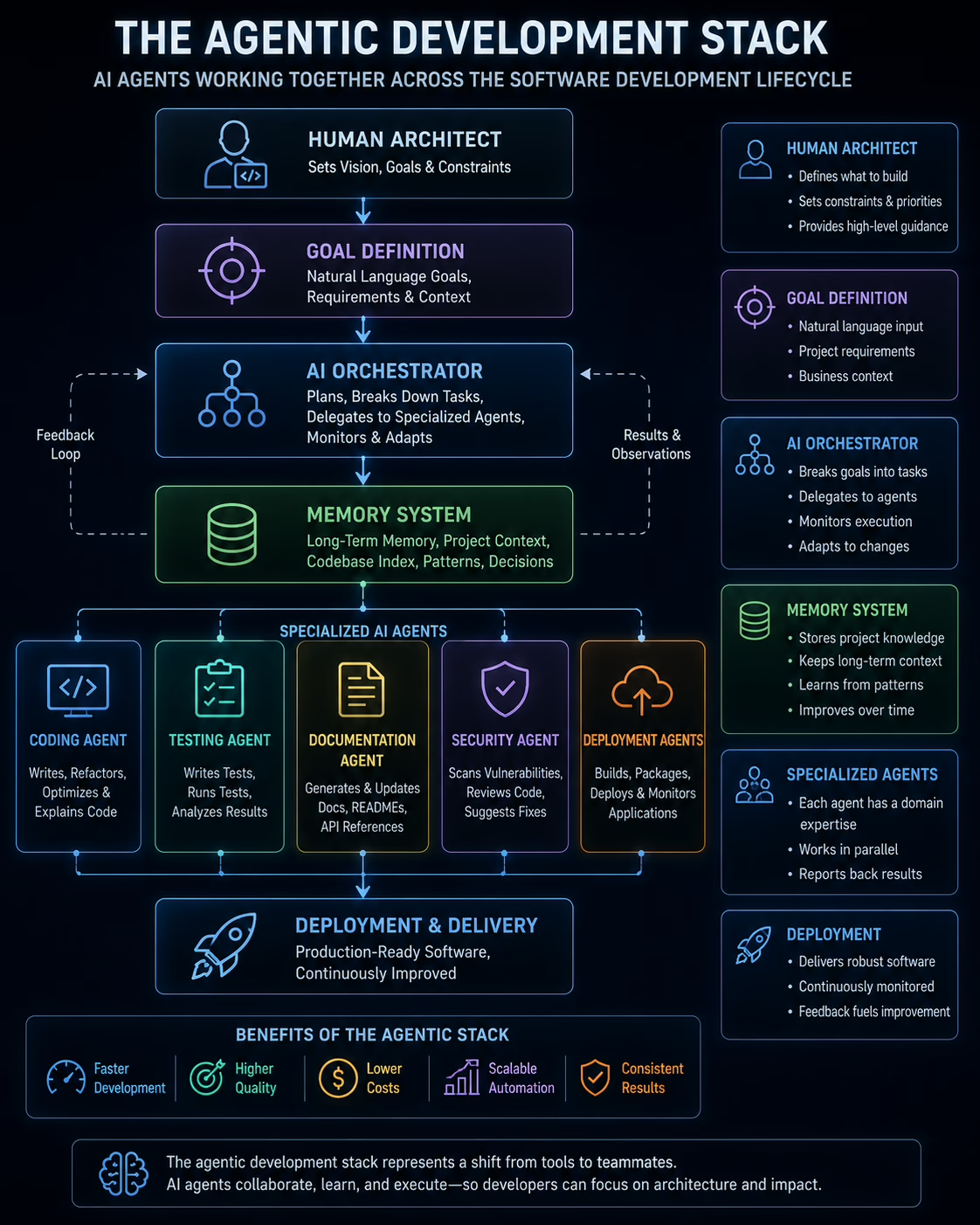
For two years, the dominant thesis in AI development tooling was that bigger context windows would solve everything. Just ingest the whole codebase at once and let the model reason across it. MiMo Code’s architecture implicitly argues that this is wrong, or at least insufficient that attention doesn’t scale linearly with context, and that structured external memory is a more reliable foundation for sustained agentic execution than hoping the model maintains coherence across thousands of tokens of terminal history.
┌─────────────────────────────────────────────────────────────────────────┐
│                    THE AGENTIC DEVELOPMENT PARADIGM                     │
├─────────────────────────────────────────────────────────────────────────┤
│  Human Architect  ──> Defines Objectives & Guardrails                   │
│         │                                                               │
│         ▼                                                               │
│  Orchestration    ──> Manages Multi-Agent Workflows & Tool Access       │
│         │                                                               │
│         ▼                                                               │
│  Memory Layer     ──> Decouples Long-Term Context from the Model Window │
│         │                                                               │
│         ▼                                                               │
│  Execution Node   ──> Runs Local Commands, Validates Tests, Refines Code│
└─────────────────────────────────────────────────────────────────────────┘
This architectural bet has implications beyond MiMo Code itself. If the open-source community extends this harness better error recovery, tighter model-agnostic tool call handling, improved loop detection – the gap between open and closed developer agents narrows considerably. Anthropic and OpenAI have noticed. Expect both companies to accelerate their own work on structured state management as a counterargument. As AI-generated content and automation systems become more sophisticated, distinguishing genuine expertise from mass-produced output has become increasingly important for publishers and developers alike.
What Comes Next for AI Coding Assistants
The near-term trajectory of this space is fairly clear. Autonomous coding agents will handle more of the mechanical work of software development—endpoint generation, test writing, dependency management, migration tasks—while human engineers focus on system design, architectural decisions, and the kind of ambiguous problem-solving that current agents handle poorly.
MiMo Code doesn’t eliminate the software engineer’s role. It changes the leverage ratio. A single engineer directing multiple specialized subagents—one updating documentation, one patching vulnerabilities, one drafting feature implementations—can cover more ground than was previously possible. How much more depends heavily on the quality of the orchestration layer and the robustness of the underlying models.
For enterprises specifically, the maturity of open-source agentic frameworks now provides a credible alternative to cloud-dependent tools for the first time. Companies that rejected AI coding assistants on data governance grounds have a new option. As open-weights models continue closing the performance gap with proprietary alternatives, the economic case for self-hosted agentic development becomes harder to argue against.
Final Verdict
MiMo Code V0.1.0 is a serious piece of work, not a showcase project. The memory architecture is genuinely well-designed, the multi-agent orchestration works as advertised on appropriate tasks, and the model-agnostic foundation gives it durability that tightly coupled tools lack.
It does not yet match Claude Code’s raw reasoning quality on complex, ambiguous tasks. That gap matters for architects and senior engineers making nuanced design decisions. For the large volume of structured, mechanical engineering work that makes up most production development—migrations, test generation, boilerplate, bug hunting—the scaffolding advantage is real and the cost advantage is substantial.
Watch V0.2. If Xiaomi addresses the model compatibility friction and improves error recovery on broken environments, MiMo Code’s adoption curve in enterprise engineering teams will steepen considerably. The open-source community’s involvement will matter too: the MIT license is an invitation, and developer tooling communities have a track record of extending exactly this kind of harness faster than the original maintainers expect.
For teams with regulatory constraints, high API costs, or a principled preference for open infrastructure, the case for evaluating MiMo Code now is clear. For everyone else, it’s worth keeping closer attention on than most hardware-company software releases deserve.
Beyond coding agents, generative AI is rapidly expanding into image creation, editing, and multimodal workflows, highlighting how quickly AI capabilities are evolving across different categories.
Frequently Asked Questions
Is Xiaomi MiMo Code completely open-source?
Yes. MiMo Code is released under the MIT license, which grants unrestricted freedom to view, modify, distribute, and commercialize the code. The underlying MiMo-V2.5-Pro model has a separate license, but the CLI harness itself is fully open.
Can I use MiMo Code with models other than Xiaomi’s MiMo?
Yes. It supports any OpenAI-compatible API endpoint, including DeepSeek, Kimi, Anthropic’s Claude, OpenAI’s GPT models, and locally-hosted models running via Ollama or vLLM.
How does the persistent memory system avoid information loss as sessions grow?
It distributes state across four structured layers—Project, Session, Notes, and Tasks—backed by a local SQLite FTS5 database. When context limits approach, a background subagent archives older data into the database and retrieves it semantically when a running task requires it, rather than simply discarding it.
What is the practical difference between Build, Plan, and Compose modes?
Build Mode handles direct, targeted file changes. Plan Mode analyzes the codebase and produces a structural roadmap without modifying anything—useful for understanding unfamiliar codebases or auditing before granting write access. Compose Mode runs a fully autonomous test-driven development loop, writing tests first and iterating until they pass.
Can I import my existing Claude Code configurations?
Yes. MiMo Code includes built-in migration compatibility that reads and imports your existing Claude Code skills, custom commands, and MCP server configurations.
Is it safe to let MiMo Code run commands in my local terminal?
Not without a sandboxed environment. The agent can execute arbitrary bash scripts, which means an unchecked command loop can damage your local file system. Always run it inside a Docker container or an isolated VM with restricted system permissions.
How does the /dream command work?
It runs weekly by default or on demand. An isolated subagent reviews historical development sessions, removes duplicates, verifies that documented file paths still exist, and compresses the output back into MEMORY.md. The goal is keeping project memory operationally useful rather than turning it into an ever-growing historical archive.
Does MiMo Code require an internet connection?
The CLI harness runs entirely locally. If you configure it to use a local open-weights model via Ollama or a private network server, the entire agent architecture can run inside an air-gapped environment with no external network access required.