In this article
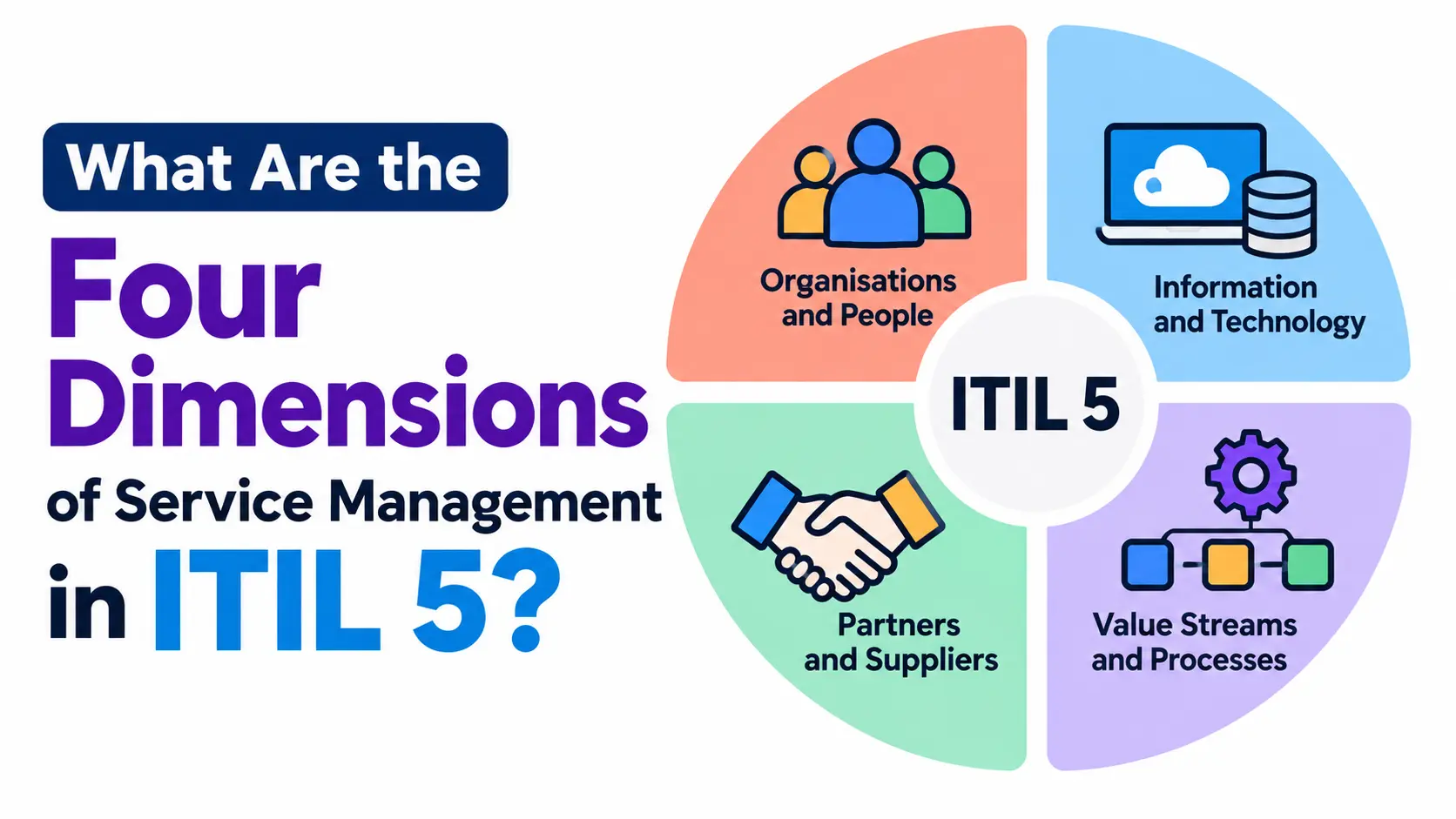
Modern IT service management in the current day is less about keeping systems running and resolving issues. It has now evolved into a larger system that requires organisations to bring together people, technology, suppliers, and efficient working processes to ensure that meaningful value, which also supports business objectives, is created. ITIL 5’s Four Dimensions of Service Management helps provide a framework for this.
These Four Dimensions give different perspectives that ought to be taken into account when designing, modifying, improving, and delivering products and services.
The four dimensions are:
- Organisations and People
- Information and Technology
- Partners and Suppliers
- Value Streams and Processes.
Professionals who want to learn how these frameworks can be effectively applied within their organisations can consider joining the ITIL 5 Foundation Training so they can help their teams deliver products and services that are relevant, reliable, and efficient.
Organisations and People
The first dimension of service management focuses on humans and organisational processes. This dimension ensures that people possess the right skills, responsibilities, communication skills, and support required to deliver significant value. Even with the most advanced technology, quality output cannot be generated if humans lack the correct resources. This dimension considers the following aspects:
- Leadership and organisational structure
- Roles and responsibilities
- Skills and capabilities
- Culture of organisation
- Staffing requirements
For example, if an organisation introduces a new IT service, employees must be trained accordingly and should be assigned responsibilities to lead the team effectively. A good service culture also ensures that collaborative skills like accountability and continuous improvement are included.
Information and Technology
The second service management dimension talks about the information and technology required to deliver and manage services effectively. This includes the information a service depends on and the technological infrastructure that will be required to support it. This can involve:
- Software applications
- Infrastructure and hardware
- Cloud technologies and network infrastructure
- Automation and emerging technologies
- Data management
For example, a customer support system might require a ticketing platform, customer records, communication, analytics, and a secured platform for efficient service delivery. However, if the technology is not integrated properly or the information is unreliable, service quality becomes compromised.
The ITIL 5 also encourages organisations to evaluate whether their technology and information support the desired service outcome. Organisations should not simply adopt technology because it is new.
Partners and Suppliers
Some aspects of a service are also provided by external suppliers. External organisations like vendors, consultants, infrastructure providers, and cloud providers also contribute to the service delivery.
The Partners and Suppliers dimension focuses primarily on effectively managing these types of relationships:
- Supplier capabilities
- Service quality
- Risks and dependencies
- Contracts and agreements
- Costing
For example, if an organisation is dependent on a cloud service provider for their product, effective management should ensure that they keep in mind the provider’s availability, performance, and obligations according to their contract.
Value Streams and Processes
The fourth dimension of service management focuses on how work transitions through different stages to create and deliver value for customers and stakeholders.
A value stream represents the order in which activities take place to create and deliver a product or service to a customer. Such processes provide a clear structure on how to run activities in a manner in which outcomes remain consistent. A value stream helps showcase the following:
- Workflows
- Value of creation
- Efficiency of processes
- Dependencies between activities
- Opportunities for improvement
- Roles present within workflows
For example, a certain customer request may involve analysing the current process, investigating the request, identifying ways in which it can be improved, and subsequently resolving it.
Value stream mapping helps organisations examine the workflow from beginning to end and look for ways to make it more efficient by identifying unnecessary steps, delays, and hindrances.
The aim of this dimension is to ensure that all organisational activities work together to contribute to a valuable outcome.
Why Are the Four Dimensions Important in ITIL 5?
The four dimensions encourage an all-rounded approach to service management. These dimensions do not need to be followed in a specific order; instead, all four aspects must be considered by organisations when designing, delivering, improving, or supporting services and products.
If a company is launching a new digital portal for its customers, it will need:
- Organisations and People: Employees with the right skillset and responsibilities to direct the tasks effectively.
- Information and Technology: The right infrastructure, secure applications, and accurate customer information
- Partners and Suppliers: Effective relationship between the organisation and external vendors like cloud, software, and technology providers
- Value Streams and Processes: A clear workflow to develop, launch, support, and continuously improve the portal service.
A service can be affected even if one dimension is not accounted for during its creation. But it should also be noted that these dimensions can also be influenced by external factors like political, economic, technological, social, legal, and environmental conditions.
How Do the Four Dimensions Support Modern Service Management?
The four dimensions help organisations to:
- Align services with business and customer needs
- Introduce collaboration across teams and suppliers
- Identify risks and dependencies
- Make informed decisions about technology and investments
- Improve workflow and reduce delays
- Facilitate continuous improvement
Professionals working in scaled Agile environments can further develop their product ownership and management skills through SAFe POPM training.
Applying the Four Dimensions in an AI-Driven Service Environment
As organisations increasingly adopt artificial intelligence and automation, the four dimensions of service management become even more relevant. AI-powered services depend on more than advanced technology. They also require skilled employees, reliable information, effective supplier relationships, and clearly defined processes to ensure that the services deliver meaningful business outcomes.
For example, an organisation introducing an AI-powered customer support system must understand what artificial intelligence is and how different types of artificial intelligence can support its objectives. Understanding machine learning can also help decision-makers identify opportunities for automation, improve service personalisation, and make better use of operational data.
The four dimensions can be applied to AI-driven services in the following ways:
- Organisations and People: Employees need the skills to manage AI-powered services, interpret their outputs, and handle situations that require human judgement. Leadership must also establish clear responsibilities for service quality, data protection, and continuous improvement.
- Information and Technology: AI services depend on suitable infrastructure, accurate data, secure applications, and reliable integrations. Organisations should assess whether their technology supports the intended outcomes and meets relevant security and performance requirements.
- Partners and Suppliers: External AI providers, cloud platforms, software vendors, and infrastructure partners can influence service availability, costs, and reliability. Organisations should evaluate supplier capabilities, contractual obligations, data-handling practices, and potential dependencies.
- Value Streams and Processes: AI should fit into established workflows rather than operate as an isolated technology. Organisations need to define how AI-generated outputs are reviewed, how exceptions are handled, and how service performance is measured.
AI can also influence how organisations make decisions and manage customer relationships. For instance, AI leadership and decision-making explores how artificial intelligence can support business decisions, while AI customer support examines its role in improving customer service. These applications demonstrate why technology adoption must be supported by appropriate people, governance, supplier management, and operational processes.
Organisations exploring more advanced AI applications may also benefit from understanding generative AI and retrieval-augmented generation (RAG). These technologies can support knowledge-based services, internal information retrieval, and customer-facing applications. However, their effectiveness depends on data quality, security controls, integration, and the ability to monitor and improve service outcomes.
Ultimately, the four dimensions provide a practical way to assess whether a new technology or service is ready for real-world use. By considering people, technology, external relationships, and workflows together, organisations can reduce operational gaps, manage risks, and ensure that innovation contributes to measurable value for customers and the business.
Conclusion
The four dimensions of service management help organisations find a way to make their services and products better and more successful. Organisations and People place an emphasis on the human element; Information and Technology provide the technological backing; Partners and Suppliers help maintain relationships, manage capabilities and dependencies with external organisations, while Value Streams and Processes ensure that all work activities come together to deliver valuable outcomes.
Instead of viewing service management as something that helps only assess technological or process problems, the ITIL 5 framework encourages organisations to see service development from the beginning to the end and how balancing people, technology, relationships, and workflows is necessary for good value delivery.
Use the key points in this guide to understand the topic and make more informed decisions.

This guide is researched and edited using relevant documentation, reliable sources and publicly available information.
Was this guide helpful?
Your feedback helps us improve future guides.