In this article
I have spent the better part of twenty years building and deploying machine learning systems. From early recommender engines to today’s 70-billion-parameter large language models, one shift has been more profound than any other: the emergence of Generative AI. It has transformed how we think about software, creativity, and even what constitutes a tool. This article is a distillation of everything I wish I had known when I first started architecting generative systems for production. No hype, no hand-waving. Just engineering reality.
Key Takeaways
- Generative AI creates new, original content by learning the underlying probability distribution of the training data.
- Modern generative systems are built on the Transformer architecture, with diffusion models leading for images and audio.
- Large Language Models (LLMs) generate text autoregressively, token by token, using the self-attention mechanism and a KV cache.
- Retrieval-Augmented Generation (RAG) grounds model outputs in external knowledge, while agents extend LLMs with tools and planning.
- Production deployment demands attention to inference cost, safety alignment, prompt injection defences, and continuous evaluation. These models are powerful, not magical.
At a Glance: What Generative AI Really Is
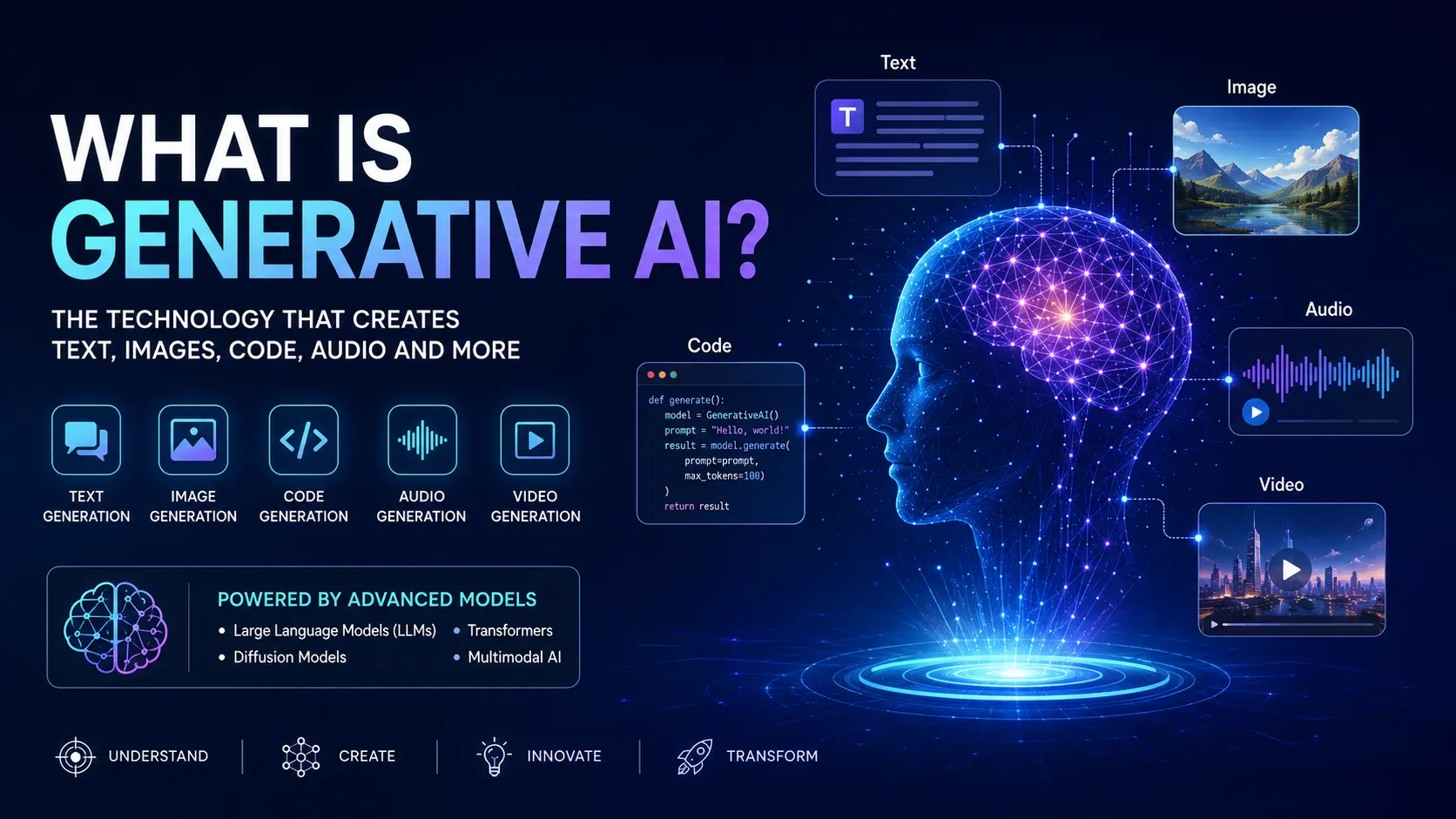
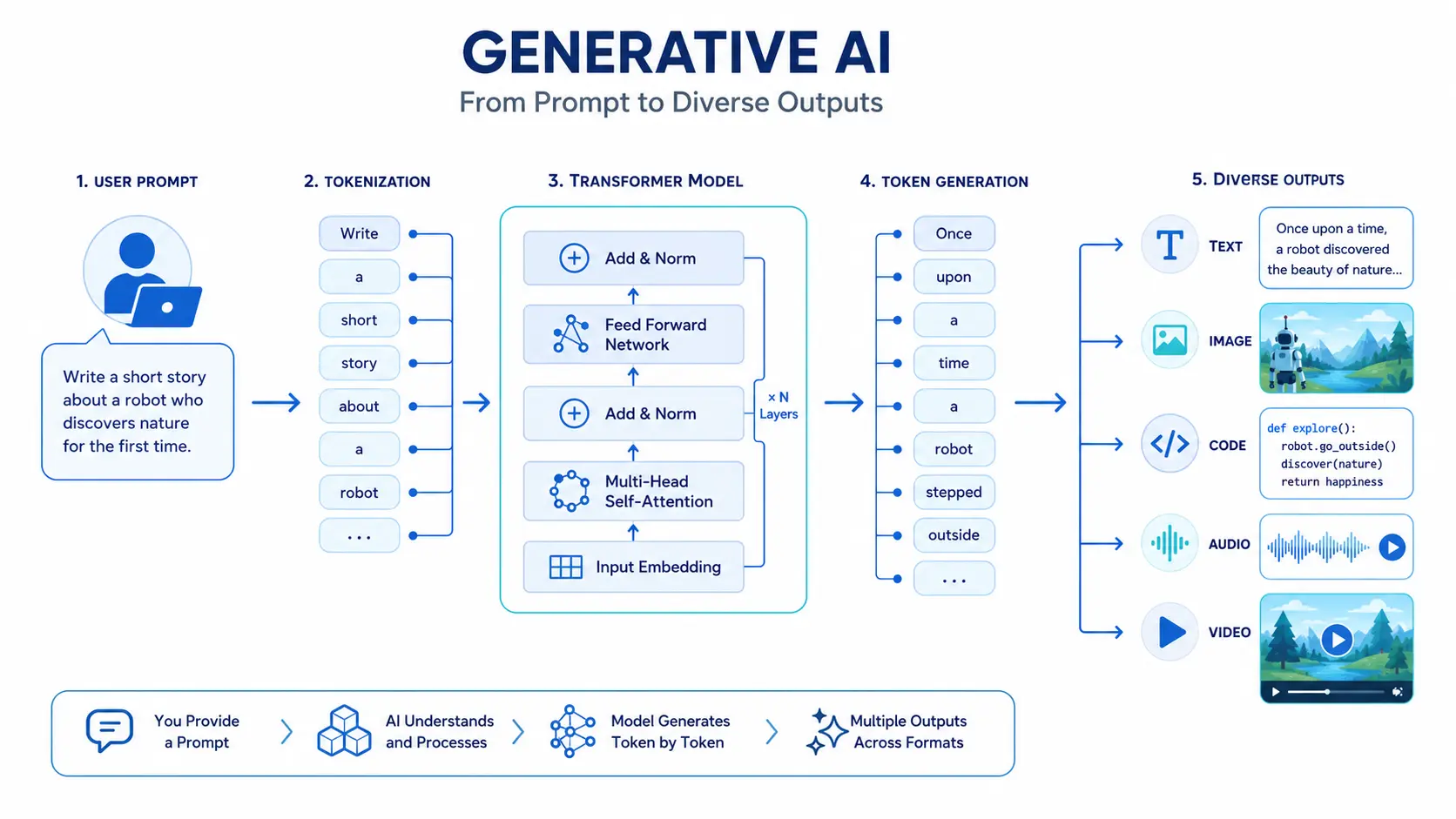
Generative AI is a branch of artificial intelligence that produces new content – text, images, code, audio, or video – by modelling the statistical patterns of existing data. It generates original outputs rather than just analyzing or classifying. Examples include ChatGPT, DALL‑E, and Stable Diffusion.
Generative AI vs Traditional AI
| Feature | Generative AI | Traditional / Discriminative AI |
|---|---|---|
| Goal | Create new data | Predict a label or value |
| Learns | P(x) or P(x|y) | P(y|x) |
| Output | Open-ended (text, image, etc.) | Fixed category or number |
| Example models | GPT, Stable Diffusion | ResNet, XGBoost |
The Foundation: AI, Machine Learning, and Deep Learning
To understand Generative AI, you need to place it within the broader landscape. Artificial intelligence is the overarching field. Within it, machine learning gives systems the ability to learn from data without being explicitly programmed. Deep learning, a subset of ML, uses multi-layered neural networks to model complex patterns. Generative AI is built almost entirely on deep learning.
Our article What Is Artificial Intelligence? provides a thorough grounding, and the Types of Artificial Intelligence Explained piece clarifies where generative models sit relative to AGI and narrow AI.
Neural Networks as Universal Approximators
A neural network is a composition of linear transformations and nonlinear activation functions. For a single layer: h = σ(Wx + b). Stack many such layers, and you have a deep network capable of approximating any continuous function. The learning happens by minimising a loss function via gradient descent. The gradient is computed by backpropagation. For generative models, the loss function is often the cross-entropy between the predicted and true data distribution, and the optimisation updates billions of parameters.
Our What Is Machine Learning? A Beginner’s Guide and What is Deep Learning? The Complete 2026 Guide cover these concepts in detail.
The Transformer: The Backbone of Modern Gen AI
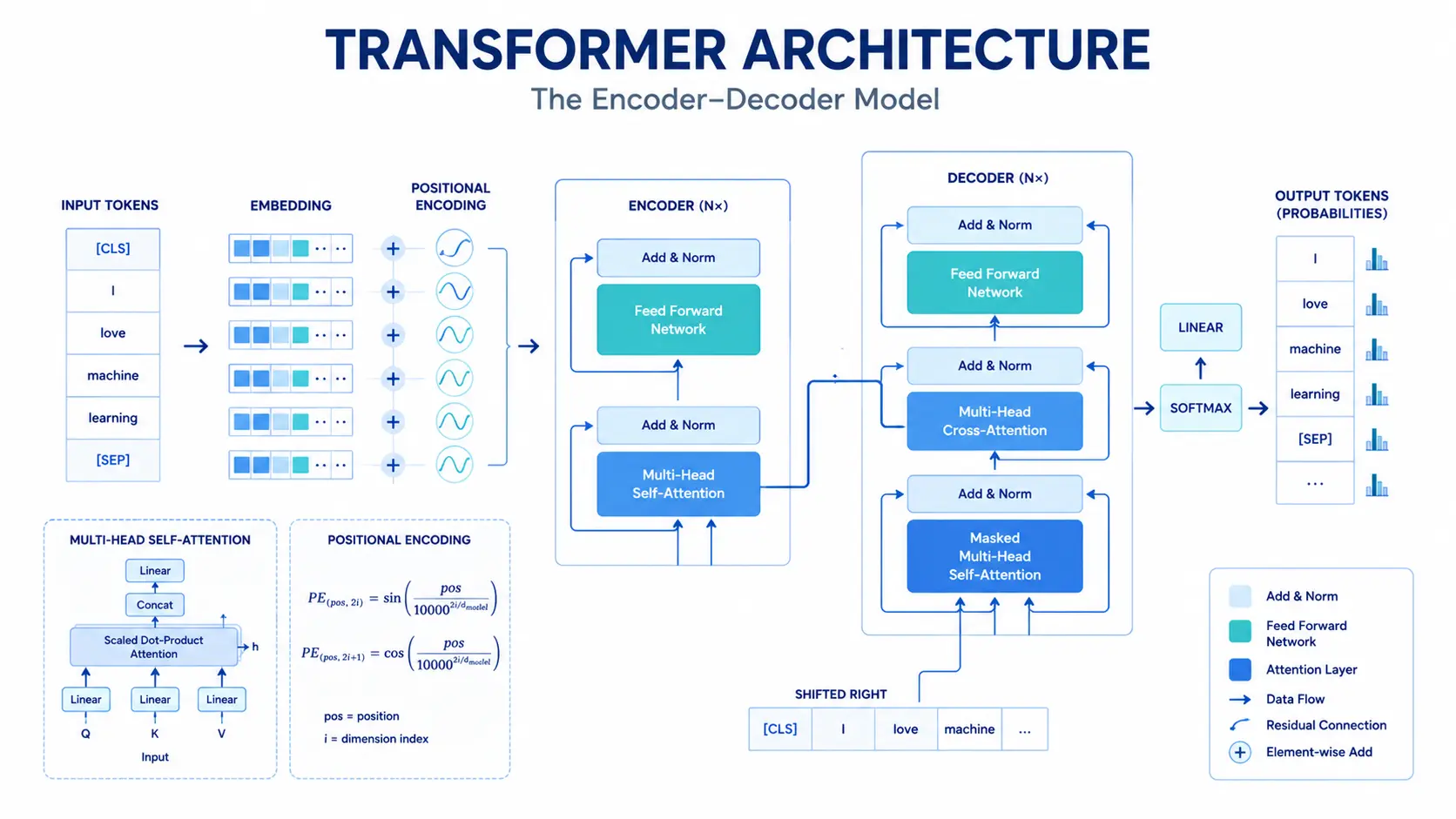
Introduced in the 2017 paper “Attention Is All You Need”, the Transformer replaced recurrence with self-attention. This allowed parallel processing of sequences and made scaling to hundreds of billions of parameters feasible. Every major LLM today – GPT, Claude, Gemini, Llama – is a Transformer variant.
Self-Attention: The Core Equation
The self-attention layer computes three matrices from the input: Query (Q), Key (K), and Value (V). The attention output is:
Attention(Q, K, V) = softmax( (QKT) / √dk ) V
The scaling factor √dk prevents large dot products from pushing the softmax into regions with extremely small gradients. In an autoregressive (causal) decoder, a mask is applied so that each token can attend only to itself and previous tokens.
Multi-Head Attention and the KV Cache
Instead of a single attention function, multiple heads run in parallel, each with its own projections. This allows the model to jointly attend to different representation subspaces. During inference, we avoid recomputing attention for past tokens by caching the key and value tensors (the KV cache). This cache can dominate GPU memory. For a 70B model with a 32k context, it easily exceeds 10 GB. Memory bandwidth, not compute, often becomes the bottleneck.
Positional Encoding
Attention has no inherent notion of token order. The original Transformer added fixed sinusoidal positional encodings to the input embeddings. Modern LLMs use learned positional embeddings or Rotary Position Embeddings (RoPE), which encode relative position directly into the attention computation and improve extrapolation to longer contexts.
Vision Transformers and Beyond
The same attention mechanism works for images when they are split into patches. Vision Transformers (ViT) are now standard backbones for multimodal models. This unification across modalities is a key reason the Transformer dominates.
[Input Sequence] → Embedding + Positional Encoding
        │
        ▼
  Multi-Head Self-Attention (masked)
        │
        ▼
  Add & Norm → Feed Forward → Add & Norm
        │
        ▼
       (repeat N×)
        │
        ▼
  Linear + Softmax → Next token probabilities
Simplified decoder-only Transformer block. Residual connections and layer normalisation are critical for training stability.
Tokenisation, Embeddings, and the Model’s Vocabulary
A Transformer does not process raw text; it works on integer token IDs. Tokenisation is the step that splits text into subword units using algorithms like Byte-Pair Encoding (BPE). The vocabulary typically ranges from 32k to 256k tokens. For example, the sentence “Generative AI is powerful” might be tokenised into [“Gener”, “ative”, ” AI”, ” is”, ” powerful”]. The choice of tokeniser influences multilingual support, efficiency, and even downstream performance. I have debugged production issues where a mismatch between the training and serving tokeniser caused garbled output.
Each token ID is mapped to a dense vector – an embedding – learned during training. These embeddings capture semantic similarity: words that appear in similar contexts end up close in the vector space. Sentence and document embeddings, obtained by pooling token embeddings, are the foundation of semantic search and RAG. Cosine similarity is the standard distance metric:
cosine_sim(A,B) = (A·B) / (||A|| ||B||)
Embedding drift – when the distribution of input data shifts and the original embedding space no longer represents it well – requires periodic re-indexing of vector stores.
How Generative Models Are Trained
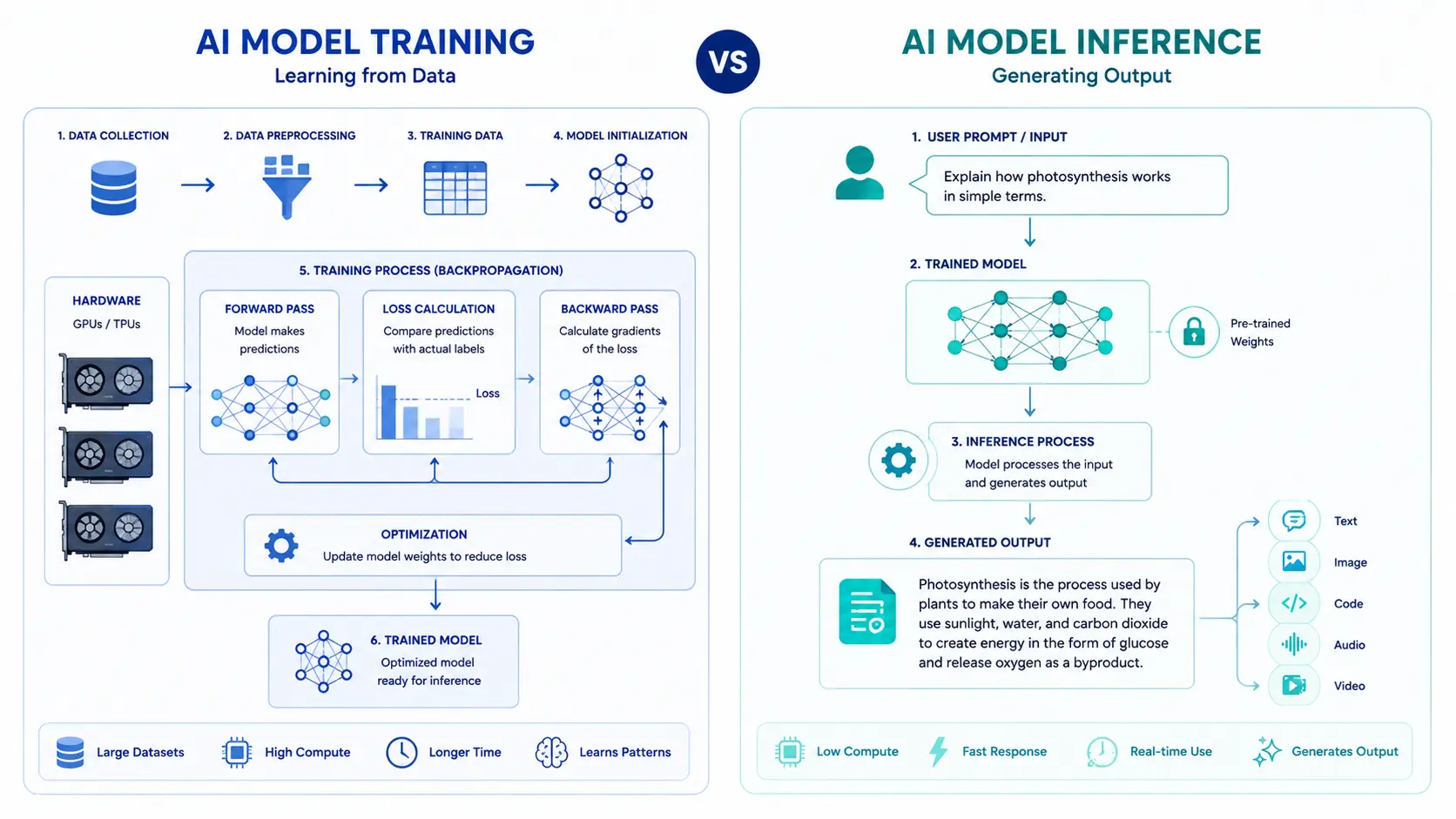
Training a modern generative model involves three distinct stages, each with its own dataset and compute budget. It’s not a single run; it’s a pipeline.
Stage 1: Unsupervised Pre-training
The model ingests trillions of tokens from public web text, books, code repositories, and curated datasets like The Pile or C4. The objective is next-token prediction: given a sequence of tokens, predict the next one. The loss is the cross-entropy between the predicted probability distribution and the actual token. Over thousands of GPU-days, the model learns grammar, facts, reasoning patterns, and even some level of world knowledge purely by minimising this loss.
Stage 2: Supervised Fine-Tuning (SFT)
A pre-trained model is a powerful pattern completer, but not a helpful assistant. SFT trains on high-quality prompt-response pairs, often written by human annotators, to teach instruction following and a conversational tone. This stage is relatively cheap and can be done on a handful of GPUs using parameter-efficient methods like LoRA.
Stage 3: Alignment via RLHF or DPO
Even after SFT, models can be unhelpful, biased, or unsafe. Reinforcement Learning from Human Feedback (RLHF) trains a reward model on human preferences and then optimises the language model via Proximal Policy Optimization (PPO). A more recent alternative is Direct Preference Optimization (DPO), which directly fine-tunes the model using a preference-based loss, skipping the separate reward model. In practice, DPO is simpler and more stable to train.
Training Infrastructure and Mixed Precision
Training a 175B-parameter model requires thousands of GPUs. Data parallelism, tensor parallelism, and pipeline parallelism are combined. Mixed precision (FP16/BF16) with tensor cores on NVIDIA H100 GPUs is standard; BF16 maintains the dynamic range of FP32 while halving memory. The fully sharded data parallel (FSDP) strategy in PyTorch distributes optimizer states, gradients, and parameters across devices.Engineering Insight: The cost of pre-training a frontier model now exceeds $100 million. Many teams instead build on top of existing foundation models via fine-tuning or RAG, which is orders of magnitude cheaper.
Inference: Generating Content Step by Step
Inference is the process of using a trained model to produce output. For LLMs, it’s autoregressive: the model generates one token at a time, feeding it back into the input. The key bottlenecks are memory (KV cache) and the sequential nature of token generation.
Sampling Strategies
The raw logits are converted to probabilities. How we pick the next token dramatically affects output:
- Greedy: always pick the highest-probability token. Deterministic but tends to be repetitive.
- Temperature: scales the logits before softmax:
pi = exp(zi/T) / Σj exp(zj/T). T < 1 sharpens the distribution; T > 1 flattens it. - Top-k: restrict sampling to the k most likely tokens.
- Top-p (nucleus): sample from the smallest set of tokens whose cumulative probability exceeds p.
For creative writing, T=0.8 with top-p=0.95 works well. For factual Q&A, T=0.3 is safer.
Optimising Inference: Quantisation, Batching, and Speculative Decoding
Inference cost is dominated by GPU memory bandwidth. Quantisation reduces weights and activations to INT8 or INT4, enabling a 70B model to fit on a single 48 GB GPU. Continuous batching (e.g., vLLM) dynamically schedules requests, improving throughput. Speculative decoding uses a small draft model to propose multiple future tokens, which the large model verifies in parallel, yielding 2-3x speedups with no quality loss. Prompt caching reuses the KV cache for repeated prefixes, drastically reducing time-to-first-token.
For on-device generative AI, models like Meta’s Llama 3.2 (1B/3B) or Google’s Gemma are quantised and run directly on smartphones via frameworks like ExecuTorch. This eliminates latency and privacy concerns for many applications.
Diffusion Models: Creating Images, Video, and Audio
While Transformers dominate text, diffusion models are the state-of-the-art for continuous data. They learn to reverse a gradual noising process. During training, clean data is repeatedly corrupted with Gaussian noise; the model learns to predict the noise added at each step. The loss is a simple mean-squared error:
L = Et, x0, ε [ || ε - εθ(xt, t) ||2 ]
At inference, you start from pure noise and iteratively denoise, guided by a text prompt injected via cross-attention. Latent Diffusion Models (like Stable Diffusion) perform the diffusion in a compressed latent space, making the process much faster. Video diffusion models extend this with temporal attention layers.
| Aspect | GAN | Diffusion |
|---|---|---|
| Training | Adversarial game, unstable | Stable, straightforward loss |
| Quality | High, but prone to mode collapse | State-of-the-art, high diversity |
| Inference | Single forward pass, fast | Iterative, 20-50 steps, slower |
Retrieval-Augmented Generation (RAG)
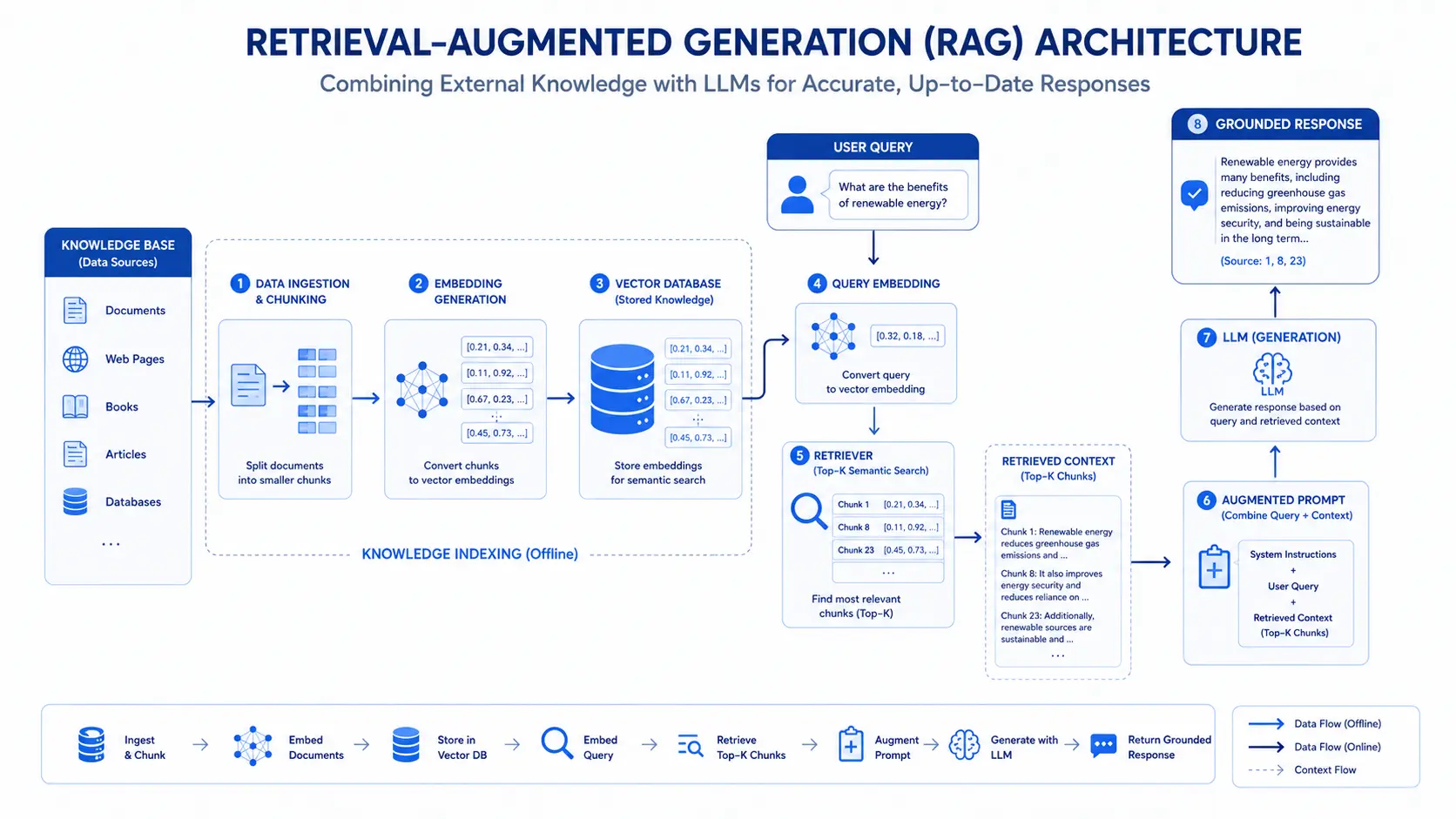
LLMs have a knowledge cut-off and tend to hallucinate. RAG grounds generation in an external, updatable knowledge base. The pipeline: chunk documents, embed them with a sentence transformer, index in a vector DB like FAISS or Pinecone. At query time, embed the query, retrieve the top-k chunks via cosine similarity, and inject them into the prompt before generation.
Our Complete RAG Guide covers the entire architecture, including advanced reranking and self-reflection. RAG reduces hallucinations but does not eliminate them; the model can still ignore or misinterpret the retrieved context.
| Criteria | Fine-Tuning | RAG |
|---|---|---|
| Knowledge update | Requires retraining | Instant (re-index documents) |
| Cost to adapt | GPU hours | Embedding + Vector DB |
| Best for | Style, tone, task-specific behaviour | Factual, up-to-date Q&A |
Prompt Engineering and In-Context Learning
Prompt engineering is the craft of designing inputs to steer the model without changing weights. System prompts set the persona; few-shot examples provide format guidance; chain-of-thought (CoT) encourages step-by-step reasoning. The model isn’t thinking – it’s completing a pattern based on its training distribution. A common pitfall: placing critical instructions in the middle of a long prompt. Attention scores naturally decay with distance, so key directives should be at the very beginning or end.
Prompt injection is a serious security concern: attackers craft inputs that override system instructions. Robust defences include strict input sanitisation, output filtering, and using models specifically fine-tuned to resist injection. In agent systems, never pass untrusted data directly into tool parameters without validation.
AI Agents and Tool Use
AI agents extend LLMs by giving them access to external tools and the ability to plan multi-step actions. The typical loop: the model receives an observation, outputs a thought or action (via function calling), the environment executes the action, and the result is fed back. This ReAct (Reasoning + Acting) pattern enables complex tasks like booking travel or debugging code.
For function calling, models like GPT-4o and Claude 3.5 have been fine-tuned to output structured JSON specifying the function name and parameters. Frameworks like LangChain and LlamaIndex provide higher-level abstractions, but in production, I often write a simple orchestration layer myself to keep dependencies minimal. Our look at Manus AI is a real-world example of agentic architecture.
Long-term memory in agents is typically a vector store that persists summarised interactions. However, cluttered context degrades planning quality; memory management is an active research area. The Model Context Protocol (MCP) is an emerging standard for providing tools and context to models in a consistent way.
Multimodal Generative AI
Multimodal models handle text, images, audio, and video natively. GPT-4o processes interleaved text, vision tokens, and audio tokens in a single autoregressive transformer. Early fusion models embed everything into a shared token space; cross-attention between modality-specific encoders is another approach. The key engineering challenge is aligning the representations of disparate data types so that the model can translate between them. For a practical example of vision-language integration, see Xiaomi MiMo Code Review.
Safety, Alignment, and Hallucination Mitigation
Hallucinations occur because LLMs optimise for statistical plausibility, not truth. Mitigation techniques include RAG, tool use (web search), and self-consistency checks. For high-stakes applications, a human-in-the-loop is non-negotiable. I have seen a medical summarisation model fabricate a drug name that looked entirely plausible – this is why rigorous evaluation and guardrails are essential.
Alignment methods like RLHF and DPO make models more helpful and harmless, but they are not perfect. Constitutional AI (used by Anthropic) trains the model with a set of principles rather than solely human feedback. Regular red-teaming and safety classifiers in the inference pipeline are mandatory for enterprise deployments. Model collapse – the degradation of quality when training on synthetic data – is a real risk when models are trained on outputs of other models. Curating high-quality, diverse human-created data remains vital.
For more on the broader implications, read Narrow AI vs AGI vs Superintelligence and How AI Builds Business Credibility and Trust.
Enterprise Deployment and Infrastructure
Deploying generative AI in production is as much about infrastructure as it is about models. Most enterprises use API services for general tasks and self-host open-source models for sensitive data. Model serving frameworks like vLLM and TensorRT-LLM optimise throughput. Observability is critical: log every prompt, response, and the retrieved context to debug issues and comply with regulations.
Cost optimisation involves semantic caching, using smaller models for classification, and setting token limits. Our article AI Leadership discusses the organisational change required. For customer-facing applications, see AI Customer Support. Other enterprise use cases span logistics (AI Logistics for E-commerce), beauty tech (AI Powered Beauty Technology), smart homes (AI Smart Home), and even football scouting (How AI Is Transforming Football Talent Scouting).
Head-to-Head Comparisons
| Feature | GPT-4o | Claude 3.5 Sonnet | Gemini 1.5 Pro |
|---|---|---|---|
| Modalities | Text, image, audio | Text, image | Text, image, audio, video |
| Max context | 128k | 200k | 2M |
| Tool use | Excellent | Excellent | Good |
| Pricing | Mid-range | Mid-range | Competitive |
For a complete breakdown, see our Complete ChatGPT Guide, Claude AI Master Guide, and Complete Kimi Guide for the long-context specialist.
| Criterion | Open (Llama 3, Mistral) | Closed (GPT-4, Claude) |
|---|---|---|
| Customisation | Full fine-tuning, on-prem | Limited fine-tuning, API only |
| Data privacy | Self-hosted | Data sent to provider |
| Performance | Narrowing gap | Top benchmarks |
Practical Code Examples
Below are production-oriented snippets. They assume Python 3.11+ and common libraries.
Text Generation with OpenAI (Streaming)
from openai import OpenAI
client = OpenAI()
stream = client.chat.completions.create(
    model="gpt-4o",
    messages=[{"role": "user", "content": "Explain backpropagation briefly."}],
    stream=True
)
for chunk in stream:
    print(chunk.choices[0].delta.content or "", end="")
Local LLM with Quantisation via Transformers
from transformers import AutoModelForCausalLM, AutoTokenizer, BitsAndBytesConfig
quant = BitsAndBytesConfig(load_in_4bit=True, bnb_4bit_compute_dtype="float16")
model = AutoModelForCausalLM.from_pretrained(
    "microsoft/Phi-3-mini-4k-instruct",
    quantization_config=quant,
    device_map="auto"
)
tokenizer = AutoTokenizer.from_pretrained("microsoft/Phi-3-mini-4k-instruct")
inputs = tokenizer("What is the attention mechanism?", return_tensors="pt").to("cuda")
outputs = model.generate(**inputs, max_new_tokens=150)
print(tokenizer.decode(outputs[0], skip_special_tokens=True))
RAG with FAISS and Sentence Transformers
from sentence_transformers import SentenceTransformer
import faiss, numpy as np
docs = ["The transformer uses self-attention.", "Paris is the capital of France."]
model = SentenceTransformer("all-MiniLM-L6-v2")
embeddings = model.encode(docs)
index = faiss.IndexFlatL2(embeddings.shape[1])
index.add(np.array(embeddings, dtype='float32'))
query_vec = model.encode(["What is attention?"])
D, I = index.search(np.array(query_vec, dtype='float32'), k=1)
print(docs[I[0][0]])
Function Calling with Anthropic API
import anthropic
client = anthropic.Anthropic()
response = client.messages.create(
    model="claude-3-5-sonnet-20240620",
    max_tokens=1024,
    tools=[{"name":"get_weather","description":"Get current weather","input_schema":{"type":"object","properties":{"location":{"type":"string"}}}}],
    messages=[{"role":"user","content":"What's the weather in Tokyo?"}]
)
print(response.model_dump_json(indent=2))
Common Misconceptions
- “LLMs are intelligent.” They are statistical systems with no consciousness or true understanding. They simulate reasoning by pattern matching.
- “Larger models are always better.” A well-curated dataset and efficient fine-tuning can make a 7B model outperform a sloppy 70B model on a specific task.
- “Fine-tuning fixes hallucinations.” It improves style and adherence, but grounding via RAG or tool use is far more effective for factual accuracy.
- “You need a PhD to use Generative AI.” API-level usage is accessible, but building and deploying reliable, safe systems still requires engineering rigour.
The Future of Generative AI
We are moving toward compound AI systems where multiple specialised components (retrieval, tool use, code execution) cooperate. On-device SLMs will become ubiquitous. Reasoning models that generate long internal chains-of-thought before answering are already here. The cost of inference will continue to plummet, making real-time generative experiences the default. Regulation will harden around transparency and safety. And perhaps most critically, the generation of synthetic training data will force the industry to develop robust methods to prevent model collapse. The engineers who understand the nuts and bolts – not just the APIs – will shape this future.
Frequently Asked Questions
What is Generative AI?
Generative AI is a branch of artificial intelligence that creates new content by learning patterns from existing data. Instead of simply analysing information, it can generate text, images, videos, music, code, and other content. Large Language Models (LLMs) and diffusion models are among the most widely used Generative AI technologies today.
Is ChatGPT Generative AI?
Yes. ChatGPT is a Generative AI application powered by a Large Language Model (LLM). It generates human-like responses, assists with writing, coding, research, brainstorming, translation, and many other language-based tasks.
How does Generative AI work?
Generative AI learns statistical patterns from massive datasets during training. When given a prompt, it predicts the most probable sequence of words, pixels, audio samples, or other outputs based on what it has learned, producing entirely new content rather than retrieving pre-written answers.
Can Generative AI think?
No. Current Generative AI systems do not possess consciousness, emotions, self-awareness, or reasoning in the human sense. They generate responses by recognising patterns and predicting likely outputs based on their training data.
How is Generative AI trained?
Training typically involves large-scale pre-training on enormous datasets, followed by supervised fine-tuning and alignment techniques such as Reinforcement Learning from Human Feedback (RLHF) or Direct Preference Optimisation (DPO) to improve accuracy, safety, and helpfulness.
What are the main types of Generative AI?
The major categories include Large Language Models (LLMs), diffusion models, Generative Adversarial Networks (GANs), Variational Autoencoders (VAEs), and multimodal models capable of understanding and generating multiple forms of data simultaneously.
What is a Transformer?
A Transformer is a deep learning architecture built around the self-attention mechanism. It processes information in parallel instead of sequentially, making it significantly faster and more effective for modern language models such as GPT, Claude, Gemini, and Llama.
What is Retrieval-Augmented Generation (RAG)?
Retrieval-Augmented Generation combines a language model with an external knowledge source. Instead of relying solely on its training data, the model retrieves relevant documents from databases before generating responses, improving factual accuracy and reducing hallucinations.
What are AI agents?
AI agents are intelligent systems that use language models together with planning, memory, reasoning, and external tools to complete complex multi-step tasks autonomously.
What is prompt engineering?
Prompt engineering is the process of designing effective instructions that guide a Generative AI model towards producing accurate, relevant, and high-quality responses without modifying the underlying model.
What are AI hallucinations?
AI hallucinations occur when a model confidently generates information that is factually incorrect, fabricated, or unsupported by reliable evidence. Techniques such as RAG, verification systems, and human review help minimise these errors.
What is fine-tuning?
Fine-tuning is the process of adapting a pre-trained AI model to perform better on a specific domain or task by continuing training on carefully selected datasets.
What is LoRA?
Low-Rank Adaptation (LoRA) is a parameter-efficient fine-tuning technique that updates only a small number of trainable parameters, reducing computational costs while maintaining strong performance.
What is quantisation?
Quantisation reduces the numerical precision of a model’s parameters, such as converting FP16 weights to INT8 or INT4. This decreases memory usage and accelerates inference with only a small impact on accuracy.
What is a diffusion model?
A diffusion model generates images, videos, or audio by gradually removing random noise over multiple iterative steps until a realistic output is produced based on the user’s prompt.
How do GPUs train Generative AI models?
Modern GPUs such as the NVIDIA H100, A100, and RTX 4090 provide thousands of processing cores capable of performing parallel matrix calculations required for deep learning, dramatically reducing training time.
What is a context window?
A context window represents the maximum number of tokens a model can process in a single interaction. Larger context windows allow AI systems to understand longer conversations, documents, and codebases more effectively.
What are embeddings?
Embeddings are dense numerical vectors that capture the semantic meaning of words, sentences, images, or other data, enabling similarity search, recommendation systems, clustering, and Retrieval-Augmented Generation.
How do you evaluate Generative AI?
Evaluation combines benchmark datasets such as MMLU, HumanEval, and SWE-Bench with human evaluation, safety testing, factual accuracy measurements, latency analysis, and task-specific performance metrics.
Is Generative AI safe?
Generative AI can be deployed safely when supported by robust governance, security controls, alignment techniques, continuous monitoring, and responsible human oversight. However, risks including bias, hallucinations, copyright issues, and prompt injection still require careful management.
What is the difference between training and inference?
Training teaches an AI model by updating billions of parameters using enormous datasets and computing resources. Inference is the stage where the trained model generates responses for users without modifying those parameters.
Can Generative AI create videos?
Yes. Modern diffusion-based models such as OpenAI Sora and Runway Gen-3 can generate realistic videos from natural language prompts by predicting sequences of visual frames.
What are foundation models?
Foundation models are large pre-trained AI models trained on diverse datasets. They serve as a base for many downstream applications through prompting, fine-tuning, or Retrieval-Augmented Generation.
What is a Small Language Model (SLM)?
A Small Language Model contains significantly fewer parameters than traditional LLMs, making it suitable for on-device AI, edge computing, and resource-constrained environments while still delivering strong task-specific performance.
How do businesses use Generative AI?
Businesses use Generative AI for customer support, software development, content creation, marketing, document analysis, product design, data summarisation, fraud detection, research assistance, and workflow automation.
What is the Model Context Protocol (MCP)?
Model Context Protocol (MCP) is an emerging open standard that enables AI models to securely communicate with external applications, databases, APIs, and enterprise tools through a consistent interface.
What is synthetic data?
Synthetic data is artificially generated rather than collected from real-world sources. It helps expand training datasets, improve privacy, and reduce data scarcity, although excessive reliance on synthetic data may reduce model quality over time.
How does Generative AI handle copyright?
Copyright remains an evolving legal area. Many organisations use licensed datasets, enterprise agreements, or internally curated data to reduce legal risks while complying with emerging AI regulations.
What is the future of Generative AI?
The future includes more capable AI agents, multimodal reasoning, on-device AI, enterprise automation, improved efficiency, larger context windows, better safety mechanisms, and deeper integration across everyday software.
Where can I learn more about Generative AI?
Start by reading our What Is Artificial Intelligence? guide, followed by the ChatGPT Guide for Beginners to build a strong foundation before exploring advanced topics.
AI Governance, Ethics and Responsible Deployment
As Generative AI becomes increasingly integrated into business operations, software development, healthcare, finance, education, and public services, organisations must balance innovation with responsible governance. Building a powerful AI system is only one part of the challenge. Ensuring that it is transparent, secure, compliant, and trustworthy is equally important.
Enterprise AI governance establishes policies, technical safeguards, and operational procedures that help organisations deploy AI responsibly throughout its lifecycle. Effective governance reduces legal, ethical, and operational risks while improving confidence among customers, employees, and regulators.
Key Principles of Responsible AI
- Transparency in how AI systems generate decisions and content.
- Human oversight for high-impact or business-critical workflows.
- Protection of sensitive and personal information.
- Continuous monitoring for hallucinations, bias, and security vulnerabilities.
- Clear accountability for AI-generated outputs.
- Compliance with regional and international regulations.
Major Governance Frameworks
| Framework | Purpose |
|---|---|
| ISO/IEC 42001 | International management system standard for Artificial Intelligence governance. |
| NIST AI Risk Management Framework (AI RMF) | Guidance for identifying, assessing, and managing AI risks. |
| EU AI Act | European legislation introducing risk-based regulation for AI systems. |
| GDPR | Protects personal data and privacy for individuals within the European Union. |
| SOC 2 | Security and operational controls commonly required for enterprise SaaS platforms. |
Research Papers and Technical References
The concepts discussed throughout this guide are based on widely recognised research papers, technical reports, engineering documentation, and industry standards that have shaped the development of modern Generative AI.
- Vaswani et al. (2017). Attention Is All You Need. Introduced the Transformer architecture that powers modern Large Language Models.
- Brown et al. (2020). Language Models are Few-Shot Learners (GPT-3). Demonstrated the capabilities of large-scale autoregressive language models.
- OpenAI. GPT-4 Technical Report. Describes capabilities, evaluation methodology, and safety considerations for GPT-4.
- Anthropic. Constitutional AI: Harmlessness from AI Feedback. Introduced Constitutional AI as an alternative alignment approach for safer language models.
- Touvron et al. Llama 2 and Llama 3 research papers published by Meta AI.
- Google DeepMind. Gemini Technical Report. Covers multimodal foundation models and large-scale AI capabilities.
- NVIDIA Technical Blog and CUDA Documentation for GPU acceleration, Tensor Cores, mixed precision, and large-scale AI training.
- Hugging Face Documentation covering Transformers, Diffusers, PEFT, tokenisation, embeddings, and production deployment.
- Stanford HELM (Holistic Evaluation of Language Models), an academic benchmark framework for evaluating foundation models across multiple dimensions.
- MLPerf Benchmarks for measuring AI training and inference performance across modern hardware platforms.
- FAISS documentation from Meta AI for efficient similarity search and vector database indexing.
- LangChain and LlamaIndex documentation covering Retrieval-Augmented Generation (RAG), AI agents, and enterprise AI workflows.
- OpenAI Cookbook containing practical implementation examples for embeddings, function calling, structured outputs, and prompt engineering.
Technology evolves rapidly, and new foundation models, optimisation techniques, and deployment practices continue to emerge. This guide has been prepared using recognised industry research and engineering best practices available at the time of publication and is reviewed periodically to maintain technical accuracy.
Use the key points in this guide to understand the topic and make more informed decisions.

This guide is researched and edited using relevant documentation, reliable sources and publicly available information.
Was this guide helpful?
Your feedback helps us improve future guides.