In this article
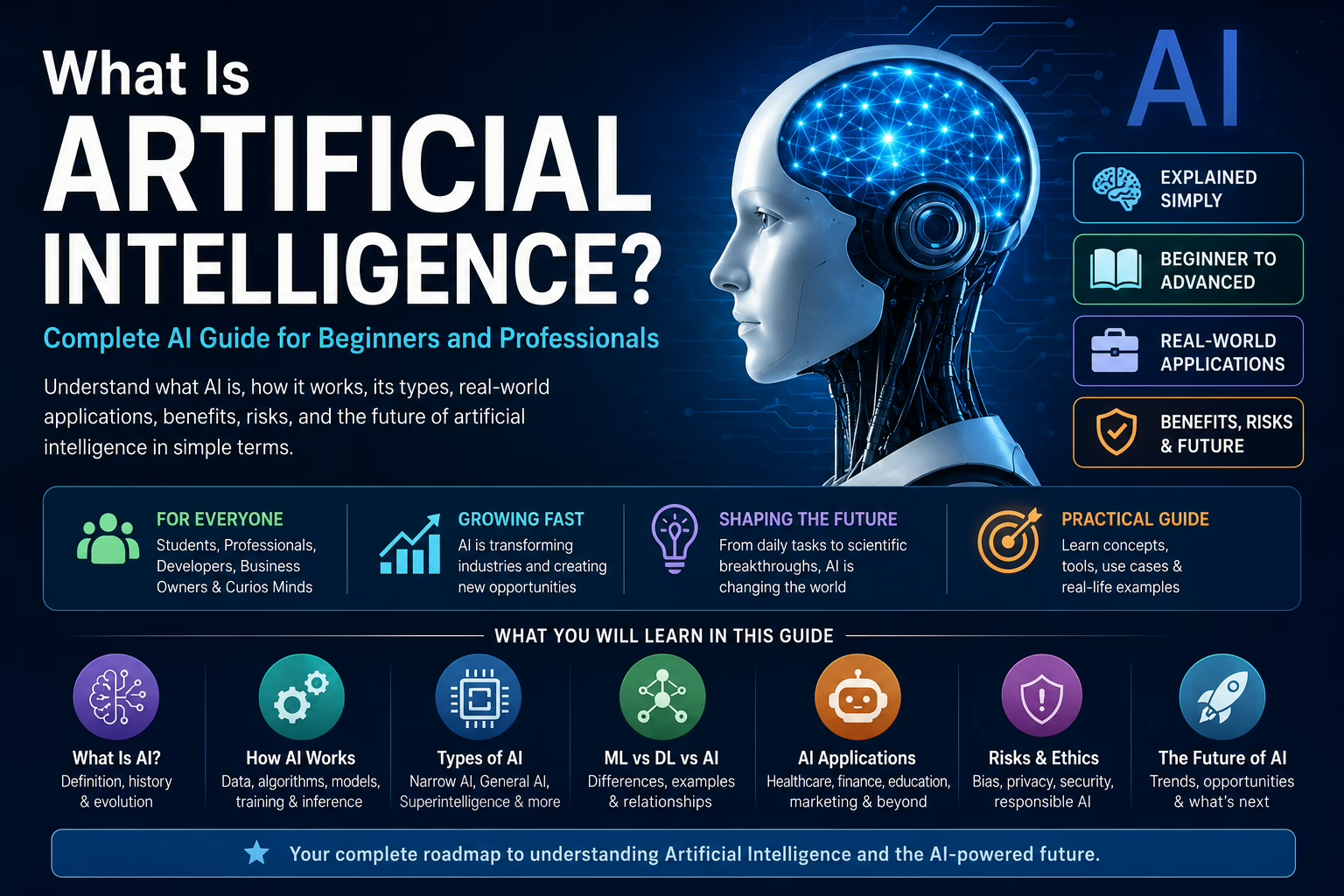
Artificial Intelligence is no longer a technology that exists only in research labs or futuristic movies. Today, it influences how people search for information, write emails, create content, shop online, navigate cities, develop software, and interact with digital services.
In just a few years, AI has moved from being a niche topic discussed by engineers and researchers to something millions of people use every day often without realizing it. From recommendation systems on streaming platforms to virtual assistants on smartphones, AI has quietly become part of modern life.
Businesses are also adopting AI at a rapid pace. Organizations use it to analyze large datasets, automate repetitive tasks, improve customer support, strengthen cybersecurity, and assist employees with research and decision-making. In software development, AI-powered modern coding assistants increasingly rely on specialized AI models designed for programming tasks. In healthcare, machine learning models are being used to support medical imaging analysis and drug discovery. Across industries, AI is increasingly viewed as a practical tool rather than an experimental technology.
As AI becomes more accessible, understanding how it works is becoming an important digital skill. Much like learning how the internet transformed communication in the 1990s or how smartphones changed daily life in the 2000s, understanding artificial intelligence helps people make informed decisions about the technologies they use.
At the same time, AI is often surrounded by confusion and exaggerated claims. Some headlines suggest that AI will soon replace most jobs, while others portray it as an intelligent system capable of thinking like a human. The reality is more nuanced. Modern AI systems can perform impressive tasks, but they also have significant limitations. They can make mistakes, generate inaccurate information, inherit biases from training data, and struggle with reasoning in situations outside their training.
This guide takes a practical and evidence-based approach to artificial intelligence. Instead of focusing on hype, it explains what AI actually is, how it works, the different types of AI systems, how machine learning and deep learning fit into the picture, and why technologies such as generative AI and AI agents have become major topics in recent years.
Whether you are a student, business professional, developer, researcher, or simply curious about the technology shaping today’s digital world, this guide will help you build a clear understanding of artificial intelligence and its growing role in society.
Why AI Matters in 2026
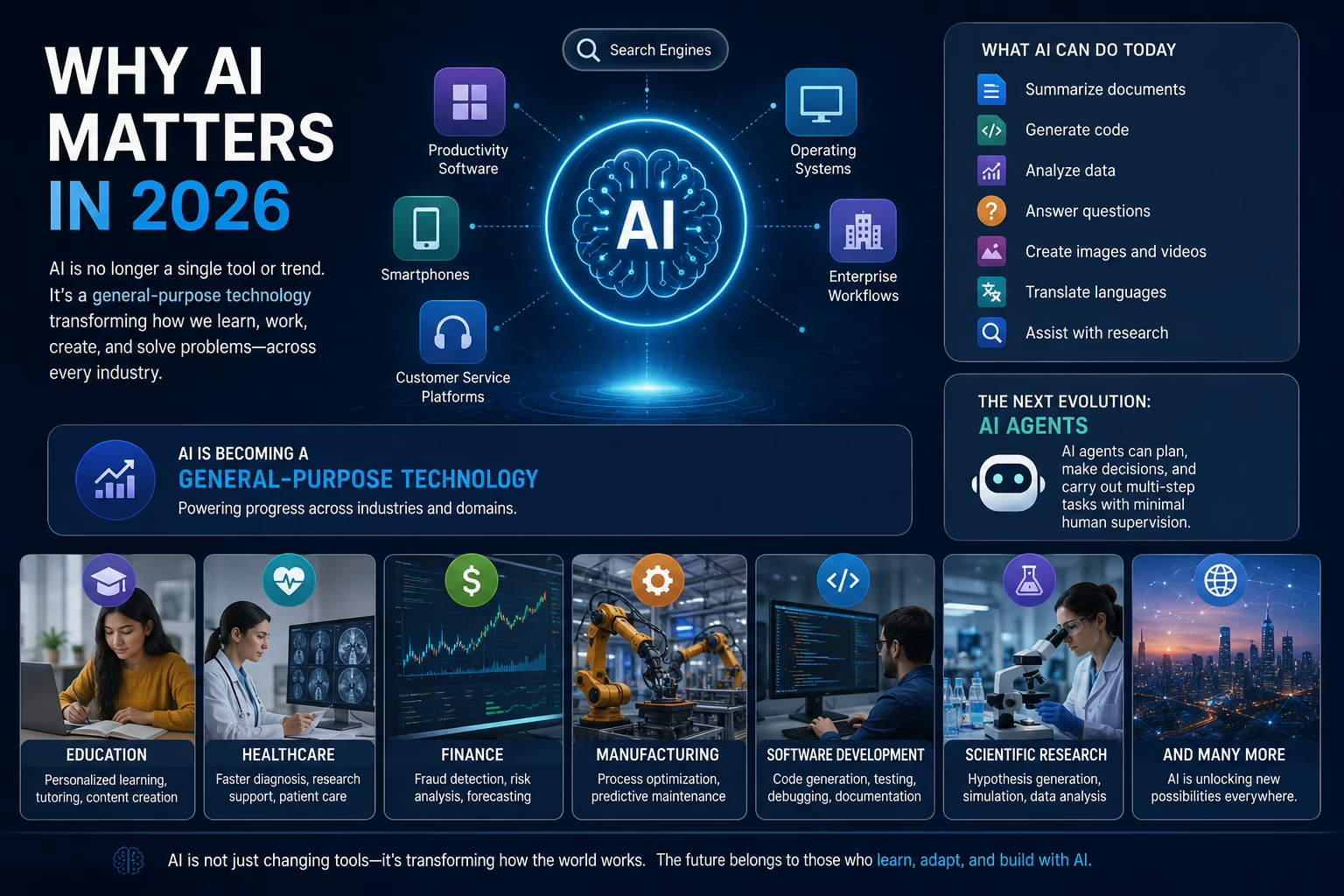
The AI landscape has changed dramatically over the past few years. Early public interest was driven by conversational chatbots and image-generation tools. Today, AI systems are being integrated directly into search engines, productivity software, operating systems, smartphones, customer service platforms, and enterprise workflows.
Modern AI models can summarize documents, generate code, analyze data, answer questions, create images and videos, translate languages, and assist with research. More recently, AI agents have emerged as systems capable of carrying out multi-step tasks with minimal human supervision. One recent example is Manus AI, which demonstrates how autonomous AI systems can perform multi-step workflows with minimal supervision.
This shift is important because AI is no longer limited to a single application or industry. It is becoming a general-purpose technology that can support work across education, healthcare, finance, manufacturing, software development, scientific research, and many other fields.
How AI Became Mainstream
Several technological developments helped make modern AI possible.
The Growth of Digital Data
The internet created an unprecedented amount of digital information. Websites, books, articles, videos, software repositories, research papers, and social media content provided the large-scale datasets required to train advanced AI models.
Advances in Computing Power
Modern AI depends on enormous computational resources. Graphics Processing Units (GPUs) and specialized AI hardware made it possible to train increasingly complex neural networks that would have been impractical only a decade ago.
Breakthroughs in AI Research
A major turning point came in 2017 with the publication of the Transformer architecture. This breakthrough significantly improved how machines process language and became the foundation for modern large language models, including many of the AI systems used today. Popular examples include ChatGPT, Claude AI, and Kimi AI.
Common Misconceptions About AI
Before exploring artificial intelligence in detail, it is important to separate reality from common misconceptions.
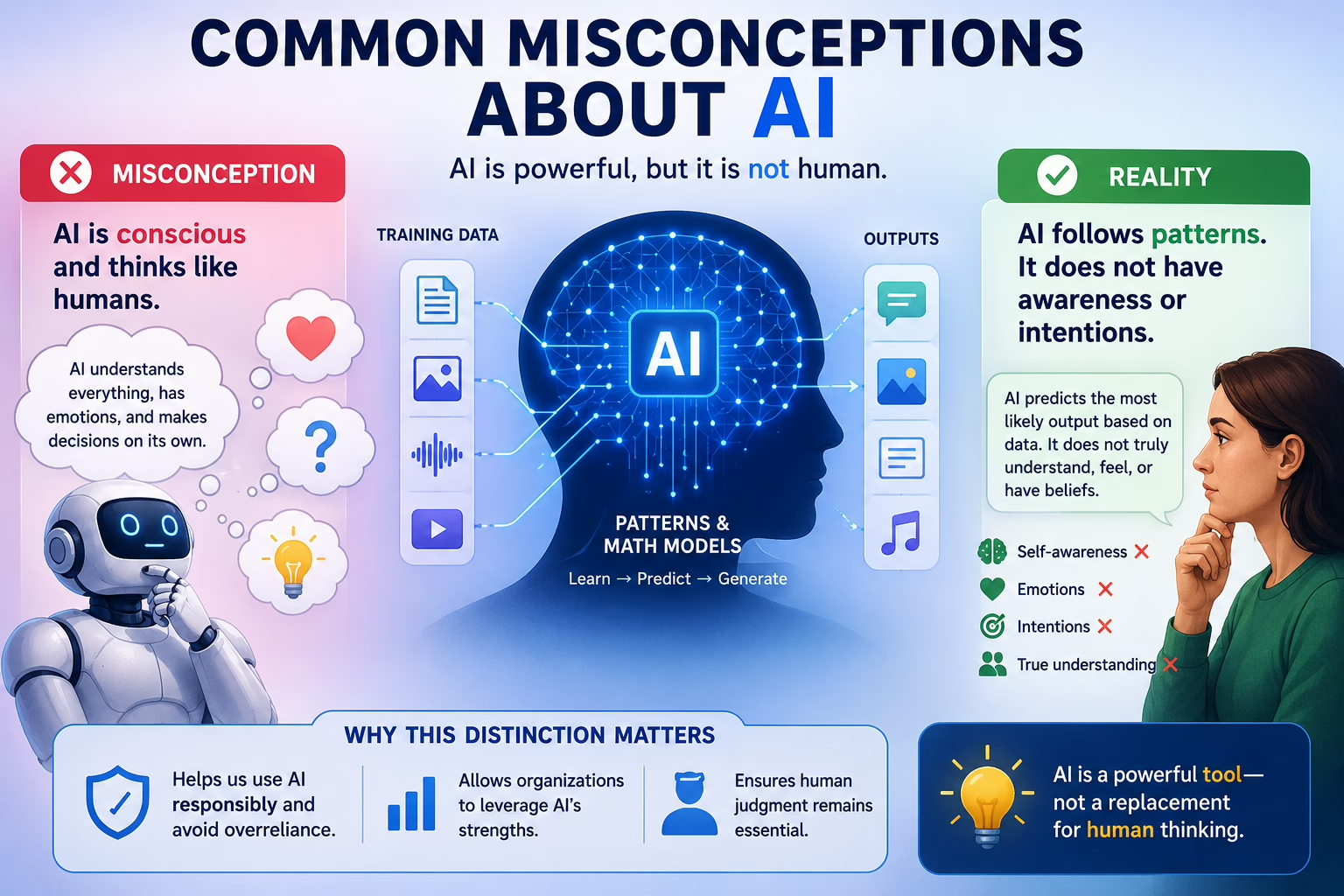
AI is not conscious. It does not possess emotions, beliefs, intentions, or self-awareness. Even the most advanced AI models do not “understand” information in the same way humans do.
When an AI system generates text, creates an image, or answers a question, it is using mathematical patterns learned from training data to predict the most likely output. The results can appear remarkably intelligent, but they are fundamentally different from human thought and reasoning.
Understanding this distinction helps people evaluate AI more realistically. It allows organizations to benefit from AI’s strengths while remaining aware of its limitations, risks, and areas where human judgment remains essential.
What Is Artificial Intelligence?
Artificial Intelligence, commonly known as AI, is a field of computer science focused on building systems that can perform tasks normally associated with human intelligence. These tasks include recognizing images, understanding language, making decisions, identifying patterns, solving problems, and generating content such as text, images, audio, and video.
Unlike traditional software, which follows a fixed set of instructions written by programmers, modern AI systems learn from data. Instead of being told exactly what to do in every situation, they analyze large amounts of information, identify patterns, and use those patterns to make predictions or generate outputs.
Today, artificial intelligence powers many of the digital services people use every day. Search engines use AI to understand queries, smartphones use AI to improve photography and voice recognition, streaming platforms use AI to recommend content, and businesses use AI to automate tasks and analyze data.
As AI technology continues to evolve, it is becoming one of the most influential technologies of the modern era, impacting industries ranging from healthcare and finance to education and software development.
Understanding AI in Simple Terms
A simple way to understand AI is to compare it with how humans learn.
Imagine teaching a child to recognize cats and dogs. Instead of providing a list of detailed rules, you show thousands of examples. Over time, the child begins to recognize patterns and can identify animals they have never seen before.
Modern AI works in a similar way. Developers provide large datasets and training algorithms. The system studies the data, learns patterns, and then applies those patterns when faced with new information.
This ability to learn from data is what makes artificial intelligence different from conventional software.
Artificial Intelligence vs Traditional Software
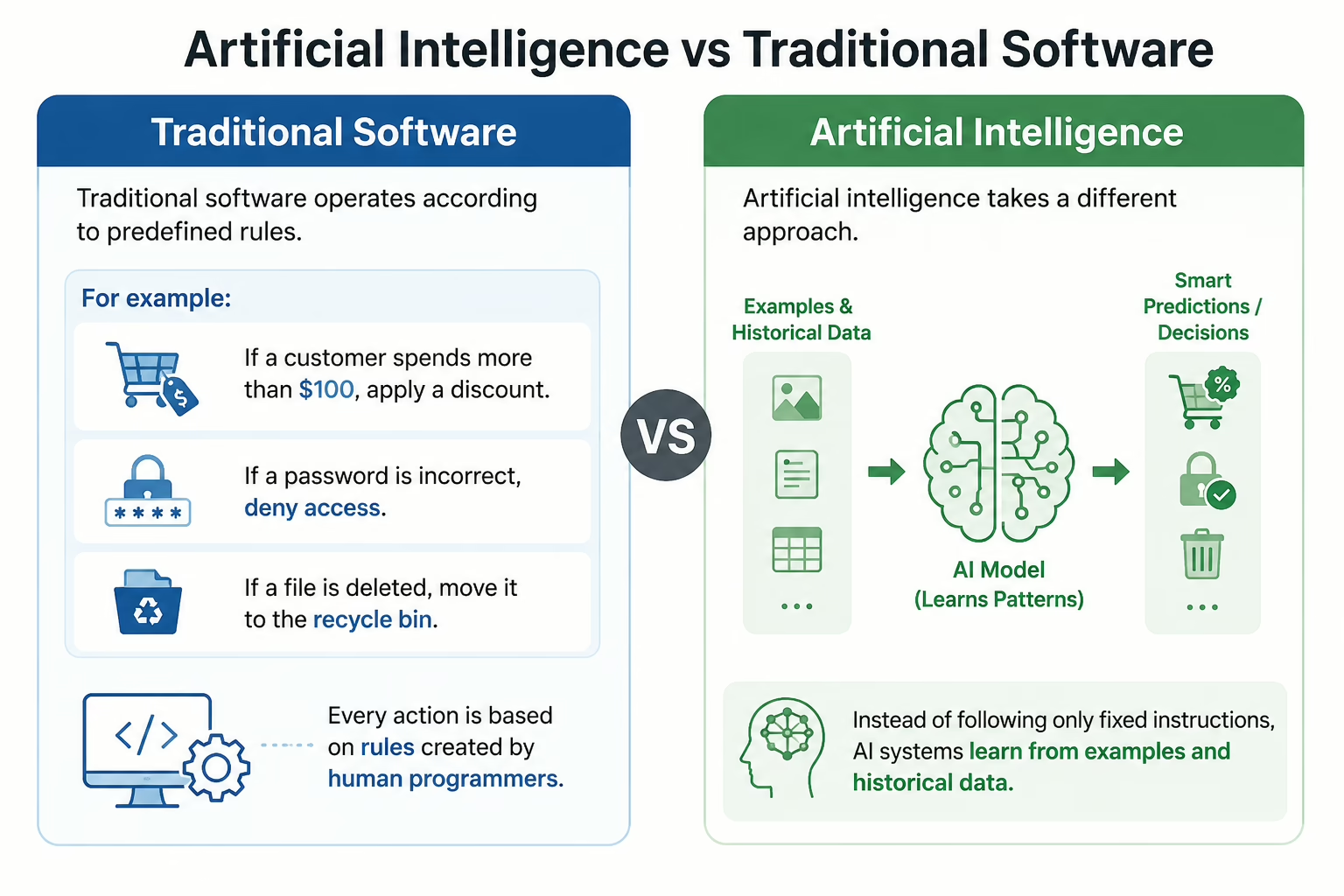
Traditional Software
Traditional software operates according to predefined rules.
For example:
- If a customer spends more than $100, apply a discount.
- If a password is incorrect, deny access.
- If a file is deleted, move it to the recycle bin.
Every action is based on rules created by human programmers.
Artificial Intelligence
Artificial intelligence takes a different approach.
Instead of following only fixed instructions, AI systems learn from examples and historical data.
For example:
- An AI email filter learns to identify spam messages.
- An AI image recognition system learns to distinguish cats from dogs.
- A language model learns how words and sentences relate to one another.
This learning-based approach allows AI systems to handle problems that would be difficult to solve using traditional rule-based programming.
The Origins of Artificial Intelligence
The idea of creating intelligent machines is much older than modern computers. Ancient myths and stories often featured artificial beings capable of performing human-like tasks. However, scientific research into machine intelligence began during the twentieth century.
One of the most influential figures in early AI research was mathematician and computer scientist Alan Turing. In 1950, he published the landmark paper Computing Machinery and Intelligence, which explored whether machines could think and introduced what later became known as the Turing Test.
The field officially gained its name in 1956 during the Dartmouth Summer Research Project on Artificial Intelligence. Researchers gathered to explore the possibility of creating machines capable of reasoning, learning, and problem-solving.
Many early scientists believed intelligent machines could be developed within a few decades. While progress proved far more difficult than expected, their work established the foundations of modern artificial intelligence research.
The Evolution of Artificial Intelligence
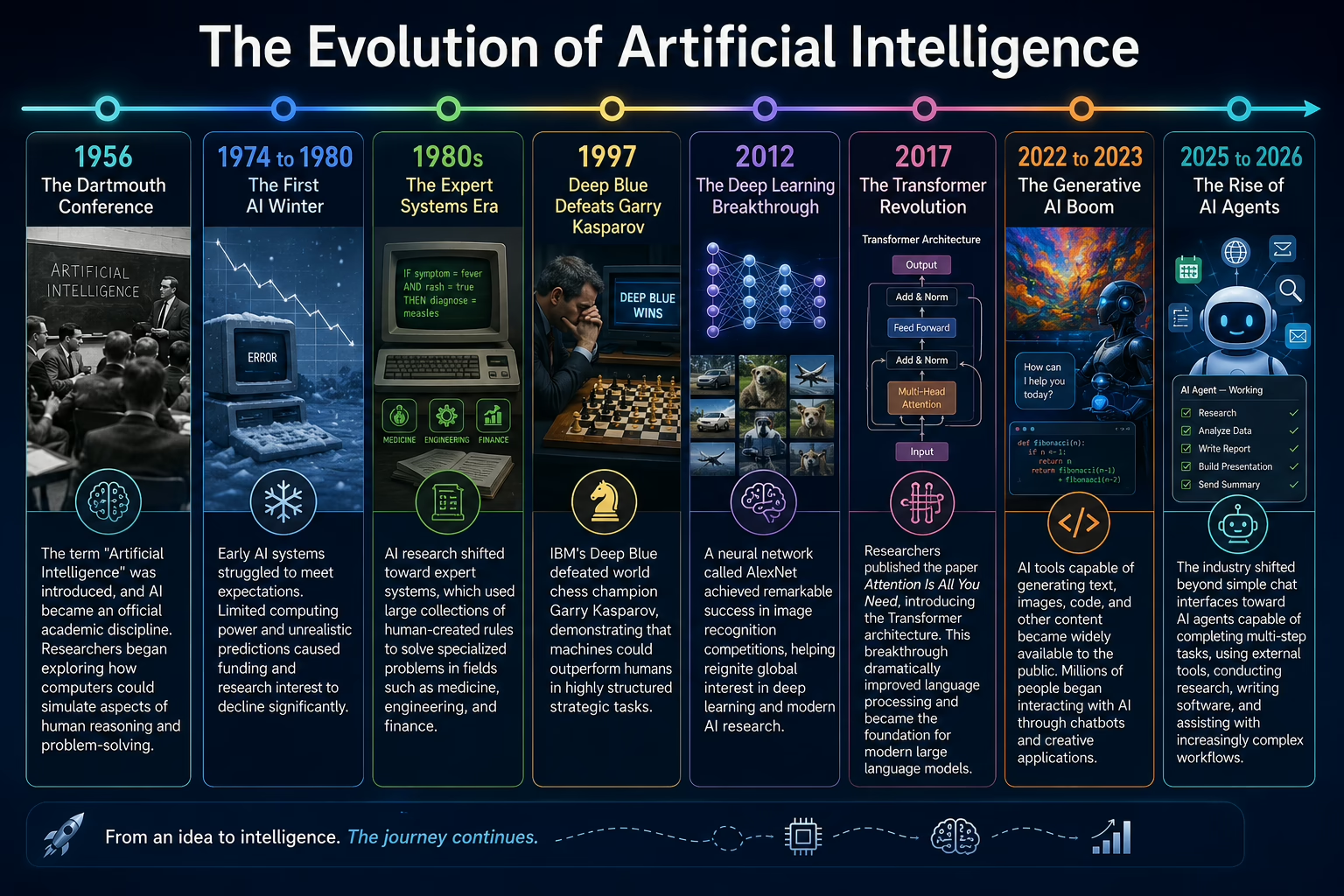
1956: The Dartmouth Conference
The term “Artificial Intelligence” was introduced, and AI became an official academic discipline. Researchers began exploring how computers could simulate aspects of human reasoning and problem-solving.
1974 to 1980: The First AI Winter
Early AI systems struggled to meet expectations. Limited computing power and unrealistic predictions caused funding and research interest to decline significantly.
1980s: The Expert Systems Era
AI research shifted toward expert systems, which used large collections of human-created rules to solve specialized problems in fields such as medicine, engineering, and finance.
1997: Deep Blue Defeats Garry Kasparov
IBM’s Deep Blue defeated world chess champion Garry Kasparov, demonstrating that machines could outperform humans in highly structured strategic tasks.
2012: The Deep Learning Breakthrough
A neural network called AlexNet achieved remarkable success in image recognition competitions, helping reignite global interest in deep learning and modern AI research.
2017: The Transformer Revolution
Researchers published the paper Attention Is All You Need, introducing the Transformer architecture. This breakthrough dramatically improved language processing and became the foundation for modern large language models.
2022 to 2023: The Generative AI Boom
AI tools capable of generating text, images, code, and other content became widely available to the public. Millions of people began interacting with AI through chatbots and creative applications.
2025 to 2026: The Rise of AI Agents
The industry shifted beyond simple chat interfaces toward AI agents capable of completing multi-step tasks, using external tools, conducting research, writing software, and assisting with increasingly complex workflows.
Why Understanding AI Matters Today
Artificial intelligence is no longer limited to research laboratories or technology companies. It is becoming a foundational technology that influences communication, business operations, education, healthcare, entertainment, and scientific research.
Understanding what AI is, how it works, and where its limitations exist helps individuals and organizations make informed decisions about adopting and using these systems responsibly.
Before exploring machine learning, deep learning, AI models, and AI agents, it is important to build a clear understanding of the fundamentals. Everything else in the modern AI ecosystem is built on these core concepts.
What Is Machine Learning
Machine learning is a subset of AI that enables systems to learn from data without explicit programming. For a deeper understanding, read our complete guide on What Is Machine Learning.
How Artificial Intelligence Works
Artificial intelligence may seem complex from the outside, but most modern AI systems follow a relatively straightforward process. Whether it is a chatbot answering questions, an AI image generator creating artwork, or a recommendation engine suggesting videos, the underlying workflow is built around learning patterns from data.
At a high level, AI systems learn from large amounts of information, identify relationships within that data, and then use those patterns to make predictions or generate outputs when presented with new inputs.
While different AI models use different techniques, most modern systems follow the same basic lifecycle.
The Lifecycle of an AI System
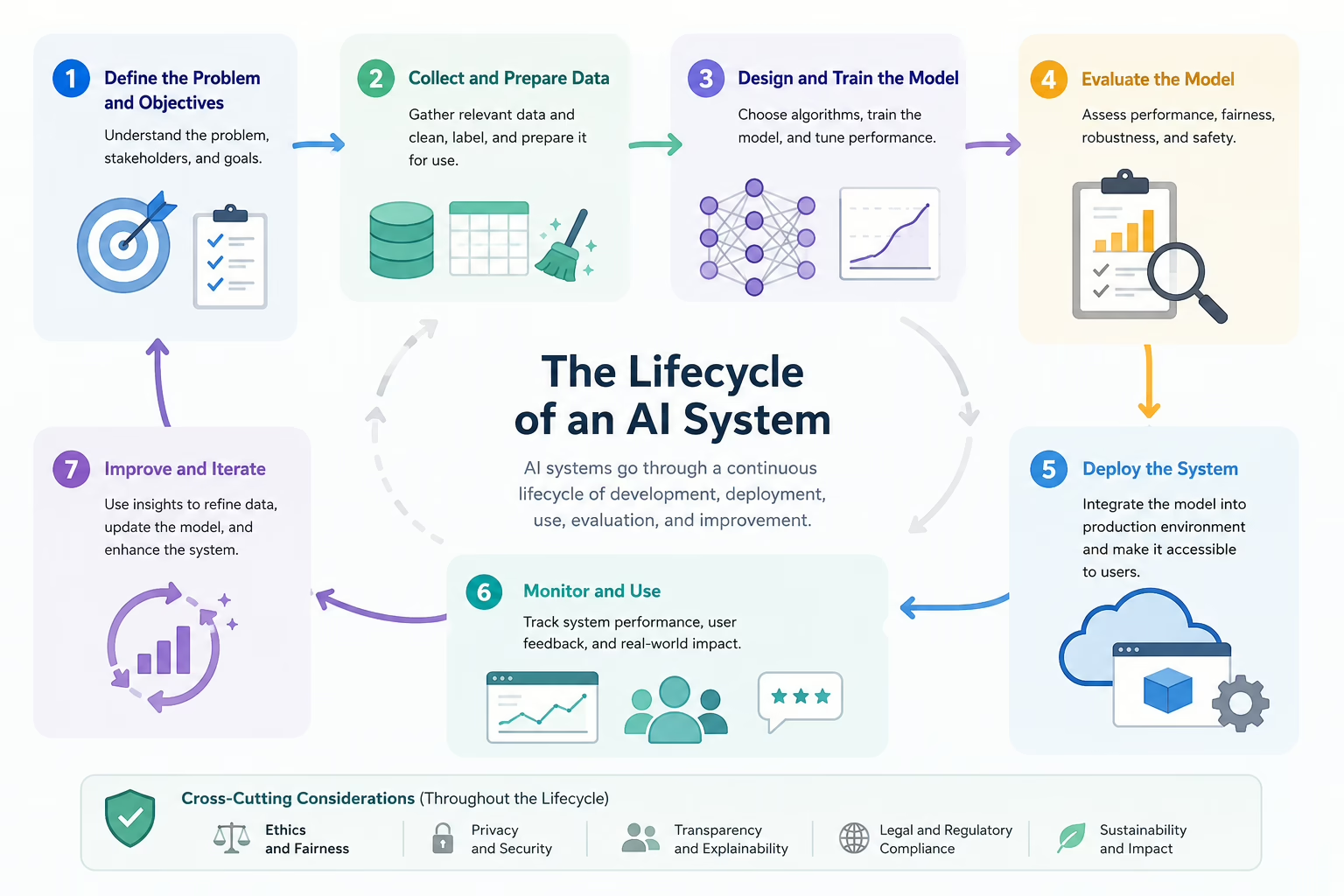
Step 1: Data Collection
Every AI system begins with data.
Just as humans learn through experience, AI models learn through exposure to information. The quality and quantity of data directly influence how capable an AI system becomes.
Depending on the application, data may include:
- Books and articles
- Websites and online content
- Images and videos
- Audio recordings
- Research papers
- Software code
- Business records and databases
For example, a language model learns from large collections of text, while an image recognition system learns from millions of labeled images.
Without data, an AI system has nothing to learn from.
Step 2: Training the Model
Training is the stage where the AI begins learning patterns from the collected data.
During training, the model processes enormous amounts of information and gradually adjusts its internal parameters to improve accuracy.
A simple way to understand this process is to imagine teaching a child to identify animals.
If the child mistakes a cat for a dog, you provide feedback. Over time, the child becomes better at recognizing the differences.
AI training works in a similar way.
The system makes predictions, measures its mistakes, and continuously adjusts itself to reduce errors.
Modern AI training often requires:
- Massive datasets
- Advanced algorithms
- Thousands of GPUs
- Weeks or months of computation
For large language models, training can involve processing trillions of words and enormous amounts of computing power.
Step 3: Creating the AI Model
Once training is complete, the result is known as a model.
A model is essentially a mathematical representation of everything the AI learned during training.
One common misconception is that AI stores exact copies of all the information it has seen.
In reality, modern AI models do not function like searchable databases. Instead, they learn statistical relationships and patterns from the training data.
For example, a language model does not memorize every sentence on the internet. It learns how words, phrases, and concepts are related so it can generate relevant responses.
This learned knowledge becomes the foundation for future interactions.
Step 4: Inference and User Interaction
Inference is the stage most people interact with directly.
Whenever you ask a chatbot a question, upload an image, request a summary, or generate code, the model is performing inference.
During inference, the AI uses everything it learned during training to analyze the input and produce an output.
For example:
- A chatbot generates a response.
- An image generator creates artwork.
- A recommendation engine suggests content.
- A fraud detection system flags suspicious activity.
Unlike training, inference happens in real time and is designed to deliver results within seconds.
Step 5: Fine-Tuning and Specialization
Many AI models begin as general-purpose systems.
However, organizations often need models that perform exceptionally well in specific industries or tasks.
This is where fine-tuning becomes important.
Fine-tuning involves taking a pre-trained model and training it further using a smaller, specialized dataset. Some enterprise systems also combine fine-tuned models with Retrieval-Augmented Generation (RAG) to improve factual accuracy.
Examples include:
- Legal AI trained on contracts and regulations
- Medical AI trained on healthcare data
- Financial AI trained on market reports
- Customer service AI trained on company documentation
Fine-tuning helps transform a general AI model into a domain expert capable of delivering more accurate and relevant results.
How AI Generates Answers
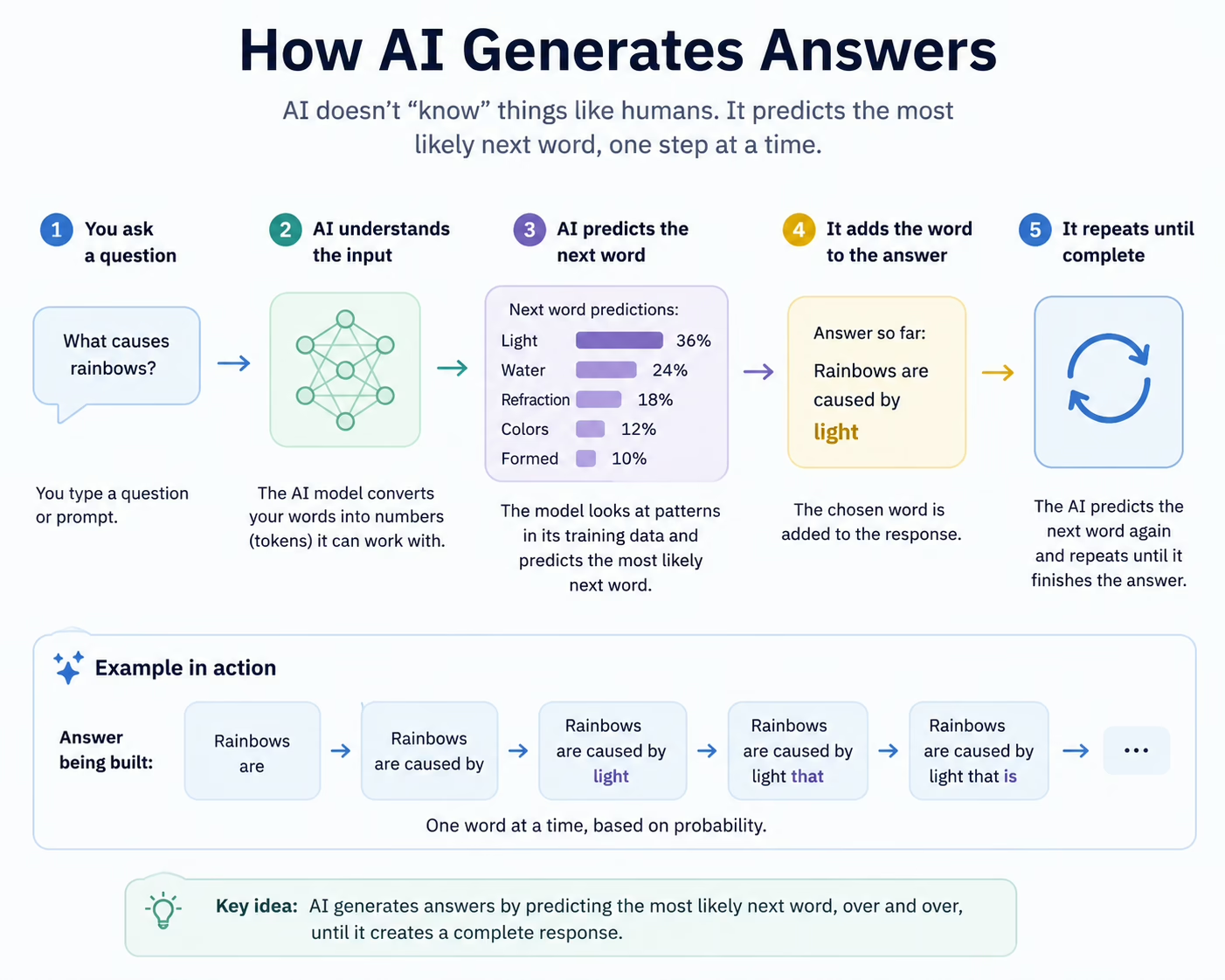
One of the most common questions people ask is how AI systems generate responses.
Modern AI models do not search for pre-written answers stored in a giant database.
Instead, they predict the most likely output based on patterns learned during training.
For example, when you type a question into a chatbot, the model analyzes the prompt, evaluates possible responses, and generates text one word at a time based on probability.
This process happens incredibly quickly, creating the impression of a natural conversation.
However, it is important to remember that AI is predicting patterns, not thinking like a human.
This distinction explains why AI can sometimes produce highly accurate answers while occasionally generating incorrect or misleading information.
The AI Workflow at a Glance
Data Collection
↓
Model Training
↓
Pattern Learning
↓
Model Creation
↓
Inference
↓
User Interaction
↓
Output Generation
↓
Fine-Tuning and Improvement
Why Understanding AI Workflows Matters
Understanding how AI works helps explain both its strengths and its limitations.
AI can process massive amounts of information, identify patterns, and generate useful outputs at remarkable speed. At the same time, its performance depends heavily on the quality of its training data, model design, and human oversight.
As AI becomes increasingly integrated into business, education, healthcare, software development, and everyday digital experiences, understanding these fundamentals provides the foundation for evaluating AI systems more effectively and using them responsibly.
Types of Artificial Intelligence
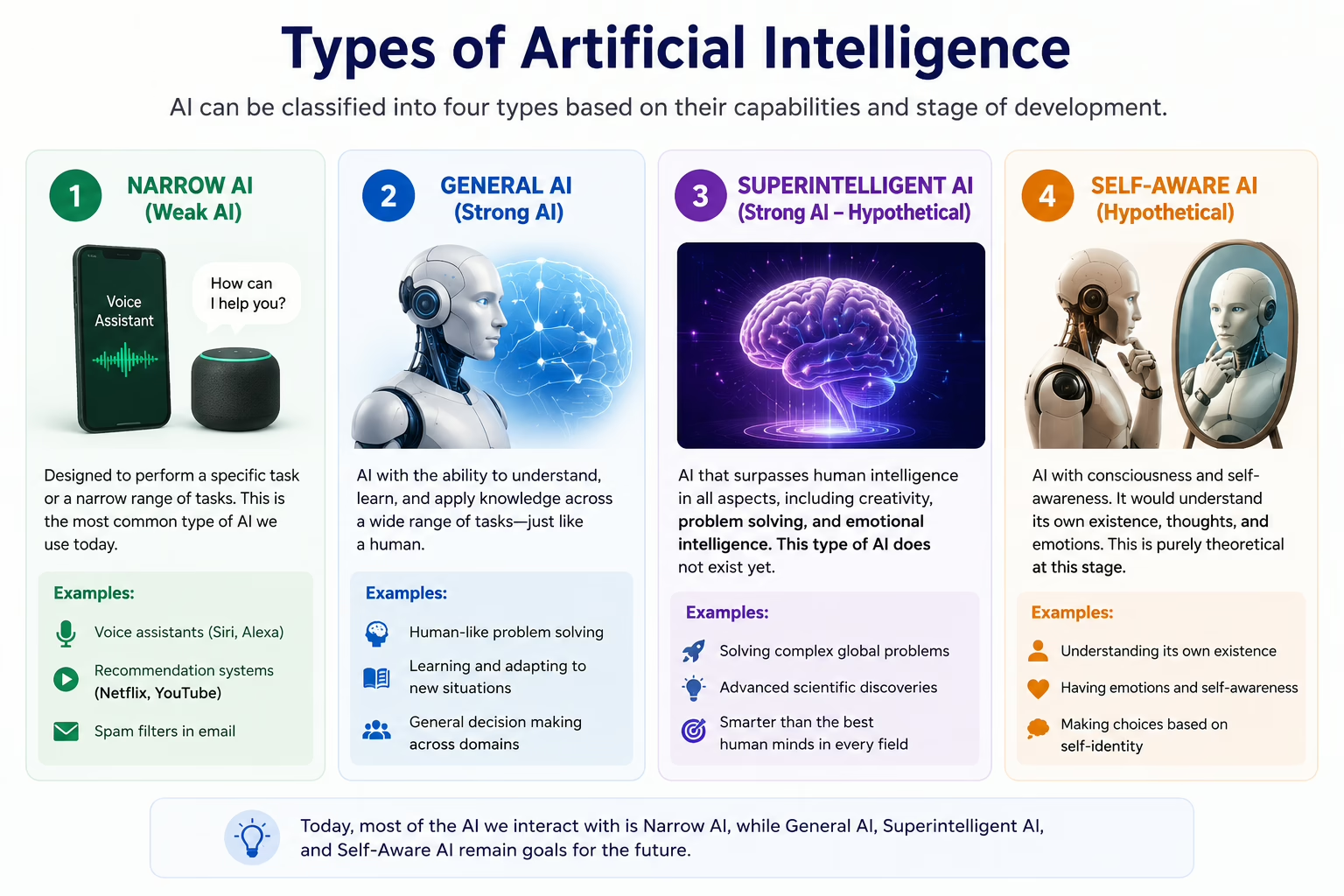
Artificial intelligence is broadly categorized into four types based on its capabilities and relation to human cognition. Currently, humanity has only achieved the first two types.
| AI Category | Description | Current Status | Real-World Example |
| Reactive AI | The most basic AI. It observes a situation and reacts based on predefined rules. It has no memory and cannot learn from past experiences. | Widely Used | Deep Blue chess engine, basic spam filters. |
| Limited Memory AI | Systems that can temporarily store data and use recent experiences to inform future decisions. They learn from historical data. | Dominant in 2026 | Large Language Models (LLMs), Autonomous vehicles. |
| Theory of Mind AI | AI that genuinely understands that human beings have thoughts, emotions, and beliefs, and adjusts its interactions accordingly. | Theoretical | None exist. Current models simulate empathy but do not possess it. |
| Artificial General Intelligence (AGI) | A hypothetical system capable of matching human intelligence across any cognitive task. It can learn anything a human can. | Theoretical | None exist. |
| Superintelligence | An entity that far surpasses the brightest human minds in every field, including scientific creativity and social skills. | Speculative | None exist. |
Machine Learning Explained
Machine Learning (ML) is one of the most important branches of artificial intelligence and serves as the foundation for many AI systems used today. While artificial intelligence is a broad field focused on creating intelligent systems, machine learning is the specific approach that enables computers to learn from data rather than relying entirely on pre-programmed rules.
In traditional software, developers write instructions for every possible scenario. If a new situation occurs that was not anticipated, the software may fail to respond correctly. Machine learning takes a different approach. Instead of providing every rule manually, developers provide data and allow the system to discover patterns on its own.
This ability to learn from experience is what makes machine learning so powerful.
For example, instead of programming every possible spam email rule manually, a machine learning system can analyze millions of emails and learn which characteristics are commonly associated with spam messages. Over time, the model becomes increasingly accurate at identifying unwanted content.
Today, machine learning powers many everyday technologies, including:
- Search engine rankings
- Product recommendations
- Fraud detection systems
- Voice assistants
- Navigation apps
- Social media feeds
- Streaming platform recommendations
How Machine Learning Works
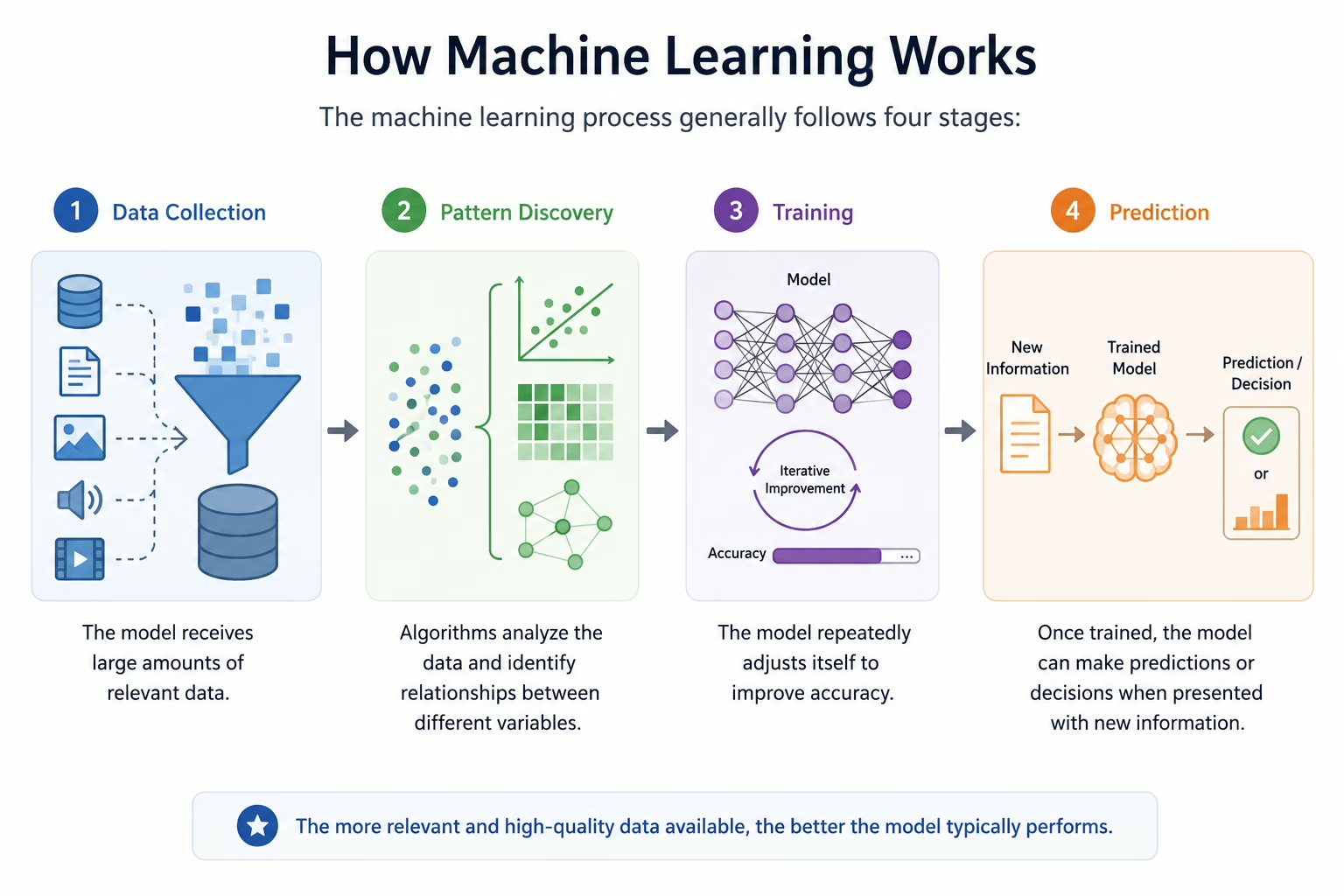
The machine learning process generally follows four stages:
Data Collection
The model receives large amounts of relevant data.
Pattern Discovery
Algorithms analyze the data and identify relationships between different variables.
Training
The model repeatedly adjusts itself to improve accuracy.
Prediction
Once trained, the model can make predictions or decisions when presented with new information.
The more relevant and high-quality data available, the better the model typically performs.
Types of Machine Learning
Supervised Learning
Supervised learning uses labeled datasets where the correct answer is already known.
For example, a healthcare dataset may contain thousands of medical scans already labeled as healthy or cancerous. The model learns from these examples and can later classify new scans.
Common applications include:
- Email spam filtering
- Medical diagnosis support
- Credit risk analysis
- Image classification
Unsupervised Learning
Unsupervised learning works without labeled answers.
Instead of being told what to look for, the model identifies hidden structures and relationships within the data.
A retailer might use unsupervised learning to analyze customer purchasing behavior and automatically identify different customer groups.
Common applications include:
- Customer segmentation
- Market research
- Pattern discovery
- Recommendation systems
Reinforcement Learning
Reinforcement learning teaches AI through trial and error.
The system receives rewards for successful actions and penalties for unsuccessful ones. Over time, it learns which actions produce the best outcomes.
This technique is commonly used in:
- Robotics
- Self-driving vehicles
- Video game AI
- Industrial automation
Many advanced AI systems rely on reinforcement learning to improve decision-making in complex environments.
Deep Learning Explained
Deep Learning is a specialized branch of machine learning that uses artificial neural networks to process information.
It is responsible for many of the most significant breakthroughs in modern AI, including image recognition, speech recognition, generative AI, and large language models.
Without deep learning, modern AI systems such as ChatGPT, Claude, Gemini, image generators, and AI agents would not exist in their current form.
What Are Neural Networks?
Artificial neural networks are inspired by the structure of the human brain.
They consist of interconnected nodes called neurons that process information through multiple layers.
Input Layer
Receives the raw data.
Examples:
- Image pixels
- Text
- Audio signals
Hidden Layers
The hidden layers analyze and transform information.
Early layers may detect simple patterns, while deeper layers identify increasingly complex relationships.
For example, when analyzing a human face:
- First layers detect edges
- Middle layers detect shapes
- Deeper layers detect eyes, noses, and facial structures
- Final layers identify a complete face
Output Layer
Produces the final prediction or decision.
Why Deep Learning Changed AI
Traditional machine learning often requires significant human involvement in selecting useful features.
Deep learning automates much of this process.
This enables models to process:
- Natural language
- Images
- Video
- Audio
- Scientific data
at a scale that was previously impossible.
As computing power and data availability increased, deep learning became the driving force behind modern AI advancements.
AI vs Machine Learning vs Deep Learning
Many people use these terms interchangeably, but they represent different layers of the same technology stack.
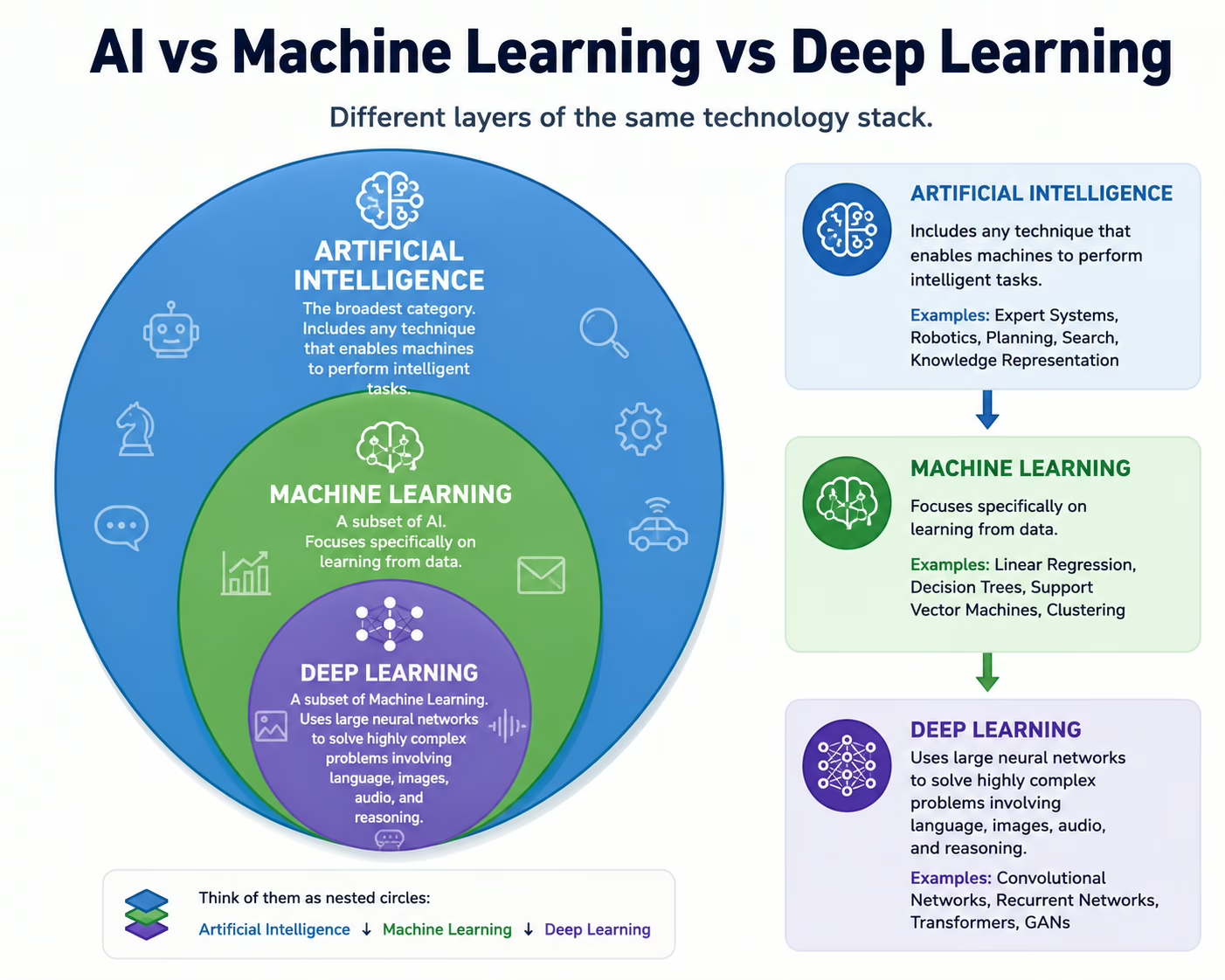
Artificial Intelligence is the broadest category.
Machine Learning is a subset of AI.
Deep Learning is a subset of Machine Learning.
Think of them as nested circles:
Artificial Intelligence
↓
Machine Learning
↓
Deep Learning
Artificial Intelligence includes any technique that enables machines to perform intelligent tasks.
Machine Learning focuses specifically on learning from data.
Deep Learning uses large neural networks to solve highly complex problems involving language, images, audio, and reasoning.
Generative AI Explained
Generative AI is one of the fastest-growing areas of artificial intelligence.
Unlike traditional AI systems that classify or analyze information, generative AI creates entirely new content.
Depending on the model, this content can include:
- Text
- Images
- Videos
- Audio
- Software code
- Presentations
- Research summaries
The rapid growth of generative AI has transformed how individuals and businesses interact with technology.
Large Language Models (LLMs)
Large Language Models, often called LLMs, power many of today’s AI chatbots and assistants.
Examples include ChatGPT, Claude, and Gemini. If you want to understand how large language models work in practice, our detailed guide on ChatGPT Explained: How OpenAI’s AI Chatbot Is Transforming Work and Learning explores its architecture, capabilities, limitations, and real-world applications.
These models are trained on enormous collections of text and learn relationships between words, phrases, and concepts.
When a user enters a prompt, the model predicts the most likely sequence of words based on everything it learned during training.
This allows LLMs to:
- Answer questions
- Summarize information
- Write articles
- Generate code
- Assist with research
AI Image and Video Generation
Generative AI is not limited to text.
Modern image-generation models can create realistic images from simple text descriptions.
Similarly, video-generation systems can create short videos based on prompts, reference images, or scripts.
Risks, Challenges, and Limitations of Artificial Intelligence
Artificial intelligence has the potential to improve productivity, accelerate research, and automate complex tasks. However, AI is not without risks. Understanding these limitations is essential for individuals, businesses, and policymakers who want to use AI responsibly.
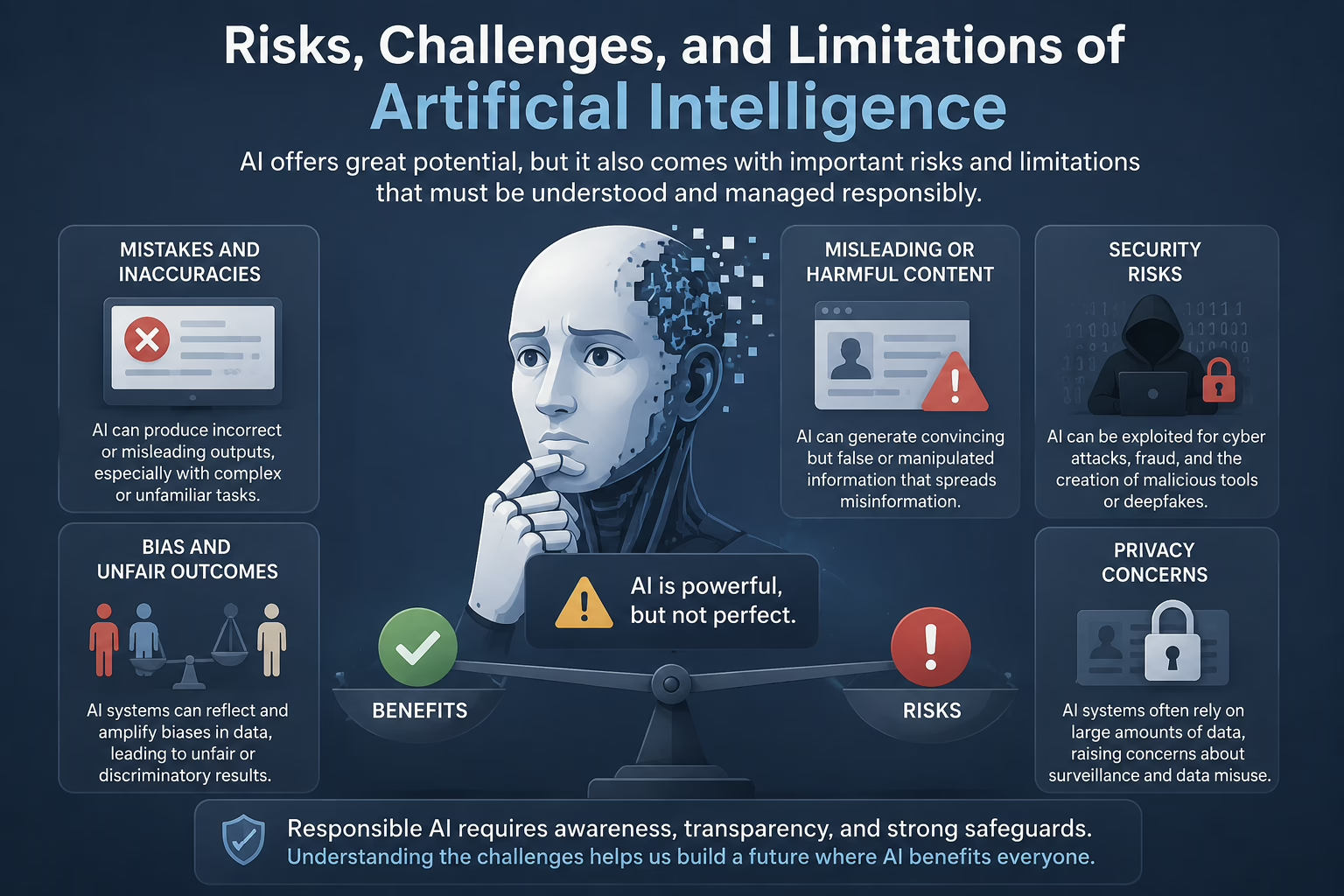
While modern AI systems can produce impressive results, they can also make mistakes, generate misleading information, reinforce biases, and create new security and privacy concerns.
A balanced understanding of AI requires looking beyond its capabilities and examining the challenges that accompany its rapid adoption.
AI Hallucinations
One of the most widely discussed limitations of modern AI systems is hallucination.
An AI hallucination occurs when a model generates information that sounds convincing but is factually incorrect. Because large language models are designed to predict likely sequences of words rather than verify facts, they can sometimes create inaccurate answers, fabricated statistics, non-existent sources, or incorrect explanations.
For example, an AI chatbot may confidently cite a research paper that does not exist or provide outdated information as if it were current.
This limitation highlights why human verification remains essential, particularly in areas such as healthcare, law, finance, and scientific research.
Bias and Fairness Concerns
AI systems learn from data created by humans. If the training data contains biases, those biases can influence the model’s outputs.
For example:
- Hiring systems may favor certain demographics if historical hiring data is biased.
- Lending algorithms may produce unfair outcomes if trained on biased financial records.
- Facial recognition systems may perform differently across demographic groups.
Reducing bias requires:
- Diverse datasets
- Regular auditing
- Transparency
- Continuous testing
While significant progress has been made, eliminating bias entirely remains a complex challenge.
Deepfakes and Misinformation
Generative AI has dramatically lowered the barrier to creating realistic content.
Today, AI can generate:
- Human-like voices
- Realistic images
- Synthetic videos
- Fabricated conversations
Although these capabilities have legitimate uses in entertainment, education, and content creation, they can also be abused.
Deepfakes can be used to:
- Spread misinformation
- Manipulate public opinion
- Damage reputations
- Conduct fraud and impersonation attacks
As AI-generated media becomes increasingly realistic, verifying authenticity is becoming more important than ever.
Privacy and Data Security
Many AI systems rely on large amounts of user data.
Organizations deploying AI must carefully consider:
- Data collection practices
- User consent
- Data retention policies
- Security protections
Without proper safeguards, sensitive information may be exposed, misused, or accessed by unauthorized parties.
For businesses operating in regulated industries, privacy compliance is becoming a major consideration when adopting AI technologies.
Copyright and Intellectual Property Challenges
Questions surrounding copyright remain one of the most debated issues in artificial intelligence.
Many AI models are trained using large collections of publicly available text, images, videos, and code. This has led to ongoing discussions about:
- Ownership of AI-generated content
- Fair use
- Licensing
- Creator compensation
Writers, artists, publishers, and software developers continue to debate how intellectual property laws should apply to AI systems and their outputs.
As regulations evolve, copyright compliance will remain a significant issue for AI developers and organizations.
Security Vulnerabilities
AI introduces entirely new categories of cybersecurity risks.
Examples include:
- Prompt injection attacks
- Data poisoning attacks
- Model manipulation
- Adversarial inputs
- AI-powered phishing campaigns
Attackers may attempt to manipulate AI systems into producing unintended outputs or exposing confidential information.
Organizations increasingly perform security testing and red-teaming exercises to identify vulnerabilities before deployment.
Environmental Impact
Training and operating advanced AI systems requires significant computing resources.
Large AI models rely on:
- Massive data centers
- High-performance GPUs
- Extensive cooling systems
- Continuous energy consumption
As AI adoption grows, researchers and technology companies are investing in more efficient hardware and sustainable infrastructure to reduce environmental impact.
Although AI can contribute to scientific and environmental solutions, its own resource requirements remain an important consideration.
Overreliance on AI
Another growing concern is excessive dependence on AI-generated outputs.
AI can assist with decision-making, but it should not replace human judgment in critical situations.
Overreliance on AI can lead to:
- Reduced critical thinking
- Poor decision-making
- Propagation of inaccurate information
- Increased operational risks
The most effective approach combines AI assistance with human expertise and oversight.
Responsible AI and AI Governance
As AI systems become more powerful and widely adopted, governments, researchers, and technology companies are developing frameworks to ensure these systems are used safely and ethically.
Responsible AI focuses on creating systems that are transparent, fair, secure, and accountable.
Rather than asking only what AI can do, responsible AI asks what AI should do and how it should be governed.
Why AI Governance Matters
AI increasingly influences decisions involving:
- Employment
- Healthcare
- Finance
- Education
- Public services
- Security
Because these decisions can affect millions of people, governance frameworks help ensure that AI systems operate responsibly and minimize potential harm.
The EU AI Act
The European Union has introduced one of the world’s most comprehensive AI regulatory frameworks.
The EU AI Act categorizes AI systems according to risk levels.
Unacceptable Risk
Certain AI applications are prohibited because they pose unacceptable risks to individuals or society.
High-Risk Systems
AI systems used in areas such as healthcare, employment, law enforcement, and critical infrastructure face stricter oversight requirements.
General Purpose AI Models
Developers of large foundation models may be required to meet transparency, safety, and risk-management obligations.
The EU AI Act is likely to influence AI regulation worldwide.
Core Principles of Responsible AI
Transparency
Users should understand when they are interacting with AI systems and how AI-generated content is produced.
Human Oversight
Humans should remain involved in high-impact decisions involving healthcare, finance, law, and public safety.
Accountability
Organizations deploying AI should remain responsible for the outcomes produced by their systems.
Safety
AI systems should undergo extensive testing before deployment.
Privacy Protection
User data should be collected and processed responsibly.
The Future of Artificial Intelligence
Predicting the future of AI is difficult, but several trends are already emerging.
Near-Term Developments (1 to 3 Years)
In the near future, AI systems are expected to become more capable, reliable, and integrated into everyday software.
Key developments may include:
- More advanced AI agents
- Better multimodal AI systems
- Improved reasoning capabilities
- Deeper integration into operating systems and productivity tools
Medium-Term Possibilities (3 to 7 Years)
Researchers expect significant progress in robotics and automation.
Potential developments include:
- Smarter industrial robots
- Autonomous logistics systems
- Advanced personal assistants
- Improved healthcare diagnostics
AI may increasingly move beyond software and into the physical world.
Long-Term Research Goals
One of the biggest long-term goals in AI research is Artificial General Intelligence (AGI).
AGI refers to a hypothetical system capable of performing a wide range of intellectual tasks at a human level.
Despite frequent headlines, no AGI system currently exists.
Researchers continue to debate:
- Whether AGI is achievable
- How long it might take
- What technical breakthroughs may be required
For now, AGI remains a research objective rather than a commercial reality.
Leading AI Platforms and Tools in 2026
The AI landscape continues to evolve rapidly, with new platforms and tools transforming how people work, create, and solve problems. From advanced AI chatbots and coding assistants to image and video generation platforms, today’s AI ecosystem offers specialized solutions for virtually every use case. Understanding the strengths, limitations, and ideal applications of these tools is essential for individuals, businesses, and developers looking to maximize productivity and stay competitive. Below, we explore the leading AI platforms and tools in 2026, highlighting what makes each solution stand out and who can benefit most from using it.
Here is the rewritten, fully optimized pillar section. It strips away temporary version numbers and news-style hype, focusing purely on evergreen value, user intent, and readability while seamlessly integrating your target keywords.
AI Chatbots
ChatGPT
- Best For: General-purpose tasks, everyday productivity, and broad knowledge queries.
- Overview: As one of the most recognizable AI chatbots on the market, ChatGPT by OpenAI remains a foundational tool for millions. It offers a highly versatile conversational interface capable of everything from drafting emails to brainstorming complex strategies.
- Key Strengths: Features extensive integrations, advanced voice capabilities, seamless web search, and robust data analysis tools. Its vast ecosystem of custom instructions and plugins makes it highly adaptable.
- Limitations: Can occasionally generate generic-sounding text and may struggle with highly specialized, niche coding or extreme long-form content generation compared to specialized counterparts.
- Why Choose It: It is the ideal starting point for anyone looking for reliable, well-rounded generative AI tools for daily work and personal productivity.
Claude
- Best For: Nuanced writing, deep analysis, and handling massive documents.
- Overview: The Claude family of models by Anthropic is built around safety, steerability, and exceptional reading comprehension. It is widely considered a top-tier writing assistant and analytical engine.
- Key Strengths: Possesses an enormous context window, allowing users to upload entire books or large codebases for synthesis. It excels at producing natural, human-like text with fewer AI clichés and demonstrates strong logical reasoning.
- Limitations: Lacks the deep native ecosystem of plugins found in some competitors and historically trails slightly in direct web browsing integration.
- Why Choose It: Choose Claude if you need an AI that sounds less like a robot and more like a thoughtful colleague, particularly for editing, creative writing, or heavy document analysis.
Gemini
- Best For: Deep integration with Google Workspace and multimodal tasks.
- Overview: The Gemini ecosystem represents Google’s flagship AI, seamlessly connecting text, image, audio, and video capabilities. It is built from the ground up to be natively multimodal.
- Key Strengths: Unmatched integration with tools like Google Docs, Drive, and Gmail. It processes massive amounts of information rapidly and excels at analyzing videos, images, and live data streams concurrently.
- Limitations: The user experience across its various tiers and integrations can occasionally feel fragmented, and its strict guardrails sometimes lead to overly cautious responses.
- Why Choose It: It is the clear winner for users heavily invested in the Google ecosystem who want powerful, multimodal AI platforms built directly into their daily workflow.
Siri AI
- Best For: Apple ecosystem integration and personal context awareness.
- Overview: Siri AI is Apple’s conversational assistant built on Apple Intelligence. It transforms the traditional voice assistant into a highly capable AI chatbot deeply embedded across Apple’s operating systems.
- Key Strengths: Features unmatched onscreen awareness and seamlessly pulls information from personal messages, emails, and photos while maintaining strict user privacy. It excels at cross-device continuity and integrates directly into systemwide context menus.
- Limitations: Strictly locked into the Apple ecosystem, offering no value outside of it. Its privacy-first, on-device processing can sometimes limit raw reasoning capabilities compared to heavily cloud-based models.
- Why Choose It: The definitive choice for Apple users who want a deeply integrated AI that securely understands their personal data across their phone, tablet, and computer.
DeepSeek
- Best For: Cost-effective reasoning, mathematics, and open-weight accessibility.
- Overview: DeepSeek has disrupted the AI landscape by offering highly efficient, capable models that rival industry giants at a fraction of the computing cost.
- Key Strengths: Exceptional performance in logical reasoning, coding, and mathematical problem-solving. Its open-weight approach empowers developers to build upon its foundation locally or through affordable APIs.
- Limitations: The consumer-facing web interface is less feature-rich than its competitors, lacking broad third-party integrations and native multimodal web browsing tools.
- Why Choose It: An outstanding choice for developers, researchers, and budget-conscious teams who need raw analytical power without paying premium enterprise prices.
Grok
- Best For: Real-time information and unfiltered conversational AI.
- Overview: Developed by xAI, Grok is integrated deeply into the X (formerly Twitter) platform, designed to process real-time data streams and offer a more rebellious, witty persona.
- Key Strengths: Unparalleled access to real-time global conversations and breaking news via X. It answers controversial questions that other heavily moderated models often reject.
- Limitations: Its heavy reliance on social media data means it can sometimes surface unverified rumors. It is also locked behind premium social media subscription tiers.
- Why Choose It: Perfect for journalists, researchers, and users who prioritize up-to-the-second news analysis and prefer an AI with fewer content guardrails.
AI Coding Tools
GitHub Copilot
- Best For: Seamless inline code completion and enterprise-level development.
- Overview: GitHub Copilot pioneered the modern era of AI coding tools, acting as a ubiquitous pair programmer directly within popular IDEs like Visual Studio Code.
- Key Strengths: Backed by Microsoft, it boasts deep GitHub integration, robust enterprise security, and excellent autocomplete functions that save developers countless hours of typing boilerplate code.
- Limitations: Primarily functions as an autocomplete and chat assistant rather than a fully autonomous agent. It struggles with making complex, multi-file architectural changes independently.
- Why Choose It: The safest, most widely supported choice for large teams and enterprise environments looking to boost developer velocity without disrupting established workflows.
Cursor
- Best For: AI-first development and context-aware codebase modifications.
- Overview: Cursor is a standalone, AI-native code editor that deeply integrates leading AI models into the entire software development lifecycle.
- Key Strengths: Understands your entire codebase, allowing for precise, multi-file edits and automated refactoring. Its composing features let developers generate full features or applications through conversational prompts.
- Limitations: Requires users to migrate to a new IDE (though familiar to VS Code users). Power users can quickly burn through high-speed generation limits on standard plans.
- Why Choose It: It is the top choice for modern developers and indie hackers who want an AI that actively writes and edits code alongside them, rather than just suggesting it.
Windsurf
- Best For: Agentic coding and autonomous multi-step problem-solving.
- Overview: Built by Codeium, Windsurf is an AI-native editor focused on agentic workflows. It acts less like a copilot and more like an autonomous developer collaborator.
- Key Strengths: Its agent operates with deep codebase awareness, capable of executing terminal commands, running tests, and iterating on errors autonomously until a feature works. It fluidly blends manual coding with AI delegation.
- Limitations: The agentic nature requires a learning curve to trust and guide the AI effectively. It is built for professional developers, not absolute beginners looking for a no-code builder.
- Why Choose It: Ideal for experienced engineers who want to delegate entire tasks—like bug fixing or test generation across multiple files—so they can focus on high-level architecture.
Xiaomi MiMo Code
- Best For: Long-horizon tasks and cross-session terminal workflows.
- Overview: Xiaomi MiMo Code is an open-source, terminal-native AI coding tool designed to act as an autonomous development partner, directly tackling the issue of AI amnesia during extended sessions. For a deeper evaluation of its coding performance, architecture, and real-world development workflows, read our complete Xiaomi MiMo Code Review.
- Key Strengths: Boasts a powerful persistent memory system that maintains project architecture and progress across multiple sessions. It effortlessly handles complex, multi-step operations by autonomously spawning subagents, managing files, and executing terminal commands.
- Limitations: The terminal-only interface lacks the graphical polish of modern standalone IDEs. Its highly autonomous, agentic nature requires a learning curve and may be overwhelming for novice programmers.
- Why Choose It: An excellent option for advanced developers who need a persistent, open-source coding agent capable of managing massive, multi-day repository refactors entirely from the command line.
Claude Code
- Best For: Terminal-based agentic workflows and heavy repository refactoring.
- Overview: Claude Code is Anthropic’s powerful coding agent that lives directly in your terminal, integrating seamlessly with your existing IDE and version control systems.
- Key Strengths: Exceptionally smart at reading vast codebases, reasoning through complex logic, making cross-file edits, and autonomously creating pull requests. It brings top-tier reasoning models directly to the command line.
- Limitations: Designed for comfortable terminal users; it lacks a flashy graphical IDE interface out of the box. Heavy reliance on premium API tiers can become expensive for continuous, large-scale automation.
- Why Choose It: The ultimate tool for terminal power users who want an AI agent that can plan, code, test, and ship changes without ever leaving the command line.
AI Image Generators
Midjourney
- Best For: High-end artistic aesthetics and photorealistic generation.
- Overview: Midjourney remains the gold standard for artistic and hyper-realistic AI image generators. It is renowned for its cinematic lighting, rich textures, and default aesthetic beauty.
- Key Strengths: Produces professional-grade imagery with relatively simple prompts. Offers deep parameter controls for stylization, aspect ratios, and blending multiple reference images.
- Limitations: The interface can be less intuitive for casual users compared to simple web apps. It occasionally struggles with generating exact text inside images compared to newer models.
- Why Choose It: The absolute best option for digital artists, concept designers, and marketers who prioritize breathtaking visual quality and distinct artistic styles.
Flux
- Best For: Prompt adherence, typography, and open-weight flexibility.
- Overview: Flux has rapidly become a dominant force in the generative imagery space, offering models that span from fast local generation to professional API-driven outputs.
- Key Strengths: Incredible at understanding complex, dense prompts. It renders human anatomy flawlessly and excels at generating legible, accurate text and typography within images.
- Limitations: Generating the highest-quality outputs requires significant local hardware or reliance on third-party cloud hosting, which can fragment the user experience.
- Why Choose It: Perfect for designers needing exact layout control, graphic elements with text, or developers wanting to integrate a powerful, open-weight image model into their own apps.
Imagen
- Best For: Enterprise safety, brand consistency, and Google integration.
- Overview: Google’s Imagen family powers the visual generation inside the Gemini ecosystem and Google Workspace. It is built with a heavy emphasis on commercial safety and photorealism.
- Key Strengths: Generates highly realistic images with strict safety guardrails, making it legally safer for enterprise use. It integrates directly into corporate workflows via Google Cloud.
- Limitations: The strict safety filters can sometimes block harmless prompts, making it less flexible for unconstrained artistic exploration compared to open alternatives.
- Why Choose It: The go-to choice for corporate marketing teams and enterprise businesses that need high-quality imagery without the risk of copyright infringement or unsafe content.
Stable Diffusion
- Best For: Complete local control, uncensored generation, and custom workflows.
- Overview: Stable Diffusion is the backbone of the open-source image generation community, offering powerful models that users can run entirely on their own hardware.
- Key Strengths: Infinite customizability. With node-based tools and thousands of community-trained fine-tunes, users can perfectly control poses, styles, and character consistency.
- Limitations: Highly technical setup. Getting the best results requires mastering complex interfaces and having a powerful local GPU.
- Why Choose It: The only choice for power users, game developers, and artists who demand absolute, granular control over every pixel and want to run the best AI tools locally.
AI Video Generators
Veo
- Best For: High-fidelity cinematic physics and Google ecosystem integration.
- Overview: Veo is Google’s flagship entry into AI video generators, designed to understand cinematic language, complex physical interactions, and fluid motion over extended sequences.
- Key Strengths: Exceptional understanding of real-world physics, fluid dynamics, and lighting. It seamlessly processes complex prompts that dictate camera movements, framing, and specific artistic styles.
- Limitations: Access can be restricted to specific creator programs or premium tiers, meaning it isn’t always immediately available for casual public experimentation.
- Why Choose It: Ideal for filmmakers and creators who need physically accurate video generation with a deep semantic understanding of cinematic terminology and prompt nuances.
Sora
- Best For: Hyper-realistic world-building and long-form continuous motion.
- Overview: OpenAI’s Sora redefined expectations for AI video by demonstrating the ability to generate lengthy, highly coherent clips that maintain physical logic and character consistency over time.
- Key Strengths: Can generate incredibly complex scenes with multiple characters and accurate details. It acts almost like a physics engine, maintaining object permanence even when things leave the frame.
- Limitations: Processing times can be lengthy, and minor hallucinations in physics (like objects morphing slightly) still occur in highly complex, multi-layered environments.
- Why Choose It: The premier choice for creating sweeping, realistic B-roll, concept visualizations, and complex world-building scenarios where scene consistency is paramount.
Runway
- Best For: Granular motion control and professional post-production workflows.
- Overview: Runway has long been a pioneer in generative video, offering a suite of models and a fully-fledged web editor built specifically for video professionals and creative studios.
- Key Strengths: Offers unmatched directional control with motion brush tools, allowing users to paint exactly which parts of an image should move. Features a robust timeline editor for post-production.
- Limitations: Rapid iterations and complex camera movements can sometimes result in degraded resolution or unnatural texture warping if pushed beyond the model’s optimal limits.
- Why Choose It: The best all-in-one platform for video editors, marketing agencies, and artists who need precise control over animation rather than just typing a prompt and hoping for the best.
Kling
- Best For: Multi-shot storyboarding, native audio, and complex character actions.
- Overview: Kling is a powerful multimodal video model that rapidly gained popularity for its ability to generate long, cinematic sequences with consistent characters and impressive physical interactions.
- Key Strengths: Excels at generating dynamic actions, multi-shot continuity, and integrating native sound effects and lip-syncing directly into the generation process.
- Limitations: The interface and pricing structures can occasionally shift, and handling extreme close-ups of human faces can sometimes produce slight uncanny valley effects.
- Why Choose It: Perfect for social media creators and storytellers who want to generate complete, narrative-driven short films with consistent characters and integrated audio on one platform.
Quick Comparison
| Tool Category | Top Choice for Quality | Top Choice for Control | Top Choice for Enterprise | Top Choice for Open-Source/Value |
| Chatbots | Claude | ChatGPT | Gemini | DeepSeek |
| Coding Tools | Cursor | Windsurf | GitHub Copilot | Claude Code |
| Image Generators | Midjourney | Stable Diffusion | Imagen | Flux |
| Video Generators | Sora | Runway | Veo | Kling |
Which AI Tool Should You Choose?
Selecting the right platform depends entirely on your daily workflow.
If you are looking for a general productivity boost, start with a versatile chatbot like ChatGPT or Claude. Developers should immediately look toward AI-native editors like Cursor or Windsurf to modernize their coding environment. For creative professionals, Midjourney remains the aesthetic king for still images, while Runway and Sora offer unprecedented power for video generation.
The secret to success isn’t adopting every tool, but mastering the one that directly addresses your biggest bottleneck. Most modern AI platforms offer free trials or affordable entry tiers test a few in your specific category before committing to a premium subscription.
AI in Everyday Life
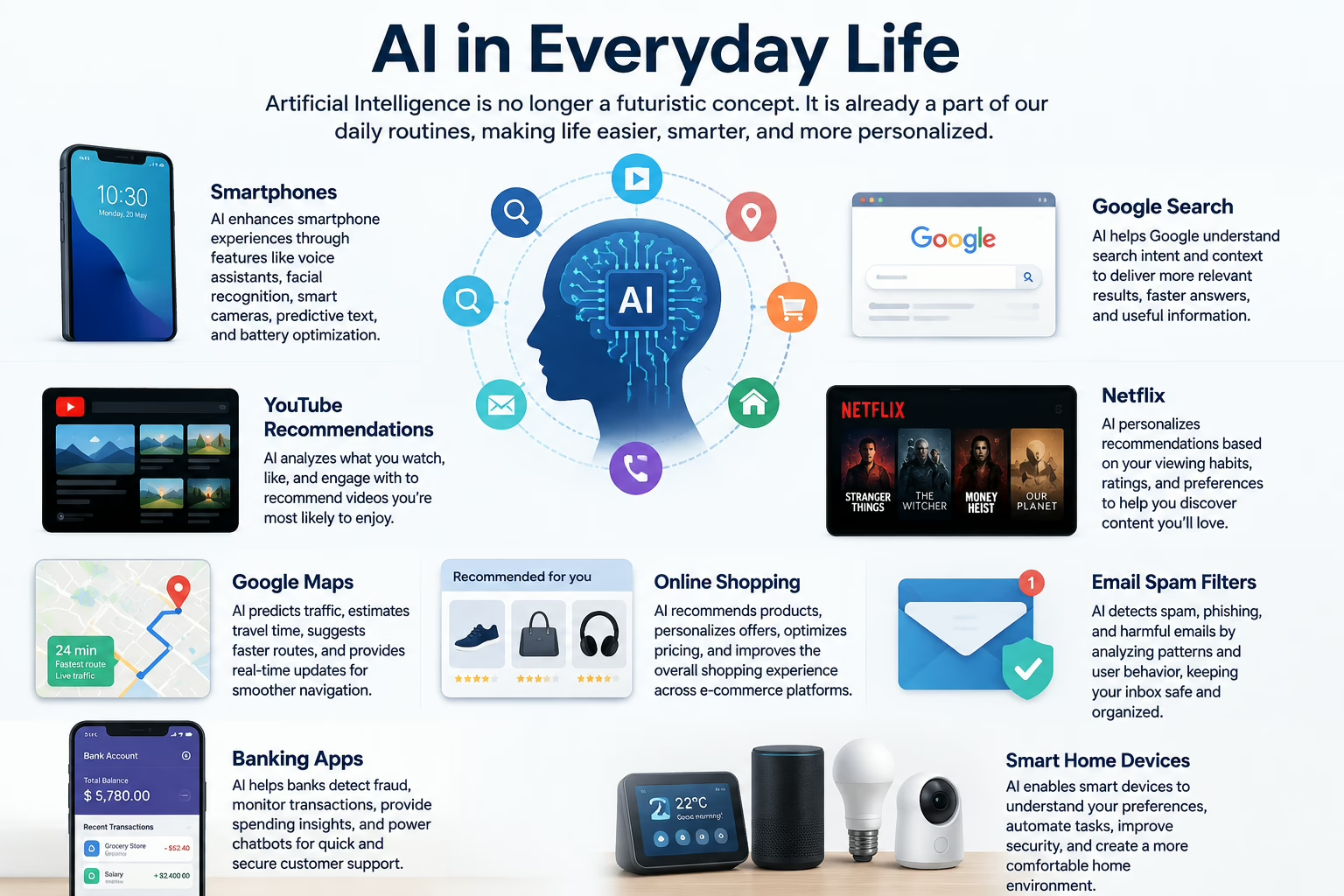
Artificial intelligence is no longer limited to research labs or technology companies. It has become a part of everyday life, often working behind the scenes to make digital experiences faster, smarter, and more personalized. From the smartphones we carry to the streaming platforms we use for entertainment, AI helps automate tasks, improve recommendations, and enhance convenience. Many people interact with AI dozens of times a day without even realizing it. Here are some of the most common examples of AI in everyday life.
Smartphones
Modern smartphones use AI to improve photography, voice recognition, battery optimization, predictive text, and app performance. Features such as facial recognition, voice assistants, and smart photo enhancements rely heavily on machine learning algorithms to deliver a more personalized user experience.
Popular voice assistants such as Siri AI demonstrate how artificial intelligence has become deeply integrated into everyday mobile experiences, helping users perform tasks through natural voice interactions.
Google Search
Google Search uses AI to better understand search intent and provide more relevant results. Instead of simply matching keywords, AI analyzes context, user behavior, and language patterns to deliver accurate answers and useful information more quickly.
YouTube Recommendations
Every time YouTube suggests a video, AI is at work. The platform analyzes viewing history, watch time, interests, and engagement patterns to recommend content that users are most likely to watch and enjoy.
Netflix
Netflix relies on AI to personalize the viewing experience for millions of subscribers. The platform recommends movies and TV shows based on viewing habits, ratings, search history, and content preferences, helping users discover relevant content more easily.
Google Maps
AI powers many of the intelligent features within Google Maps. It helps predict traffic conditions, estimate travel times, identify the fastest routes, and provide real-time navigation updates based on changing road conditions.
Online Shopping
E-commerce platforms use AI to recommend products, personalize offers, optimize pricing, and improve customer experiences. Whether browsing products on an online marketplace or receiving personalized suggestions, AI plays a significant role in shaping purchasing decisions.
Email Spam Filters
Most email providers use AI to detect spam, phishing attempts, and potentially harmful messages. By analyzing patterns and user behavior, AI systems can accurately filter unwanted emails while ensuring important messages reach the inbox.
Banking Apps
Banks and financial institutions use AI to improve security, detect fraudulent transactions, provide spending insights, and automate customer support. Many banking apps also use AI-powered chatbots to assist customers with routine inquiries.
Smart Home Devices
Smart home technologies such as voice assistants, smart speakers, security cameras, and connected appliances rely on AI to understand commands, learn user preferences, and automate everyday household tasks. These systems become more effective over time as they adapt to user behavior.
Common AI Myths Debunked
Misconceptions about AI are widespread. Separating fact from fiction helps create a more realistic understanding of the technology.
Myth: AI Understands Information Like Humans
Reality: AI identifies patterns in data but does not possess human consciousness, emotions, or understanding.
Myth: AI Is Always Accurate
Reality: AI systems can make mistakes, generate incorrect information, and produce misleading outputs.
Myth: AI Is Completely Objective
Reality: AI reflects patterns present in its training data and may inherit existing biases.
Myth: AI Will Replace Every Job
Reality: AI is more likely to automate specific tasks while changing how many jobs are performed.
Myth: Generative AI Copies Existing Content
Reality: Modern generative AI creates new outputs based on learned patterns rather than simply retrieving stored content.
Myth: AGI Already Exists
Reality: There is currently no verified Artificial General Intelligence system.
Myth: Larger Models Are Always Better
Reality: Smaller specialized models often outperform larger models in specific tasks while requiring fewer resources.
Myth: AI Is Only for Technical Experts
Reality: Modern AI tools are increasingly accessible to everyday users through natural language interfaces.
Myth: AI Coding Tools Produce Perfect Code
Reality: AI-generated code still requires human review, testing, and validation.
Myth: AI Is Just a Temporary Trend
Reality: AI is already embedded across industries and continues to influence how software, research, and business processes operate.
Frequently Asked Questions About Artificial Intelligence
What is Artificial Intelligence in simple terms?
Artificial Intelligence, or AI, is a branch of computer science focused on creating systems that can perform tasks that typically require human intelligence. These tasks include understanding language, recognizing images, solving problems, making decisions, and generating content. Modern AI systems learn from data and improve their performance over time rather than relying entirely on fixed rules.
How does AI learn?
AI learns by analyzing large amounts of data and identifying patterns within that information. During training, the model processes examples, evaluates its predictions, and adjusts its internal parameters to improve accuracy. Over time, the system becomes better at performing specific tasks such as recognizing objects, translating languages, or answering questions.
What is the difference between AI and Machine Learning?
Artificial Intelligence is the broader field focused on creating intelligent systems. Machine Learning is a subset of AI that enables systems to learn from data without being explicitly programmed for every scenario. In simple terms, all machine learning is AI, but not all AI relies on machine learning.
What is Deep Learning?
Deep Learning is a specialized branch of machine learning that uses artificial neural networks with multiple layers. These networks can process large amounts of complex data such as images, videos, speech, and text. Deep learning is responsible for many recent AI breakthroughs, including large language models and advanced image recognition systems.
What are Large Language Models (LLMs)?
Large Language Models are AI systems trained on vast amounts of text data. They can understand prompts and generate human-like responses. Popular examples include ChatGPT, Claude, Gemini, and other conversational AI systems. LLMs are widely used for writing, coding, research, summarization, and customer support.
Is ChatGPT Artificial Intelligence?
Yes. ChatGPT is an AI-powered conversational system based on a Large Language Model (LLM). Our comprehensive ChatGPT guide explains how OpenAI’s chatbot uses transformer models, tokens, context windows, and reinforcement learning to generate human-like responses. It uses machine learning and deep learning techniques to generate responses based on user prompts.
What are AI agents?
AI agents are systems that can perform tasks autonomously. Unlike traditional chatbots, AI agents can plan actions, use tools, access information, execute workflows, and work toward achieving a specific goal with minimal human intervention.
Can AI think like humans?
No. Modern AI systems do not think, feel, or understand information in the same way humans do. They identify patterns in data and generate outputs based on probabilities. While their responses may appear intelligent, they do not possess consciousness or self-awareness.
What is an AI hallucination?
An AI hallucination occurs when a model generates information that sounds convincing but is factually incorrect. Hallucinations can occur because AI systems are designed to predict likely outputs rather than verify facts. This is why important information should always be independently verified.
Are AI-generated answers always accurate?
No. AI systems can make mistakes, misunderstand context, or generate outdated information. While modern models are often highly useful, they should not be treated as infallible sources of truth.
Can AI replace human jobs?
AI is likely to automate certain tasks rather than replace all jobs. Historically, technological advancements have changed how work is performed rather than eliminating work entirely. Many professionals are already using AI as a productivity tool to assist with research, writing, analysis, coding, and decision-making.
Which industries use AI the most?
AI is widely used across industries including:
- Healthcare
- Finance
- Education
- Retail
- Manufacturing
- Transportation
- Software Development
- Cybersecurity
- Marketing
- Scientific Research
Its applications continue to expand each year.
How is AI used in healthcare?
Healthcare organizations use AI to assist with medical imaging analysis, disease detection, drug discovery, patient monitoring, and administrative tasks. AI can help healthcare professionals process information more efficiently, but human expertise remains essential.
How is AI used in software development?
AI assists developers by generating code, reviewing software, detecting bugs, creating documentation, explaining complex functions, and automating repetitive development tasks.
Related Reading: Xiaomi MiMo Code Review
What is Generative AI?
Generative AI refers to AI systems capable of creating new content such as text, images, audio, video, presentations, and software code. Unlike traditional AI systems that primarily classify or analyze data, generative AI produces original outputs based on patterns learned during training.
How do AI image generators work?
Most modern image-generation systems use diffusion models. These models learn how images are structured and gradually transform random noise into detailed images based on user prompts.
What is an open-weight AI model?
Open-weight models are AI systems whose trained model weights are publicly available. Developers can download, run, and fine-tune these models for their own applications.
What is AGI?
Artificial General Intelligence (AGI) refers to a hypothetical AI system capable of performing a wide range of intellectual tasks at a human level. Unlike today’s AI systems, AGI would not be limited to specific tasks or domains.
Does AGI exist today?
No. Despite ongoing research, there is currently no verified AGI system. Existing AI models remain specialized tools that perform well in specific areas but do not possess generalized human intelligence.
Is AI dangerous?
AI itself is not inherently dangerous, but its misuse can create risks. Concerns include misinformation, deepfakes, privacy violations, cyberattacks, and biased decision-making systems. Responsible development and governance are important for minimizing these risks.
What is responsible AI?
Responsible AI refers to the development and deployment of AI systems that are transparent, fair, secure, accountable, and aligned with ethical principles. It emphasizes human oversight and risk management.
How does AI affect privacy?
Many AI systems rely on large datasets, which may include personal information. Organizations must implement strong privacy protections and comply with relevant regulations to ensure user data is handled responsibly.
Can AI create videos?
Yes. Modern generative AI systems can create videos from text prompts, images, scripts, and other inputs. Video generation technology has improved rapidly in recent years and continues to evolve.
Can AI create software code?
Yes. AI coding assistants can generate code, explain programming concepts, debug applications, and assist developers with software projects. However, human review is still necessary to ensure accuracy and security.
Is AI the future of technology?
AI is expected to remain one of the most influential technologies of the coming decades. It is already transforming industries, improving productivity, and enabling new forms of innovation across many sectors.
What should beginners learn first about AI?
Beginners should focus on understanding:
- Artificial Intelligence fundamentals
- Machine Learning
- Deep Learning
- Generative AI
- Large Language Models
- AI ethics and governance
Building a strong foundation in these topics makes it easier to understand more advanced concepts later.
What are the main types of Artificial Intelligence?
AI is commonly categorized into Reactive AI, Limited Memory AI, Theory of Mind AI, Artificial General Intelligence (AGI), and Superintelligence. Currently, most real-world AI systems fall into the Limited Memory category.
What is the difference between AI and automation?
Automation follows predefined rules to perform repetitive tasks, while AI can learn from data, identify patterns, and adapt to new situations. AI is often used to make automation more intelligent.
What is a neural network?
A neural network is a computational model inspired by the human brain. It consists of interconnected nodes that process information and help AI systems recognize patterns in complex data.
What are AI models?
AI models are trained systems that have learned patterns from data and can perform tasks such as generating text, recognizing images, translating languages, or making predictions.
What is a foundation model?
A foundation model is a large AI model trained on broad datasets that can be adapted for many different tasks through prompting or fine-tuning.
What is prompt engineering?
Prompt engineering is the practice of designing effective instructions that help AI systems generate more accurate and useful responses.
What is fine-tuning in AI?
Fine-tuning is the process of further training a pre-trained AI model on a specialized dataset to improve performance for a specific task or industry.
What is multimodal AI?
Multimodal AI can process and understand multiple forms of data simultaneously, such as text, images, audio, and video.
What is computer vision?
Computer vision is a field of AI that enables machines to analyze and understand visual information from images and videos.
What is Natural Language Processing (NLP)?
Natural Language Processing is a branch of AI focused on enabling computers to understand, interpret, and generate human language.
What is speech recognition?
Speech recognition technology converts spoken language into text and is commonly used in voice assistants and transcription services.
What is predictive analytics?
Predictive analytics uses AI and machine learning to analyze historical data and forecast future outcomes.
What is an AI chatbot?
An AI chatbot is a conversational system designed to answer questions and interact with users through text or voice.
How are AI agents different from chatbots?
Chatbots mainly respond to user prompts, while AI agents can independently perform tasks, use tools, and execute multi-step workflows.
Can AI browse the internet?
Some AI systems can access the internet when connected to external tools, while others operate only using information available in their training data.
Does AI have emotions?
No. AI does not experience emotions, feelings, desires, or consciousness.
Can AI become self-aware?
There is currently no evidence that modern AI systems are self-aware or conscious.
What is Artificial General Intelligence (AGI)?
AGI refers to a hypothetical AI system capable of performing intellectual tasks at a human level across a wide range of domains.
What is Superintelligence?
Superintelligence is a theoretical concept describing an intelligence that surpasses human capabilities in nearly every area.
How much data does AI need?
The amount of data depends on the task. Large AI models may be trained on billions or trillions of data points.
What are AI parameters?
Parameters are numerical values learned during training that help AI models make predictions and generate outputs.
Why are GPUs important for AI?
GPUs can perform many calculations simultaneously, making them ideal for training and running AI models.
Can AI write articles?
Yes. Modern AI systems can generate articles, summaries, reports, and other written content, although human review is recommended.
Can AI create images?
Yes. Image generation models can create original visuals based on text prompts or reference images.
Can AI generate videos?
Yes. Advanced AI systems can generate short videos from prompts, images, or scripts.
Can AI compose music?
Yes. AI can create melodies, lyrics, soundtracks, and other forms of music.
Can AI translate languages?
Yes. AI-powered translation tools can translate text and speech across many languages.
Can AI help students?
AI can assist with research, explanations, tutoring, writing support, and study planning.
Can AI help teachers?
Teachers can use AI to create lesson plans, quizzes, educational materials, and administrative content.
How is AI used in finance?
Financial institutions use AI for fraud detection, risk assessment, algorithmic trading, and customer support.
How is AI used in healthcare?
Healthcare organizations use AI for medical imaging analysis, disease detection, drug discovery, and patient monitoring.
How is AI used in cybersecurity?
AI helps identify threats, detect anomalies, analyze security logs, and respond to cyberattacks.
Is AI replacing software developers?
AI is changing software development workflows but has not eliminated the need for skilled developers.
Can AI improve business productivity?
Yes. AI can automate repetitive tasks, analyze information quickly, and assist employees with decision-making.
What are open-weight AI models?
Open-weight models provide public access to trained model weights, allowing developers to run and customize them.
What are closed AI models?
Closed models are proprietary systems where the training data, weights, and architecture remain private.
Is AI regulated?
Many governments are developing AI regulations to address safety, transparency, privacy, and accountability concerns.
What is the EU AI Act?
The EU AI Act is a regulatory framework designed to govern the development and use of AI systems based on risk levels.
What are deepfakes?
Deepfakes are AI-generated images, audio, or videos that realistically imitate real people.
Is AI safe to use?
AI can be highly useful when used responsibly, but users should remain aware of limitations such as hallucinations, bias, privacy concerns, and misinformation.
What skills are valuable in the AI era?
Important skills include critical thinking, communication, problem-solving, data literacy, AI literacy, creativity, and adaptability.
How can beginners start learning AI?
Beginners should start by understanding AI fundamentals, machine learning, deep learning, generative AI, and responsible AI principles before exploring advanced topics.
What is the future of Artificial Intelligence?
AI is expected to become more integrated into software, business operations, scientific research, healthcare, education, and everyday digital experiences, although the exact pace and direction of development remain uncertain.
Key Takeaways
Before concluding, here are the most important points to remember:
- Artificial Intelligence is a broad field focused on creating systems capable of performing tasks that typically require human intelligence.
- Machine Learning enables computers to learn from data instead of relying solely on fixed rules.
- Deep Learning powers many of today’s most advanced AI systems, including image recognition and large language models.
- Generative AI can create text, images, audio, video, and software code.
- AI agents represent a major shift from simple chatbots toward autonomous systems capable of completing complex workflows.
- AI is already transforming industries such as healthcare, finance, education, software development, and scientific research.
- Despite its capabilities, AI has important limitations including hallucinations, bias, privacy concerns, and security risks.
- Responsible AI development requires transparency, accountability, safety, and human oversight.
- Artificial General Intelligence remains a long-term research goal rather than a present-day reality.
Conclusion
Artificial Intelligence has evolved from a niche area of academic research into one of the most influential technologies shaping the modern world. What was once considered science fiction is now embedded in everyday tools, business operations, healthcare systems, educational platforms, scientific research, and software development workflows.
Understanding AI is no longer limited to engineers and researchers. Business leaders need to understand how AI can improve efficiency and decision-making. Students need to understand how AI is reshaping careers and industries. Consumers need to understand how AI influences the products and services they use every day.
At its core, AI is neither magic nor a replacement for human intelligence. It is a collection of technologies that use data, algorithms, and computing power to identify patterns, make predictions, and generate outputs. Its strengths can be remarkable, but its limitations are equally important to recognize.
As AI continues to advance, the conversation will increasingly shift from what AI can do to how it should be used. Questions surrounding transparency, privacy, security, fairness, and governance will become just as important as technical innovation itself.
The organizations and individuals that benefit most from AI will not necessarily be those with access to the most powerful models. Instead, success will belong to those who understand how AI works, recognize its strengths and weaknesses, apply it responsibly, and combine it with human judgment, creativity, and expertise.
Artificial Intelligence is not the end of human innovation. In many ways, it is the beginning of a new chapter, one where humans and intelligent systems work together to solve problems, accelerate discovery, and create opportunities that were previously impossible.
About the Author
This guide was researched, written, and regularly updated by the editorial team at RCN Guide, a technology publication focused on artificial intelligence, consumer technology, software, cybersecurity, and emerging digital trends.
Our editorial process prioritizes accuracy, clarity, and practical value. Articles are reviewed using publicly available documentation, industry research, official product information, and trusted technology sources whenever applicable.
The goal of this guide is to help readers understand Artificial Intelligence through balanced, evidence-based explanations rather than marketing claims or speculative hype.
Editorial Standards
At RCN Guide, we aim to provide accurate and up-to-date technology content.
Our editorial principles include:
- Fact-based reporting and analysis
- Clear distinction between facts and future projections
- Regular content reviews and updates
- Transparency regarding limitations and uncertainties
- Use of reputable and authoritative sources
While every effort is made to ensure accuracy, readers should independently verify critical information related to healthcare, legal matters, finance, and business decisions.
Sources and Further Reading
Readers interested in exploring Artificial Intelligence in greater depth may find the following resources useful:
AI Research Organizations
- OpenAI Research: https://openai.com/research/
- Google DeepMind: https://deepmind.google/research/
- Anthropic Research: https://www.anthropic.com/research
- Meta AI Research: https://ai.meta.com/research/
- Microsoft AI Research: https://www.microsoft.com/en-us/research/research-area/artificial-intelligence/
Educational Resources
- Stanford Human-Centered AI: https://hai.stanford.edu/research
- MIT Computer Science and Artificial Intelligence Laboratory (CSAIL): https://www.csail.mit.edu/news/
- Carnegie Mellon University AI Research: https://ai.cmu.edu/
- Berkeley Artificial Intelligence Research (BAIR): https://bair.berkeley.edu/
Industry and Standards Organizations
- National Institute of Standards and Technology (NIST)
- OECD AI Policy Observatory
- European Commission AI Resources
- Partnership on AI
Recommended Internal Resources
- Siri AI Explained: https://rcnguide.com/siri-ai/
- Xiaomi MiMo Code Review: https://rcnguide.com/xiaomi-mimo-code-review/
Content Update Policy
Artificial Intelligence is one of the fastest-moving areas of technology. New AI models, regulations, research findings, and industry developments emerge regularly.
To maintain accuracy and relevance, this guide is reviewed periodically and updated when significant developments occur.
Updates may include:
- New AI models and technologies
- Changes in AI regulations and governance
- Industry developments
- Emerging AI applications
- Updated examples and case studies
- New educational resources
Last Updated
June 2026
Next Review Date
December 2026
If you identify outdated information or would like to suggest improvements, please contact the RCN Guide editorial team through our website.
Disclosure
This article is intended for educational and informational purposes only. It should not be considered legal, financial, medical, or professional advice. Readers should consult qualified professionals before making important decisions based on AI-generated outputs or technology-related recommendations.
Use the key points in this guide to understand the topic and make more informed decisions.

This guide is researched and edited using relevant documentation, reliable sources and publicly available information.
Was this guide helpful?
Your feedback helps us improve future guides.