In this article
Cybersecurity has become a lot more complicated than simply installing antivirus software and hoping for the best. Businesses now rely on cloud services, remote workers, third-party applications, connected devices, and huge volumes of data. Every one of those things can create another potential entry point for an attacker.
That is why Security Information and Event Management, or SIEM, has become such an important part of modern cybersecurity. But SIEM technology has evolved significantly, and businesses need to know what separates a genuinely useful solution from one that simply generates more alerts. As businesses adopt technologies such as artificial intelligence, their security environments can become even more complex.
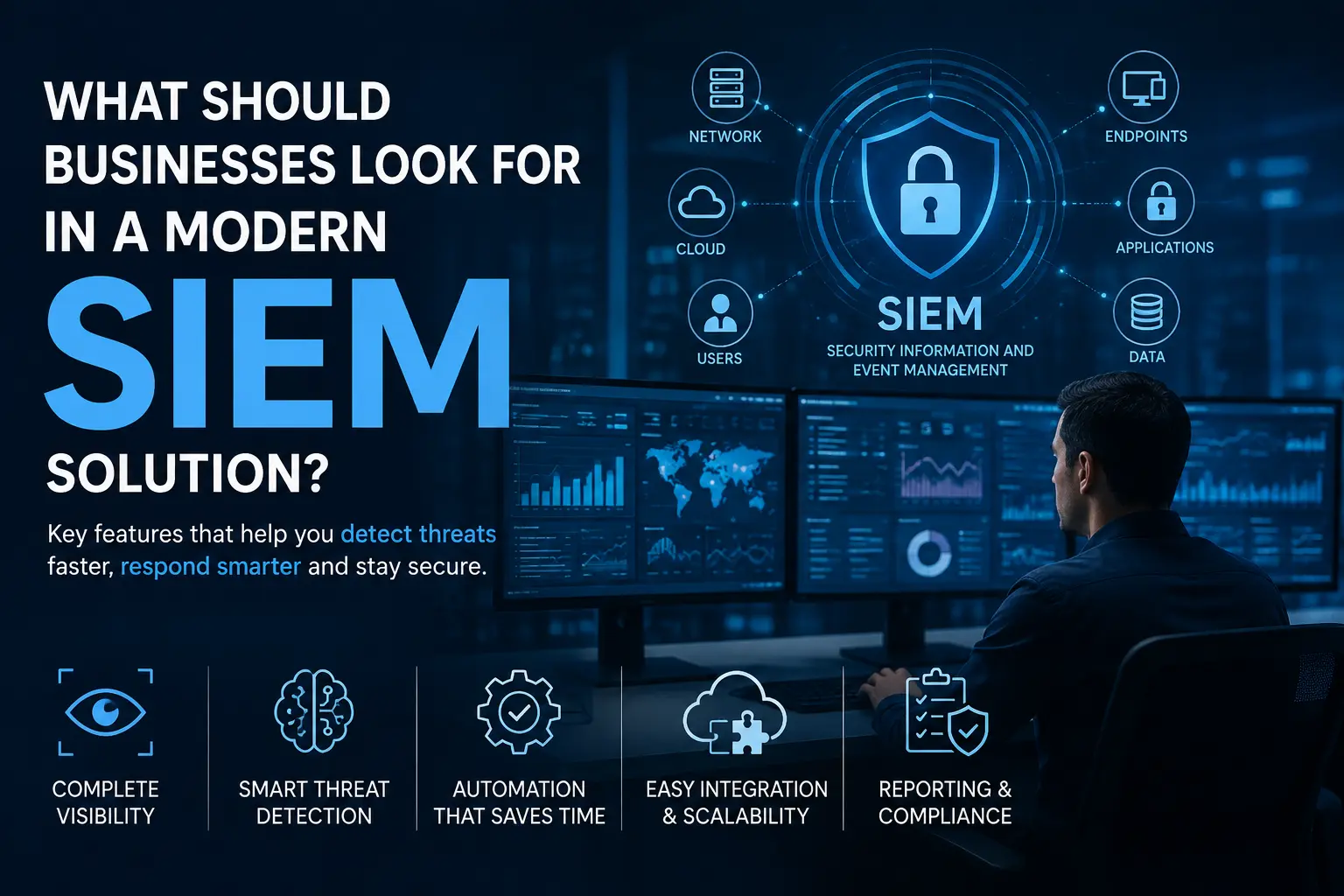
Visibility Across the Entire Business
One of the biggest advantages of SIEM is the ability to bring security information together in one place.
A modern solution should collect and analyze data from across an organization’s environment, including endpoints, networks, cloud infrastructure, applications, identity systems, and security tools. Without this broad visibility, suspicious activity can easily fall through the cracks.
Centralized monitoring also makes it much easier for security teams to spot patterns that might not look particularly concerning when viewed individually.
Smart Threat Detection
More alerts do not necessarily mean better security.
Traditional security systems can overwhelm teams with notifications, many of which turn out to be harmless. Modern SIEM solutions should help separate genuinely suspicious behavior from everyday activity.
Look for capabilities such as behavioral analytics, threat intelligence integration, and automated correlation. These technologies can connect related events and highlight activity that deserves immediate attention. Understanding how machine learning works can also help businesses understand why data-driven detection is becoming increasingly useful in modern security environments.
Most Important SIEM Capabilities
Percentage of respondents identifying each capability as important in a SIEM solution.
Source: 2022 SIEM Security Report. Figures represent the percentage of respondents identifying each capability as important. Data is presented for historical context and should not be interpreted as a current 2026 market survey.
The goal should be to give security teams useful information rather than another enormous queue of alerts to investigate. Businesses evaluating automated detection can also benefit from understanding how AI algorithms process information and identify patterns.
Automation That Saves Time
Cyberattacks can develop quickly, which means businesses cannot always afford to rely entirely on manual investigation.
A strong SIEM solution should automate repetitive parts of threat detection and response. For example, it may identify suspicious login attempts, prioritize an incident, provide useful context, or trigger predefined response actions. As automation becomes more sophisticated, technologies such as generative AI are also becoming relevant to how organizations think about intelligent software systems.
For organizations without a large in-house security team, services such as managed SIEM can also provide ongoing monitoring and specialist expertise without requiring the business to build an entire security operations function internally.
Easy Integration and Scalability
Businesses rarely use technology from just one vendor. A SIEM solution therefore needs to work effectively with the wider technology stack.
Before choosing one, businesses should consider how easily it integrates with existing cloud environments, endpoint security tools, firewalls, identity providers, and other systems.
Scalability matters too. The volume of security data a company generates can increase dramatically as it hires employees, introduces new applications, expands into additional locations, or migrates more workloads to the cloud.
Clear Reporting and Compliance Support
Security data is useful for more than detecting attacks.
Modern SIEM solutions can also help businesses demonstrate compliance, investigate incidents, and understand their overall security posture. Clear dashboards and customizable reports make it easier to communicate risks to IT teams, executives, auditors, and other stakeholders.
Choosing Security That Can Keep Up
The best SIEM solution is not necessarily the one with the longest feature list. It is the one that gives a business clearer visibility, identifies meaningful threats quickly, reduces unnecessary manual work, and adapts as the organization changes.
Cybersecurity environments will continue to become more complex. Choosing a SIEM solution designed for that complexity can give businesses a much better chance of identifying threats before they become serious incidents.
About This Guide
This guide was prepared by the RCN Guide technology editorial team to help businesses understand the key considerations when evaluating a modern Security Information and Event Management (SIEM) solution. The information focuses on practical areas including security visibility, threat detection, automation, integration, scalability, reporting, and compliance.
RCNGuide publishes technology and cybersecurity-focused guides designed to make complex technology topics easier to understand. Our editorial approach prioritises clear explanations, practical context, and information that helps readers make more informed technology decisions.
Editorial & Fact-Checking
RCN Guide reviews technology content for clarity, relevance, and factual accuracy before publication. Technical topics are assessed against established concepts and industry practices, with updates made when significant changes affect the subject.
Reviewed by: RCN Guide Technology Editorial Team
Topic: Cybersecurity & SIEM
Last Updated: August 2026
Use the key points in this guide to understand the topic and make more informed decisions.

This guide is researched and edited using relevant documentation, reliable sources and publicly available information.
Was this guide helpful?
Your feedback helps us improve future guides.