In this article
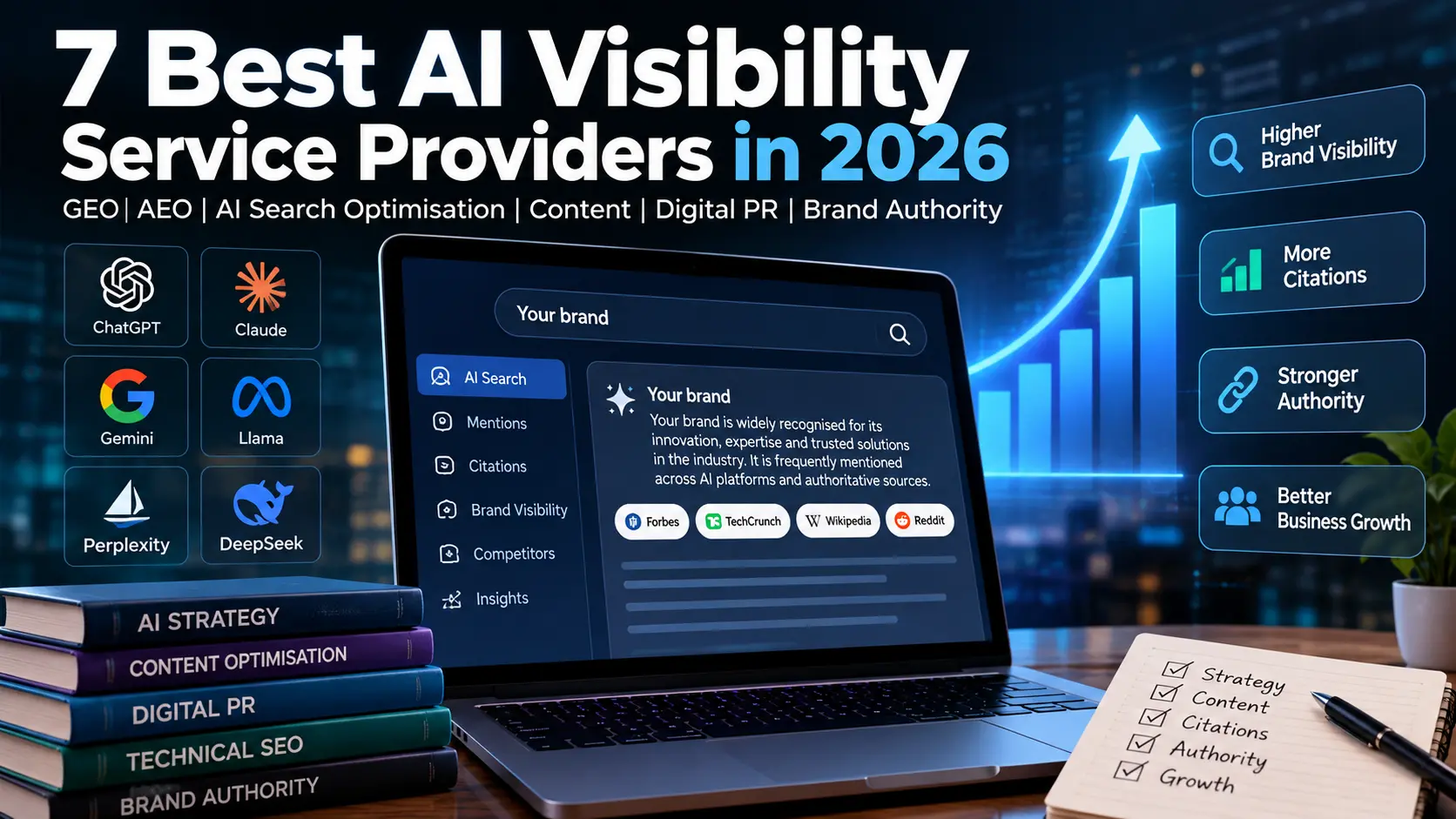
AI search creates a competitive environment that is difficult to evaluate from conventional search reports.
A marketing team might know exactly where its website ranks for an important Google query yet have little idea what happens when a potential customer asks ChatGPT to compare companies in the same category. The brand may appear immediately, appear only for certain questions, be described inaccurately, or disappear while several competitors receive mentions and citations.
Solving that problem requires different capabilities. Some companies need better measurement. Others have technical barriers that make important information difficult to retrieve. A brand may have strong content but limited independent authority, or substantial media coverage without the structured information needed to connect those signals clearly.
AI visibility service providers work across these problems in different ways. Some combine proprietary technology with managed optimization. Others come from technical SEO, content marketing, digital PR, entity optimization, or enterprise search.
For this guide, inclusion required an active service that goes further than reporting where a brand appears. Each provider must currently offer strategy or execution intended to improve visibility across generative search, answer engines, or large language model based discovery.
Seven AI Visibility Service Providers to Know
| Provider | Core Service Model | Areas of Emphasis |
| Verbatim Digital | AI visibility platform plus managed execution | Measurement, GEO, citations, authority, entities, technical optimization |
| iPullRank | AI Search and Relevance Engineering | Retrieval, content, technical SEO, measurement, enterprise strategy |
| Intero Digital | Integrated GEO and digital marketing | AI visibility auditing, entities, content, digital PR, SEO |
| Single Grain | GEO and growth marketing | Content, technical GEO, authority, conversion, performance tracking |
| Amsive | AEO integrated with search marketing | Technical discoverability, content, citations, measurement |
| Relevance | GEO, SEO, content, and digital PR | Authority, entity clarity, earned citations, content |
| First Page Sage | GEO and thought leadership | Content authority, brand positioning, reputation signals, AI search presence |
The differences between these providers matter. A company looking for enterprise retrieval engineering has a different requirement from a business that needs content, PR, and brand authority. The following reviews focus on those differences rather than applying an identical checklist to every provider.
1. Verbatim Digital
Verbatim Digital combines AI visibility technology with managed optimization services. Its platform is used to identify where brands appear across AI search, how their presence compares with competitors, and which sources are contributing to generated answers. Its service team can then work on the issues uncovered through that analysis.
The execution side covers several areas that frequently overlap in AI visibility projects. These include content optimization, citation and mention building, technical GEO, structured data, entity clarity, authority development, and broader AI search strategy. The company also works across external authority sources such as communities, Reddit, Wikipedia, and other third party environments when they are relevant to the brand’s wider information footprint.
This combination places Verbatim Digital among the best ai visibility service providers for brands that want measurement and implementation connected within the same engagement. Instead of ending the process with a visibility score or list of missing prompts, the service can move from identifying a gap to addressing the content, technical, citation, or authority issue associated with it.
The model can be especially useful when the cause of weak visibility is unclear. A company might discover that competitors appear more frequently, but that observation alone does not explain whether the gap comes from weak content, limited external corroboration, poor entity signals, technical accessibility, or a combination of factors. Verbatim’s broader service scope allows the investigation to continue into those areas.
Companies can also begin with a free GEO audit before considering a larger engagement. Ongoing measurement is available through the company’s AI Visibility Platform.
There are limits to what any agency or service provider can control. Verbatim can strengthen the information, authority, technical foundations, content, and external signals surrounding a brand, but it cannot determine whether an independent AI platform will mention or recommend that company for a particular prompt.
Service model: A practical fit for organizations that prefer one provider to handle AI visibility measurement and the resulting GEO execution rather than separating software, analysis, and implementation across different vendors.
2. iPullRank
iPullRank approaches AI search from a considerably more technical direction. The agency has organized its search services around what it calls Relevance Engineering, with Generative Engine Optimization forming part of a wider system involving retrieval, content, technical SEO, measurement, and audience understanding.
Its current AI Search work examines areas such as query fan outs, citations, AI referral traffic, content relevance, information retrieval, and the technical foundations that affect visibility across modern search surfaces. These concepts go deeper than simply checking whether a company receives a mention in ChatGPT.
Large organizations can benefit from that level of technical analysis because their search environments are usually harder to change. Enterprise websites often have years of accumulated content, complicated architecture, multiple templates, international sections, JavaScript dependencies, governance requirements, and large internal teams. Improving AI visibility in that environment can require substantial technical and organizational work.
iPullRank also treats AI search as a cross functional problem. Its current guidance connects visibility with content strategy, authority building, digital PR, technical SEO, measurement, and coordination across teams. The agency’s AI Search Strategic Roadmap is designed to turn initial analysis into a prioritized implementation plan.
Content remains part of the offering, but the service is not framed primarily as a content production program. The agency examines how information is structured and retrieved and how well a company covers the related questions that can emerge from a user’s original query.
Service model: Strongly oriented toward enterprise organizations that need technical AI search strategy, sophisticated content architecture, retrieval analysis, measurement, and coordination across complex websites or marketing teams.
3. Intero Digital
Intero Digital has built its GEO service around a proprietary framework called Intero GRO, or Generative Response Optimization. The framework brings together research, SEO, content, digital PR, and broader brand signals to improve how companies are represented across AI search.
An engagement begins with an AI visibility audit and research phase. Intero evaluates how the brand currently appears, where competitors have stronger visibility, and what information or authority gaps may be affecting its presence.
The implementation can then move across several disciplines. Intero’s current GEO service covers entity signals, content, structured information, digital PR, citations, knowledge graph development, and conventional SEO foundations. It also considers how a brand is represented across the wider web rather than limiting the program to pages on the company’s own domain.
For companies with established SEO, content, and PR teams, Intero’s model allows GEO to sit within work that is already underway. Technical SEO, content architecture, digital PR, and brand authority can continue to support conventional discovery while being adapted to the additional requirements of generative search.
Intero publishes GEO case studies on its service page, with reported results covering generative search visibility, AI Overviews presence, and engagement from AI referred traffic. These are company reported case study results and should be viewed as examples from previous engagements rather than expected outcomes for a new client.
Service model: Relevant to established brands that want GEO incorporated into a larger digital marketing program spanning SEO, content, entity development, PR, and performance measurement.
4. Single Grain
Single Grain treats GEO as a performance marketing discipline. Its current service connects AI visibility with content, technical optimization, authority development, analytics, user experience, and conversion.
The program begins with the questions people ask across AI and search environments. Single Grain researches prompts and follow-up questions, examines which brands and sources are being cited, and identifies gaps where new information or stronger evidence could improve a client’s presence.
Execution is divided across several areas. The agency develops GEO content and knowledge assets, handles technical GEO and schema, works on digital PR and authority building, supports local and brand presence, and measures performance through custom reporting.
Conversion measurement is another significant part of the service. Single Grain includes user journey analysis, landing page optimization, testing, and analytics for visitors arriving from AI platforms. This creates a distinction between gaining visibility and understanding whether that visibility produces commercially useful behavior.
Its authority work extends outside the client’s website through PR, thought leadership, expert sourcing, competitor citation analysis, and community distribution. On the technical side, the agency works with crawlability, schema, entities, internal linking, site performance, and information structure.
Single Grain therefore covers a relatively wide portion of the journey from initial AI discovery to website conversion.
Service model: Appropriate for growth focused businesses that want GEO connected with acquisition, analytics, conversion optimization, content, and digital PR rather than measured as a standalone visibility metric.
5. Amsive
Amsive provides Answer Engine Optimization as part of its wider search practice. Its approach is useful for brands that already have mature SEO operations and want to extend those foundations into AI discovery without building a completely separate search program.
The service begins at the technical level. Amsive works on clean and accessible HTML, crawlability, structured information, and other elements that affect whether content can be discovered and interpreted by AI systems.
Its content strategy is organized around related questions and topic clusters rather than isolated keyword targets. The goal is to create clearer contextual coverage that can support visibility across AI Overviews, ChatGPT, Gemini, Perplexity, and other generative search experiences.
Amsive also pays attention to citation consistency. Product and service information can appear across numerous websites and platforms, and inconsistent information creates an accuracy problem when AI systems synthesize material from multiple sources.
Measurement includes LLM share of voice, citation and sentiment monitoring, query variations, clicks, conversions, and revenue impact where attribution is available. Amsive also works with technology partners to provide AI visibility and citation data.
The service sits naturally beside the company’s existing technical SEO, ecommerce SEO, content, media, and analytics capabilities.
Service model: Well suited to organizations with established search programs that want AEO incorporated into technical SEO, content strategy, analytics, and broader performance marketing.
6. Relevance
Relevance builds its AI visibility work around GEO, digital PR, content, SEO, and brand authority.
Its current positioning draws a useful distinction between the objective and the method: AI visibility is the desired outcome, while GEO is the process used to improve it. The agency’s work addresses crawler access, structured data, entity clarity, content, and earned citations.
The earned authority component is central to its model. AI systems can encounter information about a company across independent publishers and other external sources, so Relevance combines onsite optimization with digital PR and content distribution.
This approach can make sense for brands that already have useful expertise but have difficulty establishing that authority outside their own websites. Original research, expert content, media coverage, and relevant third party citations can create a broader body of evidence around what the company is known for.
Relevance also integrates conventional SEO rather than treating AI search as an isolated replacement for it. That gives companies a way to adapt existing organic marketing programs as customer discovery spreads across traditional and generative search environments.
Relevance positions authority development as a sustained process and emphasizes setting realistic expectations around timelines. That approach is appropriate for work involving independent publishers, search engines, and AI platforms whose outputs and refresh cycles remain outside the provider’s control.
Service model: Most relevant when the visibility problem involves weak external authority, limited earned media, content positioning, or the need to connect digital PR with GEO and SEO.
7. First Page Sage
First Page Sage approaches GEO through a combination of thought leadership content, search authority, list and database visibility, reputation signals, and broader brand positioning.
Its current GEO service includes content creation alongside work involving list placement, database inclusion, review management, website authority, reputation signals, social sentiment, and ongoing monitoring. This gives the program a wider footprint than an onsite content strategy alone.
The model fits naturally with longer B2B research cycles, where buyers may encounter a company’s expertise repeatedly before making contact. A software company, professional services firm, manufacturer, or healthcare business may need to establish credibility across numerous commercial and informational questions throughout that process.
First Page Sage also connects GEO with lead generation objectives rather than treating AI visibility as the final business outcome. Its longstanding focus on thought leadership remains part of that approach, with expert content used alongside wider authority and reputation signals.
The company publishes extensive research and rankings about GEO providers and states that it has worked with brands including Salesforce, Logitech, Verizon, and Dignity Health. As with provider published rankings and case studies generally, its own comparative research should be understood as company produced material rather than independent validation of its position in the market.
That distinction does not undermine the legitimacy of its GEO service. It separates evidence that the service exists from the provider’s own assessment of how it compares with competitors.
Service model: Relevant to B2B organizations that want GEO tied closely to thought leadership, search authority, reputation, brand positioning, and lead generation.
AI Visibility Services Usually Cover Four Areas
Terminology varies considerably between providers. One company may call its work GEO, another AEO, another AI Search, and another Relevance Engineering. Those labels are less useful than understanding what work is actually being performed.
The providers reviewed here generally work across four broad areas, although the emphasis varies by company.
Visibility Intelligence
The provider establishes where the brand appears, which competitors receive greater exposure, what prompts matter, which sources are cited, and how the company is described.
This creates a baseline for deciding what should change. Without that information, teams risk prioritizing work without knowing which visibility problems they are trying to solve.
Technical and Entity Foundations
The next area concerns whether machines can access, interpret, and connect the company’s information.
Technical SEO, crawlability, structured data, internal architecture, entity relationships, knowledge graph signals, product information, and consistent brand facts can all become relevant here.
Content and Topical Authority
AI search optimization still requires useful information. Providers may create or improve category pages, comparisons, research, educational resources, product content, expert commentary, FAQs, and other assets depending on the questions customers ask.
Producing a large volume of generic content is unlikely to solve the underlying problem. The material needs to address genuine information gaps and provide enough evidence and context to be useful to people as well as retrieval systems.
External Authority
A company does not control everything written about it online.
Digital PR, publisher coverage, expert contributions, relevant citations, reviews, community discussions, industry resources, and other independent sources can contribute to the broader information environment surrounding a brand.
Providers differ significantly in how much of this work they handle themselves. That should be clarified before an engagement begins.
Why Provider Type Matters
Two companies can both sell GEO services while delivering very different programs.
A technically complex enterprise may need retrieval analysis, large scale content architecture, experimentation, and advanced measurement. iPullRank’s service model is closely aligned with that type of requirement.
A brand with strong internal SEO capabilities but limited external authority may need PR, citations, or publisher coverage instead. Relevance approaches a substantial part of the problem from that direction.
A company that lacks internal AI visibility technology may prefer a model such as Verbatim Digital’s, where measurement and execution remain with one provider. A business already operating a large digital marketing account might instead want GEO integrated with the wider services available from Intero Digital or Amsive.
Single Grain brings conversion and performance measurement into the picture, while First Page Sage connects GEO with thought leadership, reputation, authority, and lead generation.
Understanding these operating models helps prevent a common procurement mistake: comparing providers according to the same generic GEO checklist even though their services are designed around different problems.
Establish an AI Visibility Baseline Before Work Begins
Before approving a six month or twelve month program, a brand should understand its starting position.
The baseline does not need to predict every possible AI response. It needs enough structure to make future changes interpretable.
At minimum, the initial assessment should establish:
- the AI platforms being monitored;
- a defined group of commercially relevant prompts;
- major competitors within those prompts;
- current brand mention and citation frequency;
- important third party sources appearing in responses;
- recurring inaccuracies or weak positioning;
- technical barriers affecting retrieval;
- content gaps around important topics;
- areas where competitors have stronger independent authority; and
- available AI referral and conversion data.
The same prompt set does not need to remain frozen forever. Customer behavior, platforms, products, and competitors change. The baseline creates a reference point for determining whether subsequent work is producing meaningful movement.
Visibility Alone Is Not a Business Outcome
One of the risks in AI search measurement is optimizing the metric instead of the business.
A provider may increase the number of tracked prompts containing a company’s name. Whether that matters depends heavily on which prompts changed.
Appearing for broad informational questions can support awareness. Visibility during product comparisons, vendor research, category discovery, or purchase related questions can carry a different commercial value.
Referral traffic adds another layer. AI platforms can send visitors to websites, but referral volume becomes more useful when viewed alongside what those visitors actually do. Leads, sales, registrations, demo requests, assisted conversions, and other downstream behavior can provide a clearer picture of commercial impact.
The right metrics therefore depend on where AI search enters the customer’s decision process. A B2B company with a long sales cycle may value qualified inquiries and assisted conversions, while an ecommerce business may have a clearer path from AI referral to product discovery and purchase.
What to Request in a Service Proposal
A proposal should explain the work clearly enough that a marketing leader can distinguish research from implementation.
Look for a defined measurement methodology, the platforms being monitored, the proposed prompt set, expected technical work, content responsibilities, external authority work, reporting cadence, and the division of responsibilities between the provider and internal teams.
The proposal should also identify dependencies. A service provider cannot repair product information it cannot access, publish content without approval, implement technical changes without development resources, or build credible expert material without subject matter input.
Clear responsibility matters because GEO can involve SEO teams, developers, content marketers, PR professionals, brand teams, analysts, product specialists, and executives.
A provider that identifies these requirements before the project begins is easier to evaluate than one promising broad AI visibility growth without explaining what work is expected to create it.
Be Careful With AI Search Guarantees
No service provider controls ChatGPT, Gemini, Perplexity, Claude, Google AI Overviews, or other independent AI systems.
Guarantees of a specific recommendation or permanent placement should therefore be treated carefully.
Providers can influence the information environment surrounding a brand. They can improve technical accessibility, create stronger information resources, clarify entities, earn legitimate external coverage, correct inconsistencies, develop citations, and monitor how AI systems respond.
They cannot dictate the final output of an independent model.
The same caution applies when a provider presents a single tactic as a complete AI visibility strategy. Structured data can improve machine readability, but it does not create authority on its own. FAQ content can organize useful information without automatically producing citations. Digital PR can strengthen external evidence, but media coverage cannot repair an inaccessible or confusing website.
Effective AI visibility work usually involves several of these areas working together.
How to Narrow the Provider List
A useful selection process starts by defining the problem before choosing the company.
If the organization does not know why its AI visibility is weak, a provider with strong measurement and diagnostic capabilities deserves closer examination. If the problem is already known to be technical, retrieval and engineering expertise becomes more important. Brands lacking independent authority should examine PR and citation capabilities closely, while companies with mature search teams may need specialist GEO guidance rather than a completely outsourced marketing program.
Internal resources matter as well. A sophisticated enterprise SEO department can implement recommendations that a smaller marketing team cannot. Smaller teams may benefit from a provider capable of carrying strategy through to execution.
Finally, ask how success will be evaluated. A provider should be able to explain what it intends to measure without pretending that every AI interaction can be attributed perfectly.
Building a Sustainable AI Search Strategy
A sustainable AI visibility strategy starts with understanding how artificial intelligence interprets information, retrieves relevant sources, and generates responses. Businesses that understand the fundamentals of artificial intelligence, the different types of AI, and the role of machine learning can make more informed decisions about where to invest their optimization efforts. These foundations also help marketing teams distinguish between conventional search optimization, answer engine optimization, and the broader requirements of generative search.
Content strategy deserves equal attention. AI systems rely on information that addresses user questions clearly, establishes relevant context, and connects related concepts. Understanding generative AI and the role of AI algorithms can help businesses develop content that is useful beyond individual keyword targets. This means creating comprehensive resources, maintaining consistent brand information, demonstrating subject matter expertise, and supporting important claims with credible sources. The objective is not simply to produce more content, but to make the brand’s expertise easier for both people and AI systems to understand.
AI visibility should also connect with wider business objectives. As discussed in our guide to how artificial intelligence is changing the future of digital business, the value of AI adoption depends on how effectively organizations translate technological capabilities into practical outcomes. For marketing teams, this means connecting visibility initiatives with brand credibility, customer trust, and measurable business performance. A well-defined strategy should therefore combine technical improvements, useful content, independent authority, and consistent measurement rather than relying on a single optimization tactic.
Competing Where Customers Are Searching
AI search adds another layer to brand competition. Companies now need to understand how they are represented when customers ask questions, request comparisons, investigate categories, and look for recommendations without necessarily beginning on a conventional search results page.
The providers reviewed here approach that challenge from different directions. Verbatim Digital connects visibility technology with managed execution. iPullRank brings a technical AI Search and retrieval framework. Intero Digital integrates GEO with a larger digital marketing operation. Single Grain connects visibility with growth and conversion. Amsive extends mature search programs into AEO. Relevance emphasizes authority and earned visibility, while First Page Sage builds around thought leadership, reputation, and lead generation.
Those differences give companies meaningful choices. The right provider depends on why the brand is struggling to appear, be understood, or earn attention in AI search and whether the organization needs measurement, technical work, content, external authority, or a combination of them.
Use the key points in this guide to understand the topic and make more informed decisions.

This guide is researched and edited using relevant documentation, reliable sources and publicly available information.
Was this guide helpful?
Your feedback helps us improve future guides.