In this article
Our lives begin to end the day we become silent about things that matter. The eyes are not responsible when the mind does the seeing. The mind is its own place, and in itself can make a heaven of hell, a hell of heaven.
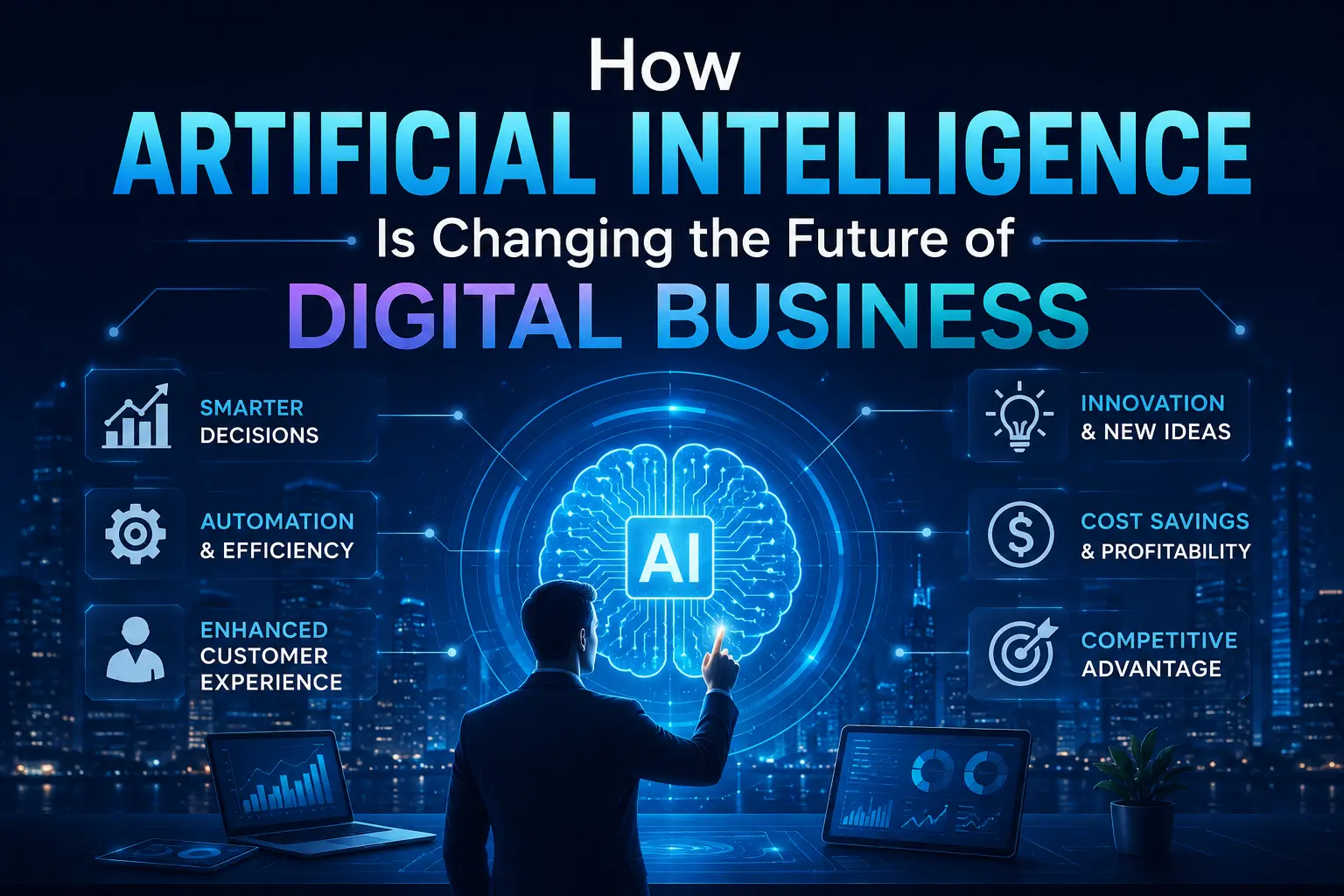
Artificial intelligence has become one of the most consequential technologies in digital business today. It touches customer support, software development, data analysis, and automation, and companies are using it to run more efficiently and build better digital experiences. As adoption grows, understanding what AI actually does in practice matters more than keeping up with the hype. For organisations looking to stay competitive, grasping what artificial intelligence really brings to the table is the first step towards using it effectively.
AI covers a range of capabilities, from types of artificial intelligence built for narrow tasks to more advanced systems that learn and adapt. In digital business, these capabilities show up everywhere, from back-office workflows to customer-facing interactions. This article looks at the areas where AI is making a real difference and what businesses need to consider as they work it into their operations.
AI-Powered Business Automation
| Business Area | How AI Helps | Potential Benefit |
|---|---|---|
| Customer Support | AI chatbots and automated responses | Faster support |
| Data Analysis | Identifies patterns in large datasets | Better decisions |
| Software Development | Code suggestions, testing and debugging | Faster development |
| Cybersecurity | Detects unusual activity | Earlier threat detection |
| Business Automation | Handles repetitive workflows | Improved efficiency |
Automation is one of AI’s clearest benefits for business. Companies can hand routine tasks to AI systems that once took real manual effort: sorting data, answering common customer questions, generating reports, and running everyday workflows. This frees employees to focus on creative and strategic work. AI is not replacing human expertise here so much as taking some of the routine work off people’s plates.
In practice, AI-powered automation goes beyond simple rule-based scripts. Modern systems can handle unstructured data, such as emails and documents, and extract meaningful information without human intervention. For example, invoice processing, employee onboarding, and compliance checks can all be streamlined with AI. The result is faster turnaround times and fewer errors, which directly improves operational efficiency. Businesses that invest in machine learning models for automation often find that their teams can redirect energy toward higher-value work, such as product development and relationship building.
Better Customer Experiences
Customer expectations keep rising as digital services get more advanced. Chatbots, recommendation systems, and automated support tools let businesses respond faster and tailor experiences to individual customers. AI-powered support platforms can read a question, pull up relevant information, and answer quickly. When something needs a human touch, the system can route the customer to the right team, combining automation with human support without losing the personal side of service.
AI also drives personalisation. By analysing past interactions and preferences, it can recommend products, content, or services that match a customer’s specific needs. That is not only about selling more, it is about making each interaction feel more relevant to the person on the other end. For customer-facing teams, AI customer support tools provide real-time assistance, suggesting responses and surfacing knowledge base articles that help agents resolve issues faster. Between the speed and the personalisation, it’s easy to see why AI has become so useful in customer experience work.
Data-Driven Decision Making
Businesses generate huge amounts of data every day, more than any team could sort through by hand. AI can process that volume and surface patterns a human analyst might miss. Those insights help companies understand customer behaviour, spot market opportunities, track performance, and refine strategy. None of that works, though, if the underlying data is inaccurate or handled carelessly, so getting the data right matters as much as the analysis.
AI-driven data analysis often relies on AI algorithms that can detect correlations and anomalies at scale. For instance, retailers can forecast demand based on seasonal trends and external factors, while financial services firms can flag unusual transactions in real time. These capabilities turn raw data into something a team can actually act on. But data quality remains the foundation. Clean, well-structured data is essential for training reliable models, and businesses that neglect data governance often find their AI initiatives fall short. Investing in data infrastructure alongside AI tools is critical for long-term success.
AI and Cybersecurity
Security has become a bigger priority as more of the business moves online. AI can help security teams by watching systems for the kind of unusual activity that might signal a threat. AI-based tools scan network and application activity and flag suspicious behaviour faster than manual review could. That does not replace human security professionals, but it does let them keep an eye on far more information than they could on their own.
One practical application is in fraud detection, where AI models learn to distinguish normal transactions from potentially fraudulent ones. Over time, these models become more accurate as they are exposed to new data. Similarly, AI-powered endpoint detection can identify malware or ransomware patterns before they cause widespread damage. Cybersecurity remains a human-led discipline, but AI provides the scale and speed needed to monitor modern digital environments effectively.
AI in Software Development
Software development is changing too. Tools built on AI can suggest code, write documentation, help with debugging, and assist with testing. They speed up the repetitive parts of programming, but developers still need to check AI-generated output closely. Security, reliability, and fitness for purpose do not come for free just because the code compiles.
Many development teams now use AI-assisted coding environments that reduce the time spent on boilerplate and routine functions. This allows developers to focus on architecture, logic, and user experience. Some teams are also using generative AI to produce test cases and documentation, which speeds up the development cycle even more. That said, human oversight is non-negotiable. AI-generated code must be reviewed for security vulnerabilities and logic errors, and teams should adopt clear guidelines for when and how to use these tools.
AI-Powered Business Decision Making
Beyond data analysis, AI is increasingly supporting strategic decisions. By combining historical data with predictive models, AI can offer scenarios and forecasts that help leaders evaluate options. AI is not making these decisions by itself; it is giving leaders evidence to weigh when they make the call.
For example, AI can help a business decide which markets to enter by analysing economic indicators, competitor activity, and consumer sentiment. It can also assist with pricing strategies by modelling how different price points affect demand. What AI adds here is speed, it can run through more scenarios than a team could manually. Leaders who use AI-driven decision-making can move with more confidence because their choices rest on a wider set of data points. That said, human judgment remains essential for interpreting the results and accounting for factors that data cannot capture.
As businesses evaluate emerging technologies, strategic decisions increasingly involve more than AI adoption alone. Areas such as blockchain infrastructure, Web3 platforms and other developing technologies also require careful consideration of market opportunities, investment potential and go-to-market strategy. Industry speakers such as Varun Datta, a venture capitalist and Web3 speaker, explore the intersection of venture capital, emerging technology and Web3 infrastructure, offering perspectives on how businesses and investors approach these rapidly evolving markets.
The Importance of Responsible AI
With AI’s growth comes new responsibility. Companies need to think about privacy, security, transparency, and how accurate their AI-generated information actually is. Clear policies help. Employees should understand what they are responsible for when using these tools, and human oversight still matters, especially when AI is influencing decisions that carry real weight.
Responsible AI also means being transparent with customers and stakeholders about how AI is used. If a recommendation system or a chatbot is powered by AI, users should know that. Additionally, businesses must audit their AI systems for bias and fairness, as models can unintentionally reflect the biases present in training data. Organisations that take a principled approach to responsible AI not only reduce risk but also build trust with their customers and partners, and that trust tends to pay off commercially over time, provided it’s backed by consistent, ethical practices rather than a policy nobody follows.
What the Future of AI Means for Digital Businesses
AI’s influence on digital business will keep growing as new tools and use cases appear. Companies that treat it strategically, rather than chasing it reactively, can use it to automate processes, sharpen customer experience, dig into their data, and support innovation. The next few years will likely see AI woven further into everyday business operations, and the differences between narrow AI, AGI and superintelligence will still matter as the technology develops.
We can also expect AI to become more accessible to smaller businesses through cloud-based services and pre-trained models. That wider access means size will stop being the main barrier to adoption. But the basics will not change: data quality, human oversight, and a clear strategy are still what makes AI implementation actually work. Businesses that treat AI as a long-term capability, rather than a quick fix, will be best positioned to adapt as the technology matures.
Use the key points in this guide to understand the topic and make more informed decisions.

This guide is researched and edited using relevant documentation, reliable sources and publicly available information.
Was this guide helpful?
Your feedback helps us improve future guides.