In this article
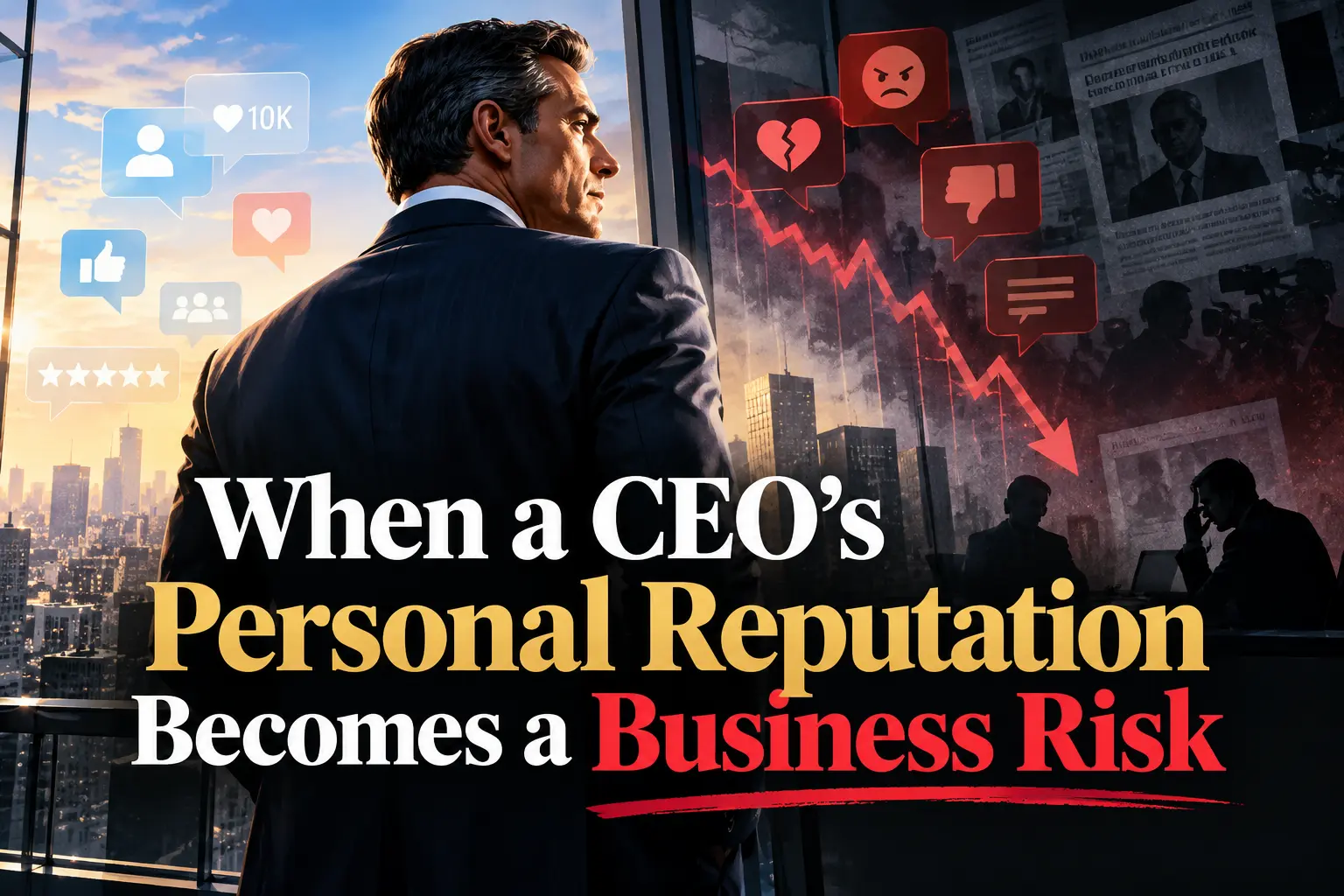
A CEO is more than the person making decisions at the top of a company. They’re often the public face of the business, representing its values, ambitions, and credibility to investors, employees, and customers.
That visibility comes with considerable responsibility. A controversial statement, damaging news story, or questionable decision can quickly become a problem for the entire organization.
And with information so easily accessible online, reputational concerns don’t necessarily disappear when the headlines move on.
For businesses, the challenge is understanding where personal reputation ends, and corporate responsibility begins. Increasingly, the two are difficult to separate.
Why Executive Reputation Management Matters
A CEO’s reputation can influence how people perceive the organization they lead. Investors may question their judgment, potential partners might reconsider commercial relationships, and employees can lose confidence in senior leadership.
This is why executive reputation management is becoming an important consideration for businesses that want to protect their leadership’s professional credibility and understand how executives are represented online.
It’s not simply about removing negative information or generating positive publicity. Effective reputation management involves monitoring public perceptions, maintaining accurate information, and responding appropriately when concerns arise.
For example, a CEO might have outdated professional profiles, misleading search results, or historical news coverage that no longer reflects their current circumstances.
These issues can shape how someone is perceived before they’ve had a chance to explain their position.
Businesses that understand these risks are better prepared to address them before they begin affecting important commercial relationships.
Investors Pay Attention to the People Behind the Business
Investors don’t evaluate companies solely through financial statements. Leadership quality, corporate governance, and management credibility also influence investment decisions.
A CEO whose behavior raises questions about integrity or judgment can create uncertainty, even when the company’s financial performance remains relatively strong.
Investors may begin to question whether the individual can manage future challenges or maintain appropriate oversight.
This is especially relevant for publicly traded companies, where leadership controversies can attract widespread media attention and prompt shareholder questions.
However, private businesses aren’t immune.
A founder seeking investment, negotiating an acquisition, or preparing to expand internationally may face additional scrutiny of their professional background.
Maintaining a credible reputation therefore becomes part of protecting the company’s commercial opportunities.
Personal Controversies Can Become Corporate Problems
One of the most difficult aspects of executive reputation is that controversy doesn’t always originate from business decisions.
A CEO’s personal conduct, public comments or activities outside work can attract attention, particularly when those actions appear inconsistent with the company’s stated values.
Social media has complicated this further.
A comment intended for a limited audience can be shared widely, taken out of context, or interpreted differently by customers, employees, and investors.
Sometimes criticism is justified. In other situations, information may be incomplete or misleading.
Either way, the organization may find itself responding to an issue that initially had little connection to its operations.
The challenge is determining whether the controversy represents a genuine governance concern, a communications problem, or a misunderstanding that requires clarification.
Reacting too quickly can make matters worse, while staying silent may let speculation grow.
Search Results Have Become Part of Business Due Diligence
Before entering a major commercial relationship, people often research the individuals involved.
A potential investor might search for a founder’s name. A prospective employee may investigate the CEO before accepting a senior position. A business partner could review previous media coverage before signing an agreement.
What appears in those search results can shape their initial impressions.
The problem is that search engines don’t necessarily present information in order of accuracy, relevance, or fairness.
An old article may rank prominently despite being outdated. A professional achievement might receive less visibility than a controversial story. Individuals with similar names can even become confused with one another.
This makes maintaining an accurate digital presence increasingly important.
Executives should periodically review their professional biographies, company profiles, interviews, and publicly available information.
Where inaccuracies exist, they should seek appropriate corrections through legitimate channels.
The objective should be to ensure publicly available information provides a fair, accurate representation, not to conceal legitimate criticism.
Employees Also Judge the People Leading Them
Reputational damage isn’t limited to external stakeholders.
Employees want to feel confident that the people running their organization demonstrate sound judgment and behave responsibly.
When a CEO becomes involved in a public controversy, staff may begin questioning the company’s culture, values, or future direction.
This can create challenges for internal communications, recruitment and employee retention.
For example, if an executive publicly expresses views that conflict with the organization’s commitments, employees may want reassurance about whether those commitments remain meaningful.
Leadership credibility matters most during periods of uncertainty, such as restructuring, financial difficulties, or organizational change.
Employees are more likely to trust difficult decisions when they believe the people making them are transparent and accountable.
Companies therefore need to consider how executive reputational issues affect their workforce, rather than focusing exclusively on media coverage or investor reactions.
The Financial Consequences Aren’t Always Immediate
Reputational damage can be difficult to measure because its consequences aren’t always visible straight away.
A controversial incident might not immediately affect revenue, but it could influence future negotiations, recruitment decisions, or commercial partnerships.
Potential customers may become hesitant to work with the company. Experienced professionals might reconsider employment opportunities, while existing clients could seek reassurance about leadership stability.
These indirect effects can accumulate over time.
The company may also incur direct financial costs for legal advice, crisis communications, internal investigations, and additional governance measures.
In more serious situations, leadership changes or regulatory scrutiny can create further disruption.
That is why businesses shouldn’t evaluate reputational risk solely by immediate sales figures or short-term publicity.
The longer-term implications for trust and commercial relationships can be just as important.
Reputation Protection Starts Before a Crisis
Waiting until a CEO becomes the subject of negative publicity is rarely the best approach.
Businesses can reduce potential reputational risks by treating leadership credibility as part of their wider governance and risk management processes.
This starts with clear expectations for executive conduct, public communications, and professional responsibilities.
Senior leaders should understand how their public statements and online activities may be interpreted in connection with the organization.
Companies should also establish procedures for responding to reputational concerns.
Who assesses the situation? Who communicates with employees? When should the board become involved? What happens if allegations require an independent investigation?
Answering these questions before a problem occurs can make the response more organized and proportionate.
Regularly reviewing publicly available information about executives is another useful step. Accurate biographies, consistent professional profiles, and transparent communication can help stakeholders better understand a leader’s experience and responsibilities.
However, reputation protection shouldn’t become an exercise in controlling every conversation.
Legitimate criticism, public accountability, and independent reporting all have an important place in business.
The aim is to build credibility through responsible conduct and accurate communication, not manufacture an unrealistic public image.
What Should Happen When a CEO’s Reputation Is Challenged?
Not every reputational issue requires the same response.
A misleading online claim may need a factual correction, while allegations of serious misconduct could require an independent investigation and board oversight.
The first priority should be establishing what actually happened.
Businesses need to distinguish between verified information, speculation, and unsubstantiated allegations.
Once the facts are understood, communications should be clear, proportionate and consistent.
If mistakes have been made, acknowledging them and explaining corrective action may be more constructive than dismissing criticism.
Equally, organizations should avoid making premature statements that could undermine investigations or create further confusion.
The CEO’s personal interests must not automatically take priority over the company’s.
Where necessary, independent directors, legal advisers or other appropriate professionals should help determine the response.
A well-managed situation shows that the organization takes accountability seriously, regardless of the individual’s seniority.
The Growing Role of Technology in Executive Reputation Management
As businesses become increasingly digital, protecting a CEO’s reputation also requires a better understanding of how information is created, shared, and interpreted online. Artificial intelligence is adding another layer to this challenge, making it easier to analyse public conversations, identify emerging concerns, and understand how stakeholders perceive a company’s leadership.
Understanding what artificial intelligence is can help business leaders recognise where these technologies fit into modern reputation management. AI-powered systems can assist with monitoring media coverage, identifying changes in online sentiment, and organising large volumes of information that might otherwise be difficult to review manually.
However, these tools should support human judgment rather than replace it. A negative comment, an unexpected increase in online criticism, or a misleading search result does not automatically indicate a serious reputational threat. Businesses need to understand the context before deciding how to respond.
This is where enterprise AI and AI leadership become particularly relevant. When implemented responsibly, AI can help executives and communications teams make better-informed decisions, identify potential risks earlier, and coordinate responses across different parts of an organisation.
Technology can also play a role in strengthening public confidence. Companies that understand how AI builds business credibility and trust can explore ways to improve the accuracy, consistency, and accessibility of information available to customers, employees, investors, and other stakeholders.
At the same time, greater reliance on digital systems creates its own responsibilities. Reputation management increasingly overlaps with data protection, information security, and corporate governance. Businesses should understand the risks associated with automated data collection and review practical approaches to protecting data from AI web scrapers and LLM crawlers, particularly when sensitive business information or executive communications are involved.
Ultimately, technology cannot compensate for poor leadership or a lack of accountability. AI can help identify patterns and support decision-making, but rebuilding trust still depends on the facts, the quality of a company’s response, and the actions its leaders take afterwards.
Executive Reputation Is a Long-Term Business Responsibility
A CEO’s personal reputation should not be treated as a separate concern that matters only when a controversy attracts public attention. It is closely connected to corporate credibility, stakeholder confidence, employee relationships, and the opportunities available to the business.
Organisations that take executive reputation seriously are better positioned to identify emerging concerns, correct inaccurate information, and respond proportionately when difficult situations arise. This requires a combination of responsible leadership, accurate communication, appropriate oversight, and a clear understanding of the company’s wider commercial interests.
There is no guaranteed way to prevent criticism or eliminate reputational risk entirely. What businesses can do is prepare for uncertainty, establish clear accountability, and ensure that their response reflects the standards they expect from their leadership.
In the long run, a strong executive reputation is built through consistent conduct rather than publicity alone. When a CEO demonstrates sound judgment, communicates honestly, and takes responsibility for difficult decisions, that credibility can become an important asset for the entire organisation.
Use the key points in this guide to understand the topic and make more informed decisions.

This guide is researched and edited using relevant documentation, reliable sources and publicly available information.
Was this guide helpful?
Your feedback helps us improve future guides.