In this article
AI adoption has moved well past the experimentation phase. Many businesses now rely on generative AI assistants, automation platforms, and AI-powered SaaS products in their daily work. But having access to these tools doesn’t automatically mean a company is using enterprise AI.
The distinction matters because the stakes change once AI moves from helping one person draft an email to taking part in real operations. So the central question becomes: what changes when AI becomes responsible for actual business operations?
Enterprise AI has to work with real data, existing systems, business rules, security requirements, and the exceptions every organization eventually runs into. This guide explains what that looks like in practice.
What Is Enterprise AI?
Enterprise AI refers to AI capabilities designed to operate within an organization’s processes and constraints. The emphasis is on the environment the AI works in, not just the technology itself.
It helps to be clear about what enterprise AI is not. It isn’t simply a larger language model, ChatGPT connected to company documents, an AI chatbot on a support page, or an automation workflow with an AI step added. Each of these can be a useful component, but none of them alone amounts to enterprise AI.
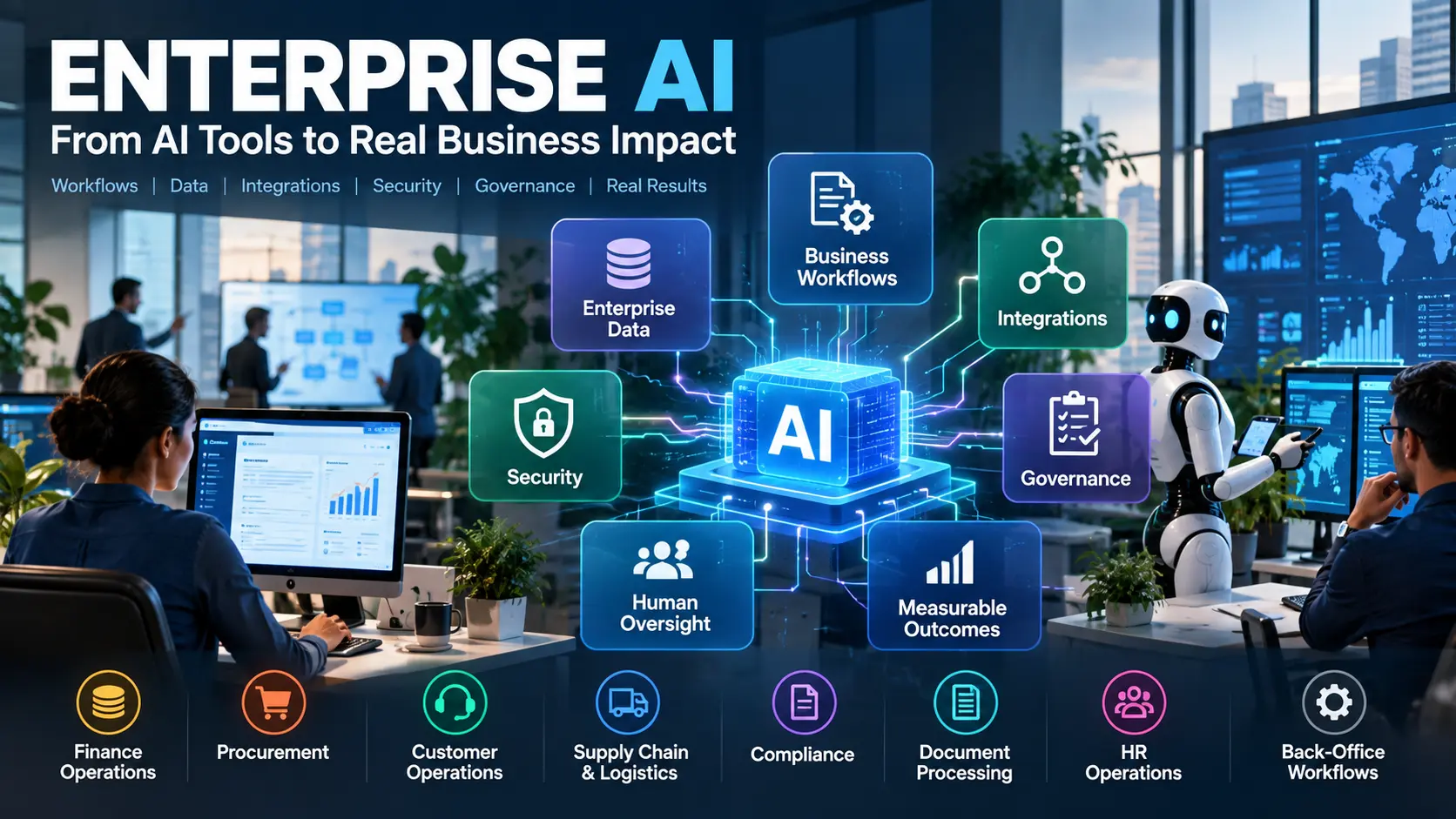
What sets it apart is the surrounding context. Enterprise AI typically involves:
- Business workflows: support for defined processes such as approvals, reconciliations, or intake
- Enterprise data: work with the organization’s own records, not just general knowledge
- Integrations: connections to the systems where work already happens
- Security: respect for access controls and data protection requirements
- Governance: clear rules about what the AI may and may not do
- Human oversight: people who can review, correct, and step in
- Measurable outcomes: success judged by results such as accuracy or turnaround time, not novelty
Enterprise AI vs. AI Assistants and AI Agents
These three terms are often used interchangeably, but they describe different levels of capability.
AI assistants help people perform work. They draft emails, summarize documents, answer questions, and generate reports. The person stays in control of each step and decides what to do with the output.
AI agents go further by executing multiple steps on a user’s behalf. An agent might process an invoice, collect missing information, update a system, or route a request to the right team. It acts rather than only suggests.
Enterprise AI adds the infrastructure and controls needed to make that kind of action reliable inside an organization. That includes permissions that define what the AI can access, integrations with core systems, governance rules, audit trails, escalation paths, methods for handling exceptions, and ongoing monitoring. Without these, an agent may perform well in a demonstration yet be hard to trust with real operations.
Put simply, an assistant helps with a task, an agent completes a task, and enterprise AI ensures the task is completed safely, traceably, and within the organization’s rules. Platforms built around this operational approach, reflect the shift from AI as a helper to AI as a participant in business operations.
What Makes AI “Enterprise-Grade”?
Five characteristics separate enterprise-grade AI from general-purpose tools.
1. Security and privacy. Enterprise systems often handle confidential financial, operational, customer, or employee information. AI operating in that environment must protect data and respect who is allowed to see what.
2. Governance. AI needs defined rules about what it can and cannot do. Which actions can it take on its own? Which requires approval? Clear boundaries make its behavior predictable.
3. Integration. Useful enterprise AI works with the systems a business already runs, such as ERP, CRM, HR platforms, email, databases, and internal applications. An AI that sits outside those systems can only advise, not act.
4. Auditability. Organizations need to understand what happened and why. If an AI approves a payment or reroutes a request, there should be a record of the inputs, the decision, and the action taken.
5. Exception handling. Real business processes rarely follow a perfect happy path. Documents arrive incomplete, data doesn’t match, and requests fall outside policy. Enterprise-grade AI must recognize when it has hit something outside its expected conditions and hand it to a person rather than guess.
Where Can Businesses Use Enterprise AI?
The strongest use cases are specific, repetitive, and tied to existing workflows, rather than broad promises that AI will transform everything.
- Finance operations: matching invoices to purchase orders, flagging discrepancies, and preparing reconciliations for review
- Procurement: comparing supplier quotes, checking requests against purchasing policy, and routing approvals
- Customer operations: classifying incoming requests, pulling account context, and drafting responses for agents to review
- Supply chain and logistics: reading shipping documents, tracking exceptions such as delays or mismatches, and updating status across systems
- Compliance: reviewing documents against defined criteria and surfacing items that need human judgment
- Document processing: extracting structured data from contracts, forms, and reports
- HR operations: handling routine onboarding paperwork and answering policy questions
- Back-office workflows: moving information between systems that don’t talk to each other
In each case, AI handles the repetitive groundwork while people focus on judgment calls and exceptions.
Why AI Projects Often Struggle After Deployment
A successful demo and a successful production system are two different things. A demo runs on clean, predictable examples. Production runs on everything the business actually encounters.
Over time, that gets harder. Business processes change. Vendors introduce new document formats. Unusual cases appear that nobody planned for. Policies get updated, data shifts, and the underlying model has limitations that only show up at scale. Human corrections pile up, and if the system can’t learn from them or at least surface them, the same problems repeat.
The key idea is that an AI system that works perfectly on day one may still need mechanisms for dealing with change. That means monitoring, feedback loops, and clear ways to update rules and handle new situations. Treating deployment as the finish line, rather than the starting point, is one of the most common reasons AI initiatives fall short of expectations.
How Businesses Can Start With Enterprise AI
A practical starting point is a small, well-defined workflow, not a company-wide rollout:
- Identify a repetitive, high-volume workflow where the rules are reasonably clear.
- Measure the current process: time, cost, error rate, and volume.
- Define what AI can and cannot do, including which decisions stay with people.
- Establish human escalation rules for low-confidence or unusual cases.
- Test against real examples, including messy ones, not just clean samples.
- Launch with a controlled scope, such as one team or one document type.
- Monitor performance against the baseline you measured.
- Expand only after the first workflow is stable.
This order keeps risk low and gives the organization evidence to guide the next step.
The Future of Enterprise AI
Enterprise AI is moving from isolated AI features toward systems that participate directly in business operations. Instead of a summarize button in one application, the shift is toward AI that carries work across systems, follows organizational rules, and involves people when judgment is needed.
That changes the question businesses should be asking. It’s no longer simply, “Does our company use AI?” It’s, “Where can AI reliably perform useful work inside our organization?”
An AI tool helps someone do a task. Enterprise AI is built to operate inside the realities of an organization: its data, systems, rules, and exceptions. When evaluating options, look beyond the demo. Judge enterprise AI on business value, reliability, security, governance, and its ability to operate in real workflows.
Watch: Enterprise AI Architecture Explained
This video explores how enterprise AI moves beyond experimentation into real business operations, covering AI architecture, workflow integration, governance, and performance measurement.
The Enterprise AI Stack: What Happens Behind the Scenes?
Enterprise AI is rarely a single product working in isolation. In most organisations, it is a combination of models, business data, software integrations, security controls, and workflow logic. Each component has a specific role, and the way these components work together determines whether an AI system can handle real operational tasks.
A useful way to understand this is to look at the journey from a business request to a completed action.
The process generally involves five layers.
1. The Data Layer
This is where the system retrieves relevant information from company databases, documents, customer records, and other approved sources. The quality and accessibility of this information directly affect the usefulness of the output.
2. The Intelligence Layer
An AI model interprets the information, identifies patterns, understands requests, or generates a response. Depending on the task, the system might use a language model, a machine learning model, or a combination of different AI technologies.
Businesses exploring the fundamentals can start with this guide to what artificial intelligence is, followed by an explanation of the different types of artificial intelligence.
3. The Orchestration Layer
This coordinates the steps required to complete a task. It determines which tools to call, what information to retrieve, and when to move to the next stage of a workflow.
4. The Execution Layer
Once the required checks have passed, the system interacts with business applications. It might update a CRM record, create a support ticket, prepare a purchase order, or send a document for approval.
5. The Control Layer
Permissions, approval requirements, monitoring, and audit logs operate across the entire process. They help ensure that the AI does not perform actions beyond its authorised scope.
The architecture will differ between organisations. A small business might connect one AI model to its CRM and document storage, while a large enterprise could operate multiple models across departments, regions, and software environments.
The important point is that the AI model is only one part of the system.
How Enterprise AI Uses Company Data
An AI model can generate useful answers using its general training, but enterprise tasks often require information that is specific to the organisation.
Consider a finance employee asking an AI system whether a supplier invoice is ready for payment. The answer depends on more than the model’s ability to understand financial language.
The system may need to retrieve the purchase order, compare the invoice with the goods received, check the supplier’s details, review the payment terms, and identify any outstanding approvals.
This is where enterprise data integration becomes essential.
One approach is retrieval-augmented generation, commonly known as RAG. It allows an AI system to retrieve relevant information from an approved knowledge source before generating a response.
For example, an employee could ask about a company’s travel reimbursement policy. Instead of relying on potentially outdated information in its training data, the system retrieves the applicable policy document and uses it to formulate an answer.
Our complete RAG guide explains how this approach works, including the relationship between retrieval, document processing, and language models.
However, retrieval is not a complete solution to enterprise data management. A system must still respect document permissions, distinguish current policies from archived versions, and identify when the available information is insufficient.
There is also an important distinction between retrieving information and changing it. Reading an approved policy document may require relatively limited permissions. Updating a financial record or approving a transaction requires a different level of control.
Choosing the Right AI Model for Business Tasks
Not every enterprise workflow needs the same model.
A language model may be suitable for interpreting customer messages, summarising contracts, or extracting information from documents. A conventional machine learning model might be more appropriate for forecasting demand, identifying unusual transactions, or estimating the likelihood of equipment failure.
Deep learning can support more complex pattern recognition, while generative AI makes it possible to produce text, code, images, and other content.
For a more detailed technical foundation, see our guides to machine learning, deep learning, and generative AI.
The selection process should consider the task, data requirements, response time, operating costs, and consequences of an incorrect result.
A more sophisticated model is not automatically the right choice for every business problem.
Enterprise AI in Practice: From a Request to a Completed Workflow
To understand the operational difference, consider an AI-powered customer support workflow.
A customer contacts a company because an order has not arrived. In a conventional support process, an employee reads the message, searches for the order, checks the delivery status, reviews the relevant policy, and prepares a response.
An enterprise AI system can coordinate much of this work.
Inside an AI-Powered Support Workflow
- Customer request received: The system identifies the issue and extracts relevant details, such as the order number and delivery concern.
- Customer and order records retrieved: The AI accesses authorised CRM and logistics data to establish what happened.
- Business rules checked: The workflow checks delivery policies, refund eligibility, and any restrictions on the requested action.
- Next action selected: A routine status enquiry may receive an automatically prepared response. A refund outside policy is sent for review.
- Action recorded: The system logs the response, relevant checks, and any changes made to the customer record.
This is different from simply placing a chatbot on a support page. The system connects the conversation to the underlying business process.
It also illustrates why customer-facing automation needs carefully defined limits. An incorrect answer about a delivery is inconvenient. An unauthorised refund, a disclosure of another customer’s information, or an incorrect change to an account can create more serious consequences.
Businesses developing these systems should consider the practical guidance in our article on AI customer support, including benefits, use cases, and best practices.
Enterprise AI and Business Process Automation
Traditional business process automation generally follows predefined rules. When a particular condition is met, the software performs a specified action.
For example, a workflow might send an invoice for approval whenever its value exceeds a defined threshold.
AI introduces another capability: interpreting information that does not arrive in a perfectly structured format.
An invoice might contain an unfamiliar layout, a handwritten note, or a description that differs slightly from the corresponding purchase order. An AI-enabled process can help extract the information, interpret the discrepancy, and determine what needs further attention.
The two approaches can complement one another.
| Traditional Automation | AI-Enabled Automation |
|---|---|
| Follows predefined rules | Can interpret less structured information |
| Works well with predictable inputs | Can help process varied documents and requests |
| Usually requires explicit rules for each condition | Can identify patterns and suggest appropriate next steps |
| May stop when inputs do not match expectations | Can classify exceptions and prepare them for review |
| Often produces predictable outputs | Requires additional validation of AI-generated outputs |
Neither approach eliminates the need for process design. In many cases, the most practical solution combines conventional automation for deterministic steps with AI for interpretation, classification, and decision support.
For instance, AI could extract supplier details from an invoice, while conventional software checks the invoice total against a purchase order. A workflow engine could then route the result to the appropriate approver.
This division of responsibilities helps keep the system understandable and makes it easier to investigate errors.
The Role of AI Agents in Enterprise Operations
AI agents are becoming an important part of the enterprise AI conversation because they can work through sequences of actions rather than responding to a single instruction.
An agent might receive a request to prepare a supplier comparison. It could collect quotations, extract prices and delivery terms, organise the information, and produce a comparison for a procurement manager.
The distinction is that the agent can coordinate several steps towards a defined objective.
However, an agent’s ability to complete a sequence of actions does not mean it should have unrestricted authority.
A supplier comparison can be prepared automatically, but selecting a supplier may involve contractual obligations, financial exposure, and business considerations that require human judgement.
The same principle applies to more advanced autonomous systems. The level of independence should depend on the task’s risk, the reliability of the available information, and the ability to reverse an action if something goes wrong.
Tools such as Manus AI illustrate the broader move towards systems that can carry out multi-step tasks. Within an enterprise, though, those capabilities need to be connected to organisational permissions, approved tools, and clearly defined responsibilities.
Enterprise AI Security: Protecting Data Without Blocking Useful Work
Security is one of the most important considerations when introducing AI into an organisation.
An employee may be authorised to view a particular customer record but not to access payroll information. An AI system operating on that employee’s behalf should not bypass that distinction simply because it can technically retrieve the data.
This is why enterprise AI security needs to extend beyond the security of the model itself.
- Identity and access management: Determining which users, agents, and services can access particular resources.
- Data classification: Identifying confidential, sensitive, and publicly available information.
- Permission-aware retrieval: Ensuring that AI-generated answers do not expose information a user is not authorised to access.
- Secure integrations: Protecting connections between AI systems and business applications.
- Prompt injection protection: Recognising attempts to manipulate an AI system through malicious instructions embedded in documents, messages, or other inputs.
- Activity logging: Recording important requests, decisions, and actions.
- Data retention: Defining how long prompts, outputs, and operational records are kept.
Security also needs to account for the way employees use AI independently of official company systems.
When workers upload business documents to unapproved AI services, the organisation may lose visibility over where its information is processed and how it is handled. Clear policies, suitable approved tools, and employee training can help address this problem.
Businesses reviewing their wider security architecture may also find it useful to understand what a UTM firewall is and how it works, alongside the considerations involved in selecting a modern SIEM solution.
Enterprise AI security is ultimately about controlling access and actions throughout the workflow, not simply choosing a model that advertises strong security features.
Measuring Enterprise AI Performance
An AI system can produce impressive demonstrations without delivering meaningful business value. To understand whether a deployment is working, organisations need to measure what changes after implementation.
The metrics should reflect the workflow rather than the technology.
Enterprise AI Performance Scorecard
Illustrative measurement framework. These are metrics to track, not reported results from a specific deployment.
- Processing time: How long does the task take before and after AI implementation?
- Accuracy and quality: How often does the system produce correct, complete, and policy-compliant results?
- Human intervention: How many cases require correction, approval, or manual completion?
- Cost per completed task: What is the total operating cost, including models, software, reviews, and error correction?
- Risk and compliance: Are there unauthorised actions, data exposure incidents, or policy violations?
A business should establish a baseline before introducing AI. If a team currently processes 500 invoices each week, for example, it should record the existing processing time, error rate, staffing requirements, and cost.
The same measurements can then be collected during a controlled pilot.
It is also worth tracking the cases in which the AI refuses to act or escalates a request. A high escalation rate may indicate that the system needs better data, clearer rules, or a narrower scope. A very low rate is not necessarily a positive result if the system is making decisions without recognising uncertainty.
Calculating the Return on Enterprise AI
Return on investment should account for the full cost of operating the system.
Net benefit is the financial value created after subtracting the relevant operating costs from the gross benefits. Total investment can include implementation, integration, training, licences, infrastructure, governance, and ongoing maintenance.
For example, reducing the time employees spend on repetitive work may create additional capacity. Whether that translates into a financial return depends on how the organisation uses that capacity, as well as the cost of operating the AI system.
The same logic applies to improvements in customer service, fewer processing errors, and faster decisions. These benefits should be measured rather than assumed.
Enterprise AI Governance: Who Is Responsible When AI Makes a Mistake?
As AI takes on more operational responsibility, accountability becomes a practical management issue.
If an AI system sends an incorrect customer response, updates a record incorrectly, or recommends a transaction that violates company policy, the organisation needs a way to identify what happened and determine who should address it.
Governance should therefore establish clear ownership.
Business teams understand the process and its operational requirements. IT teams manage integrations and system reliability. Security teams oversee access controls and threats. Legal, compliance, and risk specialists help define the obligations that apply to the workflow.
The precise arrangement depends on the organisation, but responsibilities should be documented before the system is given meaningful authority.
Three Levels of Enterprise AI Autonomy
The system analyses information and proposes an action. A person reviews and executes it.
The system prepares an action, but a person must authorise it before execution.
The system completes approved, bounded tasks independently and escalates cases outside its authority.
These levels are a practical way to structure permissions rather than a universal industry standard. A company may use all three within the same workflow.
For example, an AI assistant could automatically categorise support tickets, prepare a refund for approval, and be prohibited from changing a customer’s payment details without additional verification.
This approach allows organisations to introduce automation incrementally while retaining control over sensitive decisions.
Enterprise AI and the Changing Role of Business Leaders
Enterprise AI is not solely an IT project. Its implementation can change how teams allocate work, make decisions, manage performance, and interact with customers.
Business leaders need to determine which processes should change, which responsibilities should remain with people, and how employees will work alongside AI systems.
The objective is not to automate every task that can technically be automated. Some processes depend on relationships, negotiation, contextual judgement, or accountability that cannot be reduced to a simple sequence of instructions.
A procurement manager, for example, may use AI to compare supplier proposals and identify contractual differences. The manager still needs to consider reliability, commercial relationships, and the wider implications of the decision.
Similarly, executives can use AI to consolidate information and explore scenarios, but the quality of the final decision depends on the evidence, assumptions, and business context.
Our guide to AI leadership and the transformation of decision-making explores this relationship between artificial intelligence and management. For a broader view of the commercial implications, see how artificial intelligence is changing the future of digital business.
The leadership challenge is to make AI useful without allowing the technology to become a substitute for clear ownership.
Common Enterprise AI Implementation Mistakes
Even organisations with strong technical teams can encounter difficulties when introducing AI into production. Several mistakes are worth addressing before a project moves beyond its initial pilot.
Starting with the technology instead of the problem. Choosing a model first can lead to a solution that has impressive capabilities but little relevance to the organisation’s actual needs. Begin with the workflow, the problem, and the expected outcome.
Automating a broken process. If the existing workflow contains unnecessary approvals, inconsistent records, or unclear responsibilities, adding AI may simply make those problems harder to identify. Review the process before automating it.
Giving AI excessive permissions. A system should receive only the access required for its assigned tasks. Broad permissions increase the potential consequences of mistakes or misuse.
Ignoring the cost of exceptions. AI may handle routine cases efficiently while creating additional work for employees who must correct unusual cases. Measure the entire workflow, including human review.
Treating a successful pilot as proof of readiness. A pilot may involve a narrow dataset and a small group of users. Production introduces different workloads, access patterns, edge cases, and operational demands.
Failing to plan for ongoing maintenance. Models, policies, integrations, and business processes change. Organisations need procedures for testing updates, monitoring quality, and responding when performance deteriorates.
Measuring activity instead of outcomes. The number of prompts, automated actions, or AI-generated documents does not establish business value. The more useful measures are improvements in quality, speed, cost, and service.
These mistakes share a common cause: treating enterprise AI as a software installation rather than a continuing operational capability.
Enterprise AI in Different Industries
The underlying principles remain similar across industries, but the requirements change with the work being performed.
Retail and E-commerce
AI can support demand forecasting, inventory analysis, product categorisation, and order exception management. Integration with stock and fulfilment systems is essential for keeping recommendations aligned with actual availability.
Explore AI logistics for e-commerce.
Financial Services
AI can help classify documents, identify unusual transaction patterns, summarise reports, and support compliance reviews. Decisions involving payments, credit, or regulated activities require controls appropriate to their risk.
Healthcare
Administrative applications include document processing, appointment coordination, and information retrieval. Systems handling patient information need appropriate privacy protections, and clinical decisions require safeguards suited to the task.
Technology and Software
AI can assist with coding, documentation, incident triage, and internal knowledge searches. Code review, testing, access restrictions, and change management remain important when AI-generated work enters production.
Read the Keycloak Docker setup guide.
These examples show why there is no single enterprise AI configuration that suits every organisation. The appropriate design depends on the data involved, the consequences of an incorrect action, the systems already in use, and the level of human involvement required.
Building an Enterprise AI Roadmap
Once an organisation has validated an initial use case, the next challenge is deciding how to expand.
A roadmap helps connect individual projects to a broader operating model. Without one, departments may introduce overlapping tools, duplicate integrations, and inconsistent approaches to security and governance.
From Pilot to Enterprise Capability
- Stage 1: Establish the foundation. Identify suitable workflows, classify data, define ownership, and establish security and governance requirements.
- Stage 2: Validate a focused use case. Test the system against real examples, compare results with a baseline, and document its limitations.
- Stage 3: Integrate with operations. Connect approved systems, introduce monitoring, define escalation paths, and establish support procedures.
- Stage 4: Expand and improve. Extend the approach to additional workflows when the evidence supports expansion. Review performance and controls as the system evolves.
Organisations should also consider how employees will be trained to use AI effectively. Staff need to understand what the system can do, where its information comes from, when its outputs require verification, and how to report problems.
For companies introducing AI across multiple departments, a shared foundation can reduce duplicated effort. Common identity controls, approved model access, reusable integrations, and consistent monitoring can support individual teams without forcing every workflow into the same design.
The roadmap should remain flexible. Some processes may be suitable for greater automation, while others may continue to require human approval indefinitely.
Final Considerations for Enterprise AI Adoption
Enterprise AI is best understood as an operational capability rather than a category of software. Its value comes from bringing artificial intelligence into the processes where organisations manage information, serve customers, make decisions, and complete work.
That requires more than a capable model. Data must be reliable and appropriately protected. Integrations must work with existing systems. AI actions must remain within defined boundaries. Employees need clear escalation procedures, and performance must be measured against meaningful business outcomes.
The organisations developing this capability will need to make decisions about technology, governance, workflow design, and people at the same time. The starting point is not finding the most powerful AI available. It is identifying a real business problem, establishing what success looks like, and building a system that can solve it reliably within the organisation’s rules.
Use the key points in this guide to understand the topic and make more informed decisions.

This guide is researched and edited using relevant documentation, reliable sources and publicly available information.
Was this guide helpful?
Your feedback helps us improve future guides.