In this article
Cyber threats are no longer slow or predictable; they are faster, automated, and increasingly powered by AI itself. Traditional defenses are struggling to keep up, which is forcing businesses to rethink how they approach security.
Recent data shows that 63% of security breaches are detected faster with AI, and nearly 69% of organizations believe they cannot respond effectively to threats without it. This shift is not optional anymore; it is becoming foundational.
AI brings the ability to analyze massive data in real time, detect hidden patterns, and act before damage is done. In this blog, the focus is on how businesses can practically use AI to detect and prevent cyber threats with more speed, accuracy, and control.
Why Businesses Need AI in Cybersecurity Today
Cyber threats are not slowing down. They’re getting smarter, faster, and harder to catch. In 2026, the average cost of a data breach hit $4.99 million. And most businesses don’t even detect a breach until weeks after it happens.
Traditional security tools were built for a different era. They react when an attack happens. On the other hand, an advanced web app pentesting tool validates exploitable flaws and helps you prevent them in the first place.
Here’s the reality:
- Attackers now use automation to launch thousands of attacks simultaneously
- Human security teams can’t monitor everything around the clock
- One missed alert can cost you everything
AI fills that gap. It monitors, learns, and responds in real time without blind spots. For businesses today, AI in cybersecurity isn’t just a “good to have”; it’s a core need.
How AI Helps Detect and Prevent Cyber Threats
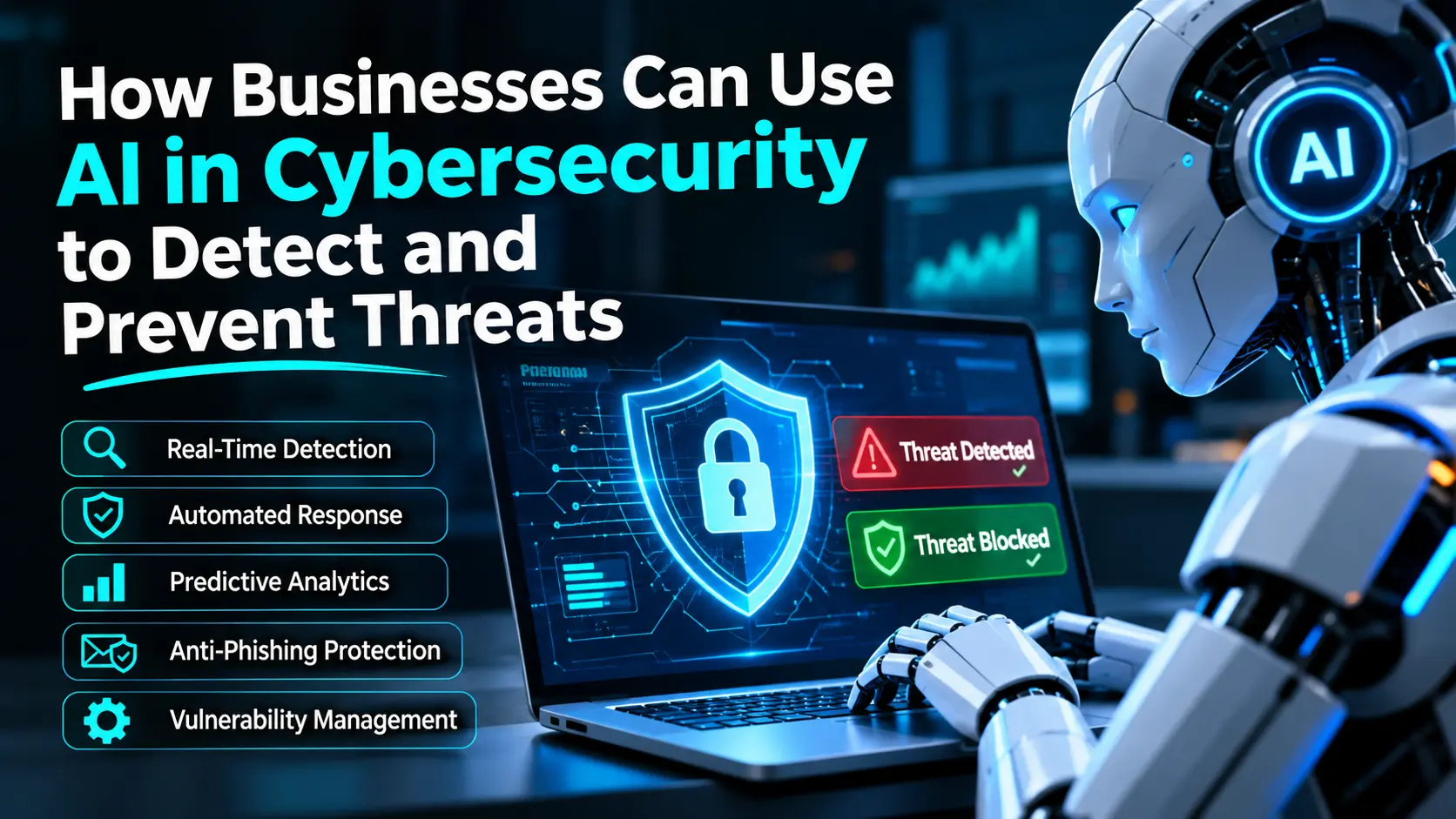
AI strengthens business security by analyzing massive data streams in real time to identify anomalies. Using machine learning, it detects unknown threats and automates responses, ensuring faster and more accurate enterprise protection.
- Behavioral Anomaly Detection: AI establishes baseline patterns for users and systems. It identifies deviations in real time, helping you catch compromised accounts or insider threats before they cause significant damage.
- Predictive Threat Analytics: By correlating historical data with global trends, AI forecasts likely attack patterns. This proactive approach allows you to strengthen defenses against anticipated threats before they strike.
- Automated Incident Response: AI triages alerts and executes automated containment playbooks instantly. This reduces mean time to resolve incidents by 30%, freeing your team for strategic security planning.
- Advanced Phishing Defense: Advanced models analyze email content and metadata to spot deepfakes and sophisticated social engineering. It blocks deceptive messages that easily bypass traditional static security filters.
- Smart Vulnerability Management: AI prioritizes system vulnerabilities based on their potential impact and actual exploitability. This ensures your team focuses its patching efforts on the most critical risks first.
Business Advantages of Using AI for Cybersecurity
AI transforms cybersecurity into a strategic business asset by providing real-time intelligence and automated responses. This proactive approach drastically reduces breach costs, optimizes operations, and builds lasting digital trust for modern enterprises.
- Substantial Cost Savings: Companies using extensive security AI save an average of US$1.9 million per breach. These savings result from faster detection and significantly lower remediation efforts.
- Higher Team Efficiency: AI-driven automation reduces alert volumes by 60%. This effectively eliminates “alert fatigue,” letting your security analysts focus on high-stakes strategy instead of chasing false alarms.
- Faster Incident Resolution: Security AI helps teams resolve incidents 30% faster. Quick containment prevents threats from spreading, which protects your critical data and minimizes expensive business downtime.
- Proactive Risk Management: Predictive analytics identify potential cyberattacks 40% faster than traditional tools. Shifting to a proactive defense model helps you stop threats before they escalate into crises.
- Lower Operational Costs: Automating triage helps address the $3.3 billion in annual labor costs for response teams. It allows you to scale security operations without constantly hiring more staff.
Real-World Use Cases of Businesses Using AI in Cybersecurity
Organizations are moving beyond theoretical discussions and actively implementing AI in their security operations. From preventing multi-million-dollar fraud attempts to significantly reducing response times, real-world use cases show that AI-driven cybersecurity has become a core business requirement.
Stopping Sophisticated Deepfake Fraud
AI has become critical in detecting advanced fraud techniques such as deepfakes. In one case, a company lost $25 million due to a CFO deepfake scam. AI tools now analyze metadata and behavioral signals to identify synthetic media that can bypass traditional verification methods.
Automating Security Operations Center (SOC) Efficiency
Security teams often struggle with overwhelming volumes of data. AI helps streamline operations by automating alert triage and analysis. For example, IBM’s Watson reduced response times by up to 50%, while organizations have reported a 60% reduction in alert volumes.
Proactive Threat Hunting with Predictive Analytics
AI enables a shift from reactive to proactive security. By analyzing historical data and global threat intelligence, predictive models can identify potential attack patterns. Businesses using this approach have reported detecting threats up to 40% faster.
Smart Data Classification and Segmentation
AI-driven data classification helps identify sensitive information across cloud and on-premise environments. It also enables intelligent segmentation based on user behavior, reducing the risk of lateral movement, and limiting the impact of potential breaches.
Best Practices for Businesses Using AI in Cybersecurity
Organizations must implement robust governance and technical controls to deploy AI safely. Combining established frameworks with continuous human oversight maximizes security performance while mitigating risks like data bias.
- Adopt Proven Governance Frameworks: Use the NIST AI Risk Management Framework to handle risks unique to generative models. Aligning with COBIT 2019 ensures security goals match your business objectives.
- Maintain Human-in-the-Loop Oversight: Always keep human experts involved. AI provides speed, but humans offer context to prevent misclassifications and manage complex, high-stakes security incidents.
- Prioritize Data Integrity: Prioritize high-quality, unbiased data. Using a “Cyber Data Lake” and monitoring data provenance prevents attackers from poisoning your models or skewing threat detection results.
- Implement Zero Trust Architectures: Integrate AI into a Zero Trust architecture. This pairing ensures continuous identity verification and prevents lateral movement if an attacker breaches your initial perimeter.
- Conduct Regular Adversarial Testing: Perform regular red teaming simulations. Test for attacks like prompt injection to identify vulnerabilities in your AI models before real threat actors exploit them.
- Use Monitoring and Kill Switches: Establish real-time monitoring and “kill switches” for AI tools. These controls let you immediately revoke access if a model starts behaving harmfully or unexpectedly.
- Invest in Team Training: Upskill your security team in AI literacy. Analysts must understand adversarial machine learning and prompt engineering to manage these advanced security tools effectively.
How AI Cybersecurity Integrates with Existing Business Infrastructure
One of the biggest questions businesses face when considering AI-powered cybersecurity is how these technologies will work alongside their existing systems. Most organizations already use firewalls, antivirus software, endpoint protection, identity management platforms, and network monitoring solutions. Replacing everything with AI is neither necessary nor practical.
The more effective approach is to integrate AI into the existing security infrastructure. It can collect information from multiple security tools, correlate events, identify suspicious activities, and provide recommendations based on the wider security environment. This creates a more connected approach to threat detection instead of relying on individual tools that operate independently.
For example, a business might receive an unusual login alert from its identity management system. On its own, this activity may not appear particularly dangerous. However, AI can compare it with network traffic, device information, login history, and access patterns. If the same account is downloading sensitive files or accessing unfamiliar servers, the combined signals may indicate a compromised account.
This is where a modern SIEM solution becomes particularly useful. AI-enhanced security information and event management allows businesses to analyse security events from different sources through a more unified monitoring environment.
How an AI-powered business security system works
Illustrative representation of an integrated AI security architecture.
Businesses with more complex infrastructure can also explore a Unified Threat Management (UTM) firewall to bring multiple network protection capabilities together. Combining network security controls with AI-based monitoring can improve visibility and help security teams investigate incidents more effectively.
AI Cybersecurity Performance: Understanding the Business Impact Through Data
Security improvements are easier to evaluate when businesses look beyond the number of threats detected. Detection speed, investigation workload, incident resolution, and financial impact are equally important. These measurements help decision-makers understand whether their investment in AI is improving the overall security posture.
The figures discussed earlier in this article highlight several potential improvements associated with AI-driven security operations. The following visualisation brings those figures together to make their relative impact easier to understand.
Reported AI cybersecurity improvements
The first three bars represent percentages reported in the figures discussed in this article. The final bar represents US$1.9 million in reported savings and uses a separate illustrative scale. These figures are not a direct comparison of identical measurements.
These improvements can have a direct effect on how businesses allocate their security resources. When analysts spend less time reviewing repetitive alerts, they can investigate unusual events, review access permissions, and identify weaknesses in critical applications.
However, performance should not be measured using a single percentage. A business that reduces alerts by 60% but misses important security incidents has not necessarily improved its security position. The quality of detection and the accuracy of automated decisions matter just as much as operational speed.
Important Metrics to Monitor After AI Implementation
| Security Metric | What It Measures | Why Businesses Need It |
|---|---|---|
| Mean Time to Detect (MTTD) | Time taken to identify a security incident | Shows how quickly suspicious activity becomes visible |
| Mean Time to Respond (MTTR) | Time taken to respond to an incident | Measures containment and response efficiency |
| False Positive Rate | Incorrect security alerts | Helps reduce unnecessary investigation work |
| Threat Detection Accuracy | Correctly identified security threats | Evaluates the quality of AI-based detection |
| Vulnerability Remediation Time | Time required to fix identified weaknesses | Helps track improvements in risk reduction |
| Security Incident Cost | Financial impact of security incidents | Connects security improvements with business outcomes |
Protecting Business Applications, Cloud Environments, and Remote Employees
Modern business environments are spread across multiple locations, cloud platforms, employee devices, and third-party applications. This creates more opportunities for attackers to exploit weak access controls or compromised credentials. AI helps businesses monitor these different environments without depending entirely on traditional perimeter-based security.
1. Securing Cloud Applications and Business Data
Cloud environments contain valuable business information, including customer records, financial documents, employee information, and intellectual property. Misconfigured permissions or unusual account activity can expose this information to unauthorised users.
AI-powered monitoring can identify unexpected changes in access patterns, detect unusual downloads, and flag suspicious behaviour across cloud applications. It can also help security teams identify sensitive information that requires stronger protection.
Businesses adopting more advanced AI systems can also learn about enterprise AI and its practical applications to understand how intelligent technologies can be integrated into larger organisational environments.
2. Improving Security for Remote Working Teams
Remote employees frequently access company systems through home networks, public Wi-Fi, personal devices, and virtual private networks. This makes identity verification and endpoint monitoring particularly important.
AI can analyse login locations, device behaviour, access frequency, and unusual account activity to identify potential compromises. If an employee suddenly accesses sensitive company information from an unfamiliar device, the system can flag the activity for additional verification.
This approach becomes even more important as businesses continue adapting to the changing security requirements discussed in how remote working has changed business security priorities.
3. Protecting Passwordless Authentication Systems
Credential theft remains one of the major challenges in business cybersecurity. Even strong passwords can be exposed through phishing campaigns, malware, or compromised third-party services.
Businesses are increasingly exploring passwordless authentication to reduce their dependence on traditional credentials. Technologies such as passkeys use cryptographic authentication to make account access more resistant to common phishing attacks.
AI can complement these systems by monitoring login behaviour and identifying unusual authentication attempts. Understanding how passkeys work without passwords can help organisations develop stronger identity protection strategies.
AI-Powered Cybersecurity vs Traditional Security: What Should Businesses Choose?
Traditional cybersecurity solutions still play an important role in protecting business infrastructure. Firewalls, signature-based antivirus systems, access controls, and security policies provide essential layers of protection. The challenge is that many traditional tools depend on predefined rules or known threat signatures.
AI introduces another layer of intelligence by identifying patterns that may not match previously documented attacks. Instead of simply checking whether an event matches a known threat, machine learning models can evaluate whether an activity looks unusual compared with normal system behaviour.
| Comparison Area | Traditional Security | AI-Enhanced Security |
|---|---|---|
| Threat Identification | Often depends on known signatures and predefined rules | Can identify suspicious patterns and behavioural anomalies |
| Monitoring | Rule-based monitoring and manual investigation | Continuous analysis of multiple data sources |
| Threat Prediction | Primarily relies on existing intelligence and indicators | Can analyse historical patterns to identify emerging risks |
| Incident Response | Often requires manual investigation and action | Can automate selected response procedures |
| Adaptability | Requires rule updates and signature changes | Models can adapt through controlled retraining and evaluation |
| Human Involvement | Analysts manage most investigation processes | AI assists analysts, with human oversight for critical decisions |
AI-enhanced cybersecurity is not automatically better in every situation. Traditional security controls are often more predictable and easier to validate for specific tasks. AI models can also produce false positives, miss unfamiliar attacks, or make incorrect decisions when trained on poor-quality data.
The strongest business security strategy combines both approaches. Traditional controls provide a dependable foundation, while AI adds analytical capabilities that help security teams respond to increasingly complex threats.
How Businesses Can Build an AI Cybersecurity Implementation Roadmap
Introducing AI into cybersecurity requires more than purchasing a new software platform. Businesses need to understand their existing vulnerabilities, identify the systems that require protection, and establish measurable goals before selecting an AI solution.
A gradual implementation strategy makes it easier to identify technical problems, evaluate model performance, and ensure that automated decisions remain aligned with business requirements.
A practical AI cybersecurity implementation roadmap
Businesses should also consider the wider technical environment before implementation. A reliable infrastructure makes it easier to deploy monitoring tools, process security data, and maintain consistent system availability. A useful starting point is understanding how to build a reliable IT infrastructure that can support modern business operations.
Why Vulnerability Testing Should Remain Part of the Process
AI can identify suspicious behaviour and highlight potential weaknesses, but it cannot guarantee that every application is secure. Businesses still need regular security assessments to determine whether vulnerabilities can actually be exploited.
For example, an AI system may flag an outdated application component or an unusual server configuration. Security specialists can then investigate the weakness, reproduce the issue in a controlled environment, and determine the appropriate remediation.
Organisations should develop their technical security capabilities by understanding the skills every ethical hacker needs beyond the CEH syllabus. These practical skills help security professionals evaluate real-world attack scenarios rather than relying exclusively on automated reports.
The Role of Machine Learning and Deep Learning in Modern Threat Detection
AI cybersecurity systems rely on different technical approaches depending on the type of threat they are designed to identify. Machine learning and deep learning are particularly important because they allow systems to analyse large datasets and identify relationships that may be difficult to recognise through traditional security rules.
Machine Learning for Behavioural Security Analysis
Machine learning models can study historical login records, network connections, device activity, and application usage. By learning what normal behaviour looks like, these systems can identify deviations that deserve further investigation.
For instance, if an employee normally accesses a limited number of business applications but suddenly begins downloading large volumes of confidential documents, the system may flag the activity. This does not automatically mean that the employee is responsible for a security breach. It indicates that the activity requires closer examination.
Businesses looking to understand the technology behind these capabilities can explore what machine learning is and how it works.
Deep Learning for Complex Threat Patterns
Deep learning uses multi-layered neural networks to analyse more complex relationships in data. In cybersecurity, this can support the analysis of suspicious files, malicious network traffic, unusual communication patterns, and sophisticated phishing attempts.
These models can identify combinations of indicators that may not be obvious when individual events are examined separately. However, they require suitable training data, careful validation, and ongoing monitoring to remain reliable.
Understanding how deep learning works provides useful context for businesses evaluating more advanced security analytics solutions.
Managing the Risks of Using AI in Cybersecurity
Although AI provides valuable security capabilities, introducing these systems also creates new risks. Businesses must remember that AI technologies can become targets themselves. Attackers may attempt to manipulate training data, exploit model weaknesses, or use malicious inputs to influence automated decisions.
Another concern is excessive reliance on automated recommendations. A model may classify legitimate activity as suspicious or fail to recognise a new attack technique. If an organisation allows every AI recommendation to trigger an automatic action, a single incorrect decision could disrupt important business operations.
Several precautions can help reduce these risks:
Model Access Restrictions
Restrict who can modify AI models, access training datasets, and change security automation settings.
Training Data Protection
Validate data sources and monitor for suspicious changes that could affect model accuracy.
Independent Security Reviews
Test AI systems against realistic attack scenarios and review their decisions regularly.
Controlled Automation
Require additional verification before AI performs high-impact actions on business systems.
Data protection is another important consideration, particularly for companies using third-party AI services. Business information should not be shared with external systems without understanding their data handling practices, retention policies, and access restrictions.
Organisations can also explore the security implications of protecting business data from automated AI web scrapers and LLM crawlers. This becomes relevant when companies manage confidential documents, proprietary information, and publicly accessible digital assets.
Privacy-focused AI solutions may offer additional considerations for organisations handling sensitive information. Understanding platforms such as Proton Lumo AI and its privacy approach can help decision-makers evaluate the relationship between AI functionality and data protection.
Preparing Security Teams for an AI-Driven Business Environment
Technology alone cannot create a strong cybersecurity strategy. Businesses still need professionals who understand how attacks happen, how security controls operate, and how to investigate incidents when automated systems identify potential problems.
As AI takes over repetitive monitoring and analysis tasks, the responsibilities of security teams are also changing. Analysts increasingly need to understand model behaviour, investigate unusual AI recommendations, validate automated responses, and evaluate the wider impact of security incidents.
Leadership teams also need to understand how cybersecurity decisions affect business continuity, customer confidence, and operational costs. This is why AI adoption should be connected to wider organisational planning rather than treated as an isolated IT project.
Developing the right capabilities requires continuous learning. Businesses can benefit from exploring the skills required for AI project management and understanding how technology initiatives can be managed across different departments.
At the leadership level, AI-driven decision-making provides another useful perspective on how organisations can balance automation, human judgement, accountability, and strategic objectives.
Ultimately, the goal is not to remove security professionals from the process. It is to give them better information, more time for investigation, and tools that help them make informed decisions before a security incident develops into a major business problem.
Wrapping Up
AI has moved cybersecurity from a reactive function to a proactive strategy. It enables faster detection, smarter analysis, and early prevention, helping businesses stay ahead of increasingly complex and automated cyber threats.
To gain real value, businesses need to use AI with the right approach. This includes combining it with human expertise, using quality data, and continuously improving systems to match evolving security challenges.
The focus should be on building a security posture that is adaptive, intelligent, and resilient. When used effectively, AI strengthens defense, reduces risk, and helps businesses operate with greater confidence in a threat-driven environment.
Use the key points in this guide to understand the topic and make more informed decisions.

This guide is researched and edited using relevant documentation, reliable sources and publicly available information.
Was this guide helpful?
Your feedback helps us improve future guides.