
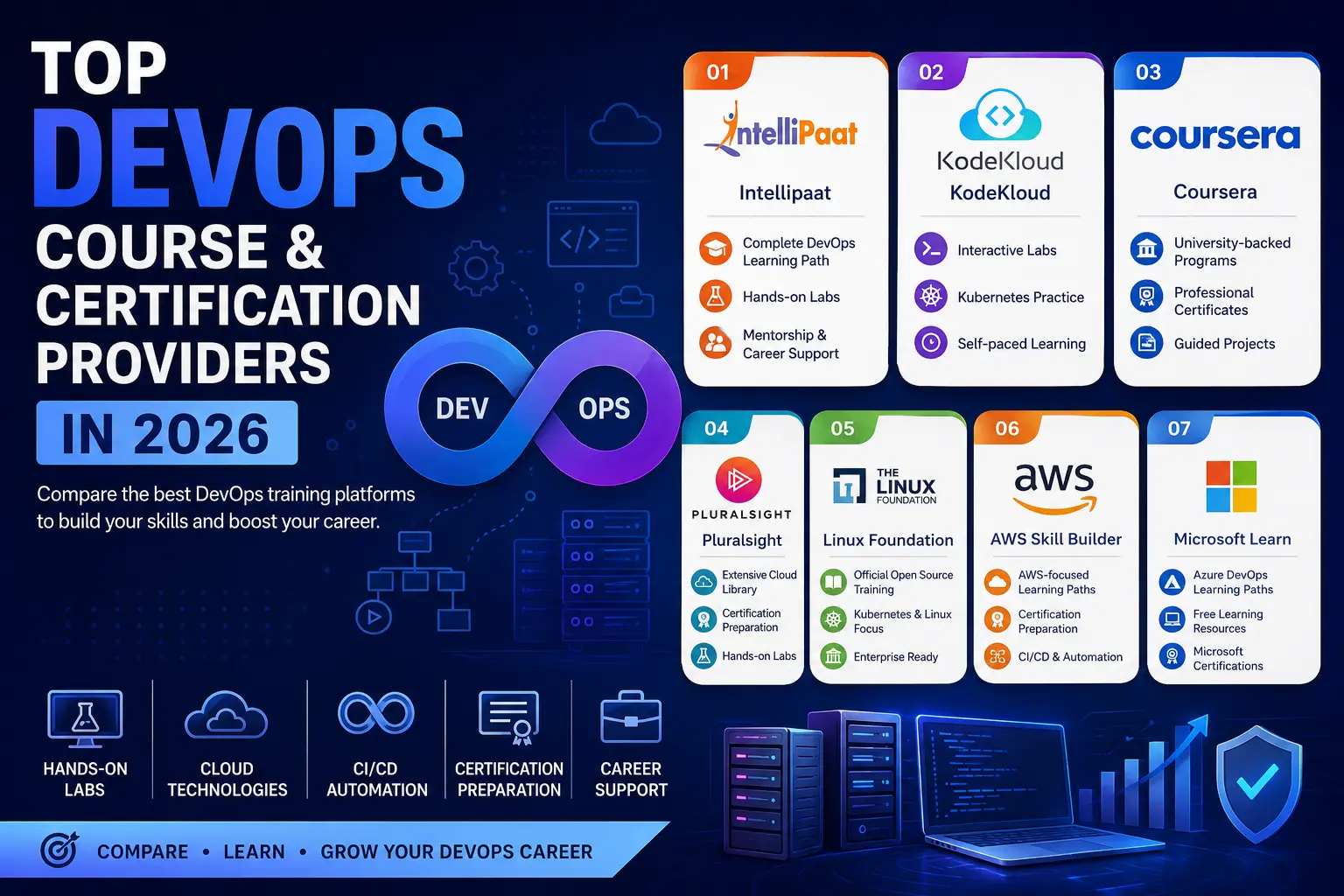
As organizations continue to adopt cloud-native technologies, automation, and continuous software delivery, DevOps has become one of the most sought-after skills in the IT industry. Companies across finance, healthcare, e-commerce, and technology are actively hiring DevOps professionals who can automate infrastructure, manage CI/CD pipelines, and improve software deployment efficiency. Modern DevOps teams also work alongside AI-powered development tools to improve code quality, automate repetitive tasks, and accelerate software delivery. If you’re new to the technology, our What Is Artificial Intelligence? guide explains the fundamentals before exploring DevOps automation.
With the growing demand comes an overwhelming number of training providers. From university-backed programs to hands-on learning platforms, choosing the right DevOps course can significantly impact your career growth.
In this article, we’ll compare the top DevOps course and certification providers in 2026 based on curriculum, hands-on learning, certification value, mentorship, and career support.
Why DevOps Skills Matter in 2026
Modern software development depends heavily on automation, cloud infrastructure, rapid deployment cycles, and continuous monitoring. Organisations across finance, healthcare, retail, e-commerce, and technology continue adopting DevOps practices to improve software quality while reducing deployment time.
As businesses migrate workloads to cloud platforms, the demand for engineers capable of managing CI/CD pipelines, Infrastructure as Code, container orchestration, monitoring systems, and cloud-native environments has increased significantly.
Many cloud providers are also integrating machine learning into monitoring systems, helping engineers detect anomalies and optimise infrastructure performance.
However, selecting the right DevOps course has become more difficult because dozens of training providers now offer similar programmes. Some focus on certification preparation, while others prioritise hands-on projects, cloud labs, or instructor-led mentoring.
Instead of looking only at marketing claims, prospective learners should compare curriculum depth, practical experience, industry recognition, flexibility, and career support before choosing a training platform.
This guide compares several well-known DevOps learning providers using a consistent evaluation framework to help readers identify the programme that best aligns with their learning objectives.
How RCN Guide Evaluated These Providers
Rather than ranking providers solely on popularity, we reviewed each platform using several practical criteria that matter to learners pursuing DevOps careers.
- Coverage of modern DevOps tools and technologies
- Linux, Docker, Kubernetes and Git training
- Cloud platform integration
- Hands-on laboratories and practical projects
- Certification preparation resources
- Instructor experience where applicable
- Learning flexibility for working professionals
- Career support mentioned within programme descriptions
No single provider is ideal for every learner. Beginners often benefit from structured learning paths, while experienced professionals may prefer specialised certification-focused platforms.
Quick Comparison of DevOps Course Providers
| Provider | Suitable For | Hands-on Labs | Career Support | Main Strength |
|---|---|---|---|---|
| Intellipaat | Beginners & Working Professionals | Yes | Yes | Complete learning pathway |
| KodeKloud | Self-paced Learners | Yes | Limited | Interactive Kubernetes practice |
| Coursera | University-style Learning | Project Based | Varies | Professional Certificates |
| Pluralsight | Cloud Engineers | Yes | No | Extensive Cloud Library |
| Linux Foundation | Enterprise Professionals | Yes | No | Official Open Source Training |
| AWS Skill Builder | AWS Professionals | Yes | No | AWS Certification Preparation |
| Microsoft Learn | Azure Professionals | Yes | No | Azure DevOps Learning Paths |
What Makes a High-Quality DevOps Course?
A strong DevOps programme should balance theoretical knowledge with practical implementation. Learners should gain exposure to Linux administration, version control, containers, automation, Infrastructure as Code, monitoring, and cloud platforms while completing real-world projects that demonstrate practical skills.
Learners interested in modern automation should also understand Generative AI, as AI coding assistants are becoming increasingly common in software engineering workflows.
The most effective programmes also encourage learners to build deployment pipelines, automate infrastructure, manage Kubernetes clusters, and understand modern software delivery workflows rather than relying entirely on recorded video lectures.
Top DevOps Course Providers Reviewed
Every learning platform approaches DevOps education differently. Some prioritise structured instructor-led training, while others focus on interactive laboratories or certification preparation. Understanding these differences can help learners choose a platform that aligns with their experience level and career goals.
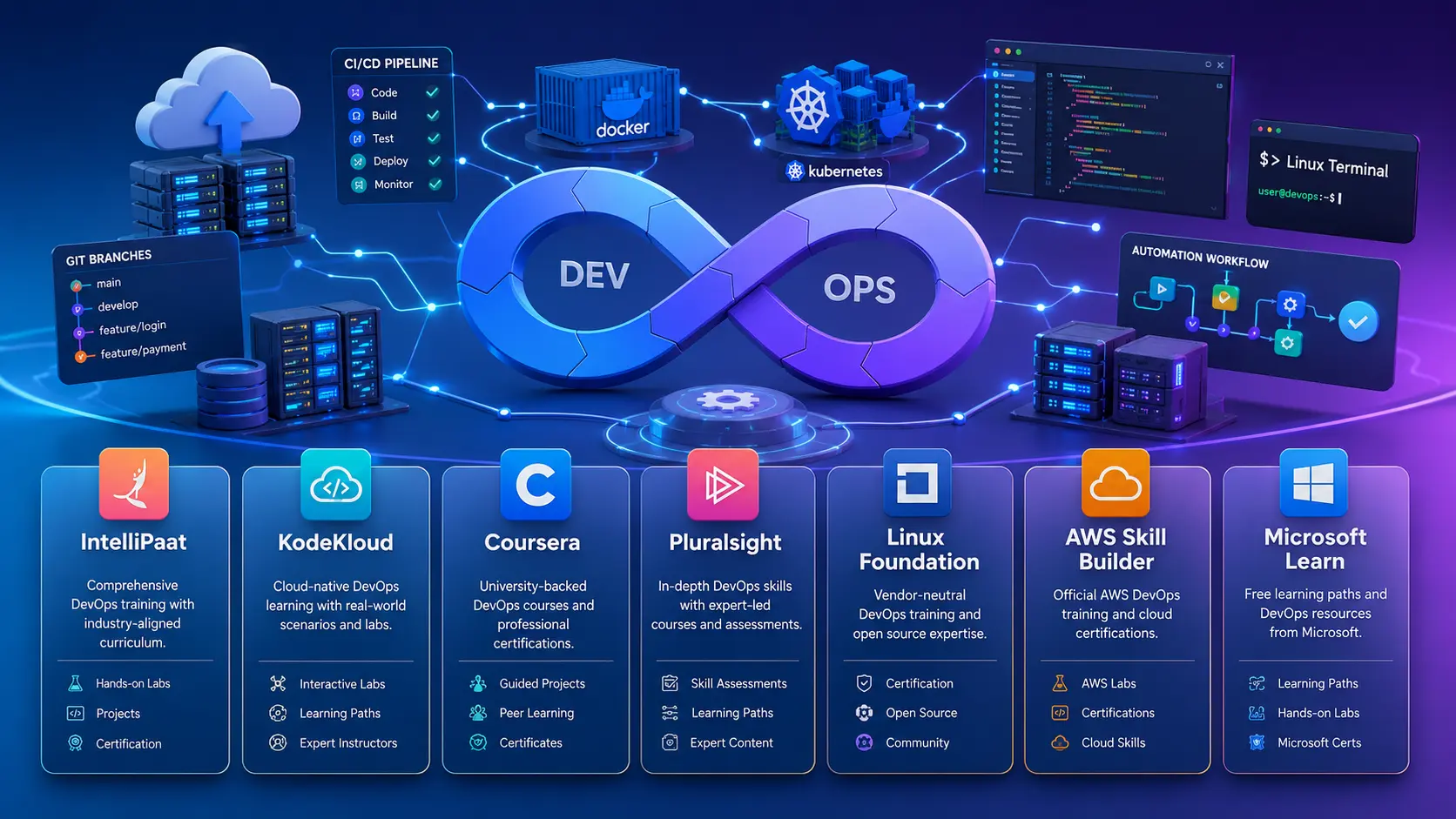
1. Intellipaat DevOps Course
The Intellipaat DevOps Online Course is designed for beginners, software developers, system administrators, and cloud professionals looking to build job-ready DevOps skills. The program covers the complete DevOps lifecycle, including Linux, Git, Docker, Kubernetes, Jenkins, Terraform, Ansible, AWS, CI/CD, monitoring with Prometheus and Grafana, and Infrastructure as Code.
A major advantage of the course is its emphasis on practical learning through live instructor-led classes, cloud labs, industry projects, and capstone assignments. Learners also receive mentorship, interview preparation, resume guidance, and career support, making it a strong option for professionals planning a DevOps career transition.
The original programme description also highlights interview preparation, resume guidance, mentorship, and career support, making it particularly suitable for learners who are planning a transition into DevOps or cloud engineering roles.
Key Highlights
- Complete DevOps learning pathway
- Linux, Docker, Kubernetes, Jenkins and Terraform coverage
- AWS integration
- Live instructor-led sessions
- Hands-on cloud laboratories
- Industry projects and capstone assignments
- Career guidance and interview preparation
Best For
- Beginners entering DevOps
- Working IT professionals
- Cloud engineers
- Software developers
- Career switchers
Editorial Analysis
Based on the information provided, this programme appears suitable for learners seeking a structured learning experience covering multiple DevOps technologies within a single curriculum. Individuals who prefer guided instruction instead of entirely self-paced study may find this approach beneficial.
2. KodeKloud
KodeKloud has established itself as a practical learning platform centred around interactive laboratories. Instead of relying exclusively on recorded lectures, learners perform tasks within simulated environments where they can practise Docker, Kubernetes, Jenkins, Terraform, Ansible and cloud technologies.
The source particularly highlights KodeKloud’s reputation among professionals preparing for Kubernetes and Linux certifications. This practical approach allows learners to experiment with infrastructure deployment and troubleshooting in environments that resemble real-world scenarios.
Hands-on experience remains one of the strongest advantages of this platform because DevOps employers increasingly value demonstrable practical skills alongside certification credentials. AI-powered coding assistants can further support practical learning by explaining Kubernetes concepts and debugging configuration files.
Key Highlights
- Interactive browser-based laboratories
- Docker and Kubernetes practice
- Terraform and Ansible exercises
- Linux-focused learning
- Self-paced study model
Best For
- Self-paced learners
- Kubernetes certification candidates
- Learners seeking practical experience
Editorial Analysis
Learners who already possess basic Linux knowledge and prefer learning through experimentation rather than traditional classroom sessions may appreciate KodeKloud’s laboratory-first approach.
3. Coursera
Coursera partners with universities and technology companies to provide structured online programmes covering DevOps, cloud computing and software engineering. According to the uploaded source, many of these programmes include guided projects, peer-reviewed assignments and professional certificates.
Rather than specialising exclusively in DevOps, Coursera offers multiple learning pathways that allow learners to combine cloud engineering, containers, CI/CD and DevOps fundamentals depending on their preferred institution or technology partner.
This flexibility can appeal to learners who prefer an academic learning structure combined with recognised professional certificates.
Key Highlights
- University-backed programmes
- Professional certificates
- Guided projects
- Flexible online learning
- Broad technology coverage
Best For
- University-style learning
- Professionals seeking recognised certificates
- Flexible online education
Editorial Analysis
Coursera offers considerable flexibility because learners can choose programmes from different institutions. Those who value structured coursework and academic partnerships may find this platform particularly appealing.
4. Pluralsight (Including A Cloud Guru)
Pluralsight provides an extensive catalogue of technical courses covering DevOps, cloud computing, Linux administration, Kubernetes, AWS, Azure, Terraform and automation technologies. Through the A Cloud Guru platform, learners also gain access to cloud laboratories and certification preparation resources.
The uploaded document positions Pluralsight as a platform designed for IT professionals who want continuous access to a large technical learning library instead of following a single predefined learning path.
Its broad catalogue makes it suitable for professionals who need ongoing technical development across multiple cloud platforms and DevOps technologies.
Key Highlights
- Large cloud learning catalogue
- AWS and Azure coverage
- Kubernetes and Linux courses
- Certification preparation
- Cloud laboratories
Best For
- Cloud professionals
- Certification preparation
- Advanced learners
Editorial Analysis
For professionals who regularly expand their technical skills across multiple cloud technologies, Pluralsight offers a broad learning ecosystem rather than focusing on a single certification pathway.
5. Linux Foundation Training
The Linux Foundation offers official training programmes covering Linux administration, Kubernetes, cloud-native technologies, containers and open-source DevOps tools. According to the source material, these courses are widely recognised within the DevOps community because Kubernetes is maintained by the Cloud Native Computing Foundation (CNCF), which operates under the Linux Foundation.
Unlike general learning platforms that cover multiple technology domains, Linux Foundation training focuses heavily on open-source ecosystems. This makes it particularly relevant for professionals working in enterprise environments where Linux-based infrastructure and Kubernetes deployments play a central role.
The curriculum is designed for learners who want to strengthen their knowledge of Linux administration, container orchestration and cloud-native infrastructure while preparing for recognised industry certifications.
Key Highlights
- Official Linux and Kubernetes training
- Cloud-native technology focus
- Enterprise-oriented learning
- Open-source ecosystem coverage
- Certification preparation resources
Best For
- Open-source professionals
- Kubernetes learners
- Enterprise DevOps engineers
Editorial Analysis
Learners planning to work extensively with Linux servers, Kubernetes clusters and open-source infrastructure may find Linux Foundation training particularly valuable because of its specialised focus.
6. AWS Skill Builder
According to the uploaded document, AWS Skill Builder provides structured learning paths for professionals specialising in Amazon Web Services. The platform covers infrastructure automation, CI/CD pipelines, monitoring, container orchestration, security and AWS deployment services.
The programme is also positioned as a preparation resource for the AWS Certified DevOps Engineer – Professional certification, making it relevant for cloud engineers who already work within the AWS ecosystem.
Rather than introducing every aspect of DevOps equally, AWS Skill Builder concentrates on implementing DevOps practices using AWS services and deployment workflows.
Key Highlights
- AWS-focused learning paths
- CI/CD implementation
- Infrastructure automation
- Monitoring and deployment services
- Certification preparation
Best For
- AWS professionals
- Cloud engineers
- DevOps practitioners using AWS
Editorial Analysis
Professionals already building applications on AWS may benefit from a platform dedicated to AWS services rather than a broader multi-cloud curriculum.
7. Microsoft Learn
Microsoft Learn provides free learning paths covering Azure DevOps, GitHub Actions, Azure Kubernetes Service (AKS), Azure Pipelines, Infrastructure as Code and cloud automation. The uploaded source highlights its usefulness for professionals preparing for Microsoft Azure certifications and working in Azure-based enterprise environments.
The platform offers structured modules that allow learners to study individual technologies while building familiarity with Microsoft’s cloud ecosystem.
Key Highlights
- Free Azure learning resources
- Azure DevOps and GitHub Actions
- Azure Kubernetes Service
- Infrastructure as Code
- Microsoft certification support
Best For
- Azure professionals
- Microsoft certification candidates
- Enterprise cloud engineers
Editorial Analysis
Learners pursuing Microsoft Azure certifications or working within Azure environments may appreciate the platform’s focused learning paths and integration with Microsoft’s cloud services.
Essential Skills Every DevOps Course Should Cover
The uploaded source identifies several core topics that should be included in a comprehensive DevOps programme. Together, these technologies form the foundation of modern DevOps workflows.
- Linux Administration
- Networking Fundamentals
- Git and GitHub
- Shell Scripting
- Python Basics
- Jenkins
- Docker
- Kubernetes
- Terraform
- Ansible
- AWS, Azure or Google Cloud
- CI/CD Pipelines
- Prometheus and Grafana
- Infrastructure as Code
- DevSecOps Fundamentals
- Real-world Capstone Projects
The source also emphasises that practical projects are just as important as theoretical knowledge because employers increasingly expect candidates to demonstrate hands-on experience with modern DevOps tools.
Which DevOps Certification Should You Choose?
The most suitable certification depends on your professional objectives and the technologies you intend to work with.
- Beginners may benefit from building strong DevOps fundamentals through a structured training programme before pursuing advanced certifications.
- Professionals working extensively with AWS can consider preparing for the AWS Certified DevOps Engineer – Professional certification.
- Kubernetes administrators may find Certified Kubernetes Administrator (CKA) relevant to their career path.
- Azure professionals can explore Microsoft Azure certification pathways.
- Linux administrators may strengthen their profiles through Linux Foundation certifications.
As highlighted in the source document, programmes that combine practical projects with certification preparation can provide a stronger overall learning experience.
Editorial Verdict
Each platform reviewed in this guide serves a different audience. Learners seeking a structured programme with instructor support may prefer a comprehensive learning pathway, while professionals preparing for cloud or Kubernetes certifications may benefit from specialised platforms aligned with their technology stack.
Rather than selecting a course based solely on popularity, compare the curriculum, practical laboratories, cloud platform coverage and certification goals with your own learning objectives. Hands-on experience remains one of the most valuable factors when developing job-ready DevOps skills.
Frequently Asked Questions
What should beginners look for in a DevOps course?
According to the uploaded source, beginners should focus on structured programmes that combine DevOps fundamentals with practical projects and hands-on learning.
Are hands-on projects important?
Yes. The source specifically notes that employers expect candidates to demonstrate practical experience with modern DevOps tools in addition to theoretical knowledge.
Which technologies appear most frequently across the reviewed providers?
Linux, Git, Docker, Kubernetes, Jenkins, Terraform, Ansible, CI/CD pipelines and cloud platforms such as AWS and Azure are consistently referenced throughout the source material.
Should certification be the only deciding factor?
The uploaded document suggests balancing certification preparation with practical projects, cloud laboratories and overall curriculum quality when selecting a learning platform.
Final Thoughts
As DevOps continues evolving alongside cloud computing and artificial intelligence, professionals who understand automation, AI-assisted development, cloud infrastructure, and Infrastructure as Code will be better positioned for future engineering roles. If you’re beginning your learning journey, explore our beginner-friendly guides below.