In this article
ChatGPT is one of the most consequential software releases of the past decade not because it invented artificial intelligence, but because it made AI genuinely usable by everyone. Within five days of its November 2022 launch, it had a million users. Within two months, it crossed 100 million, faster than any consumer application in history. Since then it has reshaped how people write, code, research, and work.
This guide explains exactly what ChatGPT is, how it works under the hood, what it does well, where it still fails, and whether it belongs in your workflow. We’ve spent considerable time testing it across real tasks from drafting marketing copy to debugging Python to summarizing research papers so what follows reflects direct experience, not press releases.
What Is ChatGPT?
ChatGPT is a conversational AI assistant developed by OpenAI. It takes text input (and, in newer versions, images, files, and voice) and generates responses that feel strikingly human because they’re built on patterns learned from an enormous volume of human-written text.
At its core, ChatGPT is a large language model (LLM)—a type of artificial intelligence system trained to predict and generate human language. If you’re new to the broader field, our guide on What Is Artificial Intelligence? explains the technologies that make tools like ChatGPT possible. The “Chat” prefix reflects its design as a dialogue interface: you send a message, it responds, and the conversation continues with full awareness of what was said before.
ChatGPT runs on OpenAI’s GPT series of models. The current flagship is GPT-4o, which handles text, images, and audio natively. Free users access GPT-4o mini; paid subscribers on ChatGPT Plus get GPT-4o with higher limits, advanced reasoning via o1 and o3 models, and access to tools like web browsing, code execution, and image generation through DALL-E.
Quick definition: ChatGPT is a general-purpose AI assistant that uses a large language model to understand and generate text, helping users write, research, code, analyze, and problem-solve through natural conversation.
A Brief History of ChatGPT
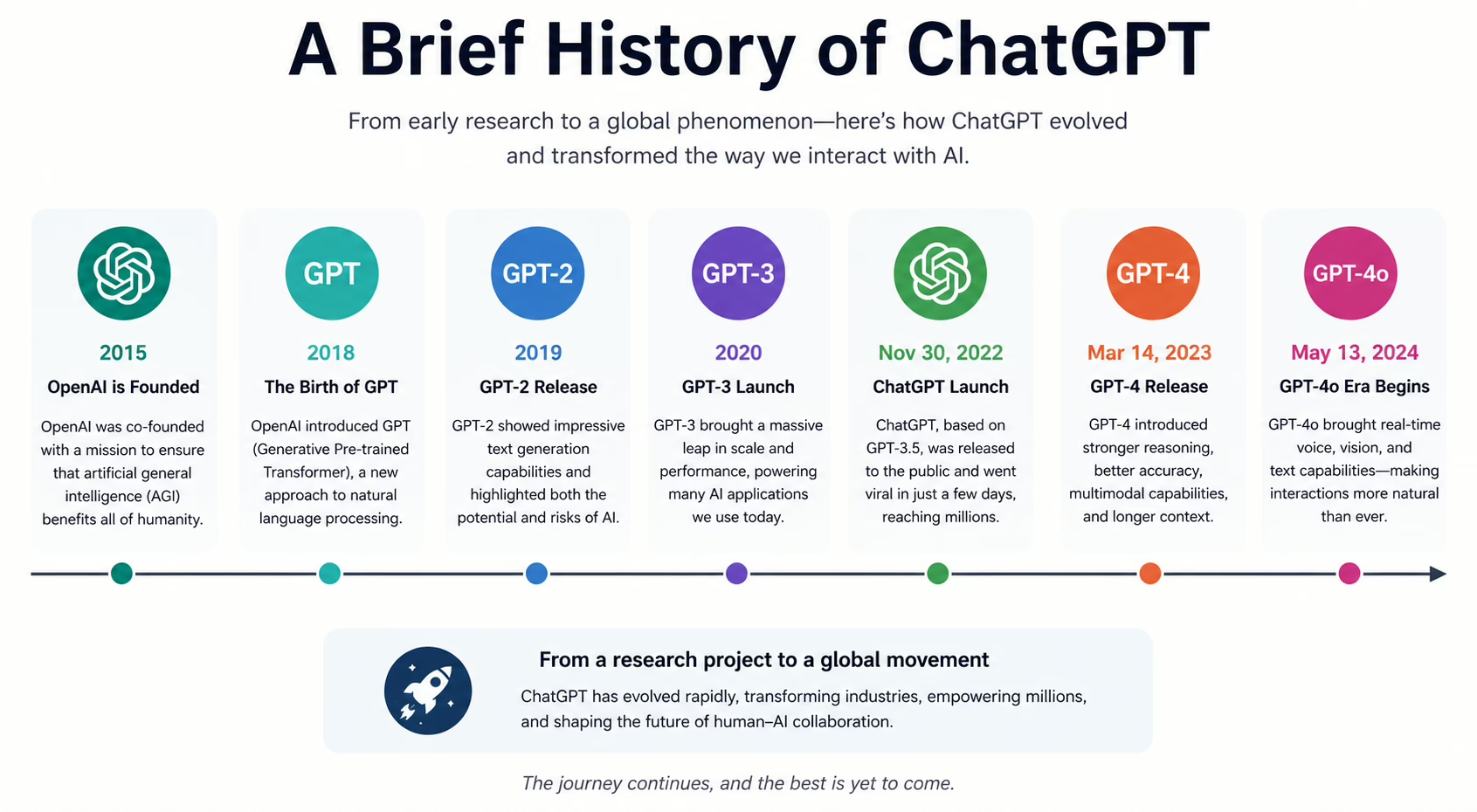
OpenAI was founded in 2015 as a nonprofit AI safety research organization, with backing from Elon Musk, Sam Altman, Peter Thiel, and others. It later transitioned to a “capped-profit” structure to attract the investment required for frontier AI development.
The GPT (Generative Pre-trained Transformer) lineage began with GPT-1 in 2018 a proof-of-concept that a transformer model pre-trained on large text corpora could perform well across language tasks. GPT-2 followed in 2019, briefly withheld from full release over concerns it would be misused for disinformation. GPT-3, released in 2020, was the first model powerful enough to attract serious commercial attention, licensing its API to thousands of developers.
ChatGPT launched in November 2022 as a fine-tuned version of GPT-3.5, specifically trained for dialogue using a technique called Reinforcement Learning from Human Feedback (RLHF). It was positioned as a research preview. The response was unprecedented.
GPT-4 arrived in March 2023 with dramatically improved reasoning and the first multimodal capabilities. The GPT-4o model, introduced in 2024, unified text, vision, and audio in a single architecture. Alongside the consumer product, OpenAI has built an API ecosystem, enterprise contracts, and partnerships with Microsoft that have embedded ChatGPT’s underlying models across Office, Azure, Bing, and GitHub Copilot.
How ChatGPT Works
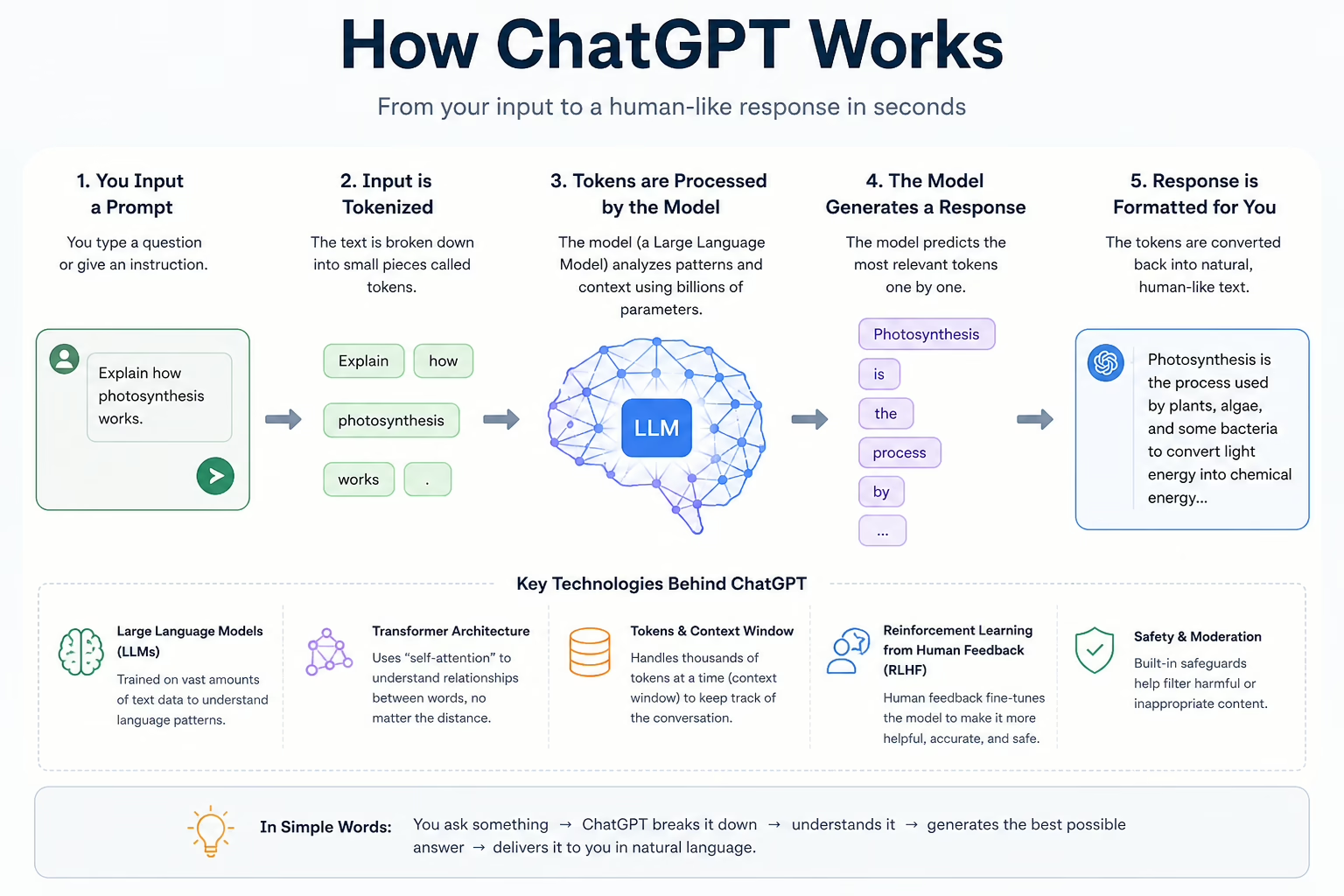
Understanding what ChatGPT can and can’t do requires understanding how it actually functions. The following is accurate but non-technical enough for any reader.
Large Language Models (LLMs)
ChatGPT is powered by a large language model a neural network trained on vast quantities of text to predict what words, sentences, or paragraphs should come next given a particular input. LLMs don’t retrieve information from a database the way a search engine does. They generate responses by drawing on statistical patterns compressed into billions of numerical parameters during training.
This distinction matters enormously in practice. ChatGPT doesn’t “look up” answers; it produces text that is statistically consistent with patterns in its training data. That’s why it can write fluently on almost any topic and also why it can confidently state something that’s simply wrong.
Transformer Architecture
The transformer architecture, introduced in the landmark 2017 paper “Attention Is All You Need” by researchers at Google, is what makes modern LLMs possible. The key innovation was the attention mechanism: a method that lets the model weigh the relevance of every word in the input against every other word, capturing long-range relationships in text that earlier architectures missed.
GPT models use a decoder-only transformer. During training, the model processes sequences of text and learns to predict the next token. Over billions of training examples, the weights of the network adjust to capture grammar, facts, reasoning patterns, style, and much more all without any explicit rules being programmed.
Tokens and Context Windows
ChatGPT doesn’t read text the way humans do. It processes tokens chunks of text that approximate words or word-parts. The word “unhelpful” might be two tokens (“un” and “helpful”). A typical English word is roughly 1.3 tokens.
The context window is the total amount of text your input plus the model’s output that the model can process in a single session. GPT-4o supports a 128,000-token context window, roughly equivalent to a short novel. Everything outside the context window is invisible to the model, which is why very long conversations can cause it to “forget” details from earlier exchanges.
Token limits also determine pricing in API usage and affect how much background information you can provide in a single prompt.
Reinforcement Learning from Human Feedback (RLHF)
Training a powerful language model doesn’t automatically produce a helpful, safe assistant. GPT-3, in its raw form, would complete prompts in ways that were often harmful, biased, or unhelpful. RLHF is the process OpenAI used to align GPT models toward genuinely useful behavior.
The process works in three stages. First, human trainers demonstrate ideal conversations. Second, a separate “reward model” is trained on human rankings of model outputs which responses are better, safer, more helpful? Third, the main model is fine-tuned using reinforcement learning to maximize the reward model’s score.
RLHF is responsible for ChatGPT’s conversational tone, its tendency to acknowledge uncertainty, and its refusals of harmful requests. It also introduces limitations: the model can become overly cautious or sycophantic, telling users what they want to hear rather than what’s accurate.
Our Testing Methodology
We evaluated ChatGPT across six primary categories over an extended period, using both GPT-4o and the o1/o3 reasoning models where relevant. Our methodology:
Content creation: We gave ChatGPT briefs ranging from 200-word product descriptions to 3,000-word technical articles, tested it on brand voice replication, and used it for email drafting, ad copy, and social media content.
Coding: We tested it on debugging tasks, asked it to write functions in Python, JavaScript, and SQL, had it explain unfamiliar codebases, and evaluated it on algorithmic problems ranging from straightforward to genuinely complex.
Research: We used it for literature summarization, competitive analysis, and fact-gathering specifically measuring how often it produced accurate citations versus fabricated ones.
Productivity: We tested meeting summarization, document drafting, scheduling logic, and workflow automation prompts.
Business workflows: We evaluated customer support script generation, policy document drafting, and internal knowledge management use cases.
Prompt engineering: We systematically varied prompt structure, persona instructions, temperature, and constraint framing to understand how output quality changes with input quality.
Our evaluation criteria: accuracy, consistency, practical utility, and failure rate. We tracked specific errors and noted which categories of task produced the most unreliable outputs.
What Can ChatGPT Do?
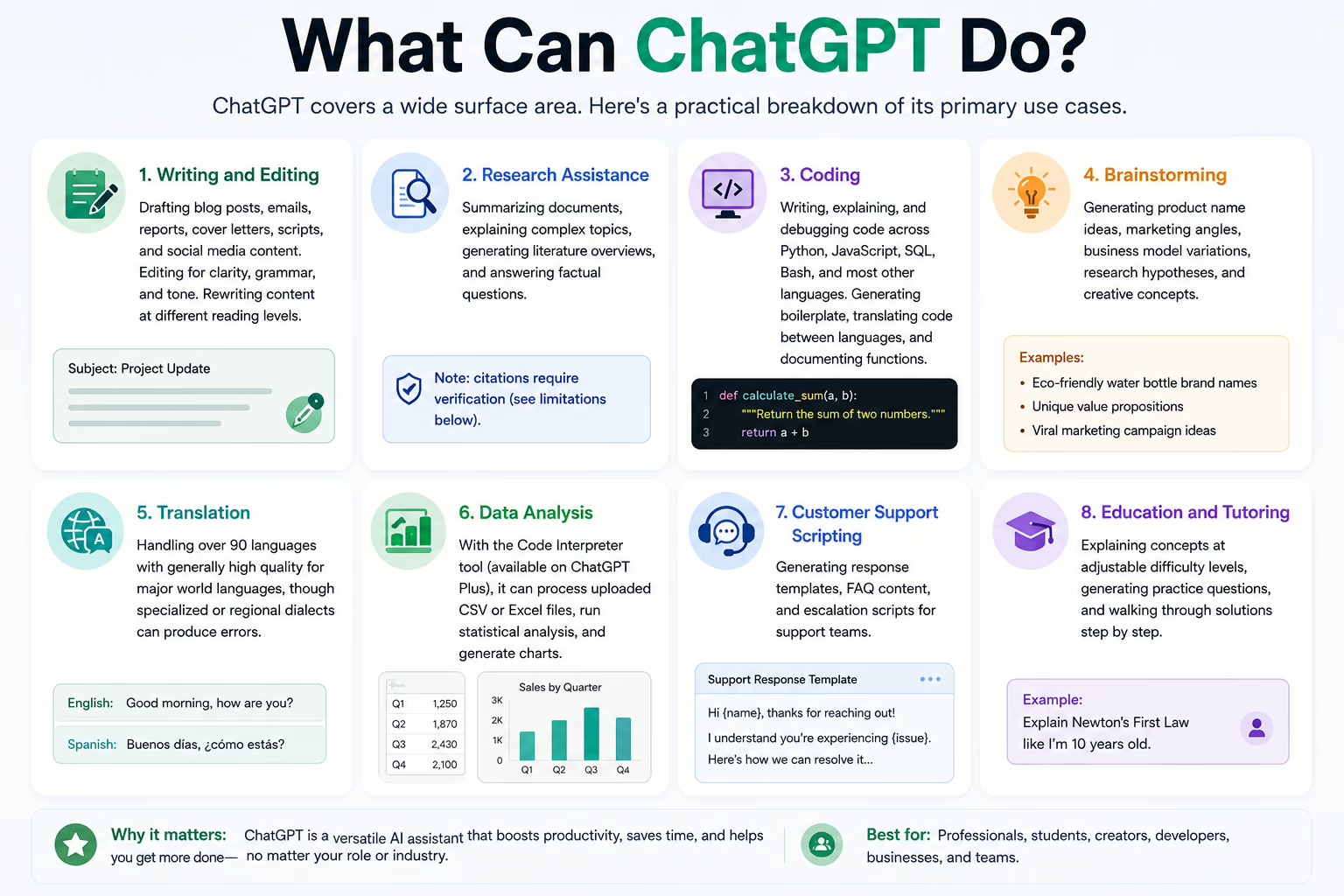
ChatGPT covers a wide surface area. Here’s a practical breakdown of its primary use cases.
Writing and editing: Drafting blog posts, emails, reports, cover letters, scripts, and social media content. Editing for clarity, grammar, and tone. Rewriting content at different reading levels.
Research assistance: Summarizing documents, explaining complex topics, generating literature overviews, and answering factual questions. Note: citations require verification (see limitations below).
Coding: Writing, explaining, and debugging code across Python, JavaScript, SQL, Bash, and most other languages. Generating boilerplate, translating code between languages, and documenting functions. We have also evaluated emerging AI coding models, including Xiaomi’s MiMo. Our detailed Xiaomi MiMo code review highlights how newer reasoning-focused models compare with ChatGPT for programming and debugging tasks.
Brainstorming: Generating product name ideas, marketing angles, business model variations, research hypotheses, and creative concepts.
Translation: Handling over 90 languages with generally high quality for major world languages, though specialized or regional dialects can produce errors.
Data analysis: With the Code Interpreter tool (available on ChatGPT Plus), it can process uploaded CSV or Excel files, run statistical analysis, and generate charts.
Customer support scripting: Generating response templates, FAQ content, and escalation scripts for support teams.
Education and tutoring: Explaining concepts at adjustable difficulty levels, generating practice questions, and walking through solutions step by step.
Our Hands-On Experience Using ChatGPT
After extensive use across the categories above, a few consistent patterns emerged.
Where it exceeded expectations: ChatGPT is genuinely excellent at the first 80% of almost any writing task. Give it a clear brief, and it produces a usable draft faster than any human writer. For developers, it functions as a tireless code reviewer paste in an error message and a code block, and it identifies the problem correctly the majority of the time. As a brainstorming partner, it generates volume that a lone human brain can’t match, and some of those ideas are actually good.
Where human expertise remains essential: The final 20% the part that requires genuine domain judgment, brand intuition, or creative distinction, is where ChatGPT consistently falls short. It produces text that is grammatically correct and structurally sound, but often lacks the specific detail, tonal precision, or argumentative depth that separates good writing from great writing. In technical domains, it can produce code that looks right and subtly isn’t, requiring review from someone who actually understands the codebase.
Productivity gains we measured: In content production workflows, experienced users with strong prompting skills reduced first-draft time by 50–70%. In coding workflows, debugging and documentation tasks were notably faster. In research contexts, the gains were real but came with a verification overhead that partially offset the time saved.
The prompting skill gap is real: ChatGPT’s output quality varies dramatically based on how a prompt is written. Vague prompts produce generic outputs. Specific, structured prompts with examples, constraints, and explicit goals produce outputs that are substantially better. This means there’s a learning curve to extracting genuine value.
What ChatGPT Does Well
- Rapid first drafts: It dramatically compresses the time from blank page to working draft across almost any text format.
- Code explanation and debugging: It explains what a block of code does with impressive clarity and catches common bugs efficiently.
- Format transformation: Converting bullet points into prose, tables into summaries, or interviews into reports it handles structural transformation reliably.
- Consistent tone application: When given a clear style guide or example text, it maintains tone consistently across long outputs.
- Simplification: Translating dense technical content into plain language, or academic writing into accessible summaries, is something it handles well.
- Multilingual work: For major languages, translation quality is competitive with dedicated translation tools, and it handles nuance better than early machine translation.
- Sustained dialogue: Within a context window, it tracks conversation history reliably and can refer back to earlier points in a session.
Where ChatGPT Still Falls Short
Hallucinations: This is the most significant and persistent limitation. ChatGPT generates text that sounds authoritative even when it’s factually wrong. It can invent academic citations, product names, historical events, and statistics with complete grammatical confidence. This isn’t a bug in the traditional sense it’s a consequence of how LLMs generate text. Any factual claim made by ChatGPT should be independently verified before publication or use in a professional context.
Citation accuracy: When asked to find or cite sources, ChatGPT frequently fabricates plausible-sounding references authors, journals, titles, and DOIs that do not exist. Verified web browsing in GPT-4o reduces this significantly, but doesn’t eliminate it. Never use ChatGPT-generated citations without confirming them yourself.
Reasoning limitations: On multi-step logical problems, complex mathematical reasoning, and tasks that require holding many variables in precise relationship, ChatGPT’s performance degrades. The o1 and o3 reasoning models improve this substantially, but even they make errors on problems that require precise symbolic reasoning.
Outdated information: ChatGPT’s knowledge has a training cutoff (currently early 2025 for GPT-4o). Events, products, regulations, or data after that date are unknown unless the web browsing tool is active. Even with browsing enabled, synthesis of very recent information can be uneven.
Brand voice consistency at scale: For organizations with tightly defined brand voices, ChatGPT needs careful constraint to stay on-voice and even then, extended outputs can drift toward generic corporate prose. It works better as a drafting accelerator than a direct publisher.
Complex document understanding: While the context window is large, ChatGPT’s ability to reason about very long, densely structured documents contracts, technical specifications, regulatory filings is less reliable than its performance on shorter inputs.
ChatGPT vs Gemini vs Claude
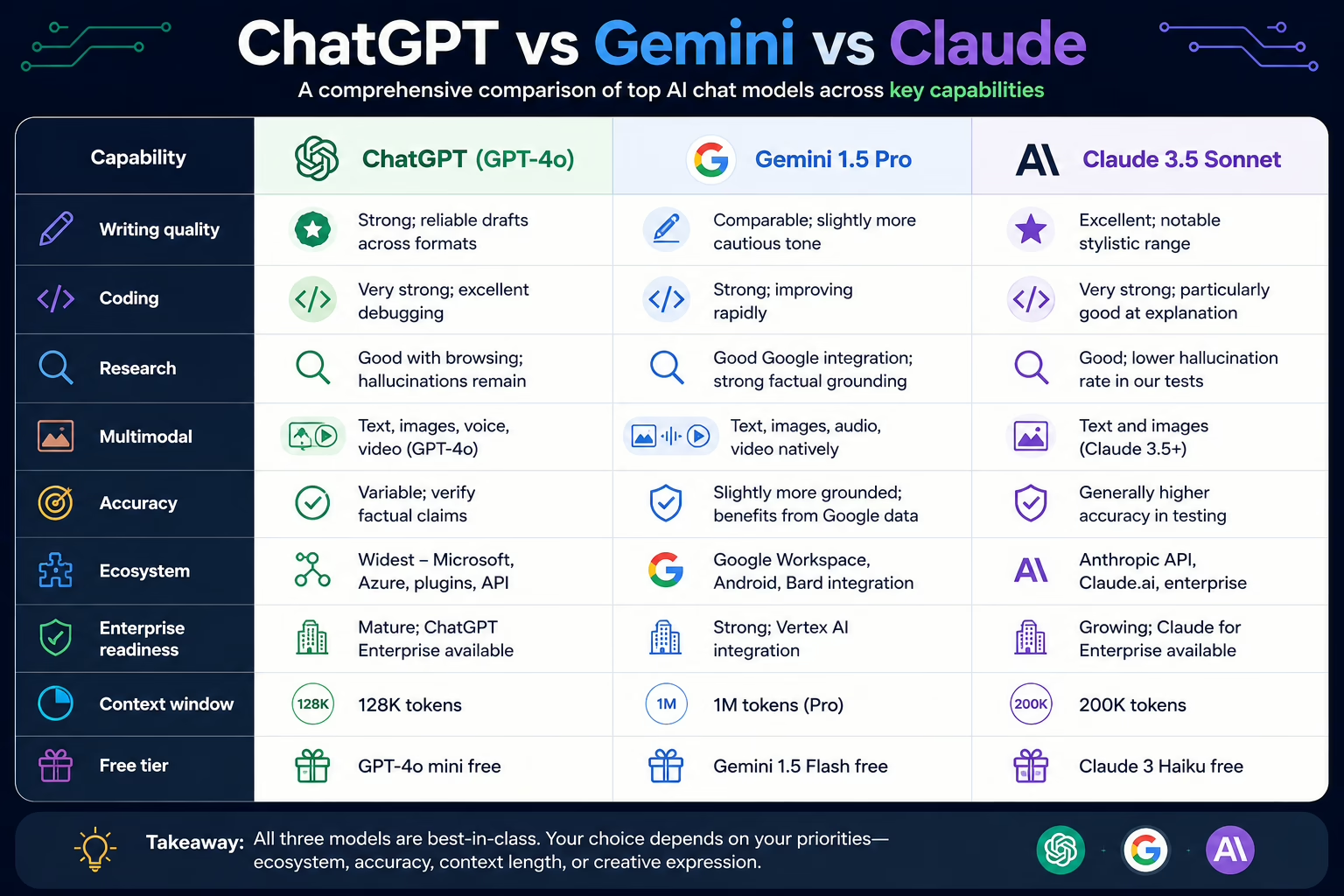
| Capability | ChatGPT (GPT-4o) | Gemini 1.5 Pro | Claude 3.5 Sonnet |
|---|---|---|---|
| Writing quality | Strong; reliable drafts across formats | Comparable; slightly more cautious tone | Excellent; notable stylistic range |
| Coding | Very strong; excellent debugging | Strong; improving rapidly | Very strong; particularly good at explanation |
| Research | Good with browsing; hallucinations remain | Good Google integration; strong factual grounding | Good; lower hallucination rate in our tests |
| Multimodal | Text, images, voice, video (GPT-4o) | Text, images, audio, video natively | Text and images (Claude 3.5+) |
| Accuracy | Variable; verify factual claims | Slightly more grounded; benefits from Google data | Generally higher accuracy in testing |
| Ecosystem | Widest Microsoft, Azure, plugins, API | Google Workspace, Android, Bard integration | Anthropic API, Claude.ai, enterprise |
| Enterprise readiness | Mature; ChatGPT Enterprise available | Strong; Vertex AI integration | Growing; Claude for Enterprise available |
| Context window | 128K tokens | 1M tokens (Pro) | 200K tokens |
| Free tier | GPT-4o mini free | Gemini 1.5 Flash free | Claude 3 Haiku free |
The honest summary: for most general-purpose use cases, all three models are capable, and the differences are meaningful but not decisive. ChatGPT has the largest ecosystem and the most consumer-facing features. Gemini benefits from Google’s real-time data integration. Claude tends to perform better on tasks requiring careful reasoning and nuanced writing, and shows a lower rate of confidently stated errors in our testing. Tool choice should come down to your specific workflow, existing integrations, and the use case where you’ll spend the most time.
While ChatGPT represents the latest generation of conversational AI, earlier virtual assistants such as Siri AI introduced millions of users to voice-based interactions. The difference is that modern LLMs can reason, generate content, and handle complex tasks far beyond the capabilities of traditional voice assistants.
How Businesses Are Using ChatGPT Today
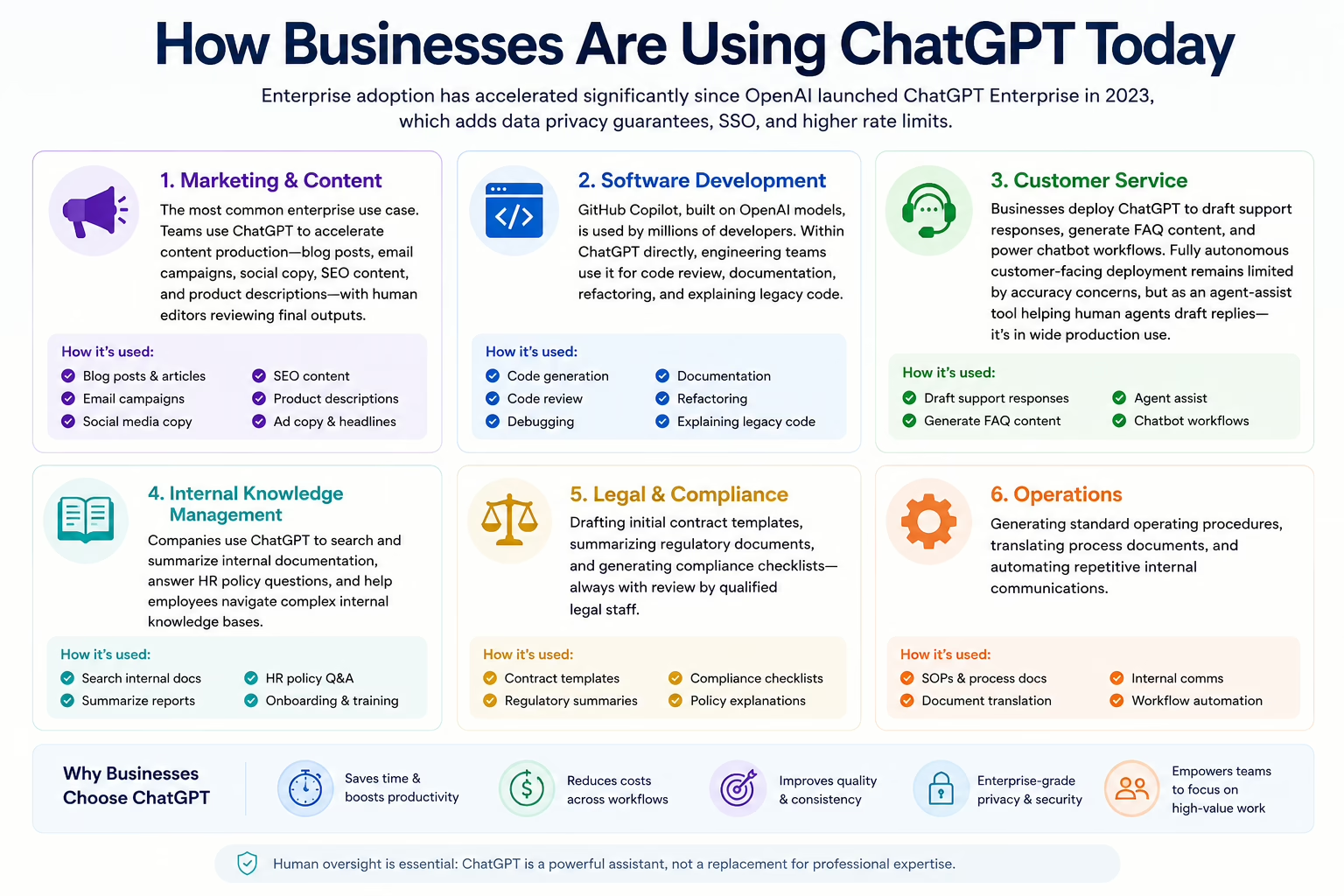
Enterprise adoption has accelerated significantly since OpenAI launched ChatGPT Enterprise in 2023, which adds data privacy guarantees, SSO, and higher rate limits.
Marketing and content: The most common enterprise use case. Teams use ChatGPT to accelerate content production blog posts, email campaigns, social copy, SEO content, and product descriptions with human editors reviewing final outputs.
Software development: GitHub Copilot, built on OpenAI models, is used by millions of developers. Within ChatGPT directly, engineering teams use it for code review, documentation, refactoring, and explaining legacy code.
Customer service: Businesses deploy ChatGPT to draft support responses, generate FAQ content, and power chatbot workflows. Fully autonomous customer-facing deployment remains limited by accuracy concerns, but as an agent-assist tool helping human agents draft replies it’s in wide production use.
Internal knowledge management: Companies use ChatGPT to search and summarize internal documentation, answer HR policy questions, and help employees navigate complex internal knowledge bases.
Legal and compliance: Drafting initial contract templates, summarizing regulatory documents, and generating compliance checklists always with review by qualified legal staff.
Operations: Generating standard operating procedures, translating process documents, and automating repetitive internal communications.
ChatGPT Privacy and Security Explained
Privacy is a legitimate concern, particularly for enterprise and professional use.
Default data handling (consumer): OpenAI’s default settings allow conversation data to be used to improve its models. Users can disable this in settings, which prevents conversations from being used for training but doesn’t affect real-time processing.
ChatGPT Enterprise and API: OpenAI’s enterprise agreements and API terms do not use customer data for model training by default. Data is not retained beyond the API response.
What not to share: Avoid entering personally identifiable information, confidential business data, trade secrets, or unpublished financial information into consumer ChatGPT. Even with privacy settings enabled, there is residual risk in any cloud-based AI service.
Security best practices:
- Use ChatGPT Enterprise or the API if handling sensitive business data
- Review your organization’s AI use policy before using consumer ChatGPT for work
- Treat any output that will be published or acted upon as a draft requiring human verification
- Enable multi-factor authentication on your OpenAI account
Regulatory considerations: Businesses operating under GDPR, HIPAA, or industry-specific data regulations should review OpenAI’s Data Processing Agreement before deployment. ChatGPT Enterprise includes a Business Associate Agreement for healthcare-adjacent use cases.
The Future of ChatGPT and Generative AI
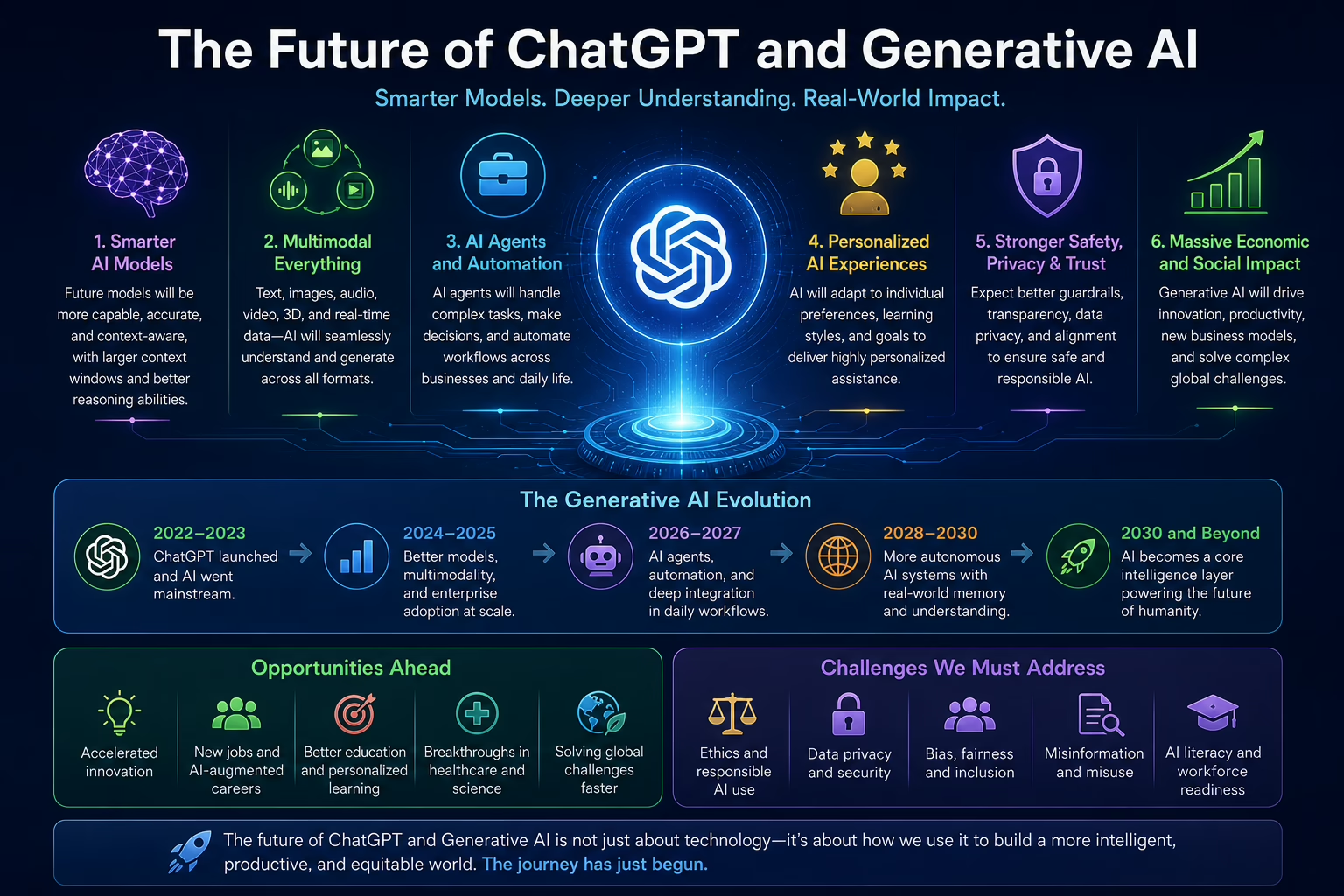
The trajectory of ChatGPT and the broader LLM market points in several clear directions.
Agentic AI: OpenAI’s Operator product and GPT-4o’s tool-use capabilities represent a shift from AI that answers questions to AI that takes actions booking appointments, running code, browsing websites, and completing multi-step tasks autonomously. This is the frontier that will matter most in the next two to three years.
Multimodal depth: Native video understanding, real-time voice conversation, and richer image generation are already available in some form. Expect these capabilities to mature significantly.
Reasoning improvements: The o-series models (o1, o3) represent a separate research track aimed at genuine multi-step reasoning rather than fluent text generation. Early results are impressive on structured problems; this track will likely converge with the main GPT lineage.
Cost reduction and specialization: As models become cheaper to run, we’ll see more fine-tuned domain-specific models legal, medical, financial rather than single general-purpose assistants.
Regulatory environment: The EU AI Act is in force; US federal AI policy continues to evolve. Enterprise adoption will increasingly require auditability, transparency, and documented compliance with AI governance frameworks.
The fundamental tension in generative AI between capability and reliability hasn’t been resolved. The models keep getting better; the hallucination problem is improving but not solved. The most productive framing for anyone building on or using these tools is “AI-assisted” rather than “AI-automated,” at least until accuracy benchmarks are substantially stronger.
ChatGPT is only one part of a much larger AI ecosystem. As artificial intelligence continues evolving, understanding foundational AI concepts becomes increasingly important for professionals and businesses alike.
Frequently Asked Questions
What is ChatGPT in simple terms?
ChatGPT is an AI chatbot that can hold conversations, write text, answer questions, and help with tasks like coding and research. It’s built on a large language model trained on vast amounts of text.
Is ChatGPT free to use?
Yes, a free version using GPT-4o mini is available at chat.openai.com. ChatGPT Plus costs $20/month and provides access to GPT-4o, advanced reasoning models, and tools like image generation and web browsing.
Who made ChatGPT?
ChatGPT was made by OpenAI, an AI research company founded in 2015 and based in San Francisco. Microsoft is a major investor and has integrated OpenAI’s models into its products.
What is the difference between ChatGPT and GPT-4?
GPT-4 is the underlying AI model; ChatGPT is the consumer interface built on top of it. ChatGPT Plus users access GPT-4o (the current flagship version of GPT-4) through the chat interface.
Can ChatGPT access the internet?
ChatGPT Plus subscribers can enable web browsing, which allows the model to retrieve and cite current information. The free tier does not include real-time web access.
Does ChatGPT save my conversations?
By default, yes. You can disable this in Settings > Data Controls. ChatGPT Enterprise and API users have stronger privacy protections by default.
Is ChatGPT accurate?
ChatGPT is often accurate but not reliably so. It can confidently state incorrect information a problem called hallucination. Factual claims, especially citations and statistics, should always be verified independently.
What is the difference between ChatGPT and Claude?
Both are AI assistants built on large language models. Claude is made by Anthropic; ChatGPT is made by OpenAI. In our testing, Claude shows a slightly lower rate of confidently stated errors and strong performance on nuanced writing tasks. ChatGPT has a larger ecosystem, more consumer-facing features, and the widest third-party integration.
What is the difference between ChatGPT and Gemini?
Gemini is Google’s AI assistant. Its main advantages are deep Google Workspace integration, a 1-million-token context window on Pro, and strong factual grounding from Google’s data. ChatGPT has a broader plugin and tool ecosystem and more mature enterprise offerings.
Can ChatGPT write code?
Yes, and well. It handles most common programming languages, explains code clearly, identifies bugs, and generates boilerplate efficiently. Complex algorithmic work and unfamiliar codebases require human review.
What are ChatGPT’s biggest limitations?
The three most important: hallucinations (confidently wrong answers), outdated knowledge (training cutoff applies unless browsing is enabled), and inconsistency (output quality varies with prompt quality and task type).
Is ChatGPT safe for business use?
With appropriate precautions using Enterprise or API tiers, avoiding sensitive data input, and treating outputs as drafts, yes. Consumer ChatGPT is not recommended for confidential business data.
Our Final Verdict
ChatGPT is the most consequential productivity tool released in the past decade. It is genuinely useful for a wide range of writing, coding, research, and analysis tasks, and when used well with skilled prompting and appropriate verification it delivers real time savings and output quality that would have seemed implausible five years ago.
It is not a replacement for domain expertise, critical judgment, or careful editing. It hallucinates. Its outputs require review. And the gap between what casual users experience and what power users extract from the same tool is larger than with almost any other software we’ve tested.
For individuals: the free tier is worth experimenting with. If you write, code, or research professionally, a Plus subscription pays for itself quickly if you put the time into learning to prompt effectively.
For businesses: start with specific, bounded use cases content drafts, support scripts, internal documentation rather than trying to automate complex workflows immediately. Measure accuracy on your specific tasks before scaling.
The technology is moving faster than any evaluation can fully capture. What’s accurate today about capabilities and limitations will be partially obsolete within months. What won’t change: the need for human judgment at the point where AI output meets the real world.
Editorial Note:
Our analysis is based on hands-on testing of ChatGPT across content creation, research, coding, and productivity workflows. Technical explanations were cross-checked using OpenAI documentation, published AI research papers, and industry resources.
Sources and References
Official Sources
Research Papers
- Attention Is All You Need (Transformer Paper)
- Language Models are Few-Shot Learners (GPT-3)
- InstructGPT Research Paper
Additional Reading
About the Author
RCN Guide Staff is the editorial team behind RCN Guide, a technology publication covering artificial intelligence, software, cybersecurity, consumer technology, mobile innovation, and digital trends. Our team researches, tests, and analyzes emerging technologies to provide accurate, practical, and up-to-date information for readers. Articles published under RCN Guide Staff undergo editorial review and fact-checking to ensure quality, accuracy, and trustworthiness.
Use the key points in this guide to understand the topic and make more informed decisions.

This guide is researched and edited using relevant documentation, reliable sources and publicly available information.
Was this guide helpful?
Your feedback helps us improve future guides.