In this article
McKinsey’s 2026 State of AI survey reports that 44% of organizations now say AI is scaling across the enterprise, up from 38% a year earlier. Among organizations with more than $1 billion in revenue, 54% report enterprise-wide scaling. Yet only 6% of respondents qualify as AI high performers that report significant value and at least 5% EBIT impact from AI.
This shows that while every business is using ML models today, a lot of the custom ML projects end up failing. And that rarely happens because the algorithm was incapable. The real reason why enterprise-grade ML models fail is that the system around the algorithm changed.
In practice, it looks like a feature pipeline that starts producing incomplete records. A source system that changes its schema without notifying the ML team. A model trained on last year’s customer behavior that is suddenly making decisions against a different market. A deployment that passes every offline evaluation but performs poorly under real traffic. Nobody notices these issues until the business metric moves.
So, yes, model training is important. But it is only one stage in a much larger operating system.
Enterprise ML therefore needs to be treated as a lifecycle: data enters the system, models are developed and validated, artifacts are versioned, deployments are controlled, production behavior is monitored, and new evidence feeds the next training cycle. Understanding the dependencies across each stage of the machine learning lifecycle helps teams maintain reliability beyond deployment.
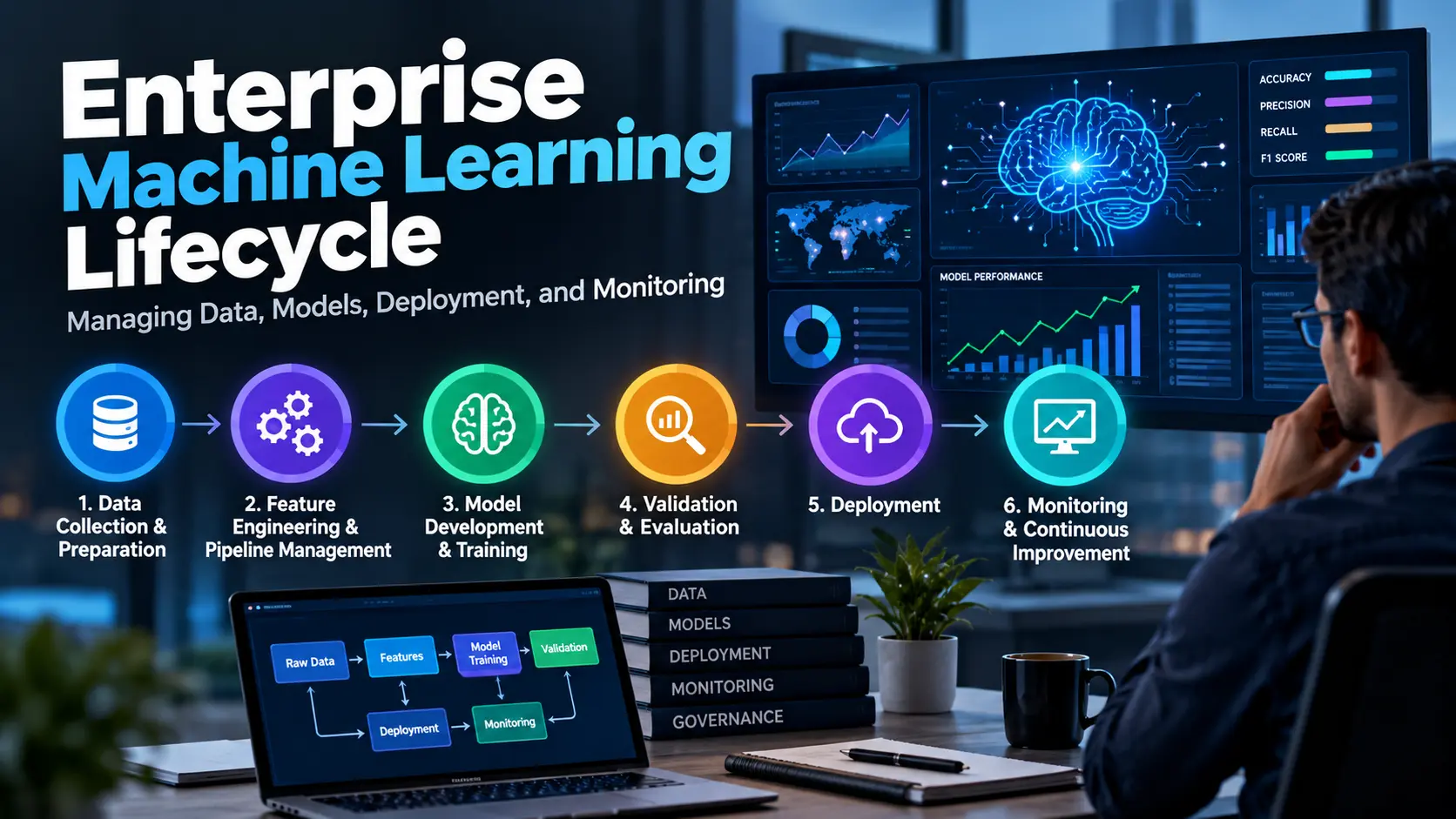
The enterprise machine learning lifecycle: 6 stages explained
An enterprise ML lifecycle connects data preparation, model development, validation, deployment, and monitoring into one continuous process. Each stage has its own failure risks, but those risks rarely stay isolated. A data quality issue can undermine model accuracy, weak validation can allow unreliable predictions into production, and inadequate monitoring can leave performance degradation undetected.
Here is how enterprise teams can manage each stage and prevent avoidable failures.
1. Data collection and preparation
Enterprise models often draw data from CRM platforms, ERP systems, transaction databases, and third-party sources. Differences in formats, missing records, inconsistent identifiers, and delayed updates can undermine the quality of training data before model development begins.
How to prevent failure:
- Validate data completeness, consistency, freshness, and acceptable values before processing.
- Track data lineage to establish where records originate and how they are transformed.
- Define data contracts that specify schemas, update frequencies, and ownership.
- Check whether datasets represent the customer segments and operating conditions the model will encounter.
These checks must continue after deployment. An upstream system can change its schema or stop supplying a required field without the ML team immediately noticing.
2. Feature engineering and pipeline management
Feature engineering converts raw data into meaningful model inputs, such as transaction frequency, customer tenure, or equipment performance trends. Problems emerge when training and production pipelines calculate these features differently.
For example, a fraud detection model trained on five-minute transaction windows may receive inconsistent inputs if production processes delayed events differently. The model may continue generating predictions even as their reliability declines.
How to prevent failure:
- Standardize feature definitions and reuse transformation logic where practical.
- Version feature pipelines alongside datasets, code, and model artifacts.
- Monitor missing features, stale values, and unexpected distribution changes.
- Test that training and production generate equivalent features under comparable conditions.
Treat feature pipelines as production software, with documented dependencies, automated tests, and controlled changes.
3. Model development and training
Model development involves selecting algorithms, defining target variables, choosing evaluation metrics, and training against prepared data. The primary risk is optimizing for training performance without establishing whether the model generalizes to unseen situations.
Data leakage, overfitting, and poorly defined business objectives can produce impressive evaluation scores without meaningful operational results. A complex model may also introduce unnecessary serving costs or maintenance requirements.
How to prevent failure:
- Define measurable business outcomes before selecting model architectures.
- Use appropriate validation splits, including time-based splits for temporal problems.
- Establish baseline models to determine whether added complexity delivers meaningful gains.
- Track experiments, parameters, dataset versions, and model artifacts for reproducibility.
- Evaluate errors according to their business consequences, not accuracy alone.
The objective is to develop a model that meets operational requirements, not simply one that achieves the highest offline score.
4. Model validation and evaluation
A model can perform well during training but fail under real business conditions. Aggregate accuracy may conceal poor performance across customer segments, unusual transactions, or seasonal demand patterns.
Validation must establish whether the model is reliable enough for its intended use and whether its limitations are understood before release.
How to prevent failure:
- Evaluate relevant metrics, including precision, recall, calibration, and latency where applicable.
- Test important segments, edge cases, and representative operating conditions.
- Establish explicit acceptance thresholds before production approval.
- Use stress testing and shadow-mode evaluations when appropriate.
- Document known limitations, assumptions, and conditions requiring further review.
Involving business owners and operational teams helps ensure that technically sound predictions also support real decisions.
5. Deployment and release management
Production introduces infrastructure, integration, security, and performance constraints that development environments may not reproduce. A model that works during testing can struggle under peak traffic, exceed latency requirements, or fail because of an incompatible dependency.
Replacing a functioning model without a reliable rollback plan can create additional operational risk.
How to prevent failure:
- Automate testing, artifact verification, and approval checks in deployment pipelines.
- Introduce changes through controlled releases, such as canary or shadow deployments.
- Test API integrations, access controls, throughput, latency, and downstream dependencies.
- Maintain approved model versions and a tested rollback procedure.
- Track infrastructure consumption and inference costs alongside model performance.
Deployment should be a controlled transition from a validated model to a functioning business capability, with every release remaining traceable.
6. Production monitoring, feedback, and retraining
Business conditions change after deployment. Customer behavior evolves, fraud patterns shift, and source systems introduce new data distributions. Monitoring must therefore assess model behavior as well as service availability.
Data drift can indicate changes in incoming features, while concept drift occurs when the relationship between inputs and outcomes changes. Some degradation becomes visible only when reliable ground-truth labels become available.
How to prevent failure:
- Monitor feature distributions, missing values, prediction patterns, and model quality.
- Connect technical alerts to business outcomes wherever measurable.
- Define thresholds and escalation paths for meaningful performance degradation.
- Trigger retraining or review based on evidence rather than calendar schedules alone.
- Revalidate every retrained model before promoting it to production.
- Maintain records of model changes, approvals, incidents, and retraining decisions.
Retraining is not a universal fix. If the underlying issue is corrupted data, a broken feature pipeline, or an incorrect business assumption, retraining can reproduce the same failure.
Pratik Mistry, EVP of Technology Consulting at Radixweb, explains the distinction very well when he says, “Enterprise ML succeeds when teams treat production as part of the learning system, not the finish line. The real discipline is building the feedback, governance, and engineering controls that allow models to evolve safely.”
This principle also shapes the engineering decisions behind building custom machine learning software. The goal is to build not just a model that meets initial requirements, but an operational system that keeps it reliable as business conditions change.
Where the enterprise ML lifecycle is heading
The next phase of enterprise ML will not be defined simply by larger models or more sophisticated algorithms. It will be defined by how reliably organizations can operate many models simultaneously.
As portfolios expand, manual model reviews, disconnected monitoring dashboards, undocumented dependencies, and ad hoc retraining schedules become organizational bottlenecks. Model registries will need stronger relationships with data catalogs, deployment platforms, observability systems, security controls, and business metrics. Governance will increasingly become embedded in deployment workflows rather than handled through separate approval processes.
The Economics of ML will matter as well. A model that improves a metric by two percentage points but requires expensive real-time infrastructure may not be the right enterprise choice. Conversely, a simpler model that is stable, explainable, inexpensive to serve, and easy to retrain may produce more durable value.
The organizations that handle this well will treat ML as an operational capability rather than a collection of successful models.
The central question is no longer whether a model can perform well in a controlled environment. It is whether the organization can continuously prove that the model remains useful, reliable, observable, governable, and economically justified after reality starts changing.
That is where the enterprise ML lifecycle becomes the real competitive infrastructure.
Connecting the machine learning lifecycle to wider enterprise operations
Machine learning does not operate in isolation. In a modern organisation, models increasingly influence customer interactions, marketing decisions, security controls, product development, and day-to-day business operations. Their reliability therefore depends on more than the quality of training data or the performance of an individual algorithm.
This is where enterprise ML becomes part of a broader enterprise AI strategy. Understanding what enterprise AI means for modern businesses helps organisations distinguish individual machine learning projects from systems designed to connect data, automation, decision-making, and operational workflows across departments.
The distinction matters because an organisation can deploy several successful models without establishing a reliable process for managing them together. Shared data standards, consistent access controls, documented responsibilities, and measurable business objectives help ensure that individual models contribute to the same organisational goals.
Data quality, security, and trust across the enterprise
Reliable predictions begin with reliable information, but enterprise data management also requires attention to privacy, access, and security. Models may depend on customer records, transaction histories, application events, and other information that organisations cannot afford to expose or process without appropriate controls.
For example, network information can contribute to fraud detection, traffic analysis, and security investigations. However, an internet provider’s IP address and what it reveals about users online also illustrates why teams must understand the limitations of individual data points. An IP address can provide useful context, but it does not independently establish a person’s identity, intent, or behaviour.
The same principle applies to identity and access management. How passkeys work without passwords provides useful context for understanding how authentication methods can reduce reliance on traditional passwords. For enterprise ML systems, stronger authentication and carefully managed permissions help protect model registries, data pipelines, deployment environments, and monitoring platforms.
Security controls should be part of the lifecycle rather than a separate activity introduced after a model has already reached production. Teams need to know which datasets a model can access, who can approve changes, how sensitive information is handled, and what happens when an account or integration is compromised.
Managing AI across marketing and customer-facing systems
The lifecycle also becomes more complicated when machine learning supports customer-facing decisions. Marketing teams, for instance, increasingly use AI-driven systems to allocate budgets, personalise campaigns, evaluate content, and understand how audiences discover a brand.
In paid advertising, what PPC management looks like now that Google Ads runs more on AI demonstrates why automation still requires meaningful human oversight. Automated bidding and campaign optimisation can make decisions at scale, but the quality of those decisions depends on conversion tracking, the relevance of the underlying data, and the objectives used to evaluate performance.
A similar challenge exists in organic and AI-driven discovery. Businesses assessing AI visibility service providers for brands competing in AI search need to understand how visibility is measured, which signals are monitored, and whether reported improvements translate into meaningful business outcomes.
These examples reinforce an important lifecycle principle: a model or automated system should not be judged solely by its immediate output. Organisations must connect technical measurements with outcomes such as qualified leads, customer retention, conversion quality, and operating costs. Without that connection, an apparently successful system can optimise the wrong objective.
Model selection, project management, and business accountability
Not every enterprise problem requires the same type of AI system. Some applications benefit from predictive models trained on structured historical data, while others may rely on generative AI, computer vision, or a combination of approaches. The appropriate choice depends on the task, available data, performance requirements, governance obligations, and cost of failure.
Consider generative video as an example. A practical Higgsfield AI review covering its features, pricing, and video tools illustrates a different category of AI application from a traditional forecasting or fraud detection model. Although the development and evaluation methods differ, the operational questions remain familiar: how should outputs be assessed, what limitations need to be documented, how are costs controlled, and who is responsible when results do not meet expectations?
Coordinating these decisions requires more than technical expertise. Teams also need clear ownership, realistic milestones, risk assessment, and communication between technical and non-technical stakeholders. Developing the skills needed to succeed in AI project management helps explain why successful AI initiatives depend on managing people, processes, and business expectations alongside the technology itself.
The same thinking applies beyond software. In exhibition planning, for example, customer requirements, design decisions, supplier coordination, and delivery deadlines all need to remain aligned. The operational considerations discussed in what makes an exhibition stand successful in Hannover provide a useful business context for understanding how multiple dependencies must come together to deliver a successful outcome. When AI supports such workflows, the quality of the result still depends on reliable inputs, clear responsibilities, and effective coordination.
Governance must also account for risks that are not captured by model evaluation metrics. A technically accurate system can still create business problems if its outputs are misleading, its decisions cannot be explained adequately, or its use damages customer confidence. This is particularly relevant when considering how a CEO’s personal reputation can become a business risk. Leadership accountability, communication, and trust remain important even when automated systems are performing as designed.
Building a lifecycle that can adapt over time
As enterprise AI adoption expands, the challenge will increasingly shift from deploying individual models to managing interconnected systems throughout their useful lives. Data pipelines, model versions, security controls, business processes, and monitoring systems must evolve without creating unnecessary operational risk.
That requires organisations to establish a repeatable process for evaluating new use cases, validating their assumptions, approving releases, measuring outcomes, and responding when performance changes. It also means recognising when a model should be retrained, when a pipeline needs repairing, and when the underlying business requirement has changed enough to justify a different approach.
The objective is not to automate every decision or continuously replace existing models with newer technology. It is to establish an operating framework in which AI systems can be evaluated on evidence, maintained responsibly, and improved when there is a clear business reason to do so.
Ultimately, the enterprise machine learning lifecycle provides the structure that makes this possible. By connecting data preparation, model development, validation, deployment, monitoring, and governance, organisations can move beyond isolated AI experiments and build systems that remain useful as their technology, customers, and business priorities change.
Use the key points in this guide to understand the topic and make more informed decisions.

This guide is researched and edited using relevant documentation, reliable sources and publicly available information.
Was this guide helpful?
Your feedback helps us improve future guides.