In this article
If you drive for work, 2026 brought a change to the mileage deduction that you cannot afford to overlook. For the first time in years, the IRS did not stick to a single rate for the whole year. Instead, it set one rate for the first half and raised it for the second, which means getting your deduction right in 2026 depends on knowing exactly when each trip happened. Understanding the irs mileage rate 2026 and how the mid-year split works is essential for anyone claiming vehicle expenses this year, and this guide lays it out clearly.
The 2026 Rate Comes in Two Parts
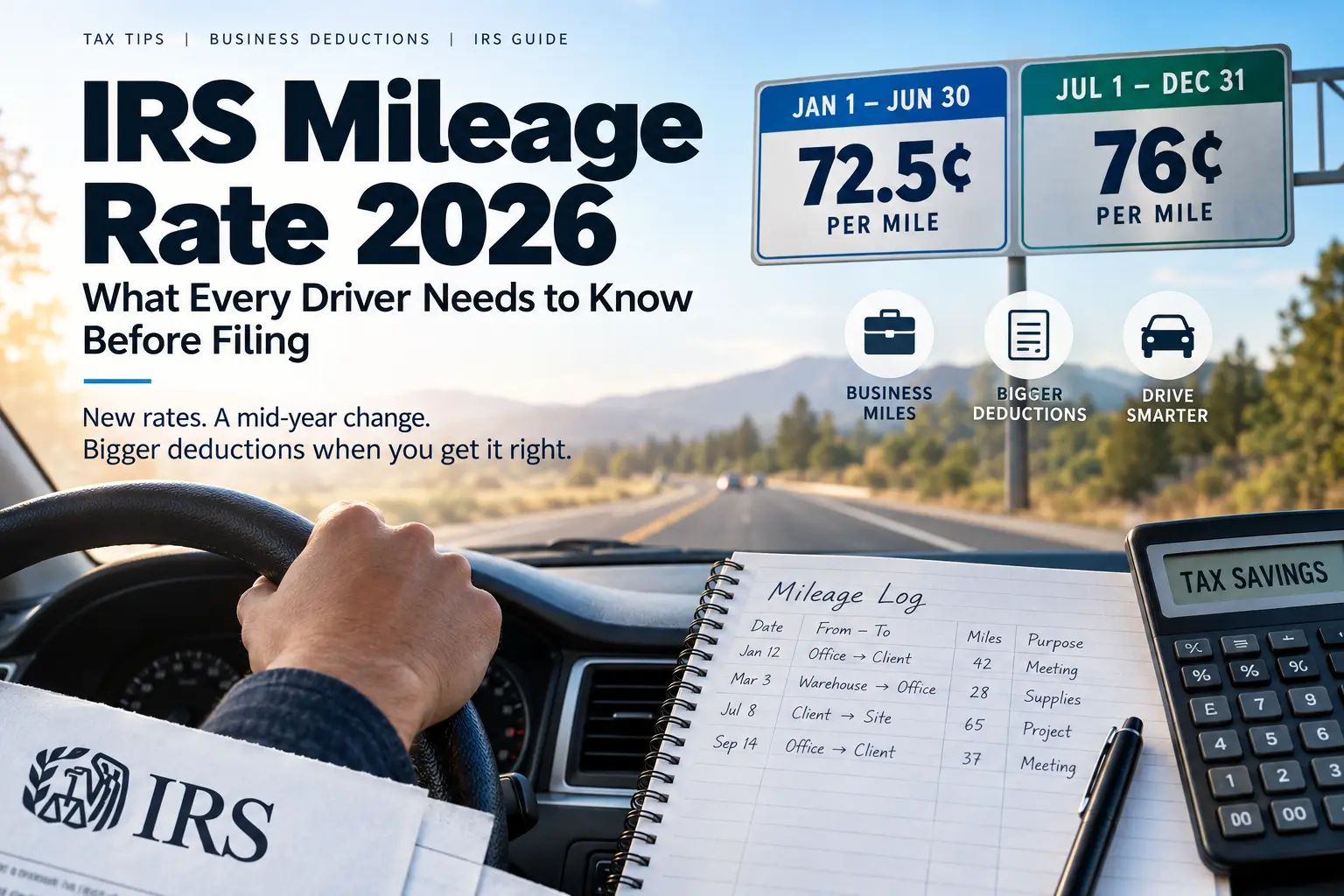
Most years, the IRS publishes one business mileage rate that applies from January through December. In 2026 that changed. The rate began at 72.5 cents per mile, then rose to 76 cents per mile from July 1 onward, an adjustment the IRS made in response to climbing fuel costs.
| Period | Business rate | Medical/moving rate | Charitable rate |
|---|---|---|---|
| Jan 1 – Jun 30, 2026 | 72.5¢/mile | 20.5¢/mile | 14¢/mile |
| Jul 1 – Dec 31, 2026 | 76¢/mile | 23.5¢/mile | 14¢/mile |
For comparison, the 2025 rate was a flat 70 cents all year. So 2026 not only raised the rate but split it into two periods, and that split is the single most important thing to understand about filing this year.
Why the Split Matters for Your Deduction
Because there are two rates, you cannot simply multiply your total annual miles by one number. You have to separate your first-half miles from your second-half miles and apply the correct rate to each. Getting this wrong in either direction causes problems.
- Apply 76 cents to everything and you overstate your deduction, which is a risk if you are audited.
- Apply 72.5 cents to everything and you understate it, leaving money on the table.
- Apply the right rate to each period and your deduction is both accurate and maximized.
The only way to do this correctly is to know the date of every trip, which turns your mileage record into time-sensitive data. A dated log is no longer just good practice in 2026; it is necessary.
A Worked Example
Suppose you drove the following business miles across 2026.
| Period | Business miles | Rate | Deduction |
|---|---|---|---|
| Jan–Jun | 3,500 | 72.5¢ | $2,537.50 |
| Jul–Dec | 4,000 | 76¢ | $3,040.00 |
| Total | 7,500 | mixed | $5,577.50 |
If you had applied 76 cents to all 7,500 miles, you would have claimed $5,700, overstating by more than a hundred dollars. Apply 72.5 cents to everything and you would have claimed $5,437.50, understating it. The correct figure only comes from splitting the miles by date.
What Counts as a Business Mile
Only business-related driving qualifies, and the distinction is where many people either capture or lose money.
| Trip | Deductible? |
|---|---|
| Driving to meet a client or customer | Yes |
| Travelling between work locations | Yes |
| Picking up business supplies | Yes |
| Driving to a temporary work site | Yes |
| Your regular commute to a fixed base | No |
| Personal errands | No |
The test is purpose. If the trip exists because of your work, it generally counts. Your regular commute does not, which is a common and costly point of confusion. Keeping business and personal miles cleanly separated is what makes the deduction defensible.
Standard Rate vs. Actual Expenses
The rates above are for the standard mileage method. The alternative is the actual expense method, where you deduct the business-use share of your real vehicle costs.
- Standard mileage is simpler and usually better for efficient cars driven a lot. You only track miles.
- Actual expenses can win for costly vehicles, but you must keep every fuel, repair, and insurance receipt.
- First-year lock-in applies. If you use actual expenses the first year a vehicle is in service, you generally cannot switch to the standard rate later for that car.
For most drivers, the standard method is both easier and often the larger deduction. The official rules on both methods are on the IRS standard mileage rates page, the authoritative source for the current figures.
Keeping Records That Hold Up
The 2026 split makes accurate records more important than ever. The IRS expects a contemporaneous log, created around the time of each trip, with:
- The date (crucial in 2026 for applying the right rate).
- The miles driven.
- The start and end points.
- The business purpose.
Reconstructing this from memory is risky in any year and especially error-prone in 2026, since a misdated trip can be valued at the wrong rate. This is why so many drivers use an app that logs trips automatically with timestamps and applies the correct rate to each period on its own.
Why the Rate Changed Mid-Year
It helps to understand why the IRS made such an unusual move. The business mileage rate is based on an annual study of what it costs to own and operate a vehicle, blending fixed costs like depreciation and insurance with variable costs like fuel.
- Fixed costs change slowly and rarely force a mid-year revision.
- Variable costs change quickly, and fuel is the most volatile of all.
- The 2026 fuel spike pushed the variable side hard enough that the IRS raised the rate partway through the year rather than waiting for 2027.
This is a useful signal for drivers: tax figures are not always set in stone for a full year, and your recordkeeping should be robust enough to handle a change. A dated log future-proofs you against exactly this kind of adjustment.
Quick Answers to Common Questions
Drivers tend to ask the same things about the 2026 rate.
- Which rate applies to a trip on July 1? The higher 76-cent rate, since it takes effect from July 1 onward.
- Do I need fuel receipts under the standard rate? No. Fuel is already included in the per-mile rate, so you only need your mileage log.
- Can I deduct tolls and parking too? Yes, business tolls and parking are deductible on top of the standard rate.
- What if I forgot to note trip dates? You will struggle to apply the correct rate, which is exactly why an automatic, timestamped log matters this year.
The Bottom Line
The 2026 IRS mileage rate is not one number but two: 72.5 cents per mile through June, then 76 cents from July onward. That mid-year change makes 2026 the year where accurate, dated mileage records truly matter, because the correct deduction depends on knowing when each trip happened.
Whether you track by hand or with an app, the message is the same. Keep a dated log, split your miles by period, and apply the right rate to each. Do that, and you claim a deduction that is both maximized and audit-proof, turning the driving you already do for work into the biggest vehicle deduction the IRS has offered in years.
Making Mileage Tracking Easier With Technology
Keeping a mileage log sounds simple until you are doing it every week for an entire year. Business owners, freelancers, contractors, and people who regularly travel between different work locations can quickly end up with hundreds of individual trips to record. That is where technology can make the process much easier.
Artificial intelligence is increasingly being used to automate routine administrative work, from organising information to identifying patterns in large amounts of data. If you are new to the subject, our guide on What Is Artificial Intelligence? explains the basic concept and how modern AI systems are being used in everyday business applications.
The same principle applies to mileage tracking. Instead of relying entirely on memory, a modern mileage app can automatically record trips, capture timestamps, calculate distances, and separate business journeys from personal driving. The more accurately those details are captured at the time of the trip, the less work there is to do when tax season arrives.
Why Automation Matters for Small Businesses
Mileage is only one part of the recordkeeping burden faced by small businesses. Receipts, invoices, customer information, expenses, schedules, and other operational records all have to be organised correctly. Small mistakes may seem insignificant individually, but they can become difficult to resolve when months of activity have accumulated.
This is one reason businesses are increasingly interested in AI-powered automation. Machine learning, for example, allows software to identify patterns in data and make useful predictions or classifications. Our What Is Machine Learning? A Beginner’s Guide explains how this technology works without requiring a technical background.
For mileage tracking, the practical benefit is straightforward. Software can help reduce manual data entry and make it easier to identify unusual or incomplete records. It does not remove the driver’s responsibility for maintaining accurate records, but it can make the process considerably less tedious.
Keep the Human Check in the Process
Automation should make recordkeeping easier, not make you stop checking your records altogether.
A mileage app can record a trip, but you still need to confirm that the journey was actually business-related. You also need to review unusual entries, correct mistakes, and make sure the information is complete before using it for tax purposes.
The same principle applies to AI more broadly. AI systems can process information quickly, but important financial and tax decisions still deserve human review. If you are using AI tools for business administration, understanding their limitations is just as important as understanding what they can automate.
That is particularly relevant as AI becomes more capable. The difference between Narrow AI vs AGI vs Superintelligence helps explain why today’s AI tools can be extremely useful for specific tasks without being a substitute for human responsibility and judgement.
A Better Mileage Routine for the Rest of 2026
If you are still tracking business miles manually, there is no reason to wait until the end of the year to improve the process. A simple routine can prevent most of the problems that make mileage deductions difficult later.
Record each business trip as close to the time of travel as possible. Keep the date and mileage together. Note where the trip started and ended, and briefly record its business purpose. At the end of each month, review the entries and correct anything that looks incomplete.
Most importantly, keep the two 2026 rate periods separate. Miles driven from January 1 through June 30 use the first-half rate, while qualifying miles from July 1 through December 31 use the second-half rate. Maintaining that separation throughout the year is much easier than trying to reconstruct it when preparing a tax return.
Technology can help with the organisation, but the underlying principle has not changed: accurate records are the foundation of an accurate deduction.
The Bigger Lesson About Digital Recordkeeping
The 2026 mileage change is a useful reminder that even a relatively simple tax calculation can become more complicated when the underlying rules change during the year. The businesses and individuals that handle this well are usually the ones that keep their data organised continuously rather than trying to reconstruct everything later.
That lesson extends beyond mileage. As more companies adopt AI for administration, customer service, research, and other repetitive tasks, the quality of the information going into those systems becomes increasingly important. Our guide to How Artificial Intelligence Is Changing the Future of Digital Business looks at this broader shift and why AI is becoming part of everyday business operations.
For drivers, however, the takeaway is much simpler. Track the trip when it happens, record why it happened, keep business and personal driving separate, and remember which mileage rate applies to the date of the journey.
Do that consistently throughout 2026 and filing becomes a calculation rather than a reconstruction exercise. The technology may change, the apps may become smarter, and tax rules may change again in the future, but good recordkeeping will remain the part you control.
Use the key points in this guide to understand the topic and make more informed decisions.

This guide is researched and edited using relevant documentation, reliable sources and publicly available information.
Was this guide helpful?
Your feedback helps us improve future guides.