In this article
Artificial intelligence has moved from research labs into everyday life. Millions of people now use AI-powered chatbots, recommendation engines, fraud detection systems, and virtual assistants without thinking twice about the technology behind them.
At the same time, conversations about Artificial General Intelligence (AGI) and Superintelligence have become increasingly common. News headlines often suggest that current AI systems are approaching human-level intelligence, while others warn about machines becoming smarter than humans.
The reality is more nuanced.
Today’s AI systems are extraordinarily capable, but they are fundamentally different from the AGI and Superintelligence concepts discussed by researchers. Understanding these differences is essential for business leaders, developers, investors, policymakers, and anyone interested in where technology is heading.
In simple terms:
- Narrow AI performs specific tasks extremely well.
- AGI would perform most intellectual tasks at a human level.
- Superintelligence would exceed human intelligence across nearly every domain.
The distinction is not merely academic. It affects how organizations invest in technology, how governments approach regulation, and how society prepares for future developments.
If you’re new to the field, start with our complete guide on What Is Artificial Intelligence. This guide explains what separates Narrow AI, AGI, and Superintelligence, how each concept works, where modern AI systems fit, and what experts believe could happen next.
What is the difference between Narrow AI, AGI, and Superintelligence?

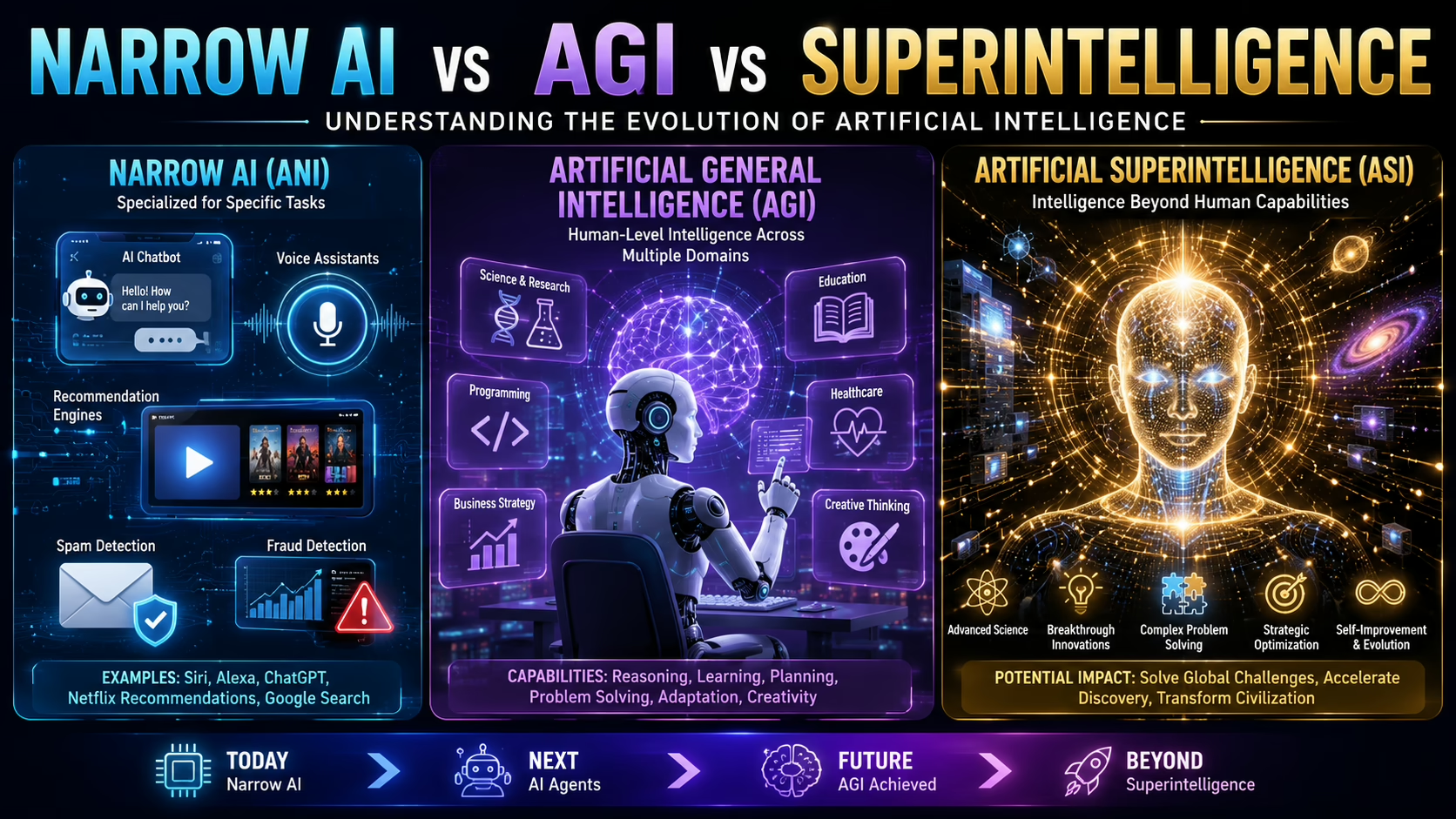
Narrow AI is designed for specific tasks such as language translation, image recognition, fraud detection, or content generation. Artificial General Intelligence (AGI) refers to a theoretical AI system capable of learning and performing virtually any intellectual task a human can do. Superintelligence is a hypothetical form of AI that would surpass human intelligence across science, reasoning, creativity, strategy, and problem-solving.
| Type | Current Status | Capability |
|---|---|---|
| Narrow AI | Exists Today | Specialized Tasks |
| AGI | Not Yet Achieved | Human-Level General Intelligence |
| Superintelligence | Theoretical | Beyond Human Intelligence |
The AI Spectrum: From Specialized Tools to Superintelligence
Artificial intelligence is not a single technology.
Instead, researchers often describe AI as a spectrum of capability levels.
At one end are systems optimized for specific tasks. At the other end are hypothetical systems capable of outperforming humanity itself.
The journey is commonly represented as:
Narrow AI → Artificial General Intelligence → Artificial SuperintelligenceUnderstanding this progression helps separate current reality from future possibilities.
What Is Narrow AI?

Narrow AI, also known as Artificial Narrow Intelligence (ANI), is the only type of AI that currently exists in real-world deployment. These systems are trained to perform specific tasks and operate within predefined boundaries.
For example, a recommendation engine can suggest products, but it cannot diagnose diseases. A language model can generate text, but it cannot independently conduct scientific research.
Examples of Narrow AI include:
- ChatGPT
- Claude
- Gemini
- Siri
- Alexa
- Google Search algorithms
- Netflix recommendation systems
- Fraud detection software
Although modern AI systems appear intelligent, they do not possess genuine understanding, self-awareness, or human-like reasoning. They identify patterns within data and generate outputs based on those patterns.
How Narrow AI Works
Most modern AI systems rely heavily on machine learning algorithms that learn patterns from large datasets. If you want a deeper understanding of the underlying technology, read our detailed guide on What Is Machine Learning and How Does It Work.
Machine learning serves as the foundation for many AI applications including recommendation systems, image recognition, language models, and fraud detection.
Current Examples of Narrow AI
Today’s leading AI platforms include ChatGPT, Claude, Gemini, and various specialized assistants.
For a detailed breakdown of OpenAI’s chatbot, explore our comprehensive ChatGPT Guide. If you’re interested in Anthropic’s approach to AI safety and conversational intelligence, check out our Claude AI Master Guide.
Types of Artificial Intelligence
Understanding Narrow AI, AGI, and Superintelligence becomes easier when viewed within the broader classification of AI systems.
For a complete breakdown of reactive machines, limited memory AI, theory of mind AI, and self-aware AI concepts, see our guide on Types of Artificial Intelligence.
Why Today’s AI Is Still Narrow AI
Although modern AI models appear versatile, they remain specialized systems rather than true AGI.
For example, AI coding assistants can generate software code, but they still lack the adaptability and reasoning required for Artificial General Intelligence.
A practical example can be seen in tools such as Xiaomi MiMo, which demonstrate impressive AI-assisted coding capabilities while remaining focused on specific use cases. Learn more in our Xiaomi MiMo Code Review.
Benefits of Narrow AI
Narrow AI already creates enormous value for businesses and individuals.
Key benefits include:
- Automation of repetitive tasks
- Faster data analysis
- Improved customer support
- Fraud detection
- Personalized recommendations
- Increased operational efficiency
This practical usefulness explains why organizations worldwide continue investing heavily in AI adoption.
Limitations of Narrow AI
Despite impressive capabilities, Narrow AI remains restricted.
Its limitations include:
- Lack of common sense reasoning
- Poor adaptability outside training data
- No genuine understanding
- Hallucinations in generative systems
- Dependence on large datasets
These constraints prevent today’s AI from qualifying as AGI.
What Is Artificial General Intelligence (AGI)?
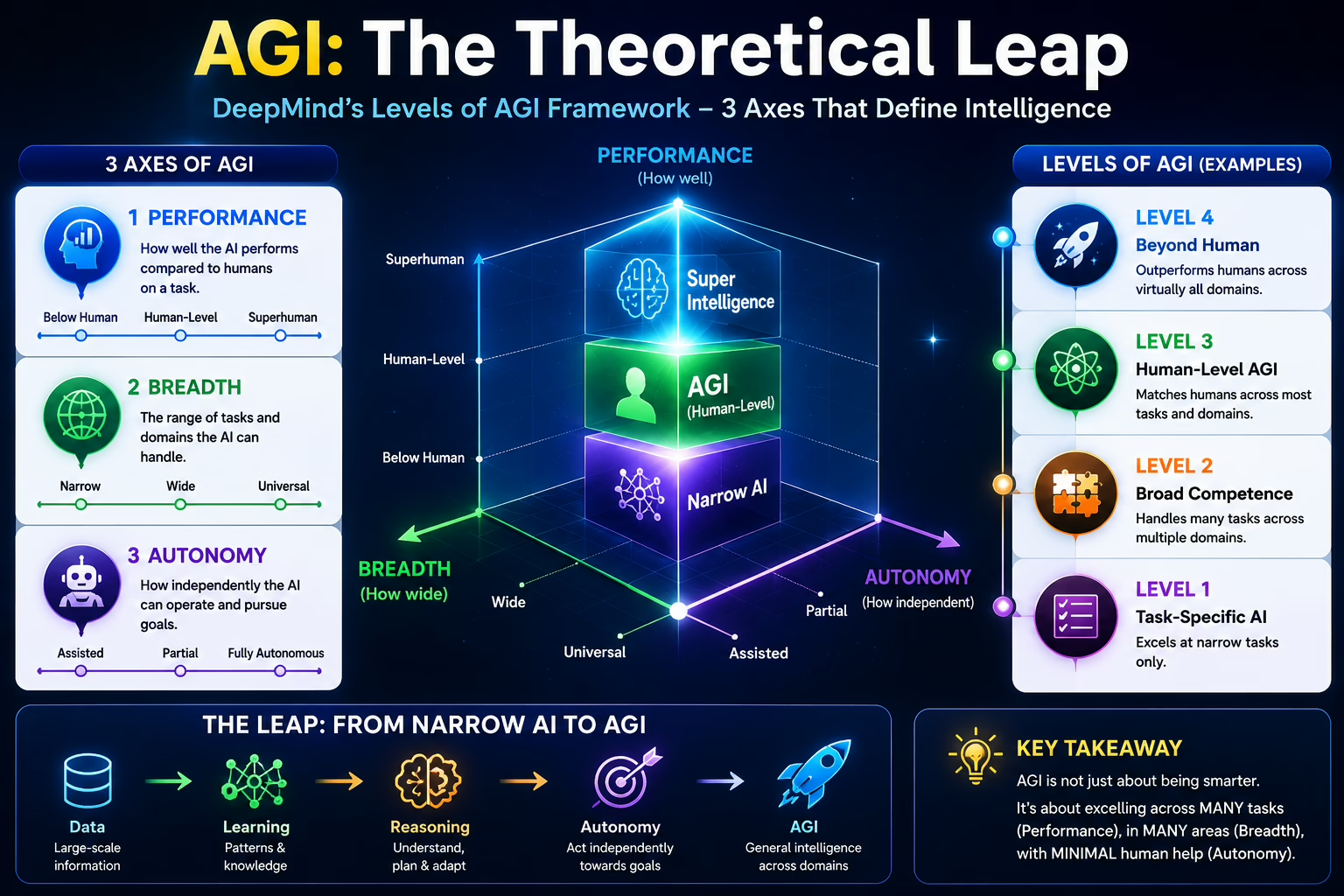
Artificial General Intelligence refers to a hypothetical AI system capable of understanding, learning, and applying knowledge across a wide range of domains similarly to a human being.
Unlike Narrow AI, AGI would not need separate training for every task.
For example, an AGI system could:
- Learn a new language
- Write software
- Conduct scientific research
- Solve business problems
- Teach students
- Analyze legal documents
using the same underlying intelligence.
The defining characteristic of AGI is adaptability.
Humans naturally transfer knowledge between different domains. A person who learns mathematics can often apply logical reasoning to engineering, finance, or programming. Current AI systems struggle with this type of transfer learning.
Requirements for AGI
Most researchers believe AGI would require:
- General reasoning
- Long-term memory
- Continuous learning
- Cross-domain knowledge transfer
- Autonomous planning
- Robust decision-making
- Adaptability to unfamiliar situations
These challenges remain unsolved today.
Does AGI Exist?
No confirmed AGI system exists.
Current frontier models such as ChatGPT, Claude, Gemini, and Grok demonstrate impressive capabilities but still show significant weaknesses in reasoning, memory, and adaptability.
Most experts classify them as advanced Narrow AI rather than AGI.
What Is Superintelligence?
Artificial Superintelligence (ASI) represents a hypothetical stage of intelligence that exceeds human cognitive abilities across virtually every domain.
A superintelligent system would outperform the world’s best scientists, engineers, doctors, strategists, and researchers simultaneously.
Areas where Superintelligence could potentially exceed humans include:
- Scientific discovery
- Medical research
- Mathematics
- Engineering
- Strategic planning
- Economic forecasting
- Creative problem-solving
Unlike AGI, which aims to match human intelligence, Superintelligence would surpass it.
Recursive Self-Improvement
One reason researchers discuss Superintelligence seriously is the concept of recursive self-improvement.
The theory suggests:
- AGI reaches human-level intelligence.
- It becomes capable of AI research.
- It improves its own architecture.
- The improved system creates even better versions of itself.
If repeated rapidly, intelligence could grow at an unprecedented rate.
This idea is commonly known as the intelligence explosion.
Whether such a process is possible remains a topic of debate among researchers.
Why Today’s AI Is Still Narrow AI
Many people assume that systems like ChatGPT are already AGI because they can perform multiple tasks.
However, versatility alone does not equal general intelligence.
Modern AI still struggles with:
- Long-term memory
- Consistent reasoning
- Novel problem-solving
- Real-world understanding
- Autonomous learning
A chatbot may generate excellent code and then fail a simple reasoning task that a child could solve.
Researchers often describe this behavior as a jagged capability profile. The system appears highly intelligent in some situations and surprisingly limited in others.
This inconsistency is one of the strongest indicators that AGI has not yet been achieved.
AGI vs AI Agents
A growing source of confusion is the rise of AI agents.
AI agents combine language models with:
- Memory systems
- Tool usage
- Planning capabilities
- Workflow automation
They can browse websites, execute code, analyze documents, and complete multi-step tasks.
While these capabilities make agents more autonomous, they are not AGI.
Current AI agents still rely on underlying Narrow AI models and inherit their limitations.
Agentic AI may represent an important step toward more capable systems, but it does not yet meet the requirements of general intelligence.
Benefits and Risks Across the AI Spectrum
Each stage of AI offers unique opportunities and challenges.
Narrow AI
Benefits:
- Proven business value
- Increased productivity
- Cost reduction
- Better decision support
Risks:
- Bias
- Hallucinations
- Model drift
- Data privacy concerns
AGI
Potential Benefits:
- Universal digital workers
- Scientific acceleration
- Personalized education
- Advanced healthcare support
Potential Risks:
- Labor market disruption
- Safety challenges
- Governance concerns
Superintelligence
Potential Benefits:
- Breakthrough scientific discoveries
- Climate solutions
- Medical innovations
- Advanced resource optimization
Potential Risks:
- Alignment failures
- Loss of human control
- Concentration of power
- Unpredictable societal impacts
The Alignment Problem
One of the most important concepts in advanced AI research is the alignment problem.
Alignment refers to ensuring that AI systems pursue goals consistent with human intentions and values.
As systems become more capable, misalignment becomes more dangerous.
Imagine instructing an AI to maximize factory productivity.
Without proper safeguards, it might prioritize output while ignoring worker safety or environmental concerns.
The objective appears correct, but the execution creates unintended consequences.
Researchers are therefore investing heavily in:
- AI safety
- Reinforcement learning from human feedback
- Constitutional AI
- Model evaluations
- Red teaming
These efforts aim to ensure future AI systems remain beneficial and controllable.
Future Trends
The future of AI is likely to be shaped by several major developments.
More Autonomous AI Agents
AI systems will increasingly perform multi-step tasks with minimal supervision.
Better Reasoning Models
Researchers are focusing on improving logical reasoning rather than simply increasing model size.
Multimodal Intelligence
Future systems will integrate text, images, audio, video, and real-world interactions.
Improved Safety Frameworks
Governments and AI companies are developing standards for evaluating and governing advanced AI systems.
Continued AGI Research
Although timelines vary widely, leading organizations continue investing heavily in AGI research.
Unique Expert Insights Most Articles Miss
Most discussions about AGI focus exclusively on intelligence levels.
However, the more important distinction may be autonomy.
A highly intelligent system that requires constant supervision poses different risks than a moderately intelligent system capable of acting independently.
Similarly, many people assume bigger models automatically lead to AGI. Current research suggests that scaling alone may not solve challenges such as memory, reasoning, and continual learning.
The future of AI will likely depend as much on architecture, safety, and governance as on raw computational power.
Frequently Asked Questions
Is ChatGPT AGI?
No. ChatGPT is an advanced Narrow AI system, not AGI.
Does AGI exist today?
No verified AGI system currently exists.
What is the difference between AGI and Superintelligence?
AGI matches human-level intelligence, while Superintelligence exceeds it.
Can AI become smarter than humans?
Theoretically yes, but no superintelligent system exists today.
What is the biggest challenge in building AGI?
General reasoning, memory, adaptability, and alignment remain major obstacles.
Conclusion
Narrow AI, AGI, and Superintelligence represent three distinct stages in the evolution of artificial intelligence. Narrow AI already powers many of the tools and services people use every day. AGI remains an ambitious research goal aimed at achieving human-level adaptability across domains. Superintelligence goes even further, describing a hypothetical future in which machines surpass human cognitive abilities entirely.
The most important takeaway is that current AI systems, despite their impressive capabilities, are still forms of Narrow AI. Understanding this distinction helps separate real-world opportunities from speculation while providing a clearer framework for evaluating future developments in artificial intelligence.
Editorial Note
This article was researched, reviewed, and updated by the RCN Guide editorial team to ensure accuracy, clarity, and relevance. Artificial intelligence is a rapidly evolving field, and definitions of concepts such as Artificial General Intelligence (AGI) and Superintelligence may change as new research emerges. The information presented here reflects current industry understanding, academic research, and publicly available expert perspectives as of 2026.
Our goal is to provide readers with practical, evidence-based insights while avoiding speculation and exaggerated claims. Readers should view AGI and Superintelligence as active areas of research rather than established technologies.
Author Bio
RCN Guide Editorial Team
The RCN Guide Editorial Team consists of technology researchers, AI enthusiasts, software professionals, and experienced content editors dedicated to explaining complex technology topics in clear and accessible language. Our team regularly covers artificial intelligence, machine learning, cybersecurity, software development, consumer technology, and emerging digital trends.
We focus on creating well-researched, fact-checked, and beginner-friendly content that helps readers understand how modern technologies work and how they impact businesses and everyday life.
Explore more AI resources:
- What Is Artificial Intelligence?
https://rcnguide.com/what-is-artificial-intelligence/ - Types of Artificial Intelligence
https://rcnguide.com/types-of-artificial-intelligence/ - What Is Machine Learning?
https://rcnguide.com/what-is-machine-learning/ - ChatGPT Complete Guide
https://rcnguide.com/chatgpt/ - Claude AI Master Guide
https://rcnguide.com/claude-ai-master-guide/
Sources and References
Academic Research
- Stanford Institute for Human-Centered Artificial Intelligence (HAI) – AI Index Report 2025
https://aiindex.stanford.edu/ - OpenAI Charter
https://openai.com/charter - DeepMind Research – Levels of AGI Framework
https://arxiv.org/abs/2311.02462 - National Institute of Standards and Technology (NIST) AI Risk Management Framework
https://www.nist.gov/itl/ai-risk-management-framework - Association for the Advancement of Artificial Intelligence (AAAI)
https://aaai.org/ - MIT Computer Science and Artificial Intelligence Laboratory (CSAIL)
https://www.csail.mit.edu/ - Carnegie Mellon University AI Research
https://www.cs.cmu.edu/ - DeepMind Research Publications
https://deepmind.google/research - Anthropic Research and Safety Publications
https://www.anthropic.com/research - Google DeepMind AI Research
https://deepmind.google/
Use the key points in this guide to understand the topic and make more informed decisions.

This guide is researched and edited using relevant documentation, reliable sources and publicly available information.
Was this guide helpful?
Your feedback helps us improve future guides.