In this article
How AI predicts what you’ll watch, hear, search for and maybe do next.
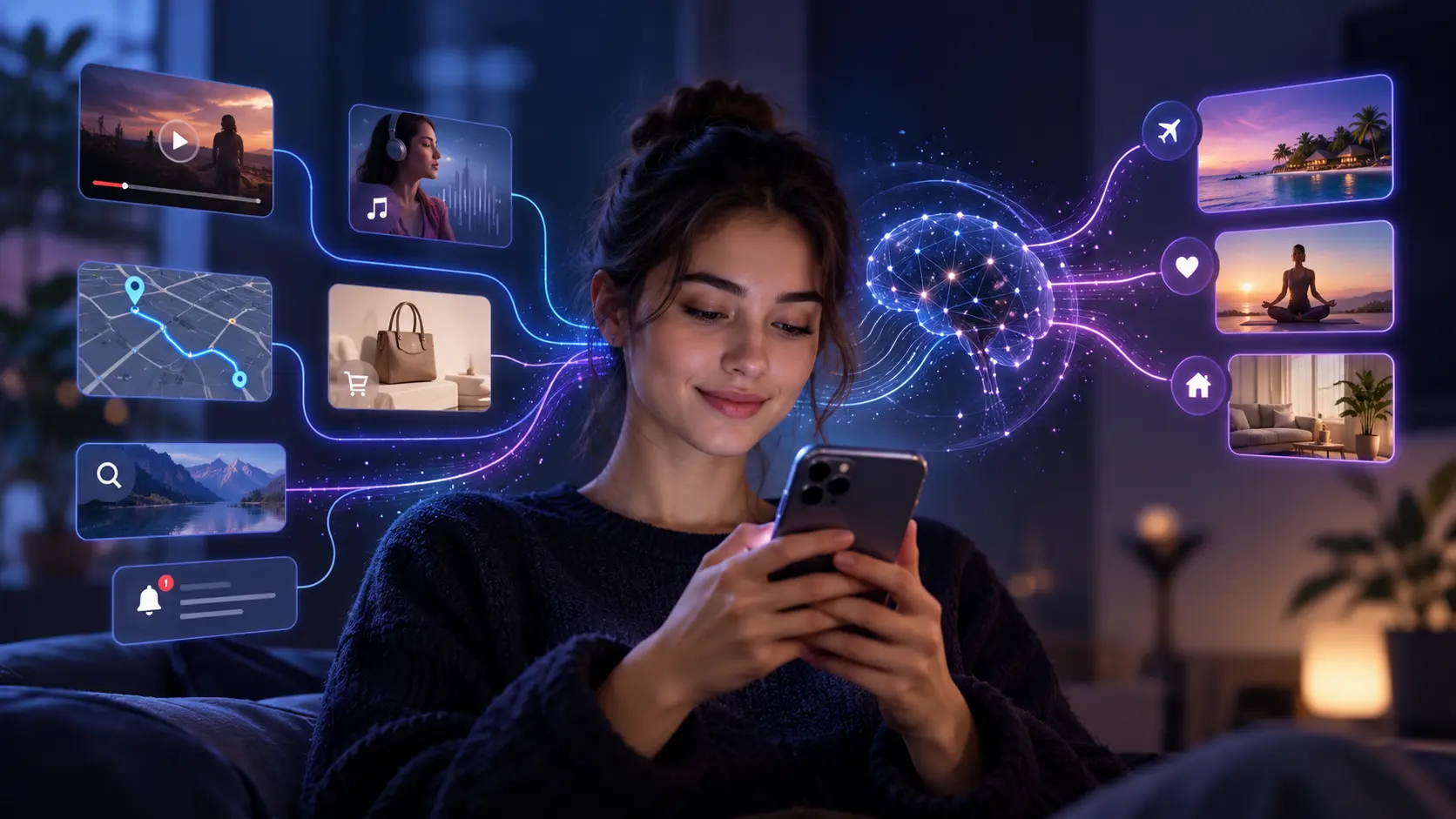
You open YouTube for one video. Somehow the next recommendation is exactly your thing. Spotify revives a song you forgot. Maps warns you about traffic before you even think about the route. It feels spooky, but the trick is less “your phone reads your mind” and more “your behavior leaves clues.“
So, does your phone actually know you?
Not like a friend does. Your phone does not necessarily understand why you love a song or why you searched for a holiday at 2 a.m. What it can do is detect patterns in your interactions and use those patterns to make predictions.
If you want the bigger picture first, read What Is Artificial Intelligence? Then see how the technology is categorized in Types of Artificial Intelligence Explained.
or click
a signal
your interest
recommendation
again
YouTube is basically learning your taste in public
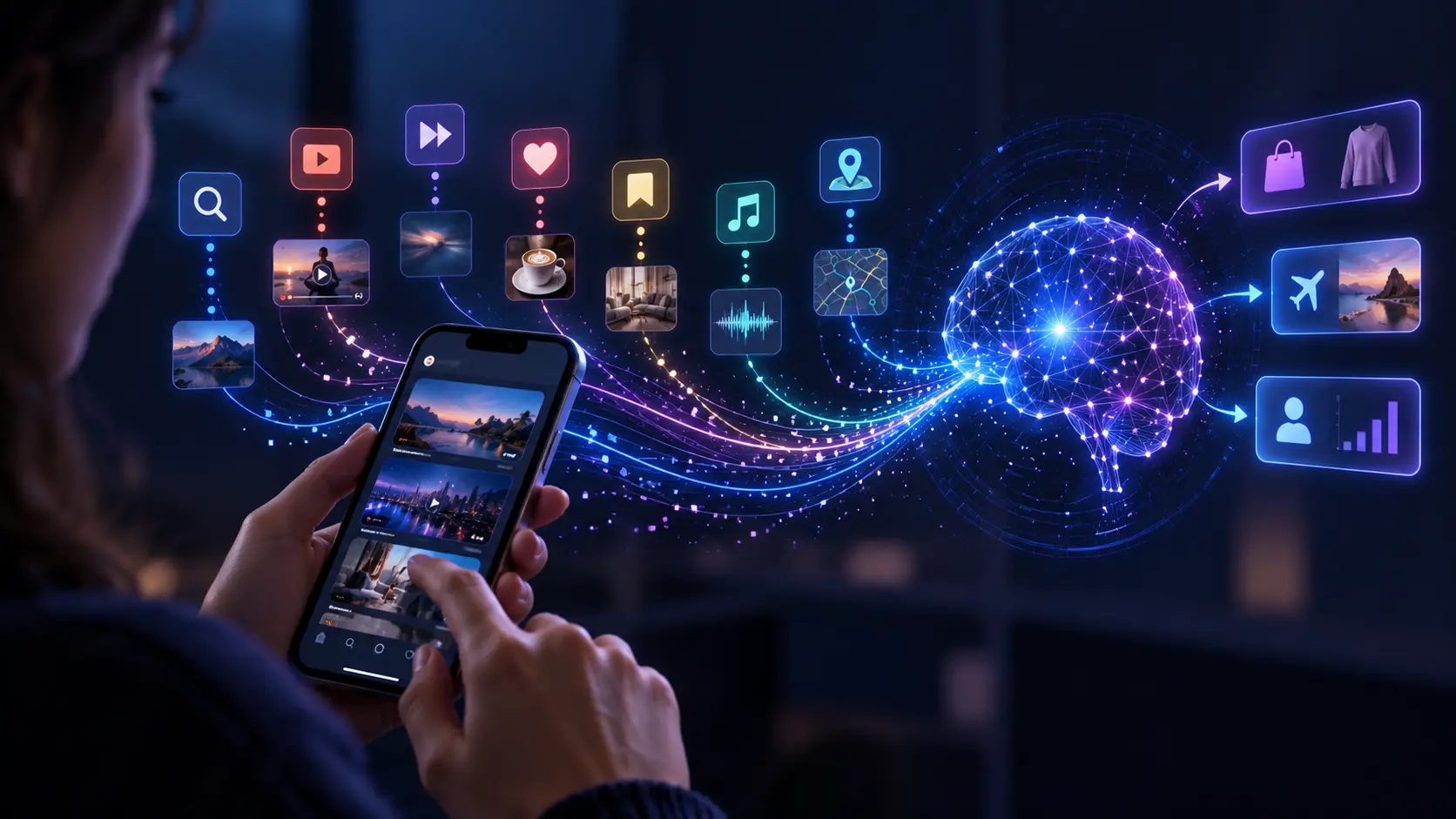
YouTube says its recommendations use signals such as watch history, search history, subscriptions, likes, dislikes, “Not interested” feedback and satisfaction surveys. It also says recommendations can take context such as device, time of day and past habits into account.
That means watching a photography tutorial to the end can tell the system more than instantly skipping it. Watching another photography video gives it another clue. Soon your homepage can start looking suspiciously like you.
Want to go deeper? Start with What Is Machine Learning? and What Are AI Algorithms?.
What different actions can signal
Illustrative visual only. It is not a measured ranking of signal strength. YouTube says different features rely on different signals.
TikTok does the same thing, just at scroll speed
TikTok says its For You recommendations use factors including interactions such as likes, shares, follows, comments and content creation, plus video information such as captions, sounds and hashtags. It also says stronger signals, such as finishing a longer video, can carry more weight than weaker contextual signals.
That is why two people can open the same app and feel like they entered two different internets.
Spotify is predicting your next vibe
Spotify describes personalization as a core part of its products, including personalized playlists, discovery, next-song suggestions, search and home-screen shortcuts. Its engineering team says its personalization systems use ML/AI and can learn from user responses and context.
The important bit is not that Spotify “understands your soul.” It has patterns. Maybe you repeatedly play calm tracks while studying and high-energy music while working out. Patterns are enough to make useful guesses.
And Maps can predict the boring stuff too
Traffic prediction is another everyday example. Google has described using machine learning, including graph neural networks, to improve traffic predictions and estimated travel times in Maps.
That is a different kind of prediction from a TikTok recommendation, but the idea feels familiar: historical and current signals go in, a model estimates what is likely to happen, and the app gives you a useful result.
Your behavior is data, even when you say nothing
You never have to type “I like sneakers.” If you repeatedly search sneaker reviews, open product pages, watch shoe videos and save a few pairs, those actions can become useful signals for personalization.
But there is a catch: a signal is not an explanation. The system can observe that you watched five travel videos. It cannot automatically know whether you are planning a holiday, doing research for work, procrastinating or just watching what a friend sent you.
Is this really AI?
Often, yes, but “AI” is a broad label. Recommendation systems can combine algorithms, machine learning models, ranking systems and other software. They are not the same thing as a chatbot or a generative AI model.
For context, see RCN Guide’s Deep Learning guide, Generative AI guide, and Narrow AI vs AGI vs Superintelligence.
Chatbots do something different, but the bigger idea is familiar
A recommendation system might predict which video you will enjoy. A conversational AI might predict which response is useful given your prompt and context. Different job, different system, similar high-level idea: process information, identify patterns and produce an output.
RCN Guide’s ChatGPT Guide for Beginners, Claude AI Master Guide and Complete Kimi Guide explore those AI assistants in more detail.
That same idea is showing up in practical AI support systems too. In iGaming, for example, AI player support can use knowledge bases, automated workflows and escalation paths to handle user questions more efficiently.
The slightly creepy part: you train the feed too
Every interaction can become feedback. Watch something, the system learns. Skip something, it learns. Tap “Not interested,” it learns. Then it changes what you see. You react again.
YouTube explicitly says users can remove videos or searches from history, pause history and use “Not interested” feedback to influence recommendations.
How to make your algorithm less chaotic
What about personalized ads?
Google’s My Ad Center lets users control information used to show personalized ads, including information associated with a Google Account and interests estimated from activity. Google also says personalized ads can be turned off, although ads will still appear.
That is worth checking because recommendation personalization and advertising personalization are related ideas, but they are not automatically one giant system.
So, does your phone know you?
Not really. It knows your signals better than it knows your story.
Your phone does not need to understand your personality completely to predict that you might watch a particular video, play a certain song, take a particular route or click a certain product.
It sees clues, finds patterns in them, and uses those patterns to predict what you’ll do next. Then you respond, and the loop starts over.
Your phone is not reading your mind. It is getting better at guessing your next move from the digital breadcrumbs you leave behind.
And you’re helping train it every time you tap.
Keep exploring
For more RCN Guide coverage, explore Siri AI, AI Smart Home, AI-Powered Beauty Technology, AI Logistics for E-commerce, and Latest AI Models 2026.
Use the key points in this guide to understand the topic and make more informed decisions.

This guide is researched and edited using relevant documentation, reliable sources and publicly available information.
Was this guide helpful?
Your feedback helps us improve future guides.