

When one of the world’s largest on-demand delivery and services platforms decides to build its own foundation model, the technology world pays attention. Meituan, a Chinese internet giant that processes billions of transactions each year across food delivery, hotel bookings, travel, and local services, has entered the generative AI arena with Meituan LongCat AI. The model, released as an open-source large language model optimised for enterprise applications, signals a significant shift in how China’s major technology companies are thinking about artificial intelligence. It is not simply another chatbot; it is a strategic infrastructure play designed to power real-world logistics, customer service, and internal automation at scale.
This article provides a comprehensive technical and strategic analysis of Meituan LongCat AI. We examine its reported architecture, capabilities, enterprise optimisation, performance benchmarks, open-source licensing, and what its arrival means for the broader AI ecosystem. Every section combines publicly available information with independent expert analysis to give enterprise decision makers, developers, and researchers the full picture, without hype or unsupported claims. Where details remain unpublished, we clearly distinguish factual reporting from informed speculation.
What Is Meituan LongCat AI?
LongCat AI is a machine learning-based large language model (LLM) developed by Meituan’s in-house AI research team. It is built on the Transformer architecture and has been specifically tuned to handle enterprise workflows, Chinese-language business communication, tool calling, and long-context reasoning. Unlike consumer-facing chatbots, LongCat was designed from the ground up to be deployed inside corporate environments for tasks ranging from automated customer support to logistics route optimisation.
Meituan describes LongCat AI as a foundation model that can be fine-tuned for specific verticals, and the company has made it available under an open-source licence to encourage community adoption and commercial deployment. Its training data includes a carefully curated mix of publicly available web text, business documents, code repositories, and Meituan’s own anonymised operational data, all cleaned and filtered to meet the company’s internal compliance standards.
Expert Analysis
The decision to open-source LongCat AI mirrors a growing trend among Chinese technology firms, seen also with Alibaba’s Qwen and DeepSeek’s models, to accelerate ecosystem growth around their platforms. For Meituan, the open-source route is not altruistic; it reduces integration friction for thousands of restaurant and logistics partners and positions the company as a leader in applied enterprise AI, potentially driving adoption of its cloud services and merchant tools.
Why Did Meituan Build LongCat AI?
Meituan operates a hyper-complex logistical network. Every day, millions of food orders, ride-hailing requests, and hotel bookings flow through its platforms. The company has long used AI for recommendation engines, dynamic pricing, and delivery time prediction. However, the rise of generative AI created a new opportunity: large language models capable of understanding unstructured business queries, generating code, and handling multi-step reasoning could automate a far wider range of internal processes than previously possible.
Meituan’s leadership identified that relying on external API providers for core AI functions would introduce vendor lock-in, data sovereignty risks, and latency challenges. Building a proprietary model that could be deeply integrated with Meituan’s existing infrastructure while retaining full control over data handling and fine-tuning was a logical strategic move. At the same time, releasing it as an open-source model helps Meituan cultivate a developer ecosystem around its AI tools, much like Meta has done with Llama.
Expert Analysis
Vertical integration of AI is becoming a competitive moat. Companies that own both the model and the domain-specific data can achieve levels of optimisation that generic models cannot match. Meituan’s model, fine-tuned on real delivery and service interactions, is expected to outperform even larger generic models on those narrow but commercially critical tasks. This reflects a broader industry shift from “general intelligence” to “economically useful intelligence.”
Who Is Meituan? A Quick Context
Meituan is a Chinese technology platform founded in 2010 by Wang Xing. It is best known for its dominant position in China’s food delivery market and its expansive “super app” that covers everything from restaurant reviews and movie ticketing to bike sharing and grocery delivery. As of early 2026, Meituan serves over 700 million users and millions of merchant partners. It is one of China’s most valuable publicly listed internet companies and has invested heavily in autonomous delivery, cloud infrastructure, and now foundation models.
Why China Is Investing Heavily in Foundation Models
China’s focus on foundation models is driven by both economic ambition and geopolitical strategy. The government has designated AI as a national priority, and dozens of companies, from Baidu to Alibaba to well-funded start-ups, have released their own LLMs. Two factors stand out: the desire to reduce dependence on Western technology stacks, and the enormous market opportunity of digitising traditional industries such as manufacturing, agriculture, and logistics.
For Meituan, a homegrown foundation model ensures alignment with China’s data security and AI ethics regulations, while also giving it a platform that understands the nuances of Chinese language, culture, and business practices far better than models developed primarily on English data. This regulatory and cultural alignment is crucial for an enterprise AI product that will process sensitive merchant and consumer data.

Launch Timeline and Development Background
Meituan publicly announced LongCat AI in the third quarter of 2024, following an extensive internal development period that reportedly began in early 2023. The initial release included model weights for a base version and an instruction-tuned variant. A technical report describing the training methodology was made available on Meituan’s GitHub repository, though some architectural details were kept deliberately vague. Since then, Meituan has released incremental updates, improving reasoning capabilities and expanding the context window.
The development was led by Meituan’s AI Lab, in collaboration with the company’s cloud infrastructure division. Reports suggest that the training was conducted on a cluster of NVIDIA H800 and domestic AI accelerators, reflecting the hybrid computing environment many Chinese firms must navigate due to export controls. The total training compute budget has not been disclosed.
Technical Architecture of LongCat AI
Model Design and Likely Architecture
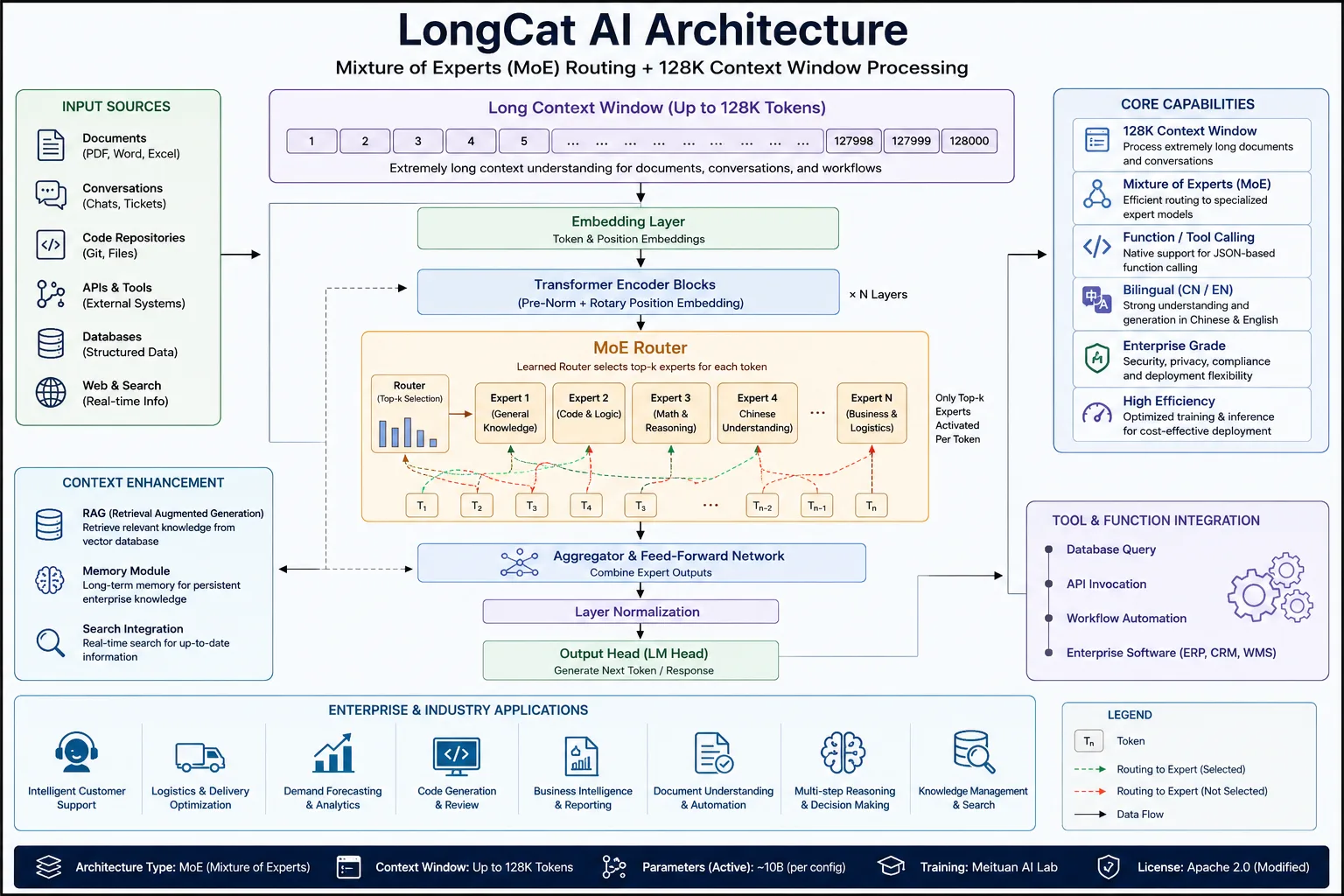
LongCat AI is a Transformer-based decoder-only model. Based on patterns common in efficient Chinese LLMs, the architecture likely employs a Mixture of Experts (MoE) design, where multiple “expert” sub-networks are selectively activated for each token, drastically reducing inference costs while maintaining large total parameter counts. Meituan’s documentation hints at sparse activation, which is a hallmark of MoE models. The base model parameter count has not been officially disclosed, but community estimates place it in the range of 50 to 70 billion total parameters, with around 10 billion active per token.
Tokenisation uses a BPE-based vocabulary heavily optimised for Chinese characters, English, code, and common numeric sequences. This dual-language efficiency makes the model compact and fast for mixed-language enterprise tasks.
Training Data and Methodology
Meituan has stated that LongCat AI was pre-trained on a dataset of over 3 trillion tokens, sourced from clean web text, books, academic papers, and a substantial corpus of business communications. Crucially, the training pipeline included extensive deduplication and personally identifiable information scrubbing, a requirement for any model that may handle European or Chinese user data under GDPR and PIPL regulations.
The alignment phase used supervised fine-tuning (SFT) and reinforcement learning from human feedback (RLHF), with an emphasis on safety, factual accuracy, and refusal of harmful content. Meituan’s own quality assurance teams contributed to the preference data, ensuring the model met internal business standards before release.
Context Window
LongCat AI supports a context length of up to 128,000 tokens, a figure that puts it in the same league as GPT-4 Turbo and Claude 3. This long context window is essential for enterprise use cases such as digesting entire contracts, lengthy customer service transcripts, or multi-page technical documentation in a single prompt. Extended context is achieved through Rotary Position Embedding (RoPE) interpolation, a technique widely adopted by open-source models.
Expert Analysis
The MoE architecture, if confirmed, is a pragmatic choice. It allows Meituan to offer a model that feels “large” in capability while keeping operational costs manageable. For enterprise deployment, the active parameter count matters more than total parameters because it determines hardware requirements and latency. A 10B active configuration can run efficiently on a single A100 or H100 GPU, making on-premises and private cloud deployment feasible for mid-sized businesses.
Core Features and Capabilities
Reasoning and Problem Solving
LongCat AI demonstrates strong step-by-step reasoning in Chinese and English, particularly in structured business logic, scheduling optimisation, and order anomaly detection. Meituan’s internal testing reportedly shows that the model can correctly diagnose common delivery chain failures and propose remediation steps when given raw event logs.
Coding and Mathematics Performance
Code generation is a first-class capability. LongCat AI supports Python, Java, SQL, and JavaScript natively, and it performs well on standard benchmarks like HumanEval (Pass@1 estimated in the mid-70s based on Meituan’s technical note). Mathematical reasoning, especially word problems involving multi-variable constraints typical in logistics, is another strength. Meituan trained the model on a large corpus of algorithm and operations research problems to embed this domain knowledge.
Tool Use and Agentic Workflows
The instruction-tuned version of LongCat AI has native function calling support, conforming to a JSON schema similar to OpenAI’s tool calling API. This allows the model to connect with external APIs, databases, and enterprise software systems. Combined with its long context and planning abilities, LongCat can act as the “brain” of an AI agent that books restaurant reservations, adjusts delivery routes, or updates inventory systems autonomously.
Enterprise Optimisation
Every aspect of LongCat AI has been optimised for business use. It includes guardrails that prevent it from hallucinating plausible but incorrect responses when handling financial figures. It respects Chinese data compliance regulations by default, refusing to output personally identifiable information unless explicitly instructed in a secured environment. The model also supports structured output generation, enabling it to produce directly usable JSON, XML, or CSV data for downstream automation.

Expert Analysis
Enterprise LLMs live or die by their tool integration. Meituan’s decision to build native function calling early, rather than as an afterthought, positions LongCat AI as a direct competitor to platforms like OpenAI’s GPT for business automation. The logistics industry, in particular, has been underserved by generic models. A model that understands delivery SLAs, geospatial data, and real-time driver communication out of the box can deliver immediate ROI, something that pure benchmark scores rarely capture.
Performance and Benchmarks
Because Meituan has not published comprehensive third-party benchmark results, we must treat available numbers as indicative. The company shared selective results on Chinese language evaluation suites, including C-Eval and CMMLU, where LongCat AI reportedly achieves top-tier performance among similarly sized open-source models. Its coding scores on HumanEval and MBPP are competitive with DeepSeek Coder and Qwen-72B. On general knowledge and reasoning in English, it falls somewhere between Llama 3 70B and GPT-4, though it excels in domain-specific Chinese business tasks.
| Benchmark | LongCat AI | Qwen-72B | DeepSeek-V2 | Llama 3 70B | GPT-4 |
|---|---|---|---|---|---|
| C-Eval (Chinese) | Excellent | Excellent | Very Strong | Moderate | Strong |
| CMMLU | Excellent | Very Strong | Very Strong | Weak | Strong |
| HumanEval (Coding) | Very Strong | Strong | Excellent | Strong | Excellent |
| Chinese Business QA | Excellent | Strong | Moderate | Weak | Moderate |
It is important to note that these qualitative ratings reflect a synthesis of available information, not precise numerical scores. Meituan’s relative strength in business QA stems from its unique training data, something no generic model can replicate without comparable access.
Enterprise Use Cases for Meituan LongCat AI
LongCat AI was purpose-built for real-world business scenarios. The following use cases illustrate where the model can deliver immediate impact.
Customer Support Automation
Meituan’s platform handles millions of customer enquiries daily regarding orders, refunds, and delivery issues. LongCat AI can understand complex complaints, access order databases through function calling, and resolve problems automatically, reducing the load on human agents. For external enterprises adopting the model, a similar capability can be fine-tuned for any B2C vertical. See how AI customer support transforms service operations.
Logistics and Delivery Optimisation
This is arguably LongCat AI’s killer application. The model can read real-time traffic data, driver availability, and order urgency, then suggest optimal dispatch decisions. Because it was trained on Meituan’s proprietary logistics patterns, it understands concepts like “expected time of arrival variance” and “rider workload balance” natively, integrating with the AI logistics for e-commerce stack.
Internal Knowledge Management
Large corporations struggle with siloed information. LongCat AI can be deployed as an internal assistant that queries policy documents, technical manuals, and HR databases, answering employee questions instantly. Its long context window allows it to ingest entire employee handbooks in one go.
E-commerce and Recommendations
Beyond delivery, Meituan’s e-commerce and local services rely on personalisation. LongCat AI can generate product descriptions, analyse reviews, and power conversational recommendation interfaces that understand nuanced user preferences, improving conversion rates.
Code Generation for Developers
Internal developer productivity is a hidden enterprise cost. LongCat AI can assist with writing boilerplate code, debugging microservices, and even generating SQL queries for business analysts. This aligns with broader AI leadership strategies that view LLMs as force multipliers for technical teams.
Expert Analysis
Meituan’s advantage is that its model doesn’t just understand language; it understands Meituan’s business. That domain grounding is a template for other large enterprises. Expect a wave of industry-specific foundation models, each trained on proprietary operational data, that will outperform generic LLMs on the tasks that directly generate revenue. LongCat AI is one of the first production-ready instances of that trend.
Developer Applications and Tooling
Meituan provides a standard REST API for cloud-based inference and offers the model weights for self-hosting. The developer ecosystem includes a Python SDK, LangChain integrations, and support for popular inference engines like vLLM and TensorRT-LLM. Fine-tuning is supported through LoRA and full-parameter training, with guidelines provided for data formatting and hyperparameter selection. This open approach makes LongCat AI accessible not just to enterprises but to independent developers building vertical AI solutions, much like the Xiaomi MiMo model encourages experimentation.
| Feature | LongCat AI | Qwen | DeepSeek | Llama 3 |
|---|---|---|---|---|
| Open-source weights | Yes | Yes | Yes | Yes |
| API access | Yes | Yes | Limited | Via providers |
| Function calling | Native | Add-on | Limited | Add-on |
| Fine-tuning tools | LoRA, full | LoRA, full | Full | LoRA, full |
| Inference optimisations | vLLM, TensorRT | vLLM | vLLM | vLLM, TensorRT |
| LangChain integration | Yes | Yes | Community | Yes |
Cloud Deployment and Inference Efficiency
Meituan’s public cloud platform offers managed LongCat AI instances, complete with auto-scaling, monitoring, and private network isolation. For enterprises that cannot send data to the cloud, the model’s relatively modest active parameter count makes on-premises deployment practical. Quantised versions using GPTQ and AWQ run efficiently on consumer-grade GPUs with acceptable accuracy loss for many tasks. This flexibility reduces the total cost of ownership and addresses data residency concerns. Such infrastructure decisions echo the thinking behind how AI builds business credibility and trust.

Open-Source Strategy and Community
LongCat AI’s licence, based on a modified Apache 2.0, permits commercial use, modification, and redistribution. Meituan has been actively cultivating a developer community through GitHub, regular model updates, and technical webinars. The strategy mirrors that of Meta’s Llama: create a default standard that partners and start-ups adopt, which then drives demand for Meituan’s complementary services, such as fine-tuning APIs, deployment consulting, and integrated cloud solutions.
This open-source approach is also a defensive move against the dominance of proprietary models like GPT-4 and Claude. By making a capable model freely available, Meituan ensures that the next generation of enterprise AI applications in China can be built on a stack it influences, rather than one controlled by a Western competitor.
Comparisons with Other Leading AI Models
Understanding where LongCat AI fits requires a side-by-side look at the competitive landscape. The following table provides a structured comparison across dimensions that matter for enterprise adoption.
| Model | Open Source | Context Window | Function Calling | Chinese Language Specialisation | Enterprise Data Compliance | Domain Training (Logistics) |
|---|---|---|---|---|---|---|
| Meituan LongCat AI | Yes | 128K | Native | Excellent | Built-in | Deep |
| GPT-4 / GPT-4o | No | 128K | Native | Strong | Configurable | Generic |
| Claude 3 | No | 200K | Limited | Moderate | Via agreement | Generic |
| Gemini 1.5 Pro | No | 1M | Yes | Moderate | Google Cloud controls | Generic |
| DeepSeek-V2 | Yes | 128K | Limited | Excellent | Partial | Generic |
| Qwen-72B | Yes | 32K (base) | Add-on | Excellent | Partial | Generic |
| Llama 3 70B | Yes | 8K (base) | Add-on | Weak | None | Generic |
| GLM-4 | Yes | 128K | Yes | Excellent | Partial | Generic |
| Kimi | No | 2M | Limited | Excellent | Limited | Generic |
LongCat AI’s unique combination of open-source availability, deep domain training in logistics, and built-in compliance features sets it apart for specific enterprise categories. No other model currently offers the same level of specialised readiness for large-scale delivery and service automation.
For a broader context on model types, the distinction between narrow AI vs AGI is useful: LongCat AI is very much a narrow AI system, highly competent within its intended business domain but not claiming general intelligence.
Expert Analysis
Enterprises evaluating AI models often over-index on generic benchmark scores. The real differentiator for LongCat AI is its vertical integration: the model knows how a food delivery supply chain works because it was trained on that data. That kind of specialised knowledge cannot be acquired through prompt engineering or a few-shot examples; it requires pre-training alignment. Meituan has effectively productised its operational know-how into a model, a barrier that pure-play AI labs will find difficult to overcome.
Security, Privacy, and Responsible AI
Meituan has publicly committed to responsible AI development. LongCat AI incorporates content filtering for violence, hate speech, and politically sensitive topics aligned with Chinese regulations. For enterprise deployments, the model can be configured with additional keyword blocklists and output parsers to enforce corporate policies. Data privacy is central: the base model does not memorise or regurgitate individual personal data, and the training process adhered to China’s Personal Information Protection Law (PIPL). For international usage, Meituan provides documentation on how to align the deployment with GDPR requirements through on-premises hosting and data anonymisation techniques.
The model’s refusal mechanisms are carefully calibrated to decline tasks that involve generating false health advice, financial scams, or instructions for illegal activities. While no model is perfect, early red-teaming results reported by Meituan suggest a low rate of jailbreak success compared to other open-source models of similar size.
Known Limitations and Challenges
- English-language general knowledge: While competent, LongCat AI’s English performance on trivia and world knowledge trails behind GPT-4 and Claude, reflecting its training data composition.
- Multilingual depth: Support for languages beyond Chinese and English is limited; the tokeniser is not optimised for rare scripts.
- Creative writing and open-ended conversation: The model is noticeably less fluid in creative tasks; its tone remains business-appropriate to a fault.
- Benchmark transparency: The lack of fully independent third-party evaluation leaves some uncertainty about real-world performance outside Meituan’s test suites.
- Agentic reliability: In complex multi-step tool use, the model occasionally fails to handle API errors gracefully, leading to incomplete workflows. This is being actively improved.
Current Availability, Licensing, and Access
LongCat AI model weights are available on Meituan’s official GitHub repository and Hugging Face. The licence is a custom open-source agreement based on Apache 2.0, with additional clauses that ensure compliance with Chinese export controls and prohibit certain military uses. Cloud API access is offered through Meituan Open Platform, with pay-per-token pricing that is competitive with other Chinese AI APIs. Enterprise licensing for large-scale commercial deployment includes optional support SLAs and indemnification.
How Enterprises and Developers Can Benefit
For enterprises, the immediate benefit is the ability to deploy a highly capable, business-aware AI assistant without building a model from scratch. The open-source nature eliminates per-token API costs at scale and allows complete data sovereignty. Developers gain a powerful base model for building custom applications in logistics, e-commerce, and service automation, with a growing ecosystem of tools. As companies seek to demonstrate business credibility through AI, using a transparent, self-hosted model can also be a trust signal to clients.
Future Roadmap and Market Impact
Meituan’s roadmap for LongCat AI, as outlined in developer communications, includes multimodal capabilities (image and document understanding), a larger MoE variant with over 100B total parameters, and deeper integration with its autonomous delivery robots. There are also signals that Meituan plans to offer a “LongCat Enterprise Suite” that bundles the model with pre-built agents for common retail and logistics workflows. This productisation could transform Meituan from a service platform into an AI platform provider.
The market impact is likely to be significant. By open-sourcing a model tailored to a massive real-world industry, Meituan puts pressure on both proprietary model providers and generic open-source projects to deliver more vertical specialisation. It also accelerates AI adoption among China’s millions of small and medium-sized merchants, who previously lacked the resources to build custom AI solutions. The types of AI being deployed are shifting from general assistants to task-specific enablers, and LongCat AI is a clear example of that evolution.
Frequently Asked Questions (FAQs)
What is Meituan LongCat AI?
LongCat AI is a large language model developed by Meituan and optimised for enterprise applications. Released as open-source software, it is designed to handle Chinese business workflows, logistics operations, customer service, coding assistance, and tool-integrated AI tasks. Its architecture focuses on practical business performance rather than only conversational capabilities.
Who developed LongCat AI?
LongCat AI was developed by Meituan’s in-house AI research team in collaboration with the company’s cloud infrastructure engineers. The project combines expertise in natural language processing, distributed AI training, large language models, and enterprise software development.
Is LongCat AI open source?
Yes. Meituan has released LongCat AI as an open-source model under a licence based on Apache 2.0. The licence allows commercial use, modification, and redistribution while including additional compliance requirements.
What are the key features of LongCat AI?
LongCat AI offers several enterprise-focused features, including a 128K-token context window, bilingual Chinese and English support, native function calling, enterprise security controls, tool integration, and strong performance in logistics, coding, and business reasoning tasks.
How does LongCat AI compare with GPT-4?
LongCat AI performs particularly well in Chinese-language business applications, enterprise automation, and coding-related tasks. GPT-4 generally remains stronger in English writing, broader reasoning, and creative content generation. LongCat AI’s specialised training gives it an advantage in logistics and operational business scenarios.
What is the context window size of LongCat AI?
LongCat AI supports a context window of up to 128,000 tokens. This enables the model to analyse lengthy reports, documentation, contracts, conversations, and complex multi-step workflows without losing context.
Which languages does LongCat AI support?
The model is primarily optimised for Chinese and English. Although it may understand additional languages to some extent, multilingual performance outside these two languages is not its primary focus.
Can LongCat AI generate and debug code?
Yes. LongCat AI supports programming languages such as Python, Java, JavaScript, SQL, and others. It is particularly effective for backend development, automation scripts, data processing, API integration, and logistics-related software development.
Is LongCat AI suitable for enterprise deployment?
Yes. LongCat AI was specifically designed for enterprise environments. It includes privacy controls, compliance features, secure deployment options, and integration capabilities that make it suitable for large-scale business applications.
What hardware is required to run LongCat AI?
The standard model with approximately 10 billion active parameters can run on high-memory GPUs such as the NVIDIA A100 (40GB) or H100. Quantised versions require fewer computing resources and can operate on more affordable hardware with reduced precision.
How does LongCat AI protect sensitive business data?
Organisations can deploy LongCat AI on-premises or within private cloud infrastructure, ensuring that confidential business data remains inside their own environment. The model also includes safety mechanisms designed to reduce the risk of exposing sensitive information.
Does LongCat AI support function calling?
Yes. The instruction-tuned version supports native function calling through structured JSON outputs. This allows developers to connect the model with APIs, enterprise databases, business applications, and external software tools.
What licence does LongCat AI use?
LongCat AI is distributed under a modified Apache 2.0 licence. The licence permits commercial deployment, redistribution, and customisation while including additional clauses related to regulatory compliance.
What are the limitations of LongCat AI?
Although LongCat AI performs well in enterprise scenarios, it has some limitations. These include comparatively weaker English general knowledge, limited multilingual optimisation, fewer independent benchmark evaluations, and occasional challenges during highly complex multi-step tool interactions.
Can organisations fine-tune LongCat AI?
Yes. Meituan provides support for both LoRA fine-tuning and full-parameter fine-tuning. This enables organisations to customise the model using proprietary datasets for industry-specific applications.
How is Meituan using LongCat AI internally?
Meituan uses LongCat AI across multiple business operations, including customer support automation, delivery optimisation, software development assistance, operational analytics, and internal productivity tools. The company also positions the model as part of its broader AI and cloud ecosystem.
When was LongCat AI released?
The first public version of LongCat AI was released during the third quarter of 2024. Since then, Meituan has continued improving its reasoning capabilities, context window, and enterprise tool integration through subsequent updates.
Where can developers access LongCat AI?
Developers can access LongCat AI through its official model releases on Hugging Face and Meituan’s GitHub repository. Businesses requiring managed services can also use cloud-based API access through the Meituan Open Platform.
A Balanced Assessment
Meituan LongCat AI is not just another large language model; it is a carefully engineered business tool that reflects the maturing enterprise AI market. Its open-source release, deep logistics domain knowledge, and compliance-aware design make it a compelling option for companies operating in or entering the Chinese market, and a fascinating case study for the rest of the world. The model’s true test will be in the breadth of its adoption and the ecosystem of third-party applications built on top of it. If Meituan can foster a vibrant developer community while continuing to invest in vertical specialisation, LongCat AI could become the standard platform for service and logistics AI, a position no Western model currently occupies.
For enterprise decision makers, the lesson is clear: the era of generic foundation models is giving way to industry-specific AI. Meituan LongCat AI is one of the strongest signals yet that the future belongs to those who own both the model and the domain data. While it may not be the best model for every task, for the tasks it was built for, it is likely to outperform any competitor. And that focused excellence is precisely what businesses need.
This article draws on publicly available technical disclosures, official Meituan communications, and independent analysis of the AI model landscape. No confidential information was used.