In this article
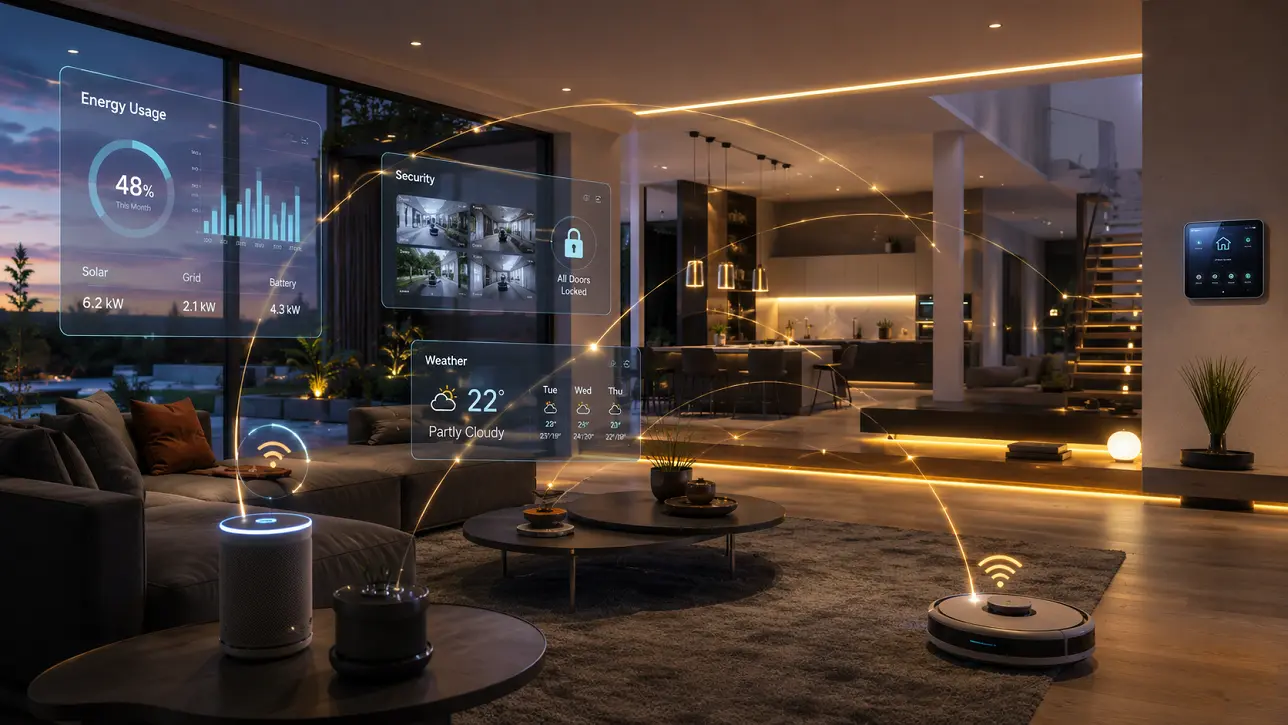
It is just past six in the evening. The front door unlocks with a tap from your phone, but the house already knows who has arrived. The hallway light fades up to a warm 30 percent, the thermostat clicks off its eco mode, and the kitchen speaker quietly announces the traffic conditions for tomorrow’s commute. Nothing dramatic. Just a series of tiny, thoughtful adjustments that feel less like technology and more like a home that has been paying attention.
We have moved well beyond asking a cylinder on the counter to play a song. The AI smart home of 2026 is an environment that learns, predicts, and adapts. It does not wait for a command. It reads the patterns of daily life and quietly responds. For a lot of households, the shift has been so gradual that they barely registered the old programmable timer getting swapped for a machine that genuinely thinks ahead.
Yet building a home that works this smoothly is not just about buying the shiniest gadget. It is about understanding the invisible thread that ties everything together: artificial intelligence, and the connectivity that feeds it. That is exactly what we are exploring here, without the marketing gloss.
The New Brains of the House: Beyond Voice Commands
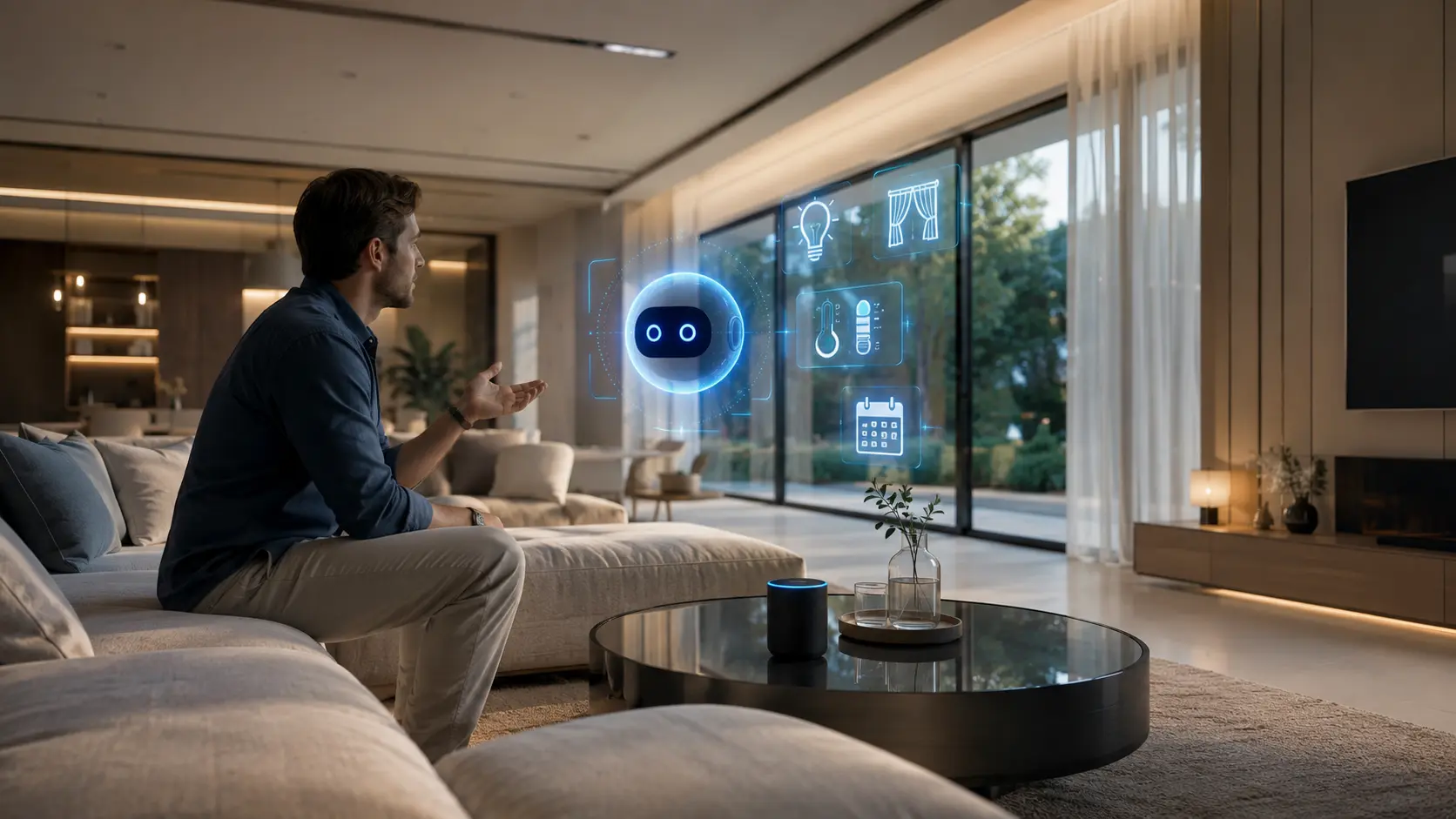
For years, a “smart home” was defined by remote control. An app to switch off a light. A timer for the heating. Voice commands that felt like a novelty. What changed is the injection of genuine machine intelligence into those everyday objects. The current wave of AI home technology is not just connected; it is context-aware. It gathers signals from motion sensors, geolocation, calendar data, and even local weather forecasts, then makes decisions on your behalf.
If you are new to the technical foundations, a quick read through what artificial intelligence actually is can ground you. In a housing context, the key idea is that older systems followed rigid “if this, then that” rules. Today’s AI-driven homes use probability and pattern recognition. They are trained, not programmed. For a clearer picture, our breakdown of the different types of artificial intelligence explains why the narrow AI in your thermostat is still a world away from the general intelligence you see in films, but powerful nonetheless.
This shift from static rules to learning behaviour is what separates a genuinely helpful smart home from a box of expensive timers. And it hinges on machine learning, the same technology that recommends your next series on Netflix or spots fraudulent transactions on your credit card.
When Your House Learns Your Routine Better Than You Do
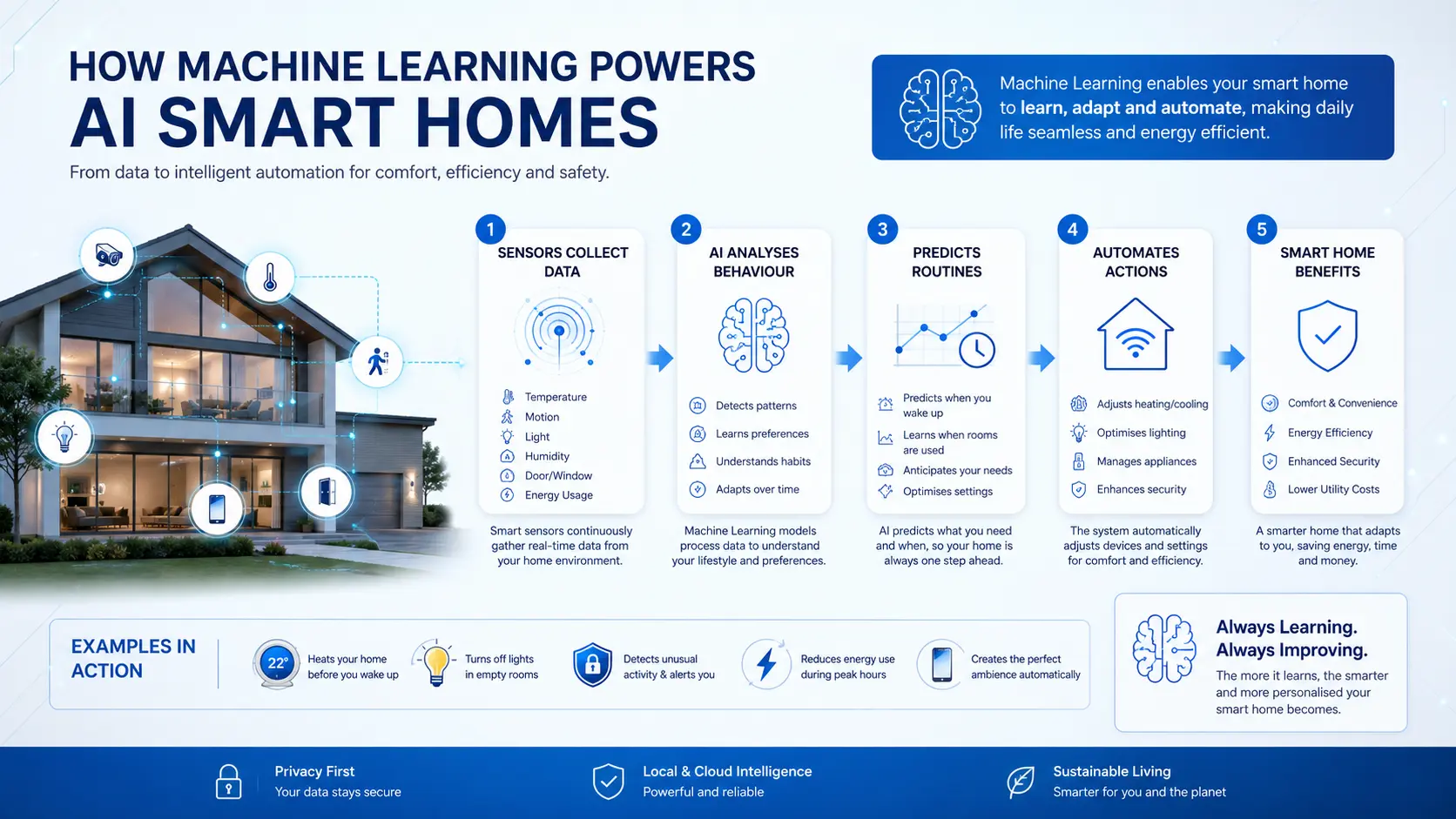
Machine learning sits at the heart of every truly intelligent home. The concept is simple to grasp once you strip away the jargon. A thermostat, for instance, does not need to be told when you leave for work. Over the course of a fortnight, it notices that motion sensors go quiet around 8:15 on weekdays and that the front door locks shortly after. It begins to drop the temperature slightly without being asked, then learns how long the boiler takes to bring the living room back up to comfort before the first person returns.
This process of continuous refinement is exactly what machine learning algorithms are built to do. They compare predictions against actual outcomes and tweak their internal models. In energy terms, the savings are tangible. Homes equipped with AI-driven heating regularly report a reduction of 15 to 20 percent on annual bills, purely because the system stops warming empty rooms.
Energy management is just one example. The same principle now runs through water leak detectors that learn the sound of a normal pipe versus a burst, and lighting systems that adjust colour temperature throughout the day to match your circadian rhythm. None of these require a schedule. They just watch, learn, and gently nudge the environment.
The Assistant That Actually Understands You
Voice assistants were the gateway drug. Alexa, Google Assistant, Siri, and a growing crop of newer players have moved beyond robotic, pre-scripted responses. The integration of large language models, the same ones behind tools like ChatGPT and Claude, means you can now say, “I’m feeling a bit chilly and I’ll be watching a film in the lounge in twenty minutes,” and the system will parse the intent, set the heating, dim the lights, and maybe even switch the TV to cinema mode.
Siri’s recent improvements in contextual awareness show how far these assistants have come. They hold conversational context across multiple requests and can trigger chains of actions without needing a separate “routine” to be built. Meanwhile, Kimi, a rising AI assistant from China, is pushing multilingual and memory capabilities that could soon make voice interactions feel even less scripted.
All of this cleverness, however, depends on a steady flow of data to the cloud and back. When that flow stutters, the intelligence evaporates.
Why Your Broadband Matters More Than Your Thermostat
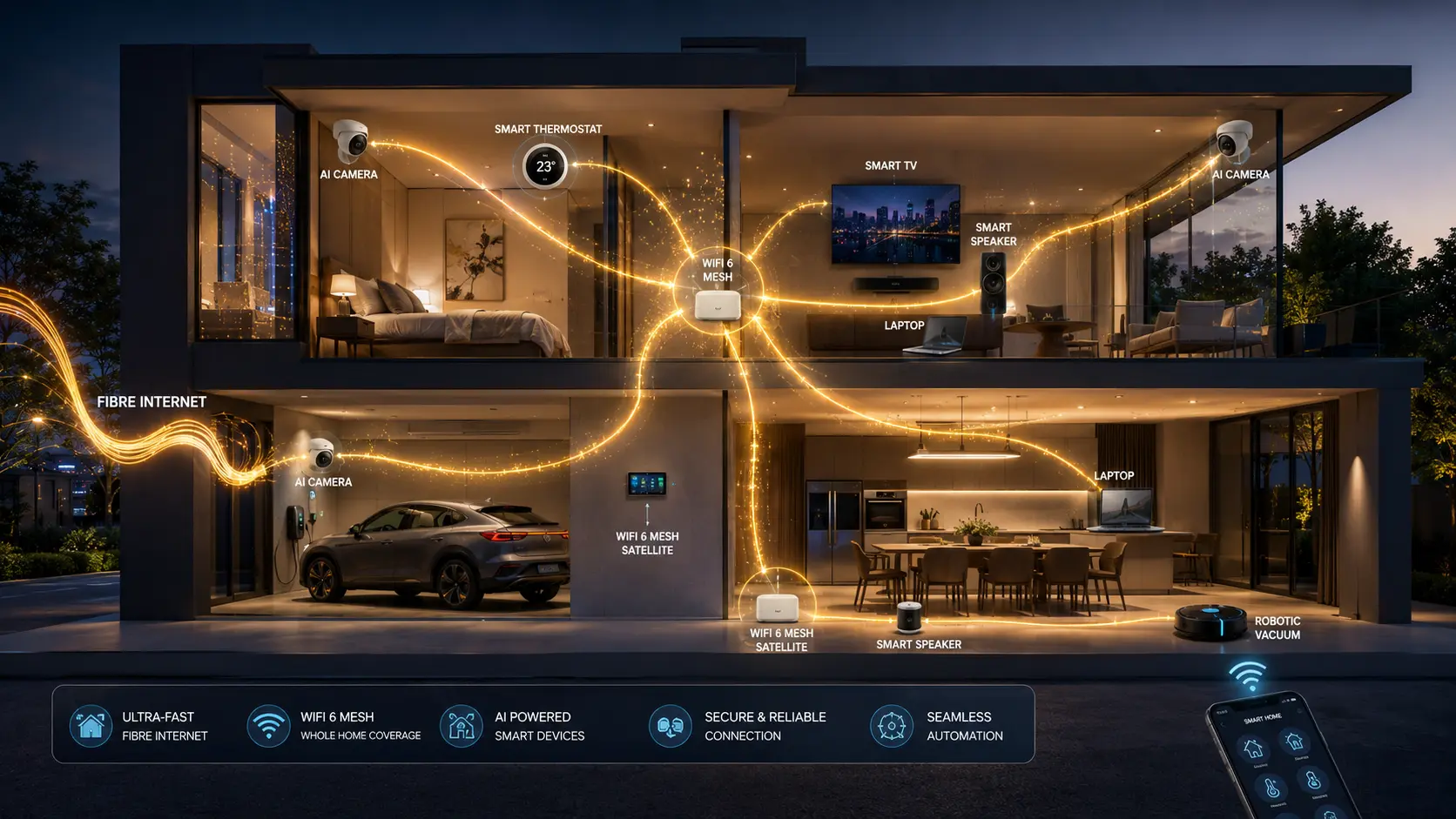
This is the section most smart home guides skip, and it is the one that saves the most heartache. Every AI-powered device in your home, from the video doorbell to the voice assistant, relies on a fast, low-latency internet connection. A camera that takes four seconds to push a notification because the network is congested is not just annoying; in a security context, it fails at its only job.
The demands are different from simply streaming Netflix. AI devices send frequent, small bursts of data for real-time inference. Smart locks, security cameras, and cloud-dependent assistants need responsiveness measured in milliseconds, not seconds. This is why so many households have turned to fibre connections as the backbone of their smart setups. In cities across the United States, including New Haven, New Haven fiber internet has become the reliable choice for homes running multiple AI streams simultaneously, with latency low enough that voice commands feel instantaneous.
Even the best mesh WiFi system will struggle if the pipe coming into the house is narrow. Modern AI routers now use built-in machine learning to prioritise traffic, automatically assigning more bandwidth to a video call while throttling background downloads. But they need a solid connection to work with. Before you buy another smart gadget, ask yourself whether your home connectivity can genuinely support a dozen always-on AI devices without grinding to a halt.
Did you know? Some AI thermostats can reduce heating and cooling costs by learning your daily routine instead of relying on fixed schedules.
Smart Home Ecosystems That Actually Play Nice
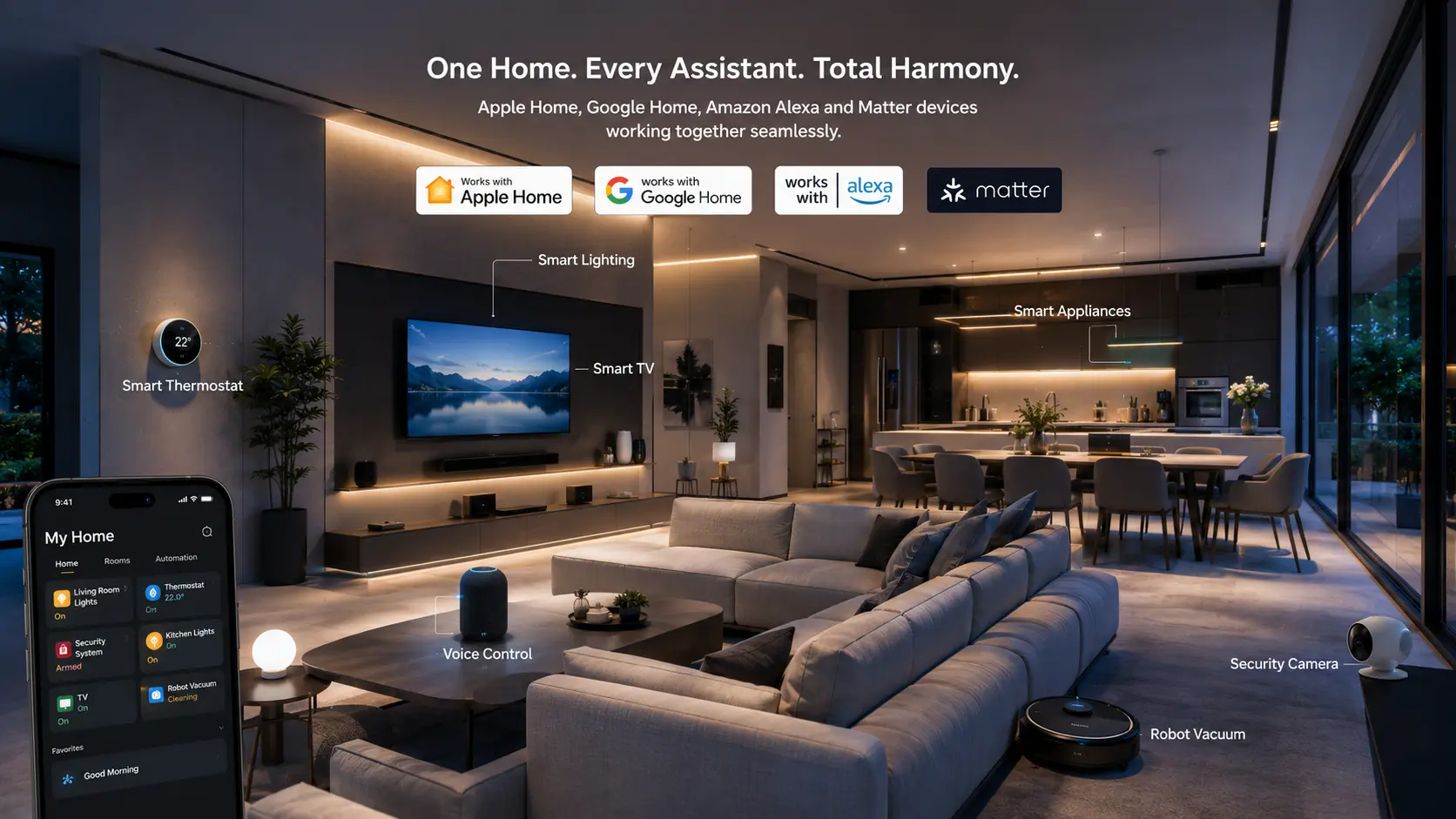
The classic blunder is buying a thermostat from one brand, cameras from another, and light bulbs from a third, only to end up juggling four incompatible apps. The industry has finally started to take interoperability seriously, thanks largely to the Matter standard and Thread protocol. These let devices from Apple, Google, Samsung, and Amazon talk to one another without a dedicated hub for each manufacturer.
When we speak of Smart home technology today, we are really describing a coordinated ecosystem of sensors, actuators, and AI agents that share a common language. Choosing products that carry the Matter badge means your new smart plug should work with your existing voice assistant, regardless of who made it. That future-proofs your investment and saves you from the slow demise of a proprietary cloud service that the manufacturer decides to discontinue.
The AI layer that sits on top of these devices is what orchestrates them. A well-designed AI home hub can recognise that a motion sensor in the hallway, combined with a drop in light levels and the absence of your phone’s Bluetooth signal, means nobody is home, and it can then arm the security system, turn off lights, and reduce heating. Without open standards, those cross-brand automations become a fragile house of cards.
Traditional Home VS AI Smart Home
| Traditional Home | AI Smart Home |
|---|---|
| Manual lights | Automated lighting |
| Standard thermostat | AI thermostat |
| CCTV recording | AI object detection |
| Fixed schedules | Predictive automation |
| Regular internet | Fibre AI connectivity |
AI Security Cameras With a Detective’s Eye
Few areas have benefited from artificial intelligence as visibly as home security. Old internet-connected cameras sent you an alert every time a pigeon flew past. Modern AI security cameras analyse the scene in real time, often on the device itself. They distinguish between a known family member, a delivery person holding a parcel, and someone lingering near a window at 2 a.m.
Facial recognition on residential cameras, when configured thoughtfully, can learn the faces of regular visitors within a few days. After that, the system can alert you only when an unfamiliar person appears, or when a vehicle parks in an unusual spot. Some models even read licence plates and log them automatically. The reduction in false alarms is dramatic, and the peace of mind is genuine.
This level of intelligence does not require a university degree in computer vision. It is a form of narrow AI, a concept we explore further in our comparison of narrow AI versus AGI and superintelligence. The takeaway is that these systems are exceptionally good at their specific task, identifying objects and behaviours, without needing to understand the wider world.
Edge AI vs Cloud AI: Where the Thinking Happens
A quiet battle is playing out inside your smart home between two different ways of processing data. Cloud AI sends information to remote servers, where vast computing resources can run complex models. That is why your voice assistant can understand a garbled request about a recipe while the extractor fan is running. Edge AI, on the other hand, keeps the processing on the device itself. A doorbell with Edge AI can recognise a face and decide whether to alert you without ever sending video to a server.
Privacy is the obvious advantage of Edge AI. If your camera never uploads raw footage, there is nothing to be intercepted or stored by a third party. Speed is the other benefit. On-device processing can react in under 100 milliseconds, whereas a cloud round-trip might take half a second even on a good connection. For a lock that needs to open when you approach, that gap matters.
The smartest homes use a blend of both. Edge AI handles urgent, privacy-sensitive tasks locally. Cloud AI steps in for deeper analysis, like searching through weeks of footage for a specific vehicle or understanding a complex spoken request. The two approaches are not rivals; they are partners.
Entertainment That Knows What You Want Before You Do
Your television now adjusts its picture settings scene by scene, not based on a generic preset, but by analysing the content in real time. AI-powered video processors can upscale older films to near-4K quality, sharpen faces, and smooth motion without the soap-opera effect that used to plague early motion interpolation. AI video editing tools that were once the domain of professionals are now built into consumer TVs and streaming boxes, making every frame look its best.
Audio has undergone a similar transformation. Soundbars now use machine learning to analyse room acoustics and adjust equalisation automatically, so dialogue stays clear even during action sequences. And all of this happens without a single trip to the settings menu.
Gaming has arguably seen the most radical shift. Instead of buying an expensive console, millions of households now stream games from remote servers, where the heavy graphical lifting is done in a data centre. This is the reality of cloud gaming in 2026. Services like GeForce Now and Xbox Cloud Gaming deliver triple-A titles to a smart TV or a budget laptop, provided the home network keeps latency below 20 milliseconds. AI plays a hidden role here too, using predictive algorithms to render frames ahead of time and mask the occasional network hiccup. A stable fibre connection once again proves its worth.
Remote Work and the AI-Powered Home Office
The home office has become a permanent fixture, and AI has quietly slipped into the workflow. Noise cancellation on video calls now isolates your voice from a barking dog or a lawnmower outside, using machine learning models trained on millions of sound samples. Smart lighting adjusts brightness and colour temperature to reduce eye strain during long meetings, while AI scheduling assistants coordinate calendars across time zones without a dozen back-and-forth emails.
Tools that incorporate AI leadership principles help managers keep distributed teams aligned, automatically summarising action points from virtual stand-ups and flagging tasks that are at risk. These are not futuristic concepts; they are available now, and they live on the same home network as your security cameras and thermostat.
The common thread, again, is the network. A patchy connection during a client presentation undermines all the intelligence sitting in the software. If your home office is going to be permanent, budgeting for a robust internet setup is as important as buying a decent chair.
Common Mistakes That Turn a Smart Home Dumb
Enthusiasm for AI devices often gallops ahead of practical planning. One of the most frequent errors is mixing incompatible ecosystems without a unifying hub. A thermostat that speaks only Zigbee, cameras locked to a proprietary cloud, and light bulbs that need a separate bridge create a fragmented mess that no amount of AI can untangle.
Underestimating WiFi coverage is another classic pitfall. A single router tucked in the hallway cannot reliably serve a garage camera, a loft office, and a back garden sensor. Before adding more AI devices, invest in a mesh system with a dedicated wireless backhaul, or run ethernet cable to fixed points.
Privacy settings also get overlooked. Many AI cameras and assistants ship with permissive defaults. Taking fifteen minutes to review what data is uploaded, set activity zones, and disable features you do not need prevents a lot of discomfort later. And when something does go wrong, having access to reliable AI customer support channels, whether through the manufacturer or third-party resources, can mean the difference between a quick fix and a bricked device.
Expert Advice Before You Start Buying
Start with the network, not the gadgets. A tri-band mesh WiFi system that covers every corner of the house is the single best investment you can make before a single AI device arrives. If you are able to run a cable to entertainment centres and security hubs, do so. Wired backhaul frees up wireless spectrum for devices that have no ethernet port.
Pick a voice assistant ecosystem and commit. Switching between Google, Alexa, and Siri for core functions adds unnecessary friction. The assistant that works best with the services you already use is the right one. Read community forums and real user reviews, not just product pages, to spot compatibility issues early.
Look for the Matter logo on every new purchase. Open standards protect you from a manufacturer pulling its cloud support in two years. And whenever possible, choose devices that offer on-device AI processing. The responsiveness and privacy benefits are immediate, and they reduce your dependency on a flawless internet connection.
What Comes Next: The Invisible Smart Home
The most exciting developments are the ones you will not see at all. Researchers are testing ambient computing environments where sensors embedded in walls, floors, and even furniture track occupancy, air quality, and subtle changes in gait that might flag a health concern. Your house will one day be able to notice that an elderly relative is moving more slowly than usual and check in, with permission, before a fall happens.
Home robotics is progressing beyond vacuum cleaners. Prototypes can already water plants, fold laundry, and sort recycling, guided by computer vision and reinforcement learning models that run on-device. The central AI coordinator, likely a combination of edge and cloud processing, will understand the rhythm of the entire household and orchestrate these helpers without any manual input.
What holds all of this together is the quiet, unglamorous work of fast, reliable connectivity. The AI smart home of the future is not a gadget showroom. It is a living, learning environment that wraps itself around the people inside it. Building one that actually works starts with understanding the brains behind it, and the wires, invisible as they may be, that let it think.
Frequently Asked Questions
What is an AI smart home?
An AI smart home uses artificial intelligence and machine learning to understand household patterns and automate tasks without needing constant manual input. It learns when you wake, adjusts temperature, manages security, and can even reorder household supplies once you give it permission. It replaces static schedules with adaptive, context-aware behaviour.
Do I need fibre internet for a smart home?
You can run basic automations on slower connections, but a fast, low-latency fibre link transforms the experience. AI assistants, security cameras, and cloud gaming all demand consistent, responsive bandwidth. Without it, you risk laggy voice responses and delayed security alerts.
How do AI security cameras differ from regular ones?
AI security cameras use on-device or cloud machine learning to distinguish between people, animals, vehicles, and background movement. They can recognise familiar faces, detect packages, and dramatically reduce false alarms by only notifying you of genuinely relevant events.
Will an AI thermostat actually lower my energy bills?
Yes. By learning your schedule, tracking thermal performance, and factoring in weather forecasts, AI thermostats can cut energy waste by 15 to 20 percent annually. They heat and cool only when and where needed, without sacrificing comfort.
What is the difference between Edge AI and Cloud AI?
Edge AI processes data locally on the device, giving faster reactions and better privacy because information never leaves your home. Cloud AI uses remote servers for complex tasks like understanding natural language or scanning weeks of footage. A good smart home blends both approaches depending on the task.
How do I avoid common smart home mistakes?
Begin with a solid mesh WiFi network and pick a central voice assistant ecosystem. Choose devices that support the Matter standard so they work together across brands, and read real user reviews before buying. Finally, spend time configuring privacy settings on every camera and microphone.
According to networking professionals, the smartest home upgrades usually begin with reliable connectivity rather than expensive gadgets. A stable network provides the foundation for AI assistants, smart security systems and automated home management.
Use the key points in this guide to understand the topic and make more informed decisions.

This guide is researched and edited using relevant documentation, reliable sources and publicly available information.
Was this guide helpful?
Your feedback helps us improve future guides.