
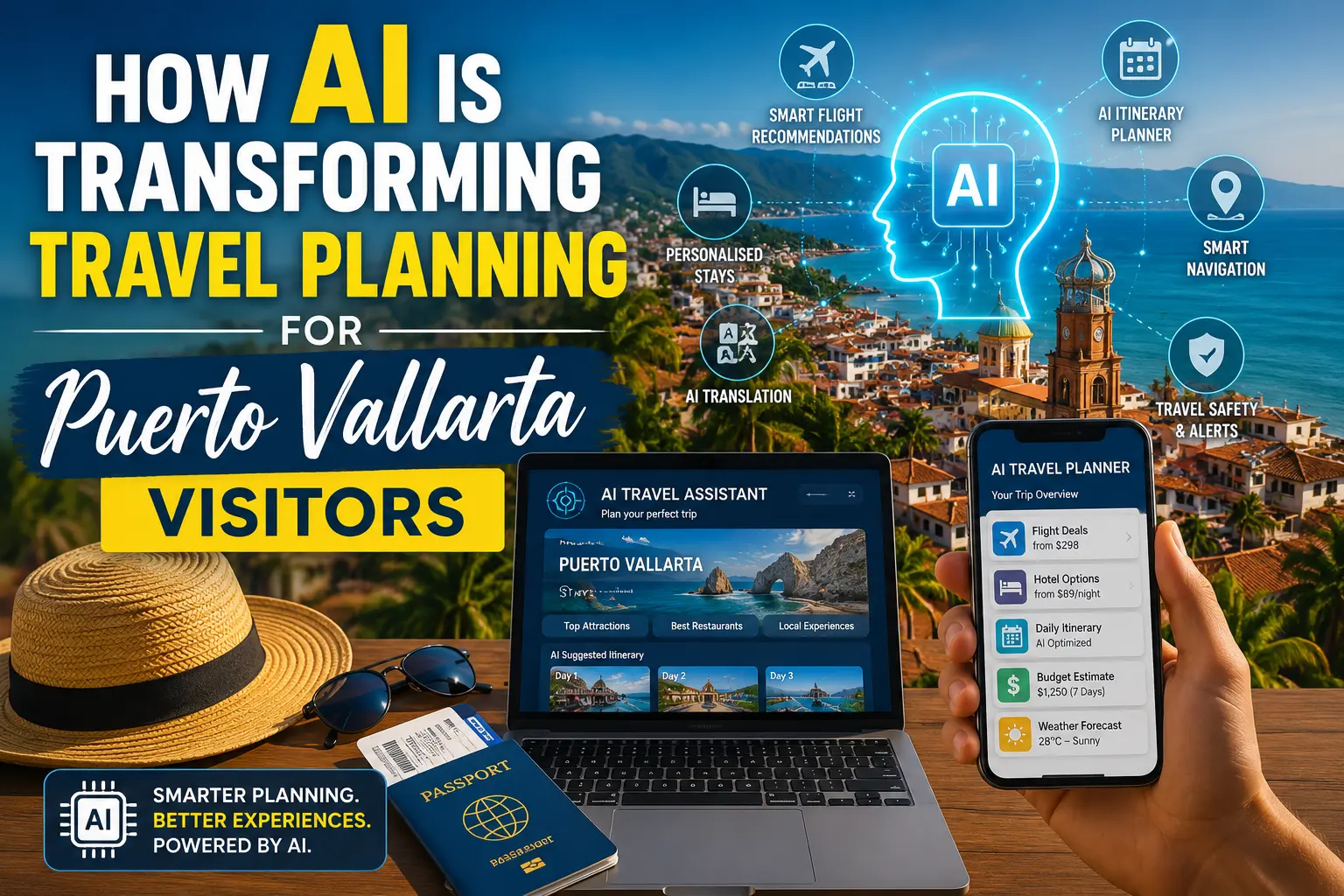
For anyone who has ever wrestled with a dozen browser tabs, three guidebooks, and a nagging suspicion they might be missing something special, the arrival of capable artificial intelligence tools in the travel planning space feels like a genuine shift. Not a magic wand, but a practical set of instruments that can handle the heavy lifting of research, comparison, and organisation. Nowhere is this more evident than when planning a trip to a multifaceted destination such as Puerto Vallarta, where the sheer variety of neighbourhoods, activities, and culinary options can overwhelm even the most experienced traveller. When searching for flights to Puerto Vallarta, AI-driven platforms now sift through real-time pricing data, predict likely fare movements, and even suggest the best booking window based on historical patterns. This article examines the underlying artificial intelligence technologies reshaping travel planning, using Puerto Vallarta as a practical lens through which to understand what these systems can and cannot do. If you are new to the foundational concepts, our primer on what is artificial intelligence offers a solid starting point.
The quiet revolution in travel research
Travel planning used to follow a predictable, linear path. You grabbed a guidebook, checked a few websites, and perhaps asked friends for recommendations. That approach was time-consuming and inherently limited by the sources you could access. Today, a constellation of AI technologies has turned that process into something far more dynamic. Large language models, machine learning, and generative AI have not simply digitised the old way of doing things; they have introduced an interactive, iterative style of planning that feels more like a conversation with a knowledgeable local than a transaction with a database.
The transformation rests on a handful of core technical advances. Recommendation algorithms, powered by machine learning, now parse enormous volumes of traveller behaviour, reviews, and contextual signals to suggest activities and restaurants that align with your personal taste rather than generic popularity. Generative AI, which we explain in depth in our guide to what is generative AI, enables the creation of full day-by-day itineraries that can be tweaked on the fly. Meanwhile, large language models bring a conversational interface that accepts nuanced instructions like “plan a rainy day with two teenagers who love street food” and returns a coherent, actionable plan within seconds. It is not about robots taking over; it is about handing travellers a research assistant that never sleeps.
| Traditional Travel Planning | AI Travel Planning |
|---|---|
| Relies on static guidebooks and websites | Pulls live data from APIs, reviews, and social media |
| Manual price comparison across multiple tabs | ML models predict fare changes and alert you |
| Generic itineraries for the “average” visitor | Personalised plans based on your behaviour and preferences |
| Language barriers hinder deeper exploration | Real-time translation and image recognition break down walls |
| Safety research requires hunting through forums | AI aggregates and summarises safety information with current context |
| Fixed bookings, difficult to adjust last minute | Dynamic rebooking and proactive disruption alerts |
| Separate tools for maps, translation, budgeting | Integrated AI assistants blend planning and on-the-ground support |
Why Puerto Vallarta works as an AI travel case study
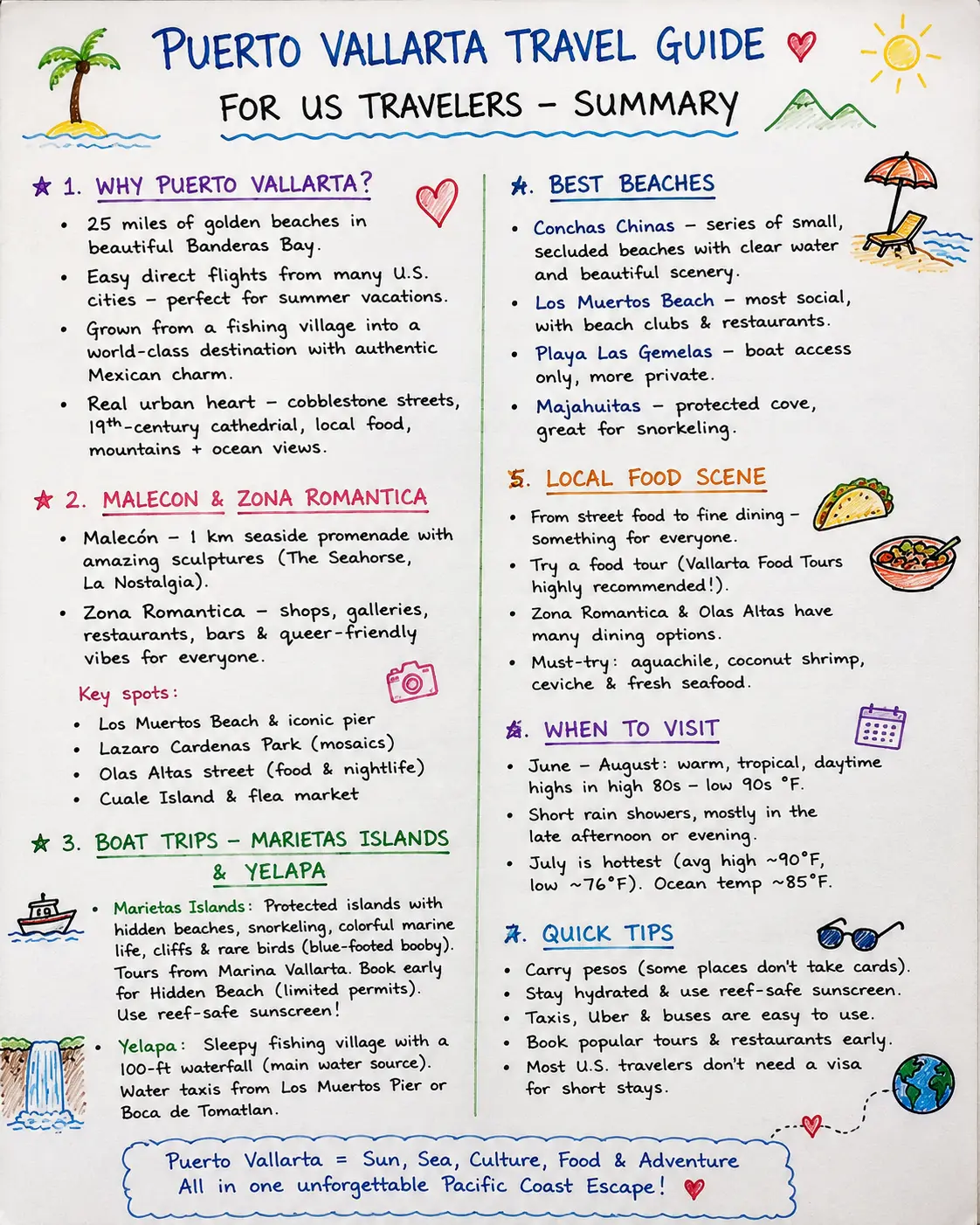
Some destinations lend themselves naturally to testing the boundaries of travel technology, and Puerto Vallarta is one of them. It combines a well-established tourist infrastructure with deeply local neighbourhoods, a bilingual environment where both Spanish and English are widely used, and a geographic layout that stretches from the cobbled streets of the Romantic Zone to the surf breaks of the Nayarit coast. This variety creates a rich data environment: thousands of restaurant reviews, real-time weather shifts that influence outdoor excursions, seasonal whale watching windows, and a mix of boutique hotels and large resorts with fluctuating dynamic pricing.
For an AI system, Puerto Vallarta is a dense, messy, and wonderfully representative dataset. The challenge of recommending a seafood stall in Versalles versus a fine-dining rooftop in the Hotel Zone forces recommendation engines to weigh dozens of signals beyond star ratings. Machine translation must handle not only standard Spanish but the informal Mexican lexicon you will encounter in market chats. Safety queries need nuanced, neighbourhood-level responses rather than blanket warnings. In short, if an AI travel tool can handle Puerto Vallarta gracefully, it is likely to perform well almost anywhere. That makes the destination an ideal proxy for exploring how each AI technology actually works under the hood.
Large language models as your travel planning partner

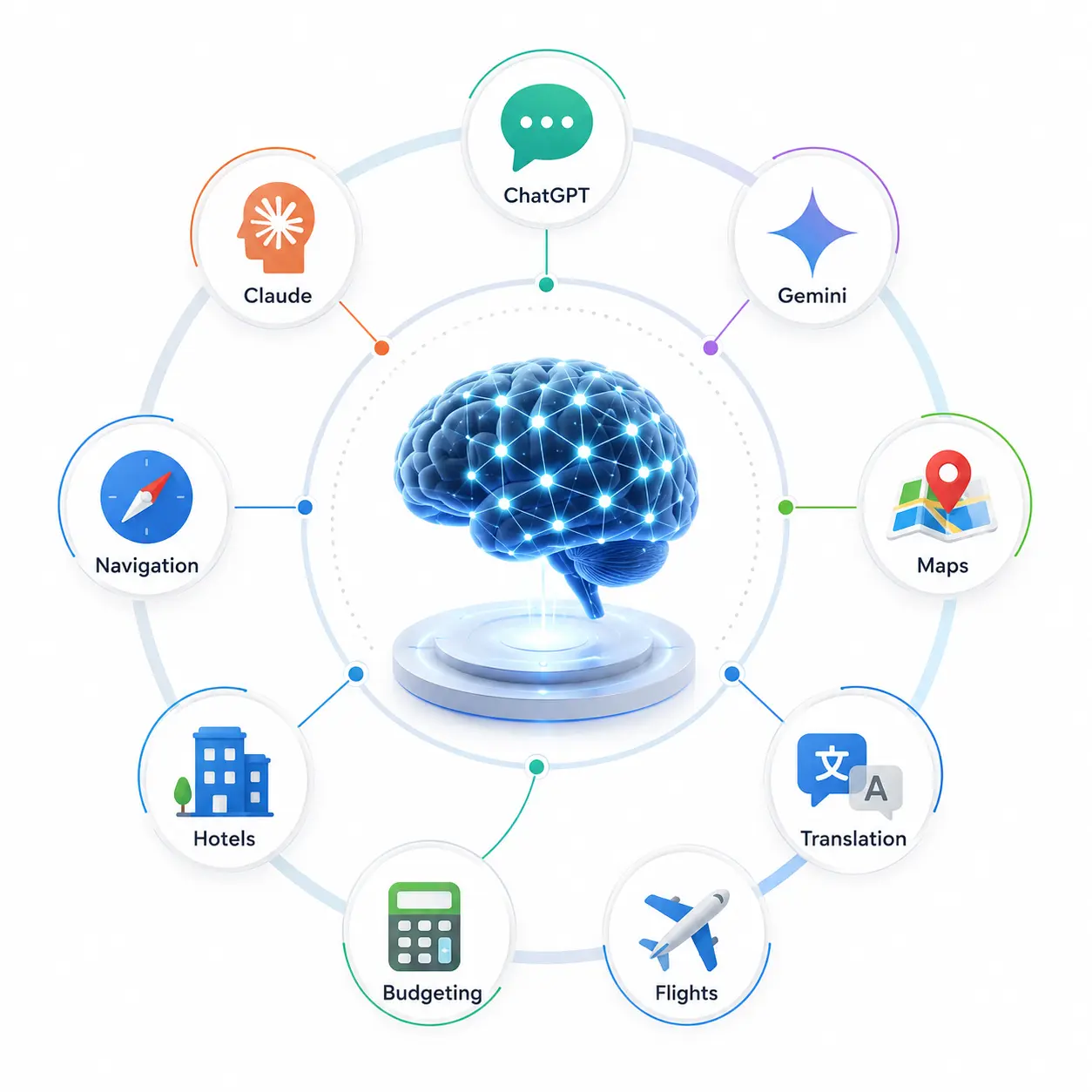
The most visible face of AI travel planning in 2026 is the large language model. These systems have moved well beyond simple question-and-answer formats. They can now maintain context over tens of thousands of words, integrate real-time web search when needed, and process images, PDFs, and even audio clips. For a traveller, this means you can upload a scanned page from a guidebook, a screenshot of a flight itinerary, and a voice memo about your dietary requirements, then ask the AI to stitch everything into a coherent plan. The three major platforms each bring something distinct to the table.
ChatGPT: Conversational itinerary building
OpenAI’s ChatGPT remains one of the most versatile tools for trip planning. The free tier, powered by the latest GPT-4o model as of 2026, handles multimodal prompts, so you can show it a photo of a handwritten list of must-visit places and ask it to map an efficient route. For travellers who want deeper customisation, ChatGPT Plus at £16 per month unlocks priority access, extended reasoning, and the ability to create custom GPTs. A custom GPT tailored to Puerto Vallarta might be trained on local blog posts, restaurant menus, and tide charts, effectively becoming a specialised digital concierge. Our ChatGPT guide for beginners walks through the setup process if you want to build your own. One practical tip: ask the model to explain the reasoning behind its suggestions. You will often discover hidden gems, like a beach club it recommends because it analysed dozens of reviews praising the combination of shade, calm water, and ceviche, exactly the criteria you fed it but never articulated as a single request.
Claude: Long-context analysis of guidebooks and reviews
Anthropic’s Claude excels where deep, document-level understanding is needed. Its context window comfortably swallows entire guidebook PDFs, lengthy TripAdvisor threads, and even the terms and conditions of travel insurance policies. As we detail in our Claude AI master guide, you can feed Claude a 200-page guide to Jalisco and then ask it to extract every mention of a taco stand that opens past midnight, or to compare the safety advice for the Malecón at different times of day. The free plan is generous for casual users, while Claude Pro at £16 per month offers higher usage limits. What sets Claude apart for travel planning is its ability to hold a genuinely nuanced discussion about trade-offs. Ask it whether you should spend your last afternoon at the Botanical Gardens or Los Arcos, and it will weigh practicalities like travel time, season, and your previously stated preference for nature over crowds, all without losing the thread of the conversation that began three days earlier when you were still choosing a hotel.
Google Gemini: Real-time data and multimodal search
Google’s Gemini ecosystem, particularly with the Gemini Advanced tier available as part of a Google One AI Premium plan at £18.99 per month, blends language understanding with direct hooks into Google’s search, Maps, and flight data. This tight integration makes it uniquely useful for travel planning that requires fresh information. You can ask Gemini to find flights to Puerto Vallarta for the first week of November, check the average rainfall that week based on recent climate data, and then overlay the results with hotel availability in Zona Romántica, all within a single chat thread. It can also process video. Point your phone camera at a bustling street scene, and Gemini can later summarise the restaurants visible in the footage, pulling up ratings and opening hours. Underneath, Google leverages retrieval-augmented generation, a technique we unpack in our complete RAG guide, to fetch live information and ground the model’s answers in verifiable sources rather than relying solely on training data. That reduces, though does not eliminate, the risk of hallucinated restaurant closures or outdated entry fees.
Other models worth knowing
Beyond the big three, specialist models can fill niches. Kimi AI, covered in our complete Kimi guide, offers a generous free context window that suits travellers who want to upload an entire trip dossier and interrogate it offline. For those who want to see how autonomous agents might book travel in the near future, Manus AI demonstrates agentic capabilities that point the way forward, though it is not yet a consumer-ready booking tool.
AI-powered translation and the end of phrasebook anxiety
Language barriers have historically corralled many visitors to Puerto Vallarta into English-speaking bubbles, limiting the depth of cultural experience and keeping some of the best food and artisan finds out of reach. AI-driven translation has changed that calculus dramatically, and the improvements since 2024 alone deserve attention. Modern neural machine translation, built on deep learning architectures explained in our piece on what is deep learning, no longer translates word by word. It considers entire sentences, idiomatic expressions, and even the speaker’s probable intent.
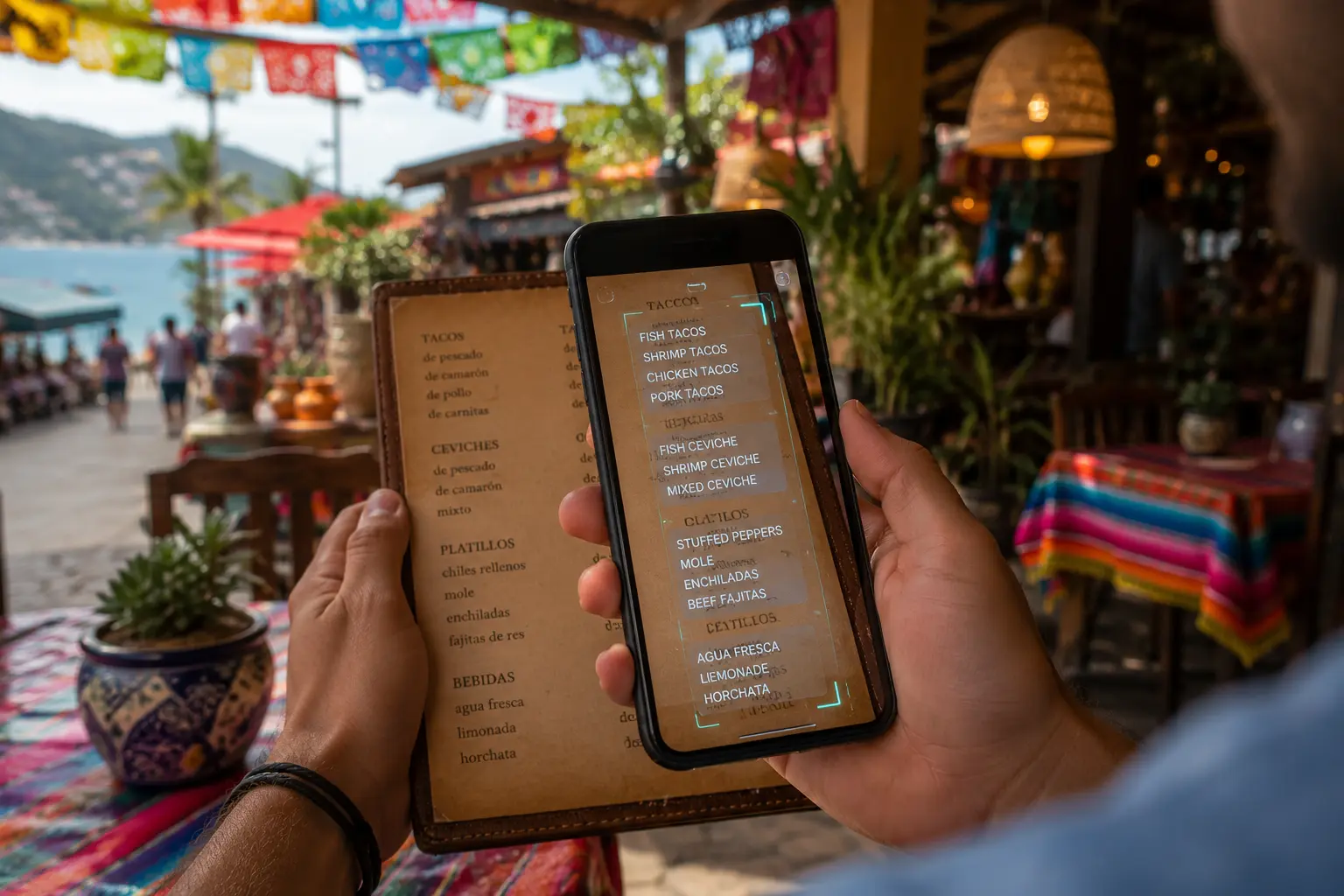
DeepL remains the gold standard for written Spanish translation, preserving the nuance that a blunt tool like a phrasebook never could. Its free tier handles short texts, while DeepL Pro, starting at around £8.99 per month, unlocks unlimited translation and the ability to translate entire documents while maintaining formatting. Google Translate, meanwhile, shines in on-the-ground scenarios. Its conversation mode now handles the quick back-and-forth of a market negotiation with impressive fluidity, and the camera-based instant translation of menus, street signs, and ingredient labels has become nearly seamless. For the traveller navigating Puerto Vallarta’s Mercado Municipal, pointing a phone at a handwritten sign advertising “chicharrón de pescado” and seeing an instant overlay reading “crispy fried fish skin” is the difference between a brave order and a missed opportunity. Behind the scenes, these tools use AI algorithms trained on billions of parallel texts, continuously refined to capture regional Mexican Spanish rather than a generic, Castilian standard.
Navigation AI: From pixelated maps to immersive previews
Getting from the airport to your hotel without a wrong turn used to be the first small victory of any trip. Today, AI-infused mapping platforms have turned that into something closer to a dress rehearsal. Google Maps now offers Immersive View for Puerto Vallarta, a feature that uses AI to stitch together billions of Street View and aerial images into a 3D model of the city. You can drag the sun across the sky to see how the light hits the Malecón at sunset, or simulate a walk from a condo in Cinco de Diciembre to a breakfast spot in Gringo Gulch, complete with projected traffic and weather conditions.
Apple Maps has similarly stepped up with AI-curated cycling routes and transit predictions that learn from real-time movement patterns rather than static schedules. What makes these tools genuinely useful rather than gimmicky is the underlying machine learning that powers live traffic estimation and rerouting. The system ingests anonymised location pings from millions of devices, predicts congestion before it solidifies, and proposes alternatives. For a destination like Puerto Vallarta, where a single accident on the highway to Punta de Mita can turn a 45-minute drive into a two-hour crawl, that kind of predictive intelligence has tangible value. Indoor navigation in airports, powered by computer vision and Bluetooth beacons, is also maturing, guiding you from the baggage carousel to the authorised taxi stand without the usual confusion.
Machine learning and the science of flight recommendations
Behind every “book now or wait” recommendation lies a complex web of supervised machine learning models. Flight comparison platforms and airline pricing systems use gradient boosting, recurrent neural networks, and increasingly transformer-based architectures to forecast fare movements. These models train on years of historical pricing data, seasonal demand cycles, fuel cost indices, and even external signals like major conference schedules or weather forecasts. Google Flights, for example, now provides a price guarantee on certain itineraries, betting that its internal ML predictions will prove accurate enough to absorb occasional payouts.
For flights to Puerto Vallarta, the algorithm considers that December through March represents the high season for North American sun-seekers, while the summer months see a dip in international visitors but a rise in domestic Mexican tourism. It can detect that a Tuesday booking for a Saturday departure typically saves 12-18% compared to a Friday booking, though such patterns shift constantly. These models are not magical; they rely on probability, not certainty. However, by coupling ML-driven price alerts with the flexible date searches that many platforms now offer, a traveller can make decisions informed by statistical likelihood rather than gut feeling. It shifts the dynamic from “I hope I am not overpaying” to “the data suggests waiting another four days is worth the risk.”
Dynamic pricing and budget optimisation: When to book and where to spend
Hotels and holiday rentals have their own AI-driven pricing machinery, and understanding it can help you avoid paying more than necessary. Platforms like Airbnb and Booking.com use dynamic pricing algorithms that adjust nightly rates based on occupancy, competitor pricing, local events, and even the booking lead time. For Puerto Vallarta, a condo near Los Muertos Beach might spike in price during the Vallarta Pride week or the Day of the Dead celebrations, and the algorithm will have learned those patterns from years of transactional data.
Travellers can fight fire with fire. Budgeting apps now incorporate ML to categorise spending on the go, compare your outlay against typical traveller profiles in the same destination, and flag when your restaurant spending is running 30% above the median for a solo traveller in the Romantic Zone. Some digital wallets and banking apps employ AI to detect duplicate charges, alert you to unfavourable currency conversion markups, and even suggest when to use a card versus cash based on the merchant’s location and typical surcharges. This is not flashy, but it is where AI quietly saves a traveller meaningful sums over the course of a fortnight. The algorithms behind dynamic pricing themselves are a rich subject; we touch on similar optimisation techniques in our look at AI logistics for e-commerce, where efficiency and cost prediction go hand in hand.
Recommendation engines that understand your taste, not just your rating
Restaurant and activity recommendations have moved well past the simple “people who liked X also liked Y” collaborative filtering that dominated early TripAdvisor and Yelp. Modern AI recommendation systems combine collaborative filtering with content-based analysis and deep learning on review text. They can distinguish between a five-star review that gushes about a romantic atmosphere and one that celebrates a rowdy, family-friendly vibe, then match those sentiments to your stated preferences even if you never used those exact words.
TripAdvisor itself now uses generative AI to summarise thousands of reviews into digestible pros and cons for each restaurant, pulling out themes like “the margaritas are strong but the ceviche portions have shrunk.” Google Maps surfaces personalised recommendations by learning your past patterns: if you consistently seek out vegetarian cafes and independent bookshops in every city you visit, it will prioritise similar spots in Puerto Vallarta without being told. For an even more specialised approach, models like Meituan Longcat, originally built for food delivery recommendations, demonstrate how fine-grained user modelling can capture tastes that are impossible to express in a simple star rating. While Longcat is primarily an Asian market tool, its underlying architecture hints at where global travel recommendation engines are heading: systems that understand you crave not just “good Mexican food” but specifically “a quiet patio where you can eat chilaquiles while watching the street life, with salsa that has more smoke than heat.”
Safety, fraud detection, and digital identity in an AI-driven travel world
Travel safety in 2026 is an information problem, and AI is exceptionally good at processing information. Platforms now aggregate data from local news, government advisories, social media, and weather services to give neighbourhood-level safety guidance. They can tell you that the walk from your Airbnb to the beach is well-lit and busy until 10pm, but quieter and less policed after midnight. This kind of granular, time-aware safety analysis was simply not available to the average traveller a few years ago.
Booking fraud remains a persistent threat, and AI works both sides of that fence. Legitimate platforms deploy anomaly detection algorithms that flag suspicious listings, fake reviews generated by large language models, and payment patterns consistent with identity theft. Travellers can use AI-powered identity verification tools that check the digital footprint of a holiday rental host or a tour operator before handing over a deposit. We explored the trust-building dimension of this technology in our article on how AI builds business credibility and trust, which applies directly to the verification systems now embedded in major travel marketplaces. Additionally, cybersecurity when using public Wi-Fi in Puerto Vallarta’s cafes is a legitimate concern. AI-driven VPNs and threat detection apps now sit quietly in the background, learning normal network behaviour and alerting you only when something looks wrong, like a man-in-the-middle attack targeting hotel guest portals.
Smart hotels and the invisible concierge
The hotel experience in Puerto Vallarta is increasingly mediated by AI, sometimes visibly and sometimes entirely behind the scenes. Smart room controls, tied together by IoT platforms, let you adjust the air conditioning, lighting, and curtains through a tablet or a voice assistant. What makes this AI rather than a simple remote control is the occupancy-learning component. After the first day, the system notices you prefer the room at 21 degrees Celsius when you return from the beach at 4pm, and it begins pre-cooling the room accordingly without a command.
Voice assistants in hotels are now capable of handling complex requests beyond “bring more towels.” Built on models like those we discuss in our Siri AI analysis, they can process a request like “book me a taxi to the airport for 6am, make sure it has a child seat, and also can you hold breakfast for us to pick up at 5:45?” by connecting to multiple backend systems. This integration is slowly transforming the front desk from a transaction point into a genuine hospitality touchpoint, because routine logistical questions are siphoned off by the AI. Other areas of the hotel, from laundry logistics to predictive maintenance of air conditioning units, run on machine learning models that reduce downtime and energy consumption, savings that sometimes trickle down to the guest’s bill. If you are curious about the underlying smart infrastructure, our AI smart home guide covers many of the same principles in a residential context.
AI photography: Editing, organising, and even generating travel visuals
Travel photography has undergone its own AI disruption. The camera hardware on modern smartphones is deeply intertwined with computational photography, where machine learning algorithms handle everything from low-light noise reduction to synthetic bokeh. But the post-capture experience is where AI makes the biggest difference for a traveller in Puerto Vallarta. Google Photos uses facial recognition and scene detection to automatically curate an album of your trip, removing blurry shots, suggesting the best group photo from a burst sequence, and even creating a highlight reel set to music. The Magic Eraser tool, powered by generative inpainting, lets you remove the stranger who wandered into your perfect sunset shot on the Malecón with a single tap.
For more serious editing, Adobe Lightroom’s AI masking can select the sky in a beach photo and enhance its colour without touching the foreground, or lift the shadows on a face backlit by the Pacific. Generative fill, driven by the same technology we outline in our comparison of AI video editors, can extend the frame of a picture that was cropped too tightly, plausibly inventing the missing sea and sand. These tools are not just about vanity; they help salvage moments that would otherwise be lost to imperfect conditions. A rainy afternoon in the Zona Romántica, captured through a fogged lens, can be transformed into a moody, atmospheric memory that reflects the feeling of the moment rather than its technical shortcomings.
Staying productive while travelling: AI for digital nomads
Puerto Vallarta has become a magnet for digital nomads, and the ability to maintain professional output while enjoying a coastal lifestyle depends increasingly on AI-driven productivity tools. Email clients now summarise long threads, draft replies in your personal tone, and triage messages so you only see what truly matters during your morning coffee at a cafe in Versalles. Calendar assistants negotiate meeting times across time zones automatically, understanding that your “afternoon” when in Jalisco might be a client’s “evening” in London.
For software developers who form a significant subset of the nomadic community, AI pair programming tools and code review assistants have changed the equation. Tools like the one we examined in our Xiaomi Mimo code review can catch bugs and suggest improvements while you work from a rooftop with an unreliable Wi-Fi connection, effectively providing a second set of eyes that does not mind the humidity. The emerging category of autonomous AI agents, represented by platforms like Manus AI, hints at a near future where an AI can independently research and book a coworking space, file an expense report, or reschedule a week’s worth of meetings while you are snorkelling at Los Arcos. That autonomy is not fully mature yet, but the building blocks are in place, and they directly impact the lifestyle of anyone who earns their living with a laptop and values the freedom to do so from Banderas Bay.
Privacy pitfalls and the data you’re handing over
Every AI convenience comes at a privacy cost, and travel planning tools are especially hungry for data. When you use a conversational AI to plan a trip, you are potentially sharing your location, travel dates, budget, dietary requirements, and the names of your travel companions. That data can be retained, used for model training, and in some cases shared with third parties. Reading the privacy policies of AI travel apps is rarely uplifting, and the reality is that many travellers opt for convenience over caution, a trade-off the industry quietly relies upon.
Location data is particularly sensitive. Navigation apps that learn your habits can infer where you sleep, where you eat, and when you are away from your accommodation. While this data is typically anonymised, re-identification attacks have shown that supposedly anonymised location traces can be linked back to individuals with alarming accuracy. AI-powered travel insurance and visa application platforms also collect biometric data, from facial scans to voiceprints, raising questions about long-term storage and cross-border data transfer. Our analysis of how AI builds business credibility and trust delves into the safeguards that responsible companies implement, but the onus remains on the traveller to understand what they are giving up. The practical advice is not to abandon AI tools, but to compartmentalise: use a dedicated travel email, avoid linking every service to your primary Google or Apple account, and regularly audit which apps have persistent location access. The technology that makes your trip smoother should not become a permanent digital shadow you never agreed to cast.
The real limitations: What AI still gets wrong about travel
For all their prowess, current AI travel tools stumble in ways that are both predictable and instructive. Hallucination remains an unsolved problem at the architectural level. A large language model might confidently recommend a taqueria that closed during the pandemic, or invent a scenic hiking trail that does not exist because it conflated details from two separate blog posts. This is not a rare edge case; it is a fundamental characteristic of generative models that do not truly “know” anything but instead predict probable text sequences based on their training data.
Bias is another persistent issue. Recommendation systems trained predominantly on English-language reviews from North American tourists will inherently skew towards restaurants with bilingual menus and milder spice profiles, systematically burying the family-run lonchería in Pitillal that has been serving the best birria in town for three decades but has no online presence. AI cannot taste food, cannot feel the energy of a plaza at dusk, and cannot replicate the serendipity of wandering into a gallery because a painter smiled at you from the doorway. It also struggles with context that requires genuine cultural understanding. A machine learning model might flag a neighbourhood as “less safe” because it has fewer police reports written in English, missing the obvious fact that many minor incidents go unreported in areas with higher police distrust, skewing the data in precisely the wrong direction. These are not arguments against using AI; they are arguments for using it as a starting point, not a final authority.
Expert tips for making AI a useful travel companion, not a dictator
Having spent considerable time testing these tools across multiple trips, a few principles stand out. First, treat the AI as a knowledgeable but occasionally overconfident friend. Ask it to cite its sources when it makes a specific claim, and be suspicious if it cannot. Second, use multiple models in parallel. Ask ChatGPT for a neighbourhood overview, Claude to cross-reference that against a PDF guidebook, and Gemini to check live opening hours and weather. Their strengths are complementary, and where they disagree, you have found something worth investigating yourself.
Third, never let an AI make the final call on anything involving safety, money, or your gut instinct. The model can tell you that a particular beach has statistically fewer jellyfish in January; it cannot smell the offshore wind that the old man repairing fishing nets on the sand can read like a newspaper. Fourth, use AI for the heavy lifting of logistics so that your human brain is free for the things that matter: noticing the quality of the light, remembering the name of the salsa you liked, and being present. Finally, keep your prompts specific and iterative. “Plan a Puerto Vallarta trip” will yield a generic result. “I am a vegetarian who loves street photography, avoids crowds, and wants to spend under £80 a day including a private room in a guesthouse. It’s early June, and I am scared of jellyfish. Build a four-day plan.” will produce something you can actually work with. The difference lies in the detail, and that remains a human skill. For those in leadership roles who need to make decisions under uncertainty, the strategies we discuss in our AI leadership article resonate here too: use data, but trust your own domain expertise.
What comes next: The near-future of AI travel planning
The trajectory of travel AI is pointing towards autonomy, multimodality, and deeper personalisation. Within the next few years, it is reasonable to expect AI agents that can be given a budget and a set of preferences, and that will then independently book flights, accommodations, and restaurant reservations, negotiating with booking platforms on your behalf. The foundations of such agentic systems are already visible in tools like Manus AI, though consumer-grade travel agents with true transactional authority remain in development. The step from suggesting a hotel to charging your card requires a different level of security and liability, and that is where the current bottleneck sits.
Augmented reality will likely merge with AI to provide real-time overlay information as you walk through a city. Pointing your phone at a building and seeing not just its name but its TripAdvisor rating, a translated historical plaque, and a live overlay of your friend’s geotagged photo from two years ago is a technically achievable demo; making it work without draining your battery or invading privacy is the engineering challenge. Predictive disruption handling, where your AI assistant rebooks you on a new flight before the airline even announces the cancellation because it detected a weather pattern and crew timeout that make the original flight impossible, is similarly within reach. The retrieval-augmented generation techniques we covered in our complete RAG guide will become standard, grounding every AI response in verifiable, up-to-date sources. As these systems move from narrow AI toward more general capabilities, a topic we explore in our comparison of narrow AI vs AGI vs superintelligence, the line between a travel tool and a travel companion will blur considerably.
AI Tools for Travel Planning at a Glance (2026)
| AI Tool | Purpose | Pricing (as of 2026) | Free Plan | Best Use Case |
|---|---|---|---|---|
| ChatGPT | Conversational itinerary building, custom GPTs, multimodal planning | Free; ChatGPT Plus £16/month | Yes | Iterative, highly personalised trip design |
| Claude | Long-document analysis, guidebook and review processing | Free; Claude Pro £16/month | Yes | Deep research, comparing multiple sources, nuanced trade-off discussions |
| Google Gemini | Integrated search, maps, flight data, video summarisation | Free; Gemini Advanced £18.99/month (Google One AI Premium) | Yes | Real-time information, visual trip previews, planning with live data |
| DeepL | High-quality text translation, document translation | Free; DeepL Pro from £8.99/month | Yes | Translating menus, contracts, detailed cultural materials |
| Google Translate | On-device and cloud translation, conversation mode, camera translation | Free | Yes | Everyday interactions, market negotiations, instant sign reading |
| Google Maps AI | Immersive 3D previews, predictive traffic, indoor navigation | Free | Yes | Route planning, neighbourhood walkthroughs, transit guidance |
| TripAdvisor AI | Review summarisation, personalised restaurant and activity recommendations | Free | Yes | Quickly understanding the consensus on a venue |
| Google Flights / Kayak | ML-driven price prediction and fare alerts | Free | Yes | Deciding when to book flights to Puerto Vallarta |
| TravelSpend | AI-powered budget tracking and spending comparison | Free; premium from £2.99/month | Yes | Keeping daily expenses aligned with your overall trip budget |
Summary
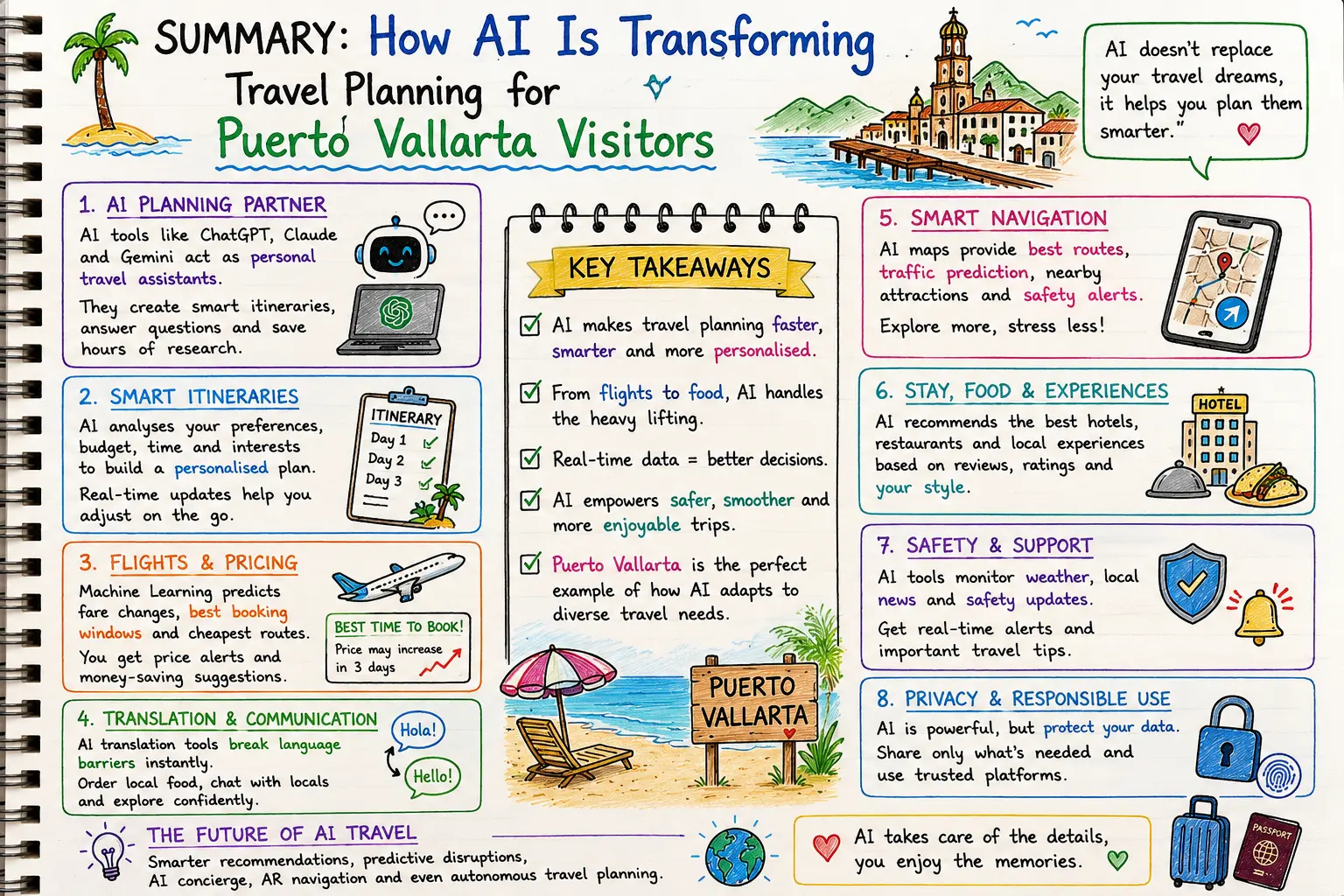
Editorial Review
This article has been reviewed by the RCNGuide editorial team to ensure technical accuracy, factual consistency, and alignment with current developments in artificial intelligence and travel technology. Product pricing, AI platform capabilities, and feature availability were verified at the time of publication. As AI services evolve rapidly, readers should confirm the latest features and subscription costs directly with the respective providers before making travel decisions.
Our Research Methodology
To prepare this guide, the RCNGuide editorial team analysed official documentation from leading AI providers, travel technology platforms, airline booking systems, mapping services, and translation tools. We also reviewed publicly available pricing information, developer documentation, user experience reports, and recent advancements in machine learning, generative AI, and recommendation systems. Rather than relying on promotional material, this article focuses on practical real-world applications of AI for modern travellers.
Why Trust RCNGuide?
RCNGuide publishes independent educational content covering artificial intelligence, machine learning, developer tools, cloud computing, automation, and emerging technologies. Our editorial approach focuses on explaining how modern AI systems work in real-world situations through detailed technical analysis, practical testing, and evidence-based research. Every guide is written to help readers understand both the capabilities and limitations of today’s AI technologies.
AI Content Transparency
Artificial intelligence tools may have been used during background research, topic organisation, or editorial workflow. Every technical explanation, recommendation, and final editorial decision has been reviewed by the RCNGuide editorial team before publication.
Key Takeaways
- AI can significantly reduce the time needed to research and plan a trip.
- Large language models help create personalised itineraries.
- Machine learning improves flight price predictions.
- Translation AI removes language barriers.
- AI recommendations should complement, not replace, personal judgement.
Expert Tip
If you rely on AI to plan your holiday, always verify important information such as flight schedules, hotel reservations, visa requirements, weather conditions, and attraction opening hours through official sources before travelling. AI is an excellent planning assistant, but real-time verification remains essential.
About the Author
This article was written by the RCN Guide editorial team, which specializes in Artificial Intelligence, Machine Learning, developer tools, SaaS platforms, and emerging technologies. Our team regularly researches, tests, and analyses AI applications to explain how they perform in real-world scenarios.