In this article
Quick Summary
While earning a CEH certification establishes your foundational security knowledge, thriving in live enterprise environments demands practical offensive capabilities beyond baseline theory. To accelerate your career, you must build advanced skills in key areas like cloud-native security, Active Directory exploitation, custom exploit scripting, and manual code auditing. Mastering these capabilities—alongside EDR evasion and executive risk reporting—allows you to effectively translate complex technical flaws into clear business impact. Committing to continuous hands-on practice through homelabs and real-world testing will quickly elevate you from a certified beginner to an indispensable, high-earning cybersecurity expert.
Introduction
Earning your Certified Ethical Hacker (CEH) credential is a major milestone that proves your solid understanding of core security concepts. However, passing the exam is only your entry ticket into the cybersecurity industry. Live enterprise environments, complex cloud architectures, and modern application stacks demand offensive security professionals who can perform far beyond standard multiple-choice theory.
To stand out in a competitive job market, command higher compensation, and lead high-impact security engagements, you must develop practical capabilities that solve real organizational challenges. Top employers look for professionals who can perform manual code reviews, execute custom exploit scripting, navigate Active Directory environments, and securely assess cloud infrastructures. Mastering these practical techniques bridges the gap between foundational knowledge and elite red teaming performance.
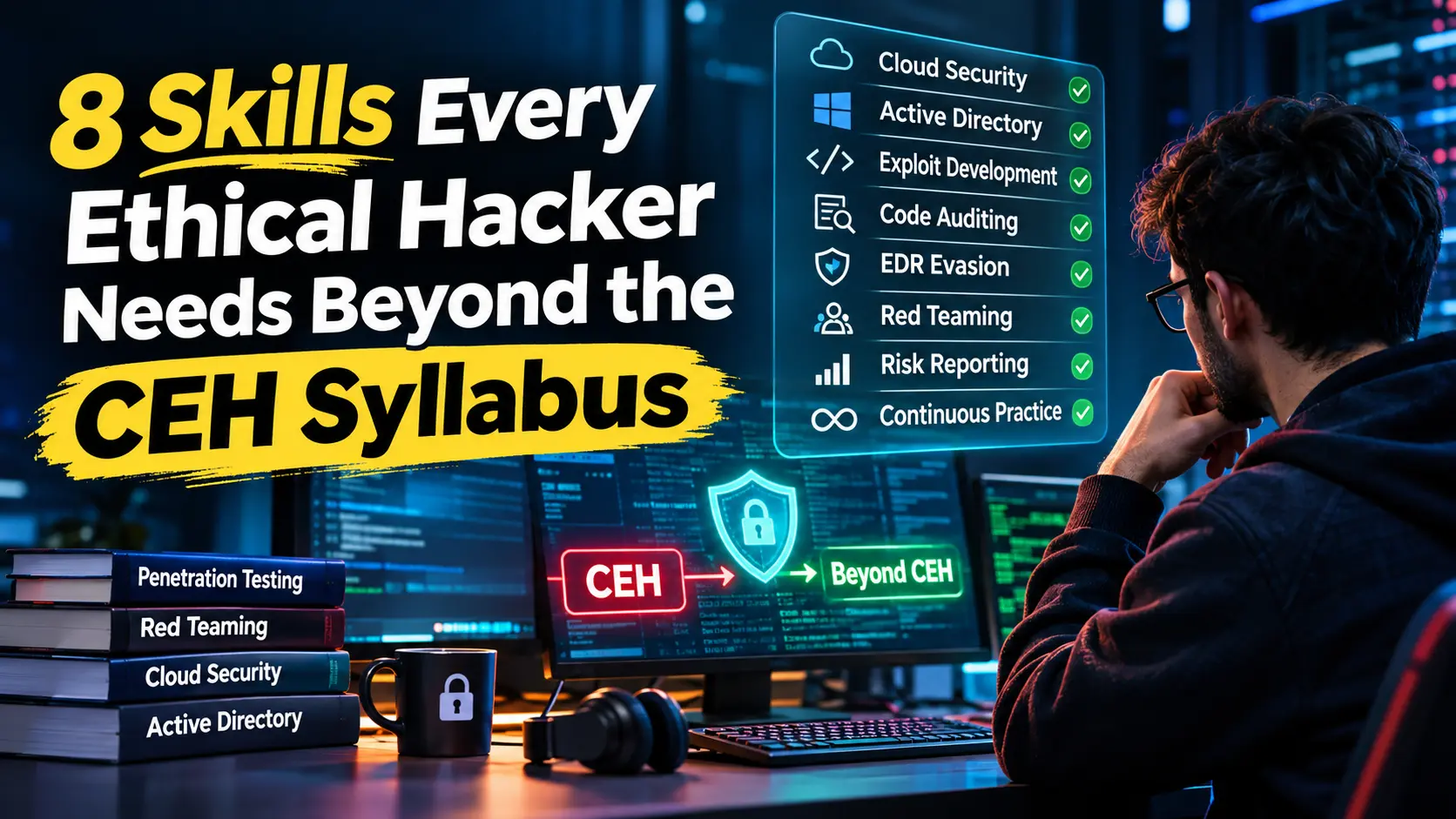
This guide outlines the eight critical ethical hacker skills you need to build beyond the CEH syllabus to accelerate your career growth, pass advanced practical certifications, and position yourself as an indispensable security expert.
Why the CEH Certification Is Only Your Ethical Hacking Baseline
The Gap Between Certified Theory and Real-World Penetration Testing
The gap between certified theory and real-world penetration testing lies in practical execution. While certifications validate foundational terminology and standard tools, live enterprise environments feature custom software, complex network security analysis constraints, and active security teams that require manual exploitation skills beyond automated testing.
Foundational security certifications provide an excellent introduction to offensive security concepts, terminology, and standard toolsets. However, theoretical knowledge rarely translates directly to live production environments. Multiple-choice exams verify that you understand what a tool does, but they cannot simulate the unpredictable nature of an enterprise infrastructure protected by modern web application firewalls, intrusion prevention systems, and internal monitoring teams.
When performing real security engagements, security professionals encounter custom applications, legacy scripts, and unique network configurations. Standard automated scanners often miss nuanced security flaws or generate high volumes of false positives. Bridging the gap between certified knowledge and real-world execution requires hands-on practice, deep technical understanding, and the ability to adapt offensive strategies when initial attacks fail.
Why Modern Enterprise Environments Demand Advanced Ethical Hacker Skills
Modern enterprise environments demand advanced ethical hacker skills because cyber threats have evolved beyond simple vulnerabilities. Complex hybrid networks, cloud-native deployments, and strict compliance rules require security professionals who can perform manual code reviews, execute custom exploit development, and protect critical assets against sophisticated adversaries.
Organizations no longer rely on single perimeter defenses. Modern corporate networks combine cloud infrastructure, remote endpoints, third-party APIs, and complex identity management systems. Consequently, basic vulnerability assessment routines are insufficient to protect corporate assets against determined threat actors.
Employers seek security experts who understand key skills needed for ethical hacking certification and can apply advanced penetration testing techniques to identify security blind spots. Demonstrating advanced ethical hacking skills after CEH certification demonstrates to leadership that you can evaluate complex architecture, safely simulate real-world attacks, and provide actionable guidance to harden enterprise systems.
| Capability Area | CEH Baseline Knowledge | Enterprise Real-World Application |
|---|---|---|
| Vulnerability Discovery | Running automated vulnerability scanners (e.g., Nessus, Nmap). | Conducting manual code reviews and business logic analysis to find zero-day flaws. |
| Exploitation Approach | Executing public scripts via frameworks like Metasploit. | Writing custom exploit scripts to bypass EDR and payload detection rules. |
| Target Environment | Isolated virtual machines with standard configurations. | Hybrid cloud infrastructures with Active Directory and security monitoring. |
| Reporting Output | Listing discovered CVEs and tool-generated severity scores. | Translating technical risk into business impact metrics with tailored remediation steps. |
1. Advanced Source Code Auditing and Manual Code Review
Moving Beyond Automated SAST/DAST Vulnerability Scanners
Automated Static Application Security Testing (SAST) and Dynamic Application Security Testing (DAST) tools are helpful for catching low-hanging fruit, such as outdated libraries or missing security headers. However, automated scanners operate on predefined patterns and rules, which prevents them from understanding context.
Manual code auditing allows security auditors to trace data flows from user input down to backend database queries and external integrations. By reviewing code line by line, ethical hackers can identify subtle sanitization errors, improper memory handling, and weak cryptographic implementations that automated tools skip entirely. Developing manual code review capabilities is one of the essential ethical hacker skills for career growth into senior application security roles.
Identifying Complex Business Logic Flaws in Application Code
Business logic flaws represent design defects in application workflows that allow users to manipulate functionality for unintended outcomes. Because logic flaws involve valid code syntax and legal application commands, automated scanners cannot detect them.
Examples of business logic vulnerabilities include modifying price values in e-commerce checkout parameters, skipping multi-factor authentication steps by altering URL paths, or abusing API workflows to access another user’s private data. Identifying these vulnerabilities requires deep analytical skills, patience, and an understanding of how application components interact under non-standard conditions.
- Input Sanitization Validation: Verifying how applications validate, escape, and sanitize user-supplied data across all functions.
- Authentication Flow Integrity: Checking logic paths for session fixation, weak password reset mechanisms, and parameter manipulation.
- Authorization Enforcement: Inspecting server-side code to ensure access controls check user privileges on every request.
- Data Exposure Tracing: Reviewing API responses and debug logs for unintended sensitive information leakage.
2. Cloud-Native Security Assessment (AWS, Azure, & GCP)
Exploiting Misconfigured IAM Roles and Serverless Architecture
As organizations migrate workloads to cloud platforms like AWS, Microsoft Azure, and Google Cloud Platform (GCP), the attack surface shifts from traditional network perimeters to Identity and Access Management (IAM) configurations. Over-privileged roles, overly permissive policy wildcards, and unrotated API keys create major security risks.
Ethical hackers must understand how attackers leverage initial access to query metadata services (such as AWS IMDSv2), extract temporary credentials, and assume higher-privilege roles across accounts. Additionally, serverless functions (like AWS Lambda or Azure Functions) require targeted assessment to ensure microservice permissions adhere strictly to the principle of least privilege.
Auditing Infrastructure as Code (IaC) Deployment Pipelines
Modern enterprises provision cloud resources using Infrastructure as Code (IaC) templates written in Terraform, CloudFormation, or Ansible. Security auditing protocols must extend upstream into continuous integration and continuous deployment (CI/CD) pipelines.
Assessing IaC configurations allows security specialists to spot security issues—such as publicly exposed S3 buckets, unencrypted database storage, open security groups, and hardcoded access keys—before infrastructure is deployed to production. This proactive security testing approach minimizes enterprise exposure and strengthens cloud resilience.
| Cloud Vector | Common Vulnerability / Misconfiguration | Assessment & Audit Approach |
|---|---|---|
| IAM Policies | Over-privileged admin roles assigned to standard service accounts. | Audit policy JSON documents for wildcard permissions (`*`) and validate role assumption rules. |
| Metadata Service | Exposed IMDSv1 allowing Server-Side Request Forgery (SSRF) data leaks. | Test applications for SSRF flaws to confirm IMDSv2 session tokens are required. |
| IaC Configurations | Hardcoded secret keys and plaintext credentials inside deployment repos. | Scan Terraform and CloudFormation code bases with static analysis tools and manual verification. |
| Serverless Endpoints | Functions with unconstrained outbound internet access and excessive API rights. | Review function triggers, environment variables, and attached IAM execution policies. |
3. Custom Exploit Development and Tool Scripting
Building Offensive Scripting Skills in Python, Go, and C/C++
Relying solely on existing, pre-packaged exploit modules limits a penetration tester’s effectiveness. Modern target environments run updated software versions, custom internal applications, and specific platform configurations that standard tools cannot exploit out of the box.
Developing proficiency in programming languages like Python, Go, and C/C++ empowers security professionals to construct custom scripts tailored to specific target responses. Python is ideal for rapid socket manipulation, HTTP request crafting, and string processing. Go offers strong concurrency for building fast scanning tools, while C/C++ is essential for lower-level buffer overflow research, memory manipulation, and shellcode construction.
Bypassing Standard Security Controls without Relying on Metasploit
Public exploit frameworks like Metasploit are widely monitored by enterprise defenses. Endpoint security software, Intrusion Detection Systems (IDS), and Web Application Firewalls (WAF) maintain signature databases designed to flag off-the-shelf Metasploit payloads instantly.
Understanding how to build practical ethical hacking skills involves writing custom network payloads, modifying exploit delivery channels, and obfuscating code manually. By crafting custom exploit scripts, ethical hackers can accurately evaluate whether defensive controls are relying on basic signature matching or robust behavioral detection.
- Custom Network Socket Scripts: Writing raw socket connections in Python to interact directly with uncommon network services.
- Payload Encoding Routines: Developing custom XOR, AES, or Base64 encoding mechanisms to hide payload signatures from disk scanners.
- API Command Wrappers: Creating Go-based utilities to interact with REST interfaces during target enumeration.
- Memory Injection Utilities: Writing C-based loaders to safely test process injection and memory execution paths.
4. Enterprise Active Directory Exploitation & Lateral Movement
Executing Kerberoasting, AS-REP Roasting, and Domain Attacks
Active Directory (AD) serves as the identity backbone for the vast majority of enterprise organizations. Securing AD requires a comprehensive understanding of how adversaries abuse native Kerberos and NTLM authentication protocols to escalate privileges.
Ethical hackers must master techniques like Kerberoasting (extracting service principal name ticket hashes for offline cracking) and AS-REP Roasting (targeting users without Kerberos pre-authentication required). Additionally, assessing Active Directory environments involves identifying misconfigured ACLs, insecure delegation rights, and vulnerable Certificate Services (AD CS) deployments that could allow an attacker to achieve Domain Admin access.
Pivoting Across Complex Hybrid Network Topologies
Gaining initial execution on a single workstation is rarely the end objective of an offensive security assessment. To demonstrate real business risk, a penetration tester must navigate from segment to segment across isolated enterprise networks.
Pivoting techniques involve using compromised internal hosts as relays to route network traffic through SSH tunnels, SOCKS proxies, and port redirection tools. Mastering network security analysis across dual-homed systems and hybrid network environments ensures that ethical hackers can identify weak isolation boundaries between corporate and production zones.
| Attack Technique | Target Component | Impact on Enterprise Security |
|---|---|---|
| Kerberoasting | Service Principal Names (SPNs) with service accounts. | Allows offline brute-forcing of service account passwords to compromise high-privilege credentials. |
| AS-REP Roasting | User accounts without Kerberos pre-authentication enabled. | Enables hash extraction for offline password cracking without direct interaction with domain controllers. |
| AD CS Exploitation | Active Directory Certificate Services templates. | Grants persistence and domain-wide privilege escalation by requesting forgeable computer certificates. |
| SOCKS Pivoting | Compromised multi-homed hosts and internal routers. | Bypasses network segmentation to grant access to isolated internal subnet assets. |
5. API Security & Microservices Vulnerability Testing
Uncovering Exploits in RESTful, GraphQL, and gRPC Endpoints
Modern application architectures rely heavily on microservices communicating through APIs. Understanding what skills do you need to be a penetration tester in Web3 and cloud ecosystems requires an in-depth focus on API endpoints, including RESTful web services, GraphQL schemas, and high-performance gRPC protocols.
APIs present distinct attack surfaces compared to traditional web applications. Security testing requires enumerating hidden routes, examining schema definitions, and analyzing structural request bodies. Penetration testers search for broken object-level authorization (BOLA), broken function-level authorization (BFLA), and excessive data exposure where endpoints return full database objects while relying on client-side filtering.
Bypassing Modern API Gateways and JWT Authentication Mechanics
API gateways manage rate limiting, authentication, and routing across microservices. Evaluating API gateway configurations involves testing for HTTP request smuggling, missing rate limits, and header spoofing vulnerabilities that allow attackers to bypass security filters.
Furthermore, JSON Web Tokens (JWT) are heavily used for stateless authentication. Ethical hackers must test JWT implementations for common cryptographic weaknesses, such as key confusion attacks (switching algorithm from RS256 to HS256), weak secret signatures, missing token expiration validation, and improper parameter parsing.
- Authorization Boundary Testing: Verifying that changing object IDs in API requests fails to expose unauthorized data records.
- JWT Signature Validation: Testing token handlers against signature stripping, weak secret keys, and algorithm downgrades.
- GraphQL Schema Introspection: Utilizing schema queries to map backend object relationships and unlinked endpoints.
- Rate Limit Verification: Testing gateway limits against distributed IP networks and header manipulation techniques.
6. Purple Teaming & EDR Evasion Techniques
Understanding Endpoint Detection and Response (EDR) Telemetry
Traditional antivirus products rely primarily on static file signatures. Modern enterprises deploy Endpoint Detection and Response (EDR) agents that continuously monitor process creation, API calls, registry modifications, and network connections to detect anomalous behavior.
Ethical hackers must understand how blue teams collect and analyze telemetry. By understanding how security operations centers (SOC) build detection rules using Event Tracing for Windows (ETW), Sysmon logs, and parent-child process anomalies, red teams can assess whether enterprise monitoring solutions are configured correctly.
Obfuscating Payloads to Avoid Detection by Blue Team Defense Tools
Evaluating defensive readiness requires testing how EDR systems react to payload execution. Ethical hacking skills list for resume applications often highlight payload obfuscation, process injection, and anti-analysis mechanics.
Security testers practice techniques such as unhooking user-mode DLLs, utilizing direct system calls (Syscalls) to bypass monitored API functions, and encrypting executable payloads in memory. Performing these advanced security controls safely provides organizations with clear feedback on their actual detection and response capabilities.
| Blue Team Telemetry Source | Monitored Defensive Activity | Red Team Evasion & Assessment Method |
|---|---|---|
| API Hooking (User-Mode) | Monitoring sensitive Windows APIs (e.g., `VirtualAllocEx`, `WriteProcessMemory`). | Using direct system calls (Syscalls) to bypass hooked user-mode functions. |
| Event Tracing for Windows (ETW) | Logging detailed process, thread, and memory event telemetry. | Patching ETW memory functions within the local process space to suppress event generation. |
| Antimalware Scan Interface (AMSI) | Scanning scripts (PowerShell, VBScript) in memory before execution. | Obfuscating script strings and patching AMSI initialization buffers in memory. |
| Process Creation Monitoring | Flagging suspicious parent-child process patterns (e.g., `word.exe` launching `cmd.exe`). | Utilizing parent process ID (PPID) spoofing to make child processes appear legitimate. |
7. Operational OSINT Synthesis & Advanced Social Engineering
Extracting Deep Intelligence Beyond Open Search Engines
Open Source Intelligence (OSINT) involves far more than basic web searches. Operational OSINT synthesis requires collecting actionable intelligence from secondary data sources, public code repositories, breach databases, and exposed domain records.
Ethical hackers analyze code repositories on GitHub or GitLab for accidentally committed API keys, subdomains, and internal network maps. They trace domain assets via SSL/TLS certificate transparency logs, analyze corporate document metadata for software version info and username formats, and map cloud storage assets to uncover sensitive corporate data exposed to the public internet.
Crafting Context-Aware Phishing and Reconnaissance Scenarios
Technology controls are only as effective as the human beings who operate them. Advanced social engineering tests an organization’s security awareness and incident response procedures against targeted, context-aware scenarios.
Instead of generic mass emails, advanced penetration testers craft realistic spear-phishing campaigns aligned with an organization’s actual business tools, vendor communications, and internal terminology. These scenarios test whether employees recognize phishing markers and verify if internal reporting channels respond quickly to secure compromised accounts.
- Code Repository Auditing: Searching public code hosts for leaked production secrets, database strings, and configuration files.
- Certificate Transparency Analysis: Mapping subdomains and internal service names using historical SSL/TLS log records.
- Document Metadata Extraction: Analyzing public PDFs and corporate media to harvest internal user names, software builds, and path structures.
- Pretexting & Scenario Design: Crafting specialized communications to evaluate employee compliance with verification policies.
8. Executive-Level Reporting & Technical Risk Translation
Translating Technical Exploits into Business Impact Metrics
The technical phase of a security assessment is only half the job. A skilled ethical hacker must articulate technical discoveries to corporate executives who care primarily about risk mitigation, compliance, financial exposure, and operational continuity.
Instead of relying solely on technical CVSS scores, effective security reports explain what a vulnerability means in practical terms. For example, rather than simply listing an “SQL Injection vulnerability,” a professional report explains that an unauthorized attacker could access customer record databases, trigger regulatory non-compliance fines, and cause severe reputational damage.
Delivering Actionable Remediation Frameworks to Engineering Teams
Security reports must provide technical clarity to the software engineers and system administrators tasked with resolving the vulnerabilities. Vague recommendations like “update software” or “sanitize input” add little value to engineering workflows.
High-quality reporting offers explicit remediation steps, code snippets demonstrating secure implementation, and prioritized timelines based on risk context. Providing developer-friendly recommendations builds trust between security consultants and engineering teams, accelerating remediation cycles across the enterprise.
- Executive Summaries: High-level overviews detailing overall security posture, business impacts, and strategic investments needed.
- Risk-Adjusted Prioritization: Sorting vulnerabilities by actual exploitability and asset criticality rather than generic severity scores.
- Reproducible Proof-of-Concepts: Clear step-by-step technical guides allowing developers to replicate and verify issues quickly.
- Direct Code Remediation: Explicit code snippets and architectural guidance demonstrating exact fix strategies.
Continuous Growth: How to Keep Upgrading Your Ethical Hacker Skills
Building Custom Vulnerable Labs and Target Environments
Maintaining offensive security expertise requires active, continuous practice in controlled environments. Building custom target labs using virtual platforms like VMware, Proxmox, or cloud instances enables security professionals to test exploits without risking production stability.
Engineers can set up enterprise Active Directory domains, configure intentional security misconfigurations, deploy outdated Linux services, and implement security monitoring tools like Security Onion or ELK stack. Building these environments deepens your understanding of infrastructure setups and shows you firsthand how defensive configurations react to attack techniques.
Participating in Bug Bounty Programs and Advanced CTF Challenges
Engaging with bug bounty platforms (such as HackerOne or Bugcrowd) and taking part in Capture The Flag (CTF) competitions provides exposure to real-world target applications and novel attack vectors.
Bug bounty programs provide legal frameworks to test production systems of major organizations, sharpening your application security analysis capabilities against actively defended infrastructure. Meanwhile, advanced CTF challenges foster creative problem-solving, rapid research capabilities, and deep technical discipline. Combining formal study with hands-on practice ensures your ethical hacker skills remain sharp in an ever-evolving security landscape.
- Active Directory Homelabs: Deploying multi-forest AD environments with automated scripts to test kerberos exploits and domain delegation.
- Cloud Target Labs: Provisioning intentionally vulnerable Terraform templates (e.g., CloudGoat) to practice cloud network auditing.
- Vulnerable Machine Platforms: Practicing on platforms like Hack The Box and TryHackMe to solve non-standard target challenges.
- Bug Bounty Engagements: Researching target scopes within public bug bounty programs to gain real-world application testing experience.
9. AI-Assisted Penetration Testing and Security Automation
Using Artificial Intelligence to Improve Security Investigation
Modern security teams handle more alerts, application endpoints, and configuration changes than manual workflows can comfortably process. Understanding what artificial intelligence is helps ethical hackers distinguish useful automation from unreliable predictions. AI can assist with log classification, documentation, test-case generation, and vulnerability triage, but it cannot replace the judgement required to confirm exploitability.
Professionals who understand machine learning fundamentals, deep learning, and AI algorithms can evaluate security models more critically. For example, an anomaly detector may flag unusual authentication traffic without understanding whether the activity reflects a legitimate maintenance window. A skilled analyst checks the evidence before assigning severity.
Evaluating Generative AI Tools Without Exposing Sensitive Data
Generative AI systems can explain unfamiliar code, draft detection rules, and help organise findings. A ChatGPT workflow or the capabilities described in the Claude AI guide may be useful for reviewing synthetic logs and creating report templates. However, testers should never paste client credentials, proprietary source code, or sensitive incident records into an unapproved service.
Where an organisation needs searchable internal security knowledge, a carefully permissioned retrieval-augmented generation (RAG) architecture can ground answers in approved documents. Its retrieval permissions, source citations, and retention controls must be tested as carefully as the model itself. Teams adopting AI coding agents should also review generated patches for unsafe dependencies and subtle authorisation defects.
10. Identity Security, Passkeys, and Zero Trust Architecture
Testing Authentication Beyond Traditional Passwords
Identity attacks remain a central concern even when organisations deploy sophisticated endpoint controls. Ethical hackers must understand how session tokens, device registration, privileged access, and account recovery interact. Modern authentication methods introduce new defensive opportunities, but they also create implementation details that require careful review.
The move towards passwordless passkeys changes how teams assess phishing resistance and credential theft. Security testers should examine registration, account recovery, session revocation, and fallback login methods rather than assuming that the presence of passkeys makes an entire authentication workflow secure.
Identity platforms can centralise policy enforcement across applications. A practical Keycloak deployment offers a useful learning environment for studying OpenID Connect, token validation, role mapping, and session controls. Such experiments should take place in isolated labs or explicitly authorised systems.
Connecting Identity Controls to Enterprise Network Security
Zero Trust is not a single product or a blanket refusal to trust employees. It is an architectural approach built around explicit verification, least-privilege access, and continuous assessment of context. The principles complement the network boundaries discussed in this guide and the protections described in UTM firewall architectures.
Hybrid work complicates these decisions because users connect from unmanaged networks, personal devices, and cloud services. Understanding how remote working has changed business security priorities helps penetration testers assess real access paths rather than relying on outdated office-perimeter assumptions.
| Security Control | Assessment Question | Evidence to Review |
|---|---|---|
| Passkey authentication | Can weaker fallback methods undermine phishing-resistant login? | Registration, recovery, and login policies |
| Session management | Are sessions revoked after sensitive account changes? | Token lifetimes, revocation events, and audit logs |
| Privileged access | Do roles grant more permissions than the task requires? | Role assignments and access reviews |
| Remote access | Are device posture and identity checks applied consistently? | Conditional access rules and endpoint inventory |
11. DevSecOps, Infrastructure Hardening, and Continuous Validation
Embedding Security Checks into Delivery Pipelines
Security testing becomes more valuable when it starts before an application reaches production. DevSecOps integrates security reviews into the development lifecycle, helping teams detect unsafe dependencies, exposed secrets, insecure configurations, and access-control defects while they are easier to fix.
Professionals evaluating DevOps training and certifications should prioritise practical experience with CI/CD pipelines, container isolation, software supply-chain controls, and infrastructure testing. A self-hosted Supabase deployment can also illustrate why database permissions, secret storage, backups, and network exposure must be assessed together.
Infrastructure reviews should connect directly to the broader principles of reliable IT infrastructure. A security control that prevents a breach but introduces avoidable outages still requires careful engineering. Testing should therefore include recovery procedures, monitoring visibility, and change-management safeguards.
Measuring Detection Coverage Rather Than Counting Scanner Findings
Raw vulnerability counts do not tell an organisation whether its security programme is improving. Teams need measurements that connect discovered weaknesses to verified fixes and observable defensive outcomes. A modern SIEM solution helps consolidate security events, but the value depends on telemetry quality, detection logic, and the team’s ability to investigate meaningful alerts.
The following figures are fictional training data, not industry benchmarks or measured enterprise results.
12. Turning Security Findings into Measurable Business Improvements
Prioritising Remediation According to Exposure and Business Impact
A technically impressive finding has limited value if decision-makers cannot understand what needs to change. Ethical hackers should connect each confirmed weakness to the affected asset, credible attack conditions, potential consequences, and a practical remediation owner. This approach reinforces the executive reporting principles discussed earlier in the article.
Security leaders can use the frameworks discussed in AI leadership and decision-making to evaluate automation investments without allowing algorithmic scores to replace accountability. The same principle applies to enterprise AI deployments, where security controls must account for model access, data governance, and operational responsibilities.
Customer-facing systems also deserve particular attention. Organisations deploying AI customer support need to test information access boundaries, prompt injection resistance, and escalation paths. Those managing public websites should consider the controls described in protecting data from automated AI crawlers, while recognising that crawler controls are not substitutes for authentication or authorisation.
Building a Repeatable Security Improvement Programme
The strongest ethical hackers do not treat an assessment as a one-time exercise. They maintain clear testing boundaries, preserve reproducible evidence, collaborate with engineers, and verify that fixes address the underlying weakness. This creates a repeatable cycle of discovery, prioritisation, remediation, and retesting.
As organisations adopt more connected services, the relationship between technology investment and risk becomes increasingly important. Understanding how artificial intelligence is changing digital business helps security professionals anticipate new dependencies, while knowledge of AI-driven business trust reinforces why transparent controls and responsible reporting matter.
Ultimately, advancing beyond the CEH syllabus means developing the ability to assess unfamiliar systems, challenge assumptions, and communicate verified findings. Technical depth, disciplined testing, and business awareness must evolve together if security work is to produce lasting improvements.
Conclusion: Elevate Your Ethical Hacker Skills Beyond the Baseline
Earning your Certified Ethical Hacker (CEH) credential demonstrates a solid understanding of fundamental security concepts, but real-world cyber threats require practical, deep technical execution. To excel as a high-tier security professional, you must actively expand your ethical hacker skills into areas like cloud security, custom exploit development, Active Directory mechanics, and executive communication. Moving past foundational theory enables you to secure complex environments, stand out in a competitive job market, and protect modern enterprise assets against sophisticated attacks.
Your professional advancement relies on continuous hands-on application and specialized technical growth. By mastering advanced offensive techniques and learning how to translate vulnerability data into clear business risk, you make yourself an indispensable asset to top employers and technical teams. Take the next step in your career trajectory today: audit your technical capabilities, commit to practical lab-based training, and build the advanced ethical hacker skills necessary to lead the cybersecurity industry.
Frequently Asked Questions
What are the most essential ethical hacker skills to learn?
Beyond basic networking and system security, key ethical hacker skills include proficiency in scripting languages, cloud security, reverse engineering, and web application testing. You also need strong problem-solving abilities and a analytical mindset to stay ahead of modern cyber threats.
Is the CEH certification enough to land a cybersecurity job?
While the CEH provides a solid theoretical foundation, most employers look for practical, real-world skills beyond the syllabus. Combining your certification with hands-on lab experience, bug bounty practice, and advanced technical skills will make you stand out to recruiters.
Do ethical hackers need advanced coding skills?
Yes, knowing how to code in languages like Python, Bash, and JavaScript is crucial for writing custom exploits and automating security tasks. Strong programming skills allow you to read existing code, understand software flaws, and build your own custom tools.
What soft skills are necessary for a successful ethical hacker?
Effective communication, critical thinking, and adaptability are vital soft skills for any ethical hacker. You must be able to translate complex technical vulnerabilities into clear reports that business leaders can understand and act upon.
How can I practice my ethical hacker skills safely and legally?
You can sharpen your ethical hacker skills legally by using specialized training platforms like Hack The Box and TryHackMe, or by participating in public bug bounty programs. These platforms provide safe environments where you can solve real-world challenges and build your confidence.
How long does it take to build real-world ethical hacker skills?
Building core hands-on skills typically takes six to twelve months of consistent practice alongside your studies. Cybersecurity is an ever-changing field, so the best ethical hackers commit to continuous learning and upgrading their skills daily.
Use the key points in this guide to understand the topic and make more informed decisions.

This guide is researched and edited using relevant documentation, reliable sources and publicly available information.
Was this guide helpful?
Your feedback helps us improve future guides.