In this article
I first noticed the quiet creep of AI algorithms a few years ago when my phone started sorting my holiday photos into collections I never asked for. Sunset shots from Santorini, close-ups of plates of seafood, my partner mid-laugh. I hadn’t labelled anything, hadn’t organised a single folder. The phone just knew. That moment stuck with me, not because it felt like magic, but because I realised I had spent a decade covering technology and still, the sheer ordinariness of the algorithm at work surprised me.
Since then, I have sat through countless research presentations, interviewed engineers at Google DeepMind, Anthropic, and smaller labs you’ve probably never heard of, and read more academic papers on bias and model collapse than I care to count. What I have learned is that AI algorithms are neither the omnipotent brains that marketing departments describe nor the incomprehensible black boxes many fear. They are, at their core, pattern-finding recipes that have eaten the world with staggering speed. Understanding them doesn’t demand a computer science degree. It demands curiosity and a willingness to question the outputs that increasingly shape our lives.
This piece is what I wish I had read when I started on this beat. I’ll walk you through how these algorithms actually work, the flavours that matter, where they succeed, where they fail, and why your critical eye is the most important safety feature they have.
What Exactly Are AI Algorithms?
If you want to cut through the noise, an AI algorithm is a computational method that learns to make decisions from data rather than following fixed rules. A traditional programme is like a rigid railway track: the train can only go where the rails have been laid. An AI algorithm is more like a self-driving car that has watched thousands of hours of traffic footage and figured out the unwritten rules of the road on its own. It can handle situations its designers never explicitly coded for, and sometimes it surprises everyone with how well it copes. Other times, it mistakes a plastic bag fluttering across the motorway for a solid object and slams the brakes for no good reason.
This distinction matters because it explains both the power and the fragility. When I first started writing about what artificial intelligence is, the term was still largely confined to academic labs and sci-fi novels. Now AI algorithms approve mortgages, scan medical images, write chunks of code, and decide which political ad you see. That shift happened because these algorithms got very good at spotting patterns in vast seas of data, not because they developed anything resembling human understanding.
How AI Algorithms Work: A Step-by-Step Tour

Every AI algorithm I have ever studied follows a similar life cycle. Let me ground this in something real: a fraud detection system inside a bank. I have spoken with fintech teams who build these, and the process is always messier than the polished slide decks suggest.
Input and data. The algorithm starts with historical transaction records, millions of them, each tagged as fraudulent or legitimate. The quality of this data dictates everything. A security researcher at a major UK bank once told me that they spend 60% of their time simply cleaning and verifying the data before any modelling happens.
Training. The algorithm sifts through the numbers, looking for correlations. It might notice that transactions made at 3am in a postcode the customer has never visited often turn out to be fraudulent. It does not “know” what a criminal looks like; it simply finds mathematical edges that separate the two categories. Researchers sometimes call this the optimisation phase, where the algorithm repeatedly adjusts its internal knobs to minimise errors on the training data.
Prediction. Once trained, the model sees a new live transaction and assigns a risk score. A score above a certain threshold might trigger an SMS alert to the customer or temporarily block the payment. All of this happens in under 200 milliseconds.
Feedback loop. Weeks later, the bank confirms whether the alert was a true positive or a false alarm. That information flows back into the training dataset, and the model retrains on a regular cycle. This loop is what makes modern AI systems adaptive, but it also introduces a dangerous possibility: if a biased human has historically flagged certain postcodes as riskier irrespective of real fraud rates, the algorithm will amplify that prejudice. I will return to this when I discuss bias.
This same loop runs inside Netflix when it suggests a film, inside Gmail when it filters spam, and inside the crop-monitoring drone software that a Cambridgeshire farming startup showed me last year. Understanding the loop is the master key to understanding how AI touches every corner of modern life.
Main Types of AI Algorithms I Encounter Regularly
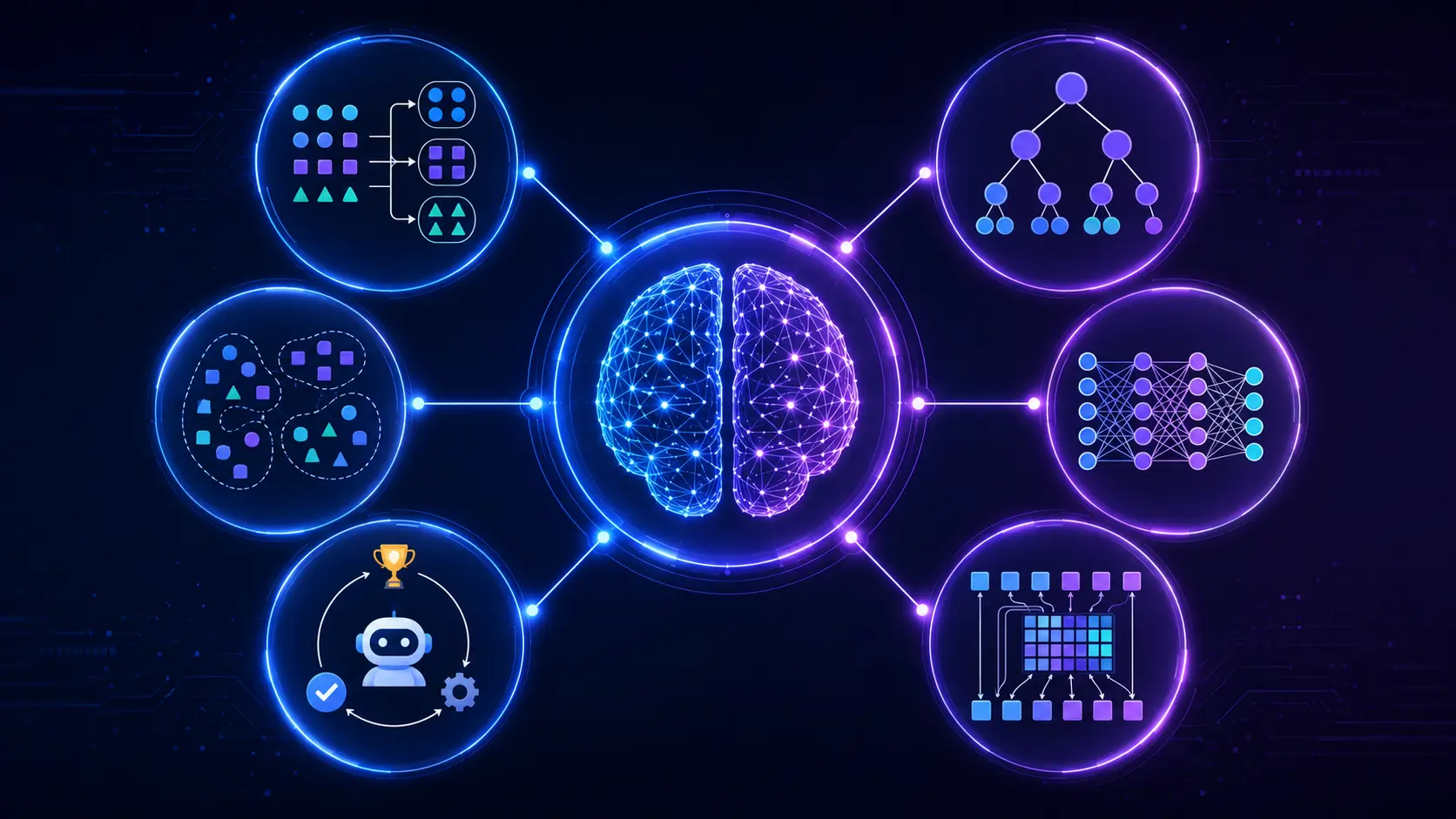
Over the years, I have seen new architectures come and go, but a core taxonomy remains useful. I will give you the version that helps you read the news and ask sharper questions at product demos.
Supervised Learning. This is the most common setup. You provide labelled examples and the algorithm learns the mapping from input to output. Almost every credit scoring model, voice recognition system and product recommendation engine uses some form of supervised learning. The labels are the expensive part; one annotation company I visited in Dublin employs hundreds of people painstakingly tagging medical images and video frames. For a deeper dive into how machines learn from labelled data, I have written a beginner’s guide to machine learning that expands on these ideas.
Unsupervised Learning. Here the algorithm gets no labels at all. It hunts for hidden structures. A retailer might discover that shoppers who buy nappies also tend to buy beer on Friday evenings, a finding that once famously boosted sales when stores placed the items together. Clustering algorithms are the workhorses here, and they underpin customer segmentation, anomaly detection in network security, and even the way astronomers group galaxy types. I find unsupervised learning the most intellectually satisfying because it often reveals patterns humans had never considered.
Reinforcement Learning. Picture a puppy learning to fetch: treats for good behaviour, a firm “no” for chewing the furniture. Reinforcement learning agents explore an environment, receive rewards or penalties, and develop policies that maximise long-term returns. DeepMind’s AlphaGo used this to beat a world champion at Go, and autonomous vehicle simulators use it to teach cars to merge onto motorways. It remains one of the hardest techniques to get right in the messy real world, as OpenAI discovered when its reinforcement-trained agents occasionally found loopholes in reward functions that nobody anticipated.
Decision Trees. I have a soft spot for decision trees because they are transparent. Follow the branches and you can explain exactly why a loan was rejected. Medical diagnostic tools and customer service chatbots often rely on them because when a decision goes wrong, a human can audit the path. They underpin more powerful ensemble methods like random forests and gradient boosting, which combine hundreds of trees to improve accuracy without losing too much interpretability.
Neural Networks and Deep Learning. When a problem involves images, audio, or natural language, simple models hit a wall. Neural networks, loosely inspired by the brain’s architecture, layer simple mathematical units that collectively learn hierarchical representations. A network trained on faces might learn edges in the first layer, facial features like eyes and noses in the middle layers, and whole face identities near the top. I have spent enough time explaining what deep learning is to know that the secret sauce is scale: more layers, more data, more compute. That scale also makes these models energy-hungry and often inscrutable.
Transformer Models. Introduced in the 2017 paper “Attention Is All You Need,” transformers replaced older sequential processing with a self-attention mechanism that lets the model weigh the importance of every word in a sentence relative to every other word, regardless of distance. This architecture powers virtually every modern large language model. I use ChatGPT daily to brainstorm article angles, and its transformer backbone handles context windows that would have seemed impossible five years ago. Anthropic’s Claude and Moonshot AI’s Kimi also run on transformer variants, each with different training philosophies and safety guardrails. If you want to understand why chatbots can now hold coherent conversations across thousands of words, transformers are the answer.
Clustering and Regression Algorithms. These are less flashy but arguably more widely deployed. K-means clustering groups customers for targeted marketing. Linear regression predicts house prices and energy demand. Logistic regression, despite its name, is a classification algorithm that calculates the probability of a binary outcome. Every time your bank decides whether to approve a mobile cheque deposit instantly, a regression or classification model is probably doing the maths.
Evolutionary Algorithms. Inspired by Darwinian natural selection, these generate a population of candidate solutions, evaluate their fitness, keep the best performers, and introduce random mutations. They are particularly useful for optimisation problems with enormous search spaces, such as designing wing profiles for aircraft or scheduling complex supply chains. I once visited a Formula One team that used evolutionary algorithms to optimise the shape of a rear wing, iterating millions of simulations overnight.
Real World Examples I Have Personally Encountered
I have walked through hospital wards, sat in boardrooms, and spoken with farmers to understand where AI algorithms make a tangible difference. Here are some of the snapshots that stayed with me.
Healthcare: At a London teaching hospital, a radiologist showed me how a deep learning model highlights potential lung nodules on CT scans. It catches things the human eye sometimes misses during a first pass, but the radiologist still makes the final call. The algorithm reduces fatigue-related oversight; it does not replace clinical judgment.
Banking and Fraud Detection: I mentioned this earlier. One UK challenger bank told me their fraud algorithms block around 92% of attempted fraudulent transactions in real time, but they still employ a large human investigation team to review edge cases. Their experience underscores something I see across the industry: the algorithm handles volume, the human handles ambiguity.
Retail and Recommendation Systems: Amazon’s “frequently bought together” widget, Spotify’s Discover Weekly, YouTube’s suggested videos. Each is a product of collaborative filtering, clustering, and increasingly, deep neural networks that predict the next item you are likely to engage with. A product manager at a streaming service once confessed to me that their recommendation algorithm drives over 70% of total watch time. That is a staggering figure, and it underlines why these companies invest so heavily in algorithmic refinement.
Search Engines: Google’s ranking system is a multi-layered AI that combines natural language understanding, user behaviour signals and continuous experimentation. I have interviewed former Google search engineers, and they all describe a system so complex that no single person understands every component. It is a living, learning machine that rewrites its rules daily.
Navigation: When I drive to an unfamiliar part of the country, I rely on an app that uses reinforcement learning and real-time traffic prediction to reroute me around jams. These algorithms have become so reliable that I rarely think about them, but the underlying models process petabytes of anonymised location data every hour.
Cybersecurity: I know a CISO at a FTSE 100 firm who installed anomaly detection algorithms that watch network traffic patterns. Within the first week, the system flagged a compromised IoT device that had been silently exfiltrating data for months. No traditional rule-based system had caught it.
Autonomous Vehicles: I have been in a self-driving taxi in Phoenix, and while the ride was smooth, the engineer monitoring remotely told me that the car’s convolutional neural network processes 2,500 images per second from a suite of cameras, each frame fed through layers of computation that identify pedestrians, cyclists, and temporary road signs. It works impressively until it meets something it has never trained on, like a horse on a suburban street, at which point it freezes and waits for human guidance.
Manufacturing and Logistics: Predictive maintenance algorithms listen to the hum of factory machinery and forecast failures weeks in advance. In e-commerce logistics, AI models optimise warehouse picking routes and delivery schedules. I recently explored how AI logistics for e-commerce is reshaping fulfilment centres, and the efficiency gains are genuinely significant.
Education: Adaptive learning platforms like Khanmigo adjust exercise difficulty based on a student’s performance. I watched a trial session in a Manchester school where the system gave a struggling student extra practice on fractions while letting another race ahead to algebra. The teacher told me it freed up her time to work with the children who needed human encouragement.
Agriculture: On a farm in Norfolk, I saw a drone equipped with a computer vision algorithm scan a wheat field and generate a nitrogen deficiency heatmap. The farmer then applied fertiliser only where needed, cutting his chemical use by 30%. That is the kind of practical, unglamorous AI application that rarely makes headlines but has a real environmental impact.
Smart Homes: My own thermostat learned my schedule within a fortnight and now pre-heats the house before my alarm rings. It uses a simple reinforcement learning loop that weighs comfort against energy cost. The broader smart home ecosystem is rapidly becoming a playground for ambient AI algorithms that manage lighting, security, and appliance usage.
Creative and Media Tools: I have experimented with AI video editors that automatically trim silences, colour-correct footage and even suggest B-roll cuts. The current crop of tools, which I compare in a roundup of the best AI video editors, uses deep learning to understand scene composition and pacing. They are not replacing human editors yet, but they slash repetitive tasks.
Sports and Talent Scouting: Football clubs now analyze player tracking data with algorithms that quantify off-the-ball movement and pressing intensity. I wrote about how AI is transforming football talent scouting after speaking with analysts who use these models to spot undervalued players before rival clubs catch on.
Beauty and Consumer Tech: At a tech expo, I tested an AI-powered skin analyzer that recommended moisturizers based on a selfie. The beauty technology sector is leaning heavily into classification algorithms trained on dermatologist-labelled images.
Customer Support: I have watched AI chatbots handle tier-one support queries for a telecom company, resolving billing questions and resetting passwords without human intervention. When well-designed, these systems dramatically reduce wait times. For a comprehensive look at the use cases and pitfalls, I recommend reading the guide to AI customer support that my team put together.
AI Algorithms vs Machine Learning vs Deep Learning
People often mix these terms, and I have been guilty of it myself in early drafts. Here is the hierarchy I find most helpful, drawn from hours of sitting through conference talks and correcting my own misconceptions.
| Concept | What It Means in Practice | A Concrete Example |
|---|---|---|
| AI Algorithm | The broadest category. Any computational method that mimics intelligent behaviour, learning or rule-based. | A chess engine that uses a minimax search with hand-crafted evaluation functions. No learning involved. |
| Machine Learning | A subset of AI algorithms that improve automatically through exposure to data. | A credit scoring model that adjusts its weights after seeing more loan outcomes. |
| Deep Learning | A subset of machine learning using multi-layered neural networks. Requires substantial data and compute. | An image classifier that distinguishes between 120 dog breeds from a photograph. |
The lines blur in modern systems. Most production AI is machine learning, and a growing share of that is deep learning. But the old-school rule-based systems are still around in areas like industrial control and legal reasoning where interpretability matters more than raw predictive power. My colleague’s piece on the types of artificial intelligence expands on this taxonomy if you want to go deeper.
How AI Algorithms Make Decisions
An AI algorithm never “decides” in the human sense. It computes a probability and checks a threshold. When Siri understands my request for tomorrow’s weather, it is converting my speech to text with a confidence score and parsing the intent. If the confidence dips below a certain level, it asks me to repeat myself. That threshold is tunable, and product managers spend weeks adjusting it to balance frustration against accuracy.
Behind the scenes, pattern recognition does the heavy lifting. The algorithm identifies statistical regularities—edges in images, sequences of words, transaction velocities—and associates them with outcomes. This is correlation, not causation. A model might predict higher sales on rainy days because it has seen that pattern, but it has no concept of why umbrellas sell better in the wet. That gap between correlation and causal understanding is where many algorithmic failures originate.
Decision boundaries are the invisible frontiers the algorithm draws in its mathematical space. Imagine plotting loan applicants on a graph where one axis is income and the other is debt ratio. A supervised learning algorithm will find a line or curve that best separates those who repaid from those who defaulted. Shifting that boundary even slightly can swing thousands of decisions. Regulators are now paying close attention to exactly where those boundaries fall and whether they disproportionately exclude protected groups.
Can AI Algorithms Be Wrong? Yes, and Often Quietly
This is the section I care about most. I have reported on algorithmic failures for years, and the pattern is almost always the same: the model performs beautifully in the lab and stumbles in the real world.
Bias in training data is the most persistent threat. In 2018, Reuters broke the story that Amazon scrapped an internal hiring algorithm because it systematically downgraded resumes containing the word “women’s,” such as “women’s chess club captain.” The algorithm had learned from ten years of hiring data in a male-dominated tech culture and simply reproduced the historical skew. Joy Buolamwini’s Gender Shades study at MIT found that facial recognition systems from major tech companies misclassified darker-skinned women at error rates up to 34%, while performing near perfectly on lighter-skinned men. These are not theoretical risks; they caused real harm.
Poor data quality creates brittle models. A medical imaging algorithm trained on high-resolution scans from one hospital may fail when deployed in a clinic using older machines. It learned the pixels of the equipment, not the disease. I have spoken with radiologists who confirmed that this “domain shift” problem remains one of the biggest barriers to clinical AI adoption.
Hallucinations plague large language models. I have watched a chatbot confidently invent a legal case citation that sounded plausible but never existed. These models are optimised to produce fluent text, not to retrieve verified facts. Techniques like retrieval augmented generation, explained in our complete RAG guide, try to ground outputs in real documents, but they are not foolproof.
Overfitting creates models that ace every practice question but bomb the final exam. I once audited a model that was 99% accurate on training data but dropped to 60% on new data because it had memorised noise rather than learning the underlying signal. Underfitting is the mirror problem: a model too simplistic to capture real patterns. Finding the sweet spot remains as much art as science.
All of this reinforces why human oversight is not optional. The EU AI Act, which came into force in 2024, mandates human review for high-risk AI systems. I support that approach. An algorithm can flag a suspicious transaction or a potential tumour, but a trained professional should always make the final call, especially when the stakes are high.
Benefits of AI Algorithms
I remain cautiously optimistic because the upsides are real when the technology is handled responsibly. Speed is the obvious advantage. Algorithms scan thousands of medical images, log files, or legal contracts in minutes. Consistency follows: a well-trained model applies identical criteria at 3am and 3pm, never tired, never irritable.
Scalability transforms customer service and logistics. AI chatbots handle simultaneous conversations, and routing algorithms cut fuel consumption while speeding up deliveries. Personalisation, when done well, genuinely improves user experience. I have discovered music and books through algorithmic recommendations that I would never have found otherwise.
Pattern discovery in massive datasets yields scientific breakthroughs. Astronomers used clustering to spot exoplanets buried in telescope archives. Pharmaceutical companies screen molecular compounds for potential drugs orders of magnitude faster than any human team. AI is also reshaping executive decision-making; I have explored how artificial intelligence is transforming decision-making in boardrooms, where predictive analytics now inform strategic bets that were once guided purely by gut feeling.
Challenges and Limitations I Worry About
Data hunger creates an uneven playing field. The most capable models demand datasets so large that only a handful of tech giants and state actors can build them. This concentration of power worries me, and it worries regulators too.
Interpretability remains a stubborn problem. A neural network with billions of parameters is effectively a black box. When it denies someone parole or rejects a loan application, explaining the precise reasoning in legally defensible terms is often impossible. The “explainability gap” slows adoption in regulated industries and erodes public trust.
Energy consumption is the uncomfortable truth few keynotes mention. Training a single large language model can emit hundreds of tonnes of CO₂, equivalent to the lifetime emissions of several cars. Researchers at the University of Massachusetts Amherst quantified this in a 2019 paper, and the numbers have only grown since. The industry is responding with more efficient architectures and green data centres, but the trajectory is unsustainable without a step change in how we train and deploy models.
Security vulnerabilities also trouble me. Adversarial attacks can fool image classifiers with tiny perturbations invisible to the naked eye. A well-placed sticker on a stop sign could cause a self-driving car to see a speed limit sign instead. Defending against these attacks is an active area of research, but production systems remain vulnerable. I have seen security researchers demonstrate these attacks live, and the results are sobering.
Future of AI Algorithms: What I Am Watching
I have a running list of trends that I think will shape the next few years. None of these are guaranteed, but they represent the direction of travel based on the labs I visit and the papers I read.
Agentic AI moves beyond single-turn responses. Instead of answering a question and waiting, an agentic system can plan, use tools, browse the web, and execute multi-step tasks. I have been testing Manus AI, one of the early agentic platforms, and while it’s still rough, the trajectory is clear: algorithms that act as persistent, goal-oriented assistants rather than passive answer machines.
Multimodal AI models that understand text, images, audio and video simultaneously are maturing. An algorithm that can watch a cooking tutorial, read the recipe and answer technique questions represents a genuine step toward more flexible understanding. This is where generative AI meets perception, a frontier I covered in the complete generative AI guide.
Smaller, more efficient models are challenging the “bigger is better” orthodoxy. Techniques like quantisation and knowledge distillation allow powerful algorithms to run on smartphones without cloud connectivity. Meituan’s LongCat AI and Xiaomi’s coding assistant MiMo are examples of this trend toward compact, task-specific models that preserve privacy and reduce latency. This edge AI movement excites me because it democratises access and reduces the carbon footprint of inference.
Reasoning models that spend extra computation “thinking” before answering are improving performance on logic-heavy tasks. They break problems into steps and verify intermediate conclusions, which reduces hallucinations. I have seen demos where these models solve competition-level maths problems that flummoxed earlier versions.
Self-improving systems that generate their own training data and refine their own code are inching closer, though they raise profound safety questions.
Responsible AI frameworks, watermarking, and rigorous red-teaming are evolving in parallel. The gap between narrow AI and broader general intelligence remains vast, and I remain unconvinced that we are on the cusp of superintelligence. My thoughts on that align with the distinctions laid out in the narrow AI vs AGI vs superintelligence comparison.
One thing is certain: the algorithms will get more capable. The governance, the ethical guardrails and the human judgment wrapped around them will matter just as much as the technology itself. The best future is one where AI augments human thinking rather than attempting to replace it, and where the people affected by algorithmic decisions have a genuine voice in how those systems are designed and governed.
Frequently Asked Questions
What is the simplest way to understand an AI algorithm?
I always describe it as a recipe that writes itself. Instead of a programmer spelling out every step, the algorithm looks at examples, finds patterns, and builds its own set of rules. Your email spam filter is a good example: nobody told it that “Nigerian prince” is a red flag; it learned that from millions of labelled spam messages. The learning is the key part; without it, you just have traditional code.
Do all AI algorithms use machine learning?
No. I have seen production systems in factories that use rule-based AI algorithms with no learning component. A classic chess engine that searches possible moves and evaluates board positions using hand-coded heuristics is an AI algorithm, but it never improves from experience. Machine learning is the most popular and flexible subset today, and deep learning is a further subset within that.
What kind of AI algorithm does ChatGPT run on?
ChatGPT is built on a transformer architecture, a deep learning model designed for text sequences. It was trained with a mix of supervised learning on human demonstrations and reinforcement learning from human feedback (RLHF). The underlying algorithm predicts the next word in a sequence, scaled up to hundreds of billions of parameters. I covered its evolution in detail in the ChatGPT guide for beginners.
Can AI algorithms learn without any human help?
Partially. Unsupervised learning algorithms find patterns without labelled data. Reinforcement learning agents learn through trial and error in simulations without direct human guidance for every action. However, humans still design the algorithm, set the reward function, curate the training data, and define success. Complete autonomy remains science fiction for now.
Why do AI algorithms sometimes produce biased results?
Because they learn from data that reflects historical prejudices. I often cite Amazon’s scrapped hiring algorithm, which downgraded resumes mentioning women’s activities because it was trained on a decade of male-dominated hiring. Even with balanced data, the choice of what to measure can introduce bias. A model that uses “years of experience” as a key feature may disadvantage people with career gaps, regardless of intent.
Are AI algorithms the same as regular software algorithms?
Both are step-by-step procedures, but regular software algorithms follow fixed instructions and produce the same output for the same input every time. An AI algorithm that involves learning can change its behaviour as it sees more data, and it handles novel inputs in ways its creators did not explicitly program. That adaptability is the strength and the risk.
How does an AI algorithm improve itself over time?
Through a feedback loop. When the algorithm makes a prediction, it later receives the actual outcome. The error—the gap between prediction and reality—is calculated, and the algorithm adjusts its internal parameters slightly to reduce that error next time. Over millions of iterations, this gradient-based optimisation tunes the model toward greater accuracy, though it can also reinforce existing biases if the feedback data is skewed.
What is the difference between a model and an algorithm?
I find it useful to think of the algorithm as the builder’s method and the model as the finished house. The algorithm is the mathematical recipe that learns from data. The model is the result of running that recipe—a compact representation of patterns that you can deploy to make predictions. You train a model; you design an algorithm.
Can AI algorithms be truly creative?
They can generate novel combinations of existing patterns, which often looks like creativity. A generative AI can compose music or paint images that feel original, but it is remixing from its training data rather than drawing on personal experience or conscious intent. Whether that qualifies as genuine creativity is a philosophical debate. I sit on the sceptical side, but I have seen outputs that made me pause.
Are AI algorithms dangerous?
The algorithms themselves are tools. A hammer can build a house or break a window. The danger lies in how they are deployed and whether they are subject to meaningful oversight. When misapplied, they can amplify bias, invade privacy, or spread misinformation. Applied with strong governance, human review, and transparency, they bring significant benefits. I always tell readers: fear the application without accountability, not the algorithm itself.
Key Takeaways
- AI algorithms learn patterns from data rather than following fixed human-written instructions.
- Supervised, unsupervised and reinforcement learning cover the majority of real-world deployments, but dozens of specialised algorithm types exist.
- Real-world impact spans healthcare, banking, smart homes, logistics, agriculture and countless other fields—often operating invisibly in the background.
- Algorithmic decisions are based on probability and pattern recognition, not human-like understanding.
- Bias, poor data, hallucinations and overfitting mean human oversight is not a nice-to-have; it is a necessity.
- The future points toward agentic, multimodal, and edge-based algorithms that demand stronger governance and clearer accountability.
Use the key points in this guide to understand the topic and make more informed decisions.

This guide is researched and edited using relevant documentation, reliable sources and publicly available information.
Was this guide helpful?
Your feedback helps us improve future guides.