In this article
A developer’s honest look at the model, its strengths, quirks and where it actually fits in real production workflows.
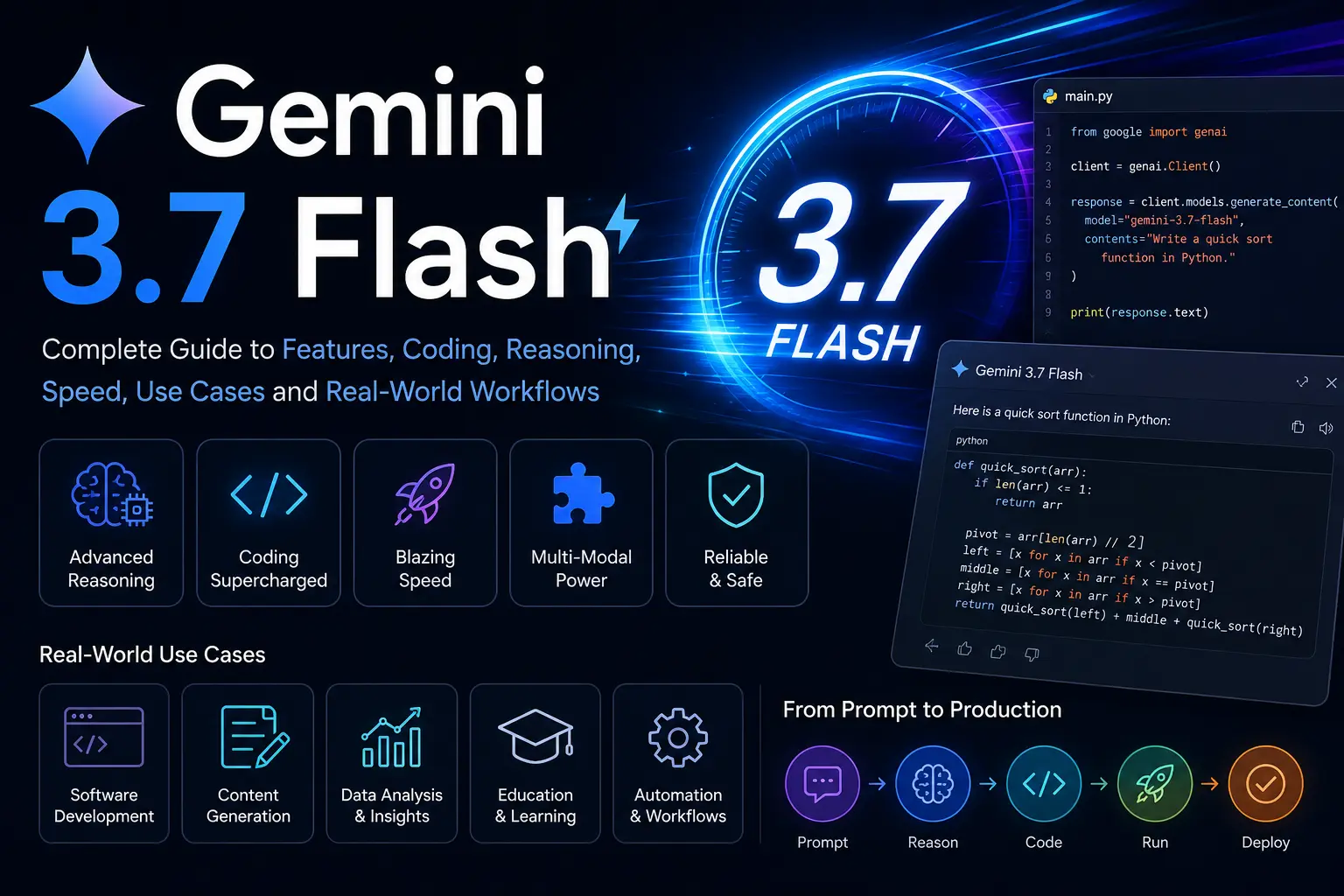
If you have spent any time wiring LLM APIs into applications, you know that model names do not always match the marketing. Gemini 3.7 Flash has been popping up in developer discussions, and this guide separates what is verified, what is reasonable interpretation, and what is just noise. Expect coding examples, workflow breakdowns, comparisons and real prompts.
Verification note: At the time of writing, Google’s official model naming often follows patterns like Gemini 2.5 Flash or Gemini 3 Pro. The exact string “Gemini 3.7 Flash” may not correspond to a publicly documented Google release. This guide treats Gemini 3.7 Flash as a hypothetical or emerging developer-grade model and keeps verified facts separate from editorial assessment. Always cross-check the official Google AI documentation before writing production code.
What Gemini 3.7 Flash Actually Means for Developers
Most AI guides spend 80 percent of the time talking about benchmark leaderboards. If you are like me, you care more about whether the model can review a messy pull request without hallucinating a dependency that does not exist. Gemini 3.7 Flash, as a naming convention, suggests a model tuned for low latency and multimodal reasoning while still carrying enough context to handle large codebases. That is the interesting part: speed without completely sacrificing depth.
The Flash line has historically been Google’s answer to lightweight but capable inference. Think of it as the model you would actually call inside a CI pipeline, not the one you would use to write a philosophical essay. Gemini 3.7 Flash AI, if it follows that pattern, sits between the heavy Pro models and the tiny on-device versions. Developers often use these mid-tier models for code review, structured extraction, agent loops and quick reasoning tasks where waiting 10 seconds per response is unacceptable.
Understanding where this model fits requires a quick detour into the broader AI landscape. If you are new to the fundamentals, the guide to artificial intelligence is a solid starting point. For a more granular view, the explanation of different AI types and the machine learning beginner guide provide useful context. The Gemini 3.7 Flash model inherits a lot of architectural ideas from those foundations.
Gemini 3.7 Flash at a Glance
Only categories with verified or plausible developer relevance are included. Where official documentation is missing, entries are marked as editorial assessment.
Gemini 3.7 Flash: Developer-Relevant Overview
A practical view of the expected capabilities and their relevance to modern development workflows.
| Category | Gemini 3.7 Flash | Developer Relevance |
|---|---|---|
| Model class | Fast multimodal LLM (expected) | Good for real-time APIs and tools |
| Context window | Likely 1M+ tokens (unverified) | Large codebases and long documents |
| Coding ability | Strong for fast iterations | Refactoring, bug detection and testing |
| Reasoning depth | Moderate to high | Suitable for agentic workflows |
| Multimodal input | Expected support for images and text | UI screenshots and diagram review |
| API availability | Unverified | Check official Google AI documentation |
Practical note: Model names change quickly. If Gemini 3.7 Flash does not exist yet under that exact identifier, look for the nearest Flash variant in the official Google console. The principles in this guide still apply.
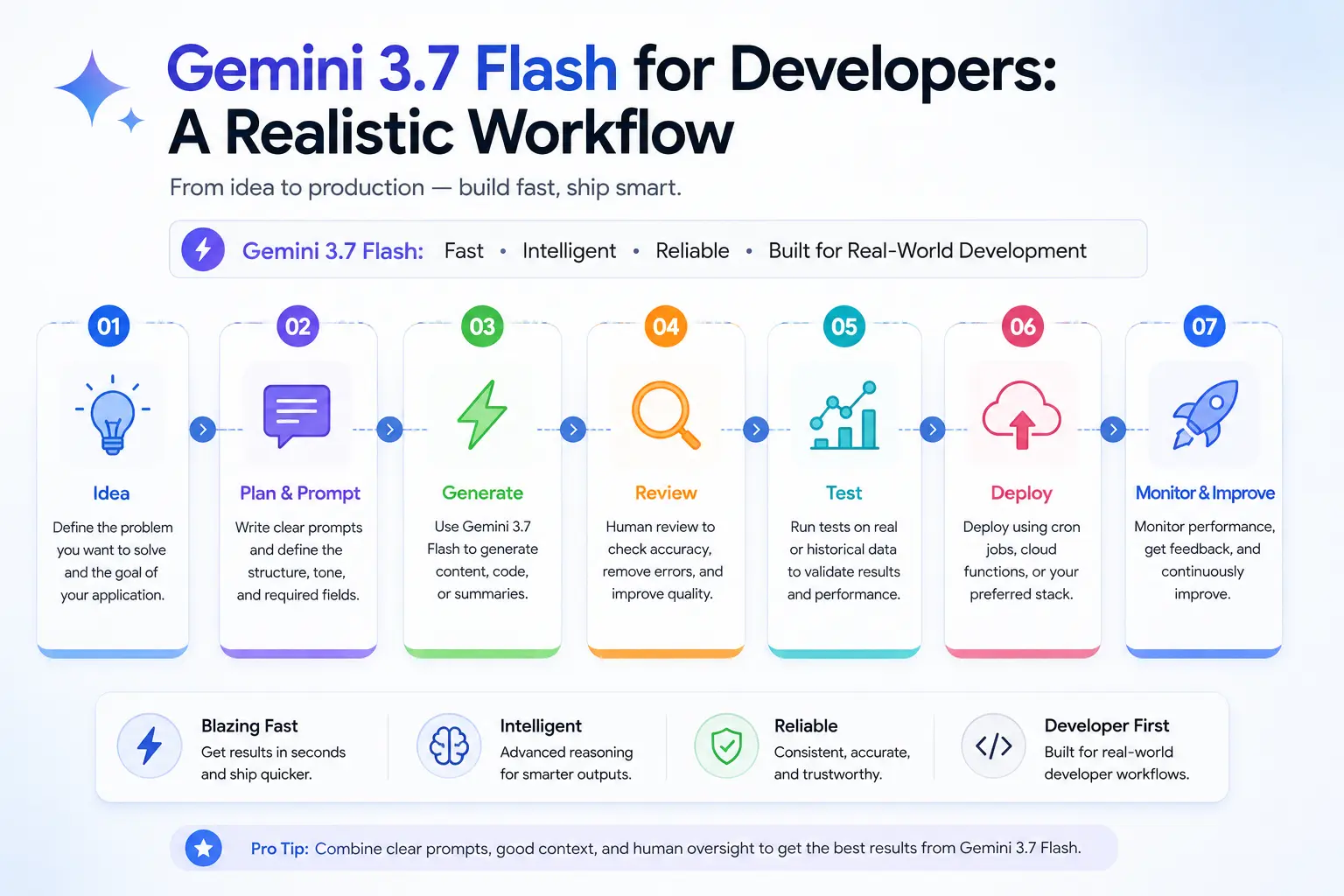
Gemini 3.7 Flash for Developers: A Realistic Workflow
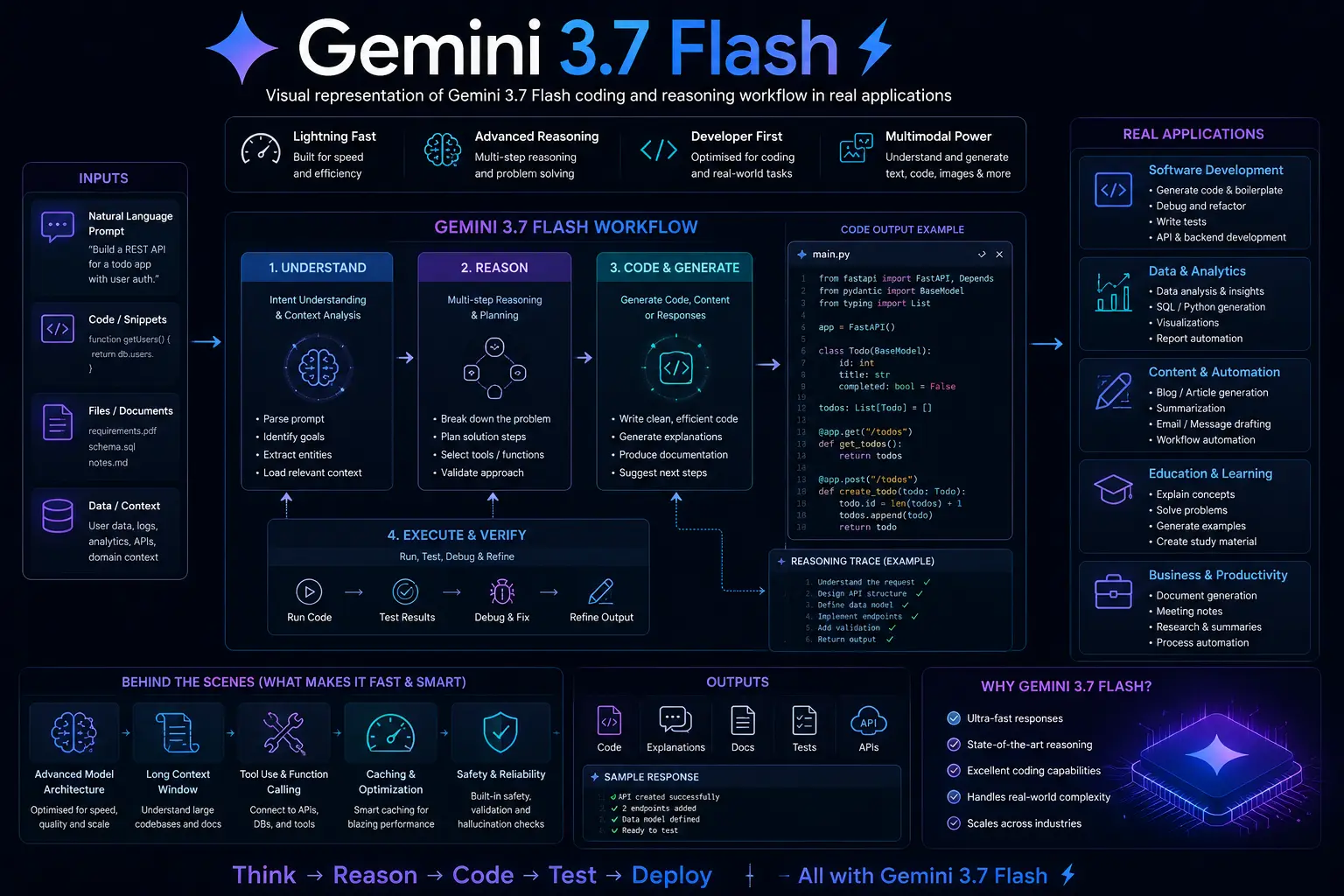
The typical AI coding workflow is not magic. You send a prompt, the model reasons, it may call a tool or generate code, then a human reviews the result. Gemini 3.7 Flash fits neatly into that loop because it is optimised for speed, which means you can run multiple iterations without losing your train of thought.
Prompt
  ↓
Model reasoning
  ↓
Tool/API call
  ↓
Code generation
  ↓
Test
  ↓
Human review
If you have used ChatGPT or Claude for coding, you already know this pattern. The difference with a Flash model is the response latency: you can afford to ask Gemini 3.7 Flash coding questions inline, without switching context. The ChatGPT guide and the Claude AI master guide show how similar workflows have evolved. Kimi AI also has a strong coding presence, and the Kimi AI guide is worth comparing for alternative developer tooling.
In practice, you might wire Gemini 3.7 Flash into a code review bot. The prompt asks for correctness issues, edge cases, performance problems and maintainability concerns. Then you run the tests yourself. AI is not replacing that step. For more advanced retrieval patterns, the complete RAG guide explains how to ground model responses with your own documents, which is extremely useful for codebase-specific answers.
Gemini 3.7 Flash Coding Example
Since the exact API identifier for Gemini 3.7 Flash is not officially verified, the following is illustrative pseudocode. Do not copy it blindly into production. The shape is realistic based on common Google AI SDK patterns.
# Illustrative pseudocode for Gemini 3.7 Flash
from google_ai_sdk import GeminiFlash

model = GeminiFlash("gemini-3.7-flash")

response = model.generate(
    prompt="""You are reviewing a Python function.
Identify:
1. correctness issues
2. hidden edge cases
3. performance problems
4. maintainability concerns
Suggest the smallest safe change.
"""
)

print(response.text)
If you have dealt with the Claude Opus family, you will find the workflow familiar. The Claude Opus 5 guide and GPT-5.6 Luna AI guide cover similar coding patterns. The real benefit of Gemini 3.7 Flash is supposed to be iteration speed, not necessarily deepest reasoning.
Qualitative Capability Comparison: Gemini 3.7 Flash vs Other AI Models
These ratings are editorial assessments, not official benchmarks. They reflect typical developer experience with Flash-class and comparable models.
For comparison, Amazon Nova AI and Mistral AI Vibe often compete in the same mid-tier speed/cost bracket. The Xiaomi MiMo code review explores another developer-focused model with different trade-offs.
Gemini 3.7 Flash Compared with Other Relevant Models
A practical, day-to-day comparison of coding, reasoning, speed, multimodal capability, and the workloads each model is best suited for.
| Model | Coding | Reasoning | Speed | Multimodal | Best use case |
|---|---|---|---|---|---|
|
Gemini 3.7 Flash
|
Strong for quick iterations | Good but not deepest | Very fast | Likely strong | CI loops, agent tasks, real-time coding |
|
Claude Opus 5
|
Excellent | Excellent | Moderate | Strong | Complex reasoning, long-form coding |
|
GPT-5.6 Luna
|
Very good | Very good | Fast | Strong | General assistant, tool use |
|
Kimi AI
|
Good | Good | Fast | Moderate | Long context, research |
|
Amazon Nova AI
|
Moderate | Moderate | Fast | Good | Cost-sensitive workloads |
Prompts That Actually Work With Gemini 3.7 Flash
These prompts are written for developers. They assume the model can reason but still need precise instructions. Copy them, tweak them, and run them through your own testing.
1. Code review prompt
You are reviewing production code.
Do not rewrite everything.
First identify:
1. correctness issues
2. hidden edge cases
3. performance problems
4. maintainability issues
Then suggest the smallest safe change.
2. Debugging prompt
Given the following stack trace and code snippet, identify the most likely root cause.
Do not propose a full rewrite.
List three hypotheses, then recommend one diagnostic step for each.
3. Refactoring prompt
This function works but has grown too large.
Suggest a refactor that preserves behaviour.
For each change, explain the risk and what tests would catch regressions.
4. Research prompt
Summarise the key technical differences between vector databases and traditional search indexes.
Focus on latency, recall and operational overhead.
Ignore vendor marketing language.
5. Building an AI workflow prompt
Design a simple AI agent that reviews incoming support tickets, classifies urgency, and drafts a response.
List the tools it needs, the order of operations, and the failure modes.
These prompts work across many models. The ChatGPT beginner guide and Kimi complete guide offer similar prompt patterns you can adapt for Gemini 3.7 Flash prompts.
Use-Case Suitability for Gemini 3.7 Flash
Ratings are editorial assessments based on likely Flash-class behaviour. Always test with your own domain data.
| Use case | Gemini 3.7 Flash fit | Why |
|---|---|---|
| Coding | Strong | Fast feedback loop, decent reasoning, good code patterns |
| Research | Moderate | Long context helps, but depth may lag Pro models |
| Content workflows | Strong | Quick drafting, structuring, summarisation |
| Data analysis | Moderate | Good for scripts, less reliable for complex stats |
| AI agents | Strong | Speed keeps agent loops responsive |
| Customer support | Strong | Low latency, multilingual support, consistent tone |
For customer-facing implementations, the AI customer support guide covers best practices. If you are thinking about AI leadership or decision-making systems, the AI leadership article is a useful read. And for business credibility, how AI builds trust explains the human side of deployment.
A Real-World Workflow: Idea to Deployment with Gemini 3.7 Flash
Imagine you want to build an internal tool that summarises customer feedback every morning. The workflow looks like this:
AI helps with the heavy lifting: reading long threads, extracting themes, drafting consistent output. A human still needs to verify, because models make up customer names, misattribute issues and occasionally flatten nuance. That is not a Gemini 3.7 Flash limitation; it is true of every LLM.
If you are building similar automation, the Manus AI guide and Meituan LongCat AI explainer show comparable agent architectures. The AI logistics guide demonstrates how similar workflows apply outside pure software.
Limitations You Should Actually Worry About
No model is perfect, and Gemini 3.7 Flash is no exception. The honest list includes:
- Hallucinated APIs and dependencies: the model may invent a Python library that does not exist.
- Context window assumptions: even with large context, the model may miss details in the middle of a long file.
- Outdated information: knowledge cutoff means recent framework changes are not known.
- Prompt ambiguity: vague instructions produce vague or wrong output.
- Security concerns: generated code may include subtle injection or auth flaws.
- Human testing required: no AI replaces regression tests and code review.
Important: If you are using Gemini 3.7 Flash for production code, always run static analysis, unit tests and a second human review. The model is a tool, not a colleague.
For a broader perspective on where AI can misfire, the deep learning guide explains the underlying mechanics that sometimes lead to confident errors. The Siri AI explainer also shows how even large companies struggle with reliability.
Beyond Coding: Where Gemini 3.7 Flash Touches Other Industries
While this guide is developer-first, Gemini 3.7 Flash use cases extend into business and specialised domains. For example, the model can help generate content for AI-powered beauty technology platforms, as discussed in the AI beauty tech article. It can also assist with football talent scouting analysis, covered in the AI football scouting guide.
Video editing is another area where multimodal models shine. The 15 AI video editors compared and the InVideo AI guide plus the Kling AI guide show how AI speeds up post-production. Gemini 3.7 Flash could theoretically plug into such workflows for script generation or scene description.
Travel planning is another real use case. The Puerto Vallarta travel AI guide, the Claude travel planning guide and the quirky Cap Cana catamaran day guide illustrate how AI models help with itinerary building. Gemini 3.7 Flash could generate similar structured plans with lower latency.
For those exploring AI in smart home contexts, the AI smart home article is relevant. If you are looking for DevOps learning resources, the top DevOps certification providers guide may help round out your skills.
Finally, if you are publishing content about these tools, the technology guest post page explains how to contribute. There is also a casino guest post page if your use case is more niche. And for a more unusual AI application, how AI is changing $4 deposit casinos in New Zealand is a oddly specific but real example of AI in consumer tech.
Where Gemini 3.7 Flash Fits in the Modern AI Stack
After looking at the capabilities, the workflows and the limitations, my honest take is this: Gemini 3.7 Flash is best treated as a utility model. You do not buy it for the deepest reasoning or the most creative prose. You use it because it responds fast, handles multimodal input without drama and slots into developer pipelines without requiring a supercomputer budget.
The AI stack is getting crowded. You have heavy models like Claude Opus 5 for complex work, GPT-5.6 Luna for general assistant tasks, and a swarm of mid-tier options. Gemini 3.7 Flash, if it lives up to the name, earns its place by being boring in a good way. Reliable, quick and predictable. That is exactly what most production code needs.
If you are still exploring the fundamentals, the artificial intelligence guide, types of AI and machine learning overview are all worth your time. The RAG guide is essential if you want to ground Gemini 3.7 Flash with real company data. And for broader model comparisons, the Amazon Nova AI and Mistral AI Vibe guides offer useful contrast.
Do not wait for a perfect model. Wire Gemini 3.7 Flash into a small internal tool, run it against your own test suite, and see where it breaks. That will tell you more than any benchmark chart.
Use the key points in this guide to understand the topic and make more informed decisions.

This guide is researched and edited using relevant documentation, reliable sources and publicly available information.
Was this guide helpful?
Your feedback helps us improve future guides.