In this article
AI model releases have stopped being simple chatbot upgrades. The conversation in 2026 is mostly about reasoning quality, coding reliability, long context retention, tool use and whether a model can hold its own inside an agentic loop. GPT-5.6 Luna has entered that conversation, but not in a clear-cut way.
I have been following the model closely, and the most honest way to describe the current situation is this: GPT-5.6 Luna is generating a lot of developer curiosity, but verified public information is still limited. That is not unusual; model names often move faster than documentation. Where official technical details are unavailable, it is better to treat a claim as unverified than to build a workflow around it.
For those new to the broader AI landscape, it helps to understand what artificial intelligence actually covers before diving into a single model. Similarly, knowing the types of artificial intelligence gives useful context, especially when people start confusing narrow models with something closer to AGI. There is a lot of that confusion around GPT-5.6 Luna right now.
What Is GPT-5.6 Luna AI?
GPT-5.6 Luna is understood to be a newer iteration within the GPT family, with an emphasis on reasoning, code generation and structured tool use. The “Luna” designation appears to signal a separate optimisation branch rather than just another minor version bump. That matters to developers because it suggests different tuning priorities, possibly favouring multi-step problem solving over raw conversational style.
For developers, the interesting part is not the marketing name. It is whether the model performs reliably in coding and agent workflows, whether it holds context over long sessions, and whether it integrates cleanly with APIs and retrieval tools. Those are the questions that matter in production. Before adopting any model, it is worth understanding the underlying machine learning principles and how they shape behaviour. You do not need to be an ML engineer, but a basic grasp of training and inference helps you judge whether a model is likely to improve with more context or simply repeat patterns from training data.
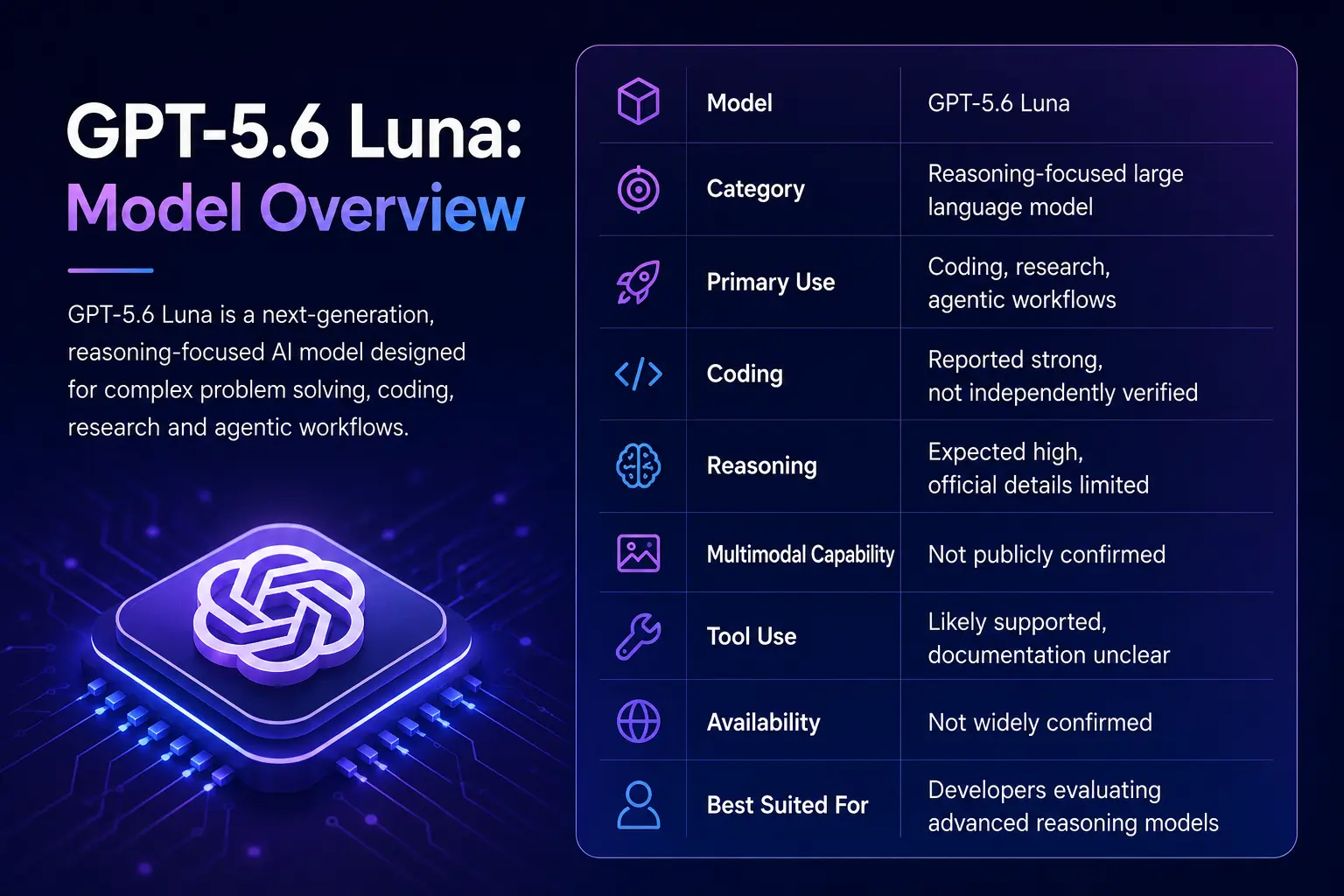
GPT-5.6 Luna: Model Overview
| Model | GPT-5.6 Luna |
|---|---|
| Category | Reasoning-focused large language model |
| Primary Use | Coding, research and agentic workflows |
| Coding | Reported strong, but not independently verified |
| Reasoning | Expected to be high, although official details remain limited |
| Multimodal Capability | Not publicly confirmed |
| Tool Use | Likely supported, but documentation remains unclear |
| Availability | Not widely confirmed |
| Best Suited For | Developers evaluating advanced reasoning models |
Some reports suggest GPT-5.6 Luna is tuned for long-horizon tasks, meaning it can plan, check its own work and iterate. But without solid benchmarks, I would not assume that is production-ready. It needs hands-on evaluation before you commit anything serious to it.
GPT-5.6 Luna AI Features
Rather than listing a speculative feature set, I have grouped the capabilities that are either confirmed, expected or unverified. This should help you decide what to test first.
Where GPT-5.6 Luna Could Make the Biggest Difference
GPT-5.6 Luna is positioned around reasoning, coding and agentic workflows. However, several capabilities remain unverified, so the practical value should be judged through real-world testing rather than marketing claims alone.
Reasoning
Expected to be a core strength. Multi-step logical problems, debugging and planning are likely focus areas, but no official benchmark has been published.
Official benchmarks: Not confirmedCoding
Reports suggest strong code generation and review ability. However, real-world testing on private repositories is the best way to determine how well it performs in production development environments.
Practical testing recommendedLong-Context Work
Long-context capability has not been publicly confirmed. Some AI models advertise very large context windows but can lose accuracy or relevance in the middle of extremely long inputs.
Capability: UnverifiedMultimodal Understanding
There is no public confirmation of multimodal input capabilities. If your workflow depends on image or audio understanding, alternative models may be a safer choice until official specifications are available.
Public confirmation: NoneTool Use
Tool use is likely to be important given the model’s apparent focus on agentic workflows. The bigger question is reliability, especially around function calling, structured outputs and API schema adherence.
Reliability: UnknownAgentic Workflows
This is where GPT-5.6 Luna could become particularly interesting. A strong reasoning model can help with multi-step tasks, but raw model intelligence does not automatically translate into a reliable autonomous agent.
Potential: High | Reliability: To be testedResearch
Summarisation, information synthesis and source comparison are plausible use cases, particularly when GPT-5.6 Luna is paired with retrieval, search or other external knowledge tools.
Best with retrieval toolsDeveloper Productivity
If its coding and reasoning capabilities hold up under independent testing, GPT-5.6 Luna could prove useful for documentation, refactoring, debugging, test generation and everyday development tasks.
Potential: StrongGPT-5.6 Luna should not be judged solely by reported capabilities. Until official documentation, reproducible benchmarks and independent testing are available, treat claims around context length, multimodal support, tool reliability and agentic performance as provisional.
For developers coming from a ChatGPT background, our complete ChatGPT guide still provides a useful baseline comparison. Beginners might also want to read the ChatGPT guide for beginners before exploring newer models like GPT-5.6 Luna. It helps to understand what an established model does well before judging an emerging one.
GPT-5.6 Luna for Developers
For developers, this is probably the part worth paying attention to. The real value of a model like GPT-5.6 Luna is not answering general questions. It is whether the model can slot into a development workflow without constant babysitting.
Practical workflows I would test immediately include debugging code, refactoring legacy files, generating unit tests, explaining unfamiliar repositories, API integration, SQL debugging, documentation generation, code review and architecture brainstorming. These are the tasks where a reasoning-focused model either saves hours or wastes them.
Review this API endpoint as a senior backend engineer.

Check:
1. Security issues
2. Validation
3. Error handling
4. Database performance
5. Race conditions
6. Maintainability

Do not rewrite the entire function.
First explain the problems, then provide a minimal patch.
That kind of prompt works well with advanced models because it forces structured reasoning rather than a one-shot code dump. If GPT-5.6 Luna handles that consistently, it becomes a genuine developer tool. If it misses race conditions or suggests insecure fixes, it is just another autocomplete.
RAG applications are another area where a strong reasoning model helps, especially when retrieval quality is high. The basic flow of documents to retrieval to context to model to answer is covered in detail in our Complete RAG Guide. For now, GPT-5.6 Luna could be useful in RAG pipelines that require careful synthesis of multiple sources.
GPT-5.6 Luna vs Other AI Models
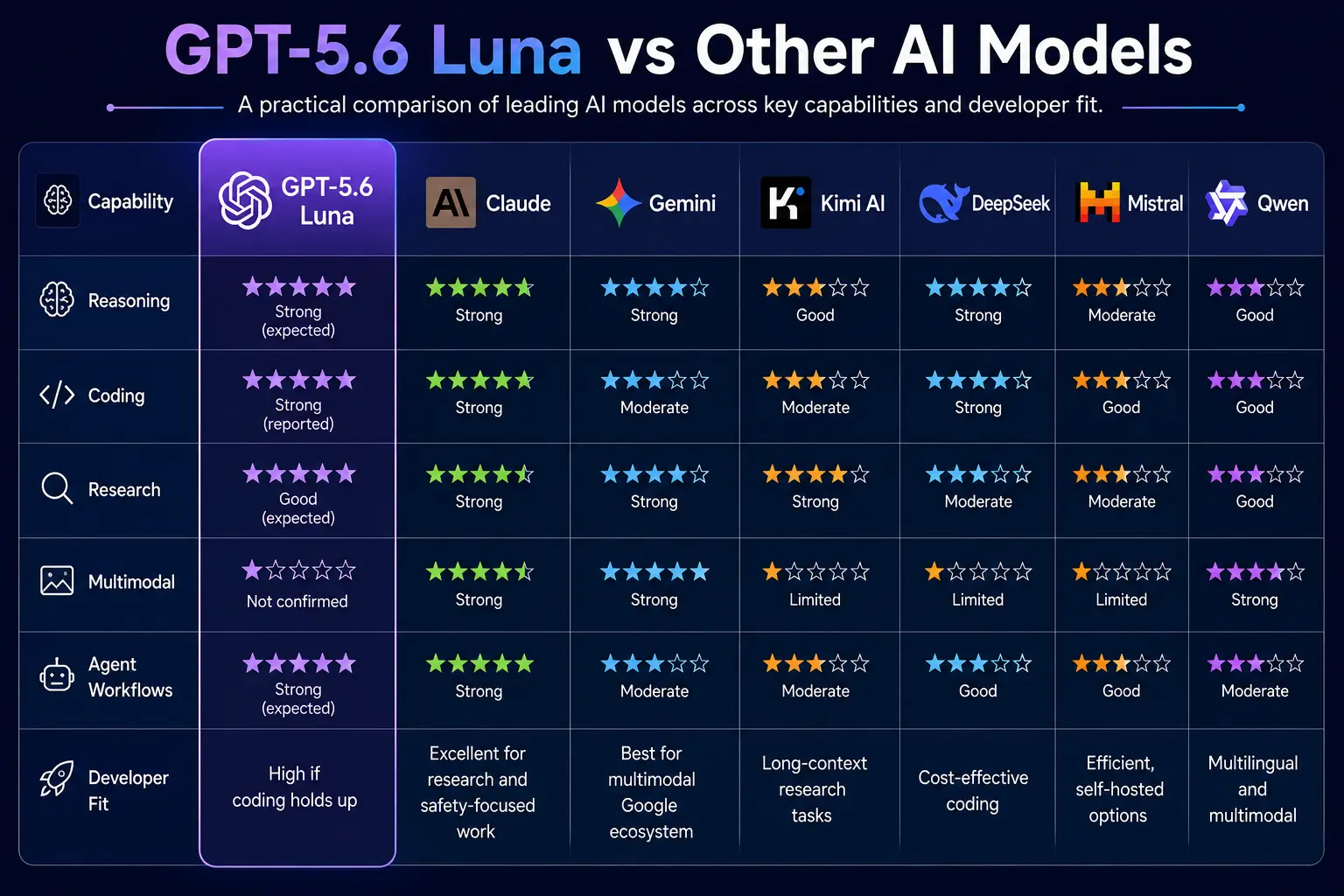
Comparing models is tricky. Benchmarks only tell part of the story, and prompt engineering can tilt results. That said, a conceptual comparison helps developers choose what to evaluate. Keep in mind this table is qualitative, not based on official GPT-5.6 Luna benchmark data.
GPT-5.6 Luna vs Leading AI Models
A practical comparison of reasoning, coding, research, multimodal capabilities, agent workflows and overall developer fit across popular AI models.
| Model | Reasoning | Coding | Research | Multimodal | Agent Workflows | Developer Fit |
|---|---|---|---|---|---|---|
|
GPT-5.6 Luna
|
High if coding holds up | |||||
| Excellent for research and safety-focused work | ||||||
|
Gemini
|
Best for the multimodal Google ecosystem | |||||
| Strong option for long-context research tasks | ||||||
|
DeepSeek
|
Cost-effective choice for coding | |||||
|
Mistral
|
Efficient option for self-hosted AI deployments | |||||
|
Qwen
|
Strong multilingual and multimodal capabilities |
GPT-5.6 Luna ratings marked as expected or reported should be treated as provisional until official documentation and independent benchmarks are available. Real-world performance can vary depending on the model version, prompting strategy, tools, context and workload.
Model performance depends heavily on the task, prompt, context and tooling. A model that wins a coding benchmark might be painful for research. GPT-5.6 Luna vs Claude or GPT-5.6 Luna vs Gemini is not a single answer. You have to test on your own workflows.
GPT-5.6 Luna AI Performance
An illustrative capability map showing how GPT-5.6 Luna could perform across common AI development and research workflows.
Illustrative Capability Map
This visual is a qualitative comparison for workflow discussion, not an official benchmark.
| Capability | Illustrative Score | Level |
|---|---|---|
|
Coding
|
|
Excellent |
|
Reasoning
|
|
Excellent |
|
Research
|
|
Good |
|
Writing
|
|
Good |
|
Tool Use
|
|
Strong |
The percentages above are illustrative rather than independently verified benchmark results. They should be used to visualise potential strengths, not as definitive measurements of GPT-5.6 Luna’s actual performance.
GPT-5.6 Luna AI Coding Workflow
A realistic development cycle with a reasoning-focused model can follow a workflow like this.
AI-generated code still needs review, testing and security checks. I would not skip that step no matter how confident the model sounds. For teams exploring DevOps pipelines, there are solid DevOps course and certification providers that teach the human side of the loop.
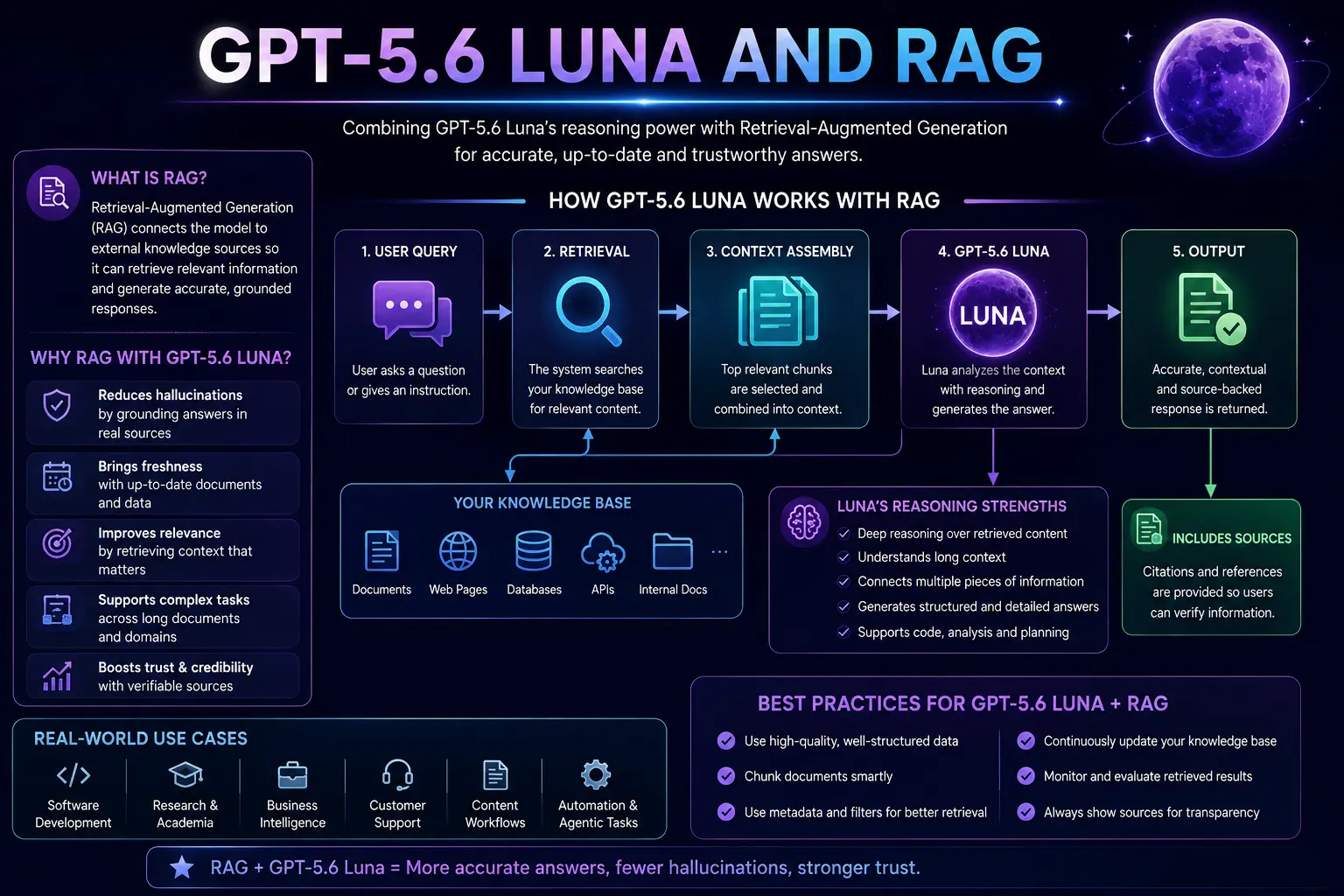
GPT-5.6 Luna and RAG
Retrieval-Augmented Generation is one of the most practical ways to use an advanced model without retraining it. The flow is simple: Documents → Retrieval → Relevant context → Model → Answer. For internal documentation, support knowledge bases and technical research, RAG can ground the model in reliable data.
The Complete RAG Guide walks through this in detail. If GPT-5.6 Luna has solid instruction following and long context handling, it could be a strong generator inside a RAG stack. The retrieval system still matters more than the model in most RAG failures.
GPT-5.6 Luna for AI Agents
Agentic workflows require planning, tool calling, memory, execution and verification. A powerful language model is necessary but not sufficient. The model must know when to stop, ask for clarification or escalate to a human. That is a behavioural problem, not just a scale problem.
GPT-5.6 Luna might be good at agentic reasoning, but the surrounding framework, tool definitions and retry logic matter just as much. I would test simple single-tool agents first before trying multi-step autonomous pipelines. For a broader look at narrow versus general intelligence, see Narrow AI vs AGI vs Superintelligence.
GPT-5.6 Luna vs Traditional Chatbots
Traditional Chatbot vs GPT-5.6 Luna Class System
The difference is not simply better answers. Modern reasoning-focused AI systems are designed to understand context, use tools, generate code and handle more complex multi-step workflows.
| Capability | Traditional Chatbot | GPT-5.6 Luna Class System |
|---|---|---|
| Conversation Flow | Fixed flows | Dynamic reasoning |
| Context Handling | Limited context | Long-context understanding |
| Tool Use | No tool use | Tool calling |
| Response Generation | Scripted answers | Adaptive responses |
| Intent Recognition | Basic intent recognition | Context-aware reasoning |
| Coding | Limited or unavailable | Code generation |
| Complex Tasks | Simple conversational tasks | Multi-step reasoning |
| Automation | Mostly scripted | Agentic capability |
Best suited to predictable support scenarios where predefined conversation flows and simple intent detection are enough.
Designed for more flexible workflows involving reasoning, coding, tool interaction, context management and agent-style task execution.
Note: “GPT-5.6 Luna class system” refers to the capability category described here. Individual features should be verified against the official documentation of the specific model or implementation.
Real-World Use Cases for GPT-5.6 Luna
From software development to business automation, a reasoning-focused AI system can fit into a wide range of professional workflows when combined with the right tools, data and human oversight.
| Use Case | What GPT-5.6 Luna Could Do | Best Workflow Fit |
|---|---|---|
|
Software Development
|
Debugging, code reviews and test generation. Coding is likely to be one of the most important practical use cases for GPT-5.6 Luna. | Development & QA |
|
Research
|
Summarising large technical documents, extracting key points and comparing information from multiple sources. When combined with RAG, it could become useful for knowledge-heavy workflows. | Research & RAG |
|
Business
|
Analysis, documentation and decision support. AI can contribute to business credibility and trust when its use is transparent and properly governed. | Analysis & Decisions |
|
Customer Support
|
Knowledge-base powered responses, support documentation and conversational assistance. For a dedicated workflow, explore AI customer support. | Support Automation |
|
Content Workflows
|
Research, outlining, editing and content repurposing can all benefit from AI assistance. Multimodal tools such as AI video editors can complement text-based generation. | Content & Media |
|
Automation
|
Connecting AI with APIs, internal systems and business tools. Real-world applications such as AI logistics for e-commerce demonstrate how intelligent automation can be integrated into operational workflows. | APIs & Agents |
Coding, debugging, testing and technical documentation could make GPT-5.6 Luna particularly useful inside software development teams.
AI-generated analysis and automation should be reviewed before being used for important technical, financial or operational decisions.
AI models are now showing up in industries well outside software, from AI-powered beauty technology to smart home systems. GPT-5.6 Luna may or may not be the best fit for those verticals, but the underlying reasoning capabilities could transfer.
GPT-5.6 Luna Prompt Engineering
Use this formula: Role + Context + Task + Constraints + Output Format + Verification. It works across coding, research and technical writing.
Role: Senior research assistant
Context: I need to compare three technical papers on transformer memory efficiency.
Task: Summarise the key trade-offs and identify which approach scales best for long documents.
Constraints: Do not include marketing language. Focus on measurable differences.
Output Format: Bullet points with one sentence per trade-off.
Verification: Add a note if any claim is uncertain.
This style of prompt works well with reasoning-heavy models because it forces structured thinking and flags uncertainty. For more prompt ideas, the Claude AI Master Guide has several transferable techniques.
GPT-5.6 Luna Limitations
Practical limitations to expect:
- Hallucinations, especially on niche APIs
- Incorrect code that looks plausible
- Context degradation over very long sessions
- Unreliable tool calls and schema mismatches
- Security risks from generated code
- Prompt ambiguity leading to wrong assumptions
- Benchmark vs real-world gap
- Cost and latency unpredictability
- Human verification still required
Even if GPT-5.6 Luna performs well in isolated tests, production environments introduce messy context, partial data and unpredictable user inputs. I would test the model against those conditions before trusting it.
It helps to place GPT-5.6 Luna inside the broader ecosystem. Models like Kimi AI and our complete Kimi guide 2026 show how competitive the long-context research space has become. Amazon Nova AI targets enterprise integration, while Mistral AI Vibe offers developer-friendly open models. Xiaomi MiMo Code Review is another interesting option for coding-specific tasks.
Agentic models like Manus AI and Meituan LongCat AI also highlight how quickly the agent workflow space is moving. GPT-5.6 Luna will need to differentiate itself clearly in that crowd.
On the multimodal side, tools like Tripo AI for 3D generation and Kling AI for video show what is possible outside pure text. InVideo AI is another practical option for content creators. GPT-5.6 Luna may eventually integrate with these kinds of tools, but that is not confirmed yet.
Even outside developer workflows, AI reasoning models are being tested for trip planning. Examples include AI-powered Puerto Vallarta travel planning and Claude AI for travel planning. GPT-5.6 Luna could follow a similar pattern if its instruction following is strong enough. A catamaran and snorkel day in Cap Cana might be a fun test prompt, but probably not a production use case.
AI is also creeping into sports analytics and niche industries. AI and football talent scouting is a good example of pattern recognition applied to player data. In the gambling space, AI and $4 deposit real money casinos in New Zealand highlights the regulatory and ethical complexities. These are not core GPT-5.6 Luna use cases, but they show how AI reasoning models get applied across domains.
From an editorial perspective, AI model coverage is changing fast. Publications like RCN Guide accept casino guest posts and gambling write for us submissions as well as technology guest posts and sponsored content. That mix of technical and commercial content reflects how broadly AI is now discussed.
For readers who want to go deeper into the technical foundations, what is deep learning and what is generative AI are good starting points. AI algorithms explained is another useful reference when evaluating how models like GPT-5.6 Luna are trained and deployed.
For a very different corner of the AI chatbot ecosystem, Janitor AI Complete Guide and the Janitor AI Complete Guide 2026 cover character-driven bots rather than reasoning systems. That contrast is useful for understanding where GPT-5.6 Luna sits.
Even consumer assistants like Siri AI are becoming more reasoning-aware, which puts pressure on models like GPT-5.6 Luna to deliver clear developer value rather than vague “smart assistant” claims.
Finally, for teams adopting any advanced model, AI leadership matters. Choosing a model is as much about team readiness, evaluation workflows and risk management as it is about benchmark scores.
Should Developers Pay Attention to GPT-5.6 Luna?
Based on available evidence, GPT-5.6 Luna is worth watching, but not blindly adopting. If you are building production systems around reasoning, coding or agentic workflows, wait for verified benchmarks and run your own evaluation suite first. Focus on the tasks that matter to your codebase, not generic chatbot tests.
Personally, I would test this before building a production workflow around it. The potential is there, but unverified claims are cheap. Developers who treat GPT-5.6 Luna as a useful but unproven tool will get more value than those who assume it is a drop-in replacement for their current stack.
Start with small, controlled experiments. Compare GPT-5.6 Luna against Claude, Gemini and your current model on real tasks. Measure latency, cost, failure modes and code quality. Then decide. That is the only honest way to evaluate a model in 2026.
For brands and publishers interested in contributing to RCN Guide, we also accept relevant casino guest posts and gambling content . Technology companies, SaaS brands and industry professionals can explore our technology guest posts and sponsored content opportunities.
Use the key points in this guide to understand the topic and make more informed decisions.

This guide is researched and edited using relevant documentation, reliable sources and publicly available information.
Was this guide helpful?
Your feedback helps us improve future guides.