In this article
Picture a customer support inbox. Hundreds of messages arrive every hour: simple questions, complaints, spam. Either someone sorts them by hand, or a chatbot writes replies word by word.
Now imagine the AI just looks at each message and says: complaint, urgency 8 out of 10, send to the senior team. No conversational text at all.
That is what Jev AI does. San Francisco startup TypeSafe AI released it on 15 September 2026, and it isn’t another chatbot. It doesn’t write essays or hold conversations. It makes fast, structured decisions that software can act on immediately, in under half a second and for very little money.
Put simply, Jev is a model that turns messy, unstructured data into clean decisions. Sorting emails, detecting fraud and prioritising tasks automatically are the jobs it was built for. It skips text generation, which is the expensive part of most AI models, so it is fast and cheap.
This guide explains what Jev AI is, how it works, what it can do, who might benefit and where it falls short. Whether you’re a beginner or a developer, you should finish it knowing whether Jev belongs in your toolkit.
What is Jev AI?
Jev AI is a proprietary model from TypeSafe AI, a San Francisco company founded in 2024. It launched publicly on 15 September 2026, alongside a $40 million seed round led by the venture capital firm DCVC.
Unlike assistants such as ChatGPT, Claude AI or Proton Lumo AI, Jev doesn’t generate conversational text. TypeSafe calls it a “System One” model, a term borrowed from psychologist Daniel Kahneman’s split between quick, instinctive thinking (System 1) and slow, deliberate reasoning (System 2).
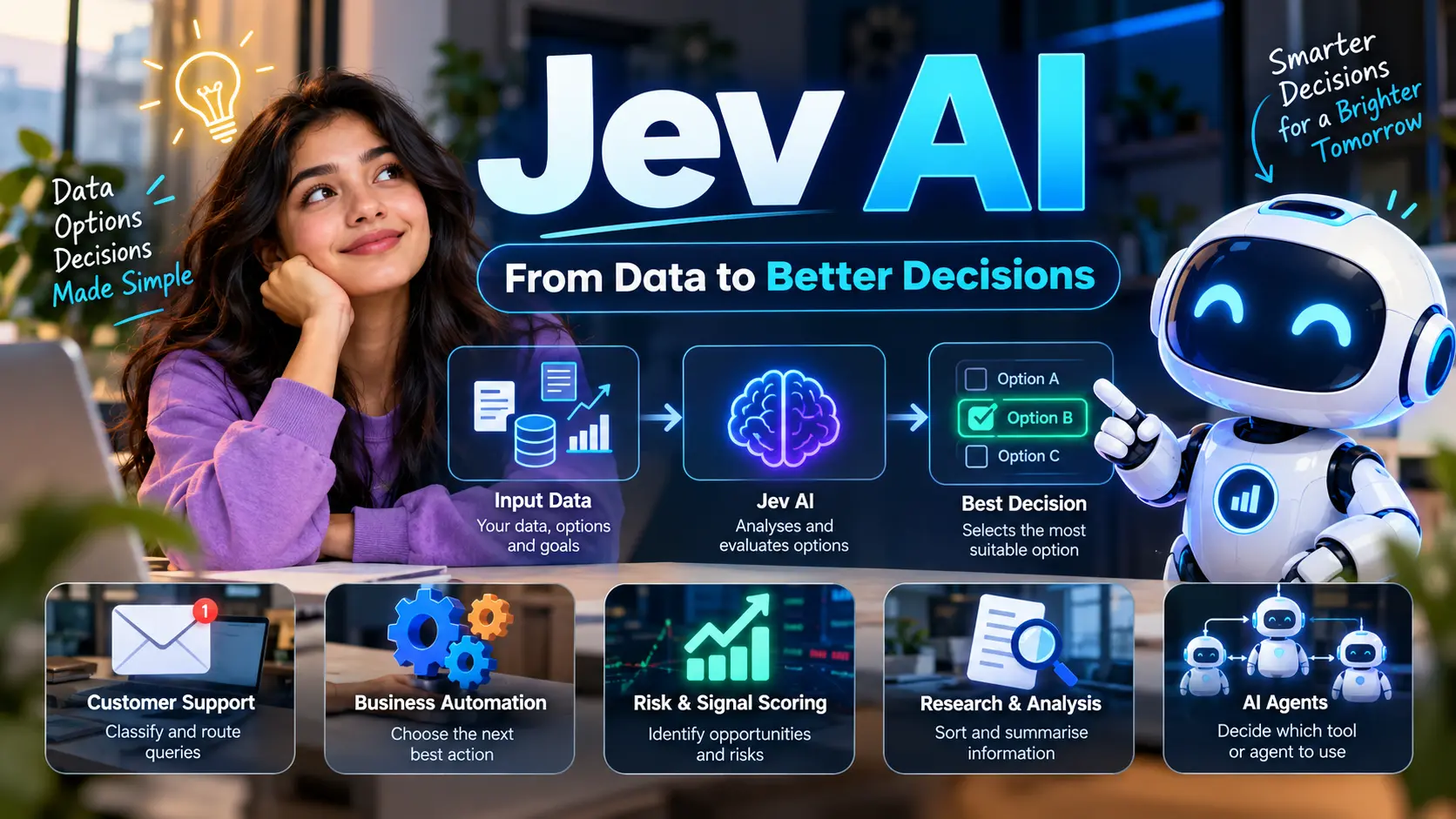
In practice, you give Jev two things:
- State: a chunk of unstructured data, such as a customer email, a transaction record or readings from a device’s sensors.
- Questions: a set of predefined, typed questions, like “Is this spam?”, “What category does this belong to?” or “On a scale of 1 to 10, how urgent is this?”
Jev then returns structured answers with calibrated confidence scores. For example: {spam: false, category: "billing", urgency: 7, confidence: 0.92}
Most AI automation today pays for generative AI capabilities when all it needs is a yes/no decision or a number. Jev drops text generation altogether, which is why it is so much faster and cheaper.
To see where Jev fits, it helps to know the basics of artificial intelligence. The field covers many techniques, from simple rule-based systems to complex neural networks, and different types of AI serve different purposes. Jev is a narrow, task-specific model built to plug into software, not to talk to people.
Diogo Almeida (CEO), Erik Gafni (CTO) and Sasha Sheng (COO) founded TypeSafe AI. Almeida spent four years at OpenAI working on reinforcement learning from human feedback (RLHF) and co-authored the InstructGPT paper that laid groundwork for ChatGPT.
Despite his success with conversational models, Almeida grew frustrated with what he saw as misaligned priorities. In interviews with TechCrunch, he put it this way: “We’ve been optimising for humans and we’re super human at pleasing humans. But the technology amounted to lightning in a bottle that was nonetheless not useful.”
His view was that most software decisions don’t need human-like conversation. They need fast, reliable classifications. Jev came out of that.
How does Jev AI work?
To see how Jev works, start with how ordinary large language models (LLMs) work. Most conversational AI is autoregressive: it predicts the next word, then the next, building sentences token by token. That produces human-like responses, but it is slow and computationally expensive.
Jev doesn’t work that way.
The core mechanism: non-autoregressive decision-making
Instead of generating text in sequence, Jev reads your whole input and returns every answer at once, in a single pass. A traditional LLM is like a chef serving a multi-course meal: you wait for the starter, then the main, then dessert. Jev is more like a vending machine. You choose what you want and it drops out immediately.
Three question types
TypeSafe’s documentation describes three basic question formats that Jev supports:
- Choice: pick from a predefined list. Example: “Which department should this ticket go to?” with the options Sales, Billing, Technical Support and General Inquiry.
- Score: return a number within a range. Example: “On a scale of 1 to 10, how risky is this transaction?”
- Noul (yes/no): a boolean judgment with a probability. Example: “Is this message potentially fraudulent? Yes or no, with confidence score.”
Jev answers all the questions in parallel within a single API call, so there are none of the sequential delays that slow traditional models.
Speed and efficiency
TypeSafe reports end-to-end latencies of 70 to 500 milliseconds. A typical LLM might take 3 to 329 seconds for a comparable classification task, so the gap runs from a fraction of a second to several minutes.
Three things explain the speed:
- Jev doesn’t predict tokens one at a time.
- Its output is small. Structured JSON is far smaller than paragraphs of text.
- The architecture is built for decision tasks, not open-ended creativity.
This fits a wider pattern in deep learning, where specialised models increasingly beat general-purpose ones on specific tasks. AI algorithms have moved from one-size-fits-all towards task-optimised variants, and Jev is another step in that direction.
Training methodology
TypeSafe says it trained Jev with reinforcement learning for calibrated decisions (RLCD). The company hasn’t published full technical details, but this appears to be a form of reinforcement learning tuned for accurate, well-calibrated probability estimates rather than for human satisfaction, as RLHF is.
The aim is that when Jev says it is 92% confident a message is spam, that figure can be trusted, neither overconfident nor underconfident.
Jev AI’s main features
Jev is a decision engine, not a conversational assistant. What follows is based on TypeSafe’s public documentation and independent reviews.
1. Structured decision outputs
Jev returns machine-readable JSON containing your answers and their confidence scores. With text-based AI you would normally need extra parsing or extraction layers. Here your application code can use the output directly, which means less complexity and fewer places for things to break.
2. Parallel multi-question processing
You can ask several questions in one API call and Jev answers them together. If you need to classify an email, rate its urgency and judge its sentiment, one request covers all three. With a traditional model that would take three sequential calls, so parallel processing means fewer calls, lower cost and faster throughput.
3. Calibrated confidence scores
Every answer comes with a probability estimate showing how confident Jev is. Your system can use that to set fallback rules when confidence drops below a threshold, for example sending low-confidence decisions to human review or an extra verification step. That makes workflows safer and more reliable.
4. Very fast responses
Response times run from tens to hundreds of milliseconds instead of seconds. That makes real-time decisions practical in live applications, without noticeable lag. Gaming, financial trading and interactive systems are obvious candidates.
5. Cost-effective scaling
At £0.042 per million input tokens with free output, Jev is orders of magnitude cheaper than most LLMs for classification work. For high-volume applications the savings are substantial, and tasks that were once too expensive to automate may now be worth doing. That could widen AI adoption where budgets are tight.
6. Easy integration through SDKs and gateways
TypeSafe provides JavaScript and TypeScript SDKs, and Jev is available through major AI gateways including Vercel AI Gateway, Cloudflare, LangChain and Langfuse. You can use familiar tooling, so developers don’t need to build custom integrations from scratch.
7. No waitlist (as of late September 2026)
Jev launched with restricted early access, but on 20 September 2026 TypeSafe announced it was open to everyone. New users start with $5 in free credits, so there is no approval process to wait through.
What makes Jev AI different?
With dozens of AI models on the market, what sets Jev apart? It does less than they do, and does that narrow job very well.
The advantage of a narrow focus
Most popular AI models try to do everything: write poetry, answer trivia, debug code, summarise documents, translate languages and chat. That breadth comes at the cost of depth in any single capability.
Jev goes the other way. It deliberately leaves out:
- Conversational abilities
- Creative text generation
- Open-ended Q&A
- Anything that needs long-form output
By narrowing to structured decision-making, Jev gets performance that general models can’t match.
Comparison: Jev vs traditional LLMs
| Feature | Jev AI | Traditional LLM (e.g. GPT, Claude) |
|---|---|---|
| Primary output | Structured decisions (JSON) | Natural language text |
| Response time | 70-500ms | 3-329 seconds |
| Cost (per M input tokens) | $0.042 | $0.20-$10+ |
| Best use case | Classification, routing, scoring | Writing, conversation, analysis |
| Output size | Tiny (bytes) | Variable (words to thousands) |
| Human interaction | None (software-facing) | Designed for humans |
Jev isn’t trying to replace your favourite chatbot. It solves a different problem.
Where Jev fits in the AI ecosystem
Think of Jev as a complement to existing models, not a rival. Many AI workflows already combine specialised components. An e-commerce recommendation system, for instance, might use one model for image recognition, another for language understanding and a third for prediction. Jev fits the decision layer of a setup like that, handling the classification and routing that would otherwise waste resources on text generation.
That mirrors AI algorithm development more generally, where hybrid systems that combine several approaches increasingly dominate. It also helps to understand narrow AI vs AGI vs superintelligence: Jev is firmly narrow AI, tuned for specific tasks rather than general intelligence.
Developers comparing Jev with the rest of their stack may also want the Complete RAG Guide on retrieval augmented generation. RAG grounds AI responses in external knowledge, while Jev extracts structured decisions. The two can work together: RAG retrieves relevant context and Jev makes a fast decision based on it.
Jev AI vs ChatGPT and other AI tools
Given how quickly Jev has drawn attention, readers will want to know how it compares with the established tools.
Jev vs ChatGPT
They aren’t really competitors, because they do different jobs. A ChatGPT guide for beginners shows that ChatGPT is good at human-facing tasks: answering questions, drafting content, brainstorming and holding a dialogue. Jev does none of that.
If you need marketing copy, ChatGPT is the clear choice. If you need to classify thousands of support tickets an hour, Jev is the better fit.
The confusion comes from both carrying the “AI” label. As our What Is Artificial Intelligence? article explains, the term covers very different technologies built for different purposes.
Jev vs other conversational AI
The same applies across the board:
| Tool | Primary purpose | Better than Jev for… | Worse than Jev for… |
|---|---|---|---|
| ChatGPT | General conversation & writing | Content creation, Q&A | Automated classification |
| Claude AI | Long-context analysis | Document summarisation | Real-time decisioning |
| Siri | Voice assistant | Smart home control | Backend automation |
| Proton Lumo | Privacy-focused assistance | Secure communications | High-volume classification |
| Jev AI | Structured decisions | Software automation | Human-facing tasks |
Some newer models deserve a mention. GPT-5.6 Luna AI and Claude Opus 5 show conversational AI still developing, while Gemini 3.7 Flash and DeepSeek V4 Pro push capabilities in specific domains. None competes directly with Jev’s decision-focused design.
Jev vs specialised classification tools
Before Jev, developers had limited options for automated classification:
- Custom-trained models were expensive to develop, hard to maintain and slow to iterate on.
- Rule-based systems were brittle, labour-intensive to update and poor at edge cases.
- Generic LLMs were overkill for simple decisions and expensive at scale.
Jev is specialised enough to be good at classification, yet it handles varied inputs and is cheap enough to deploy widely. That positioning resembles Manus AI and Mistral AI Vibe, which also carved out their own niches in a crowded market.
It also fits observations about how AI is changing consumer technology. As devices collect more data, the need for efficient, real-time decisions grows.
Real-world examples
Descriptions only go so far, so here are some concrete scenarios. The examples below are hypothetical illustrations based on Jev’s documented capabilities. The model is so new that real-world production deployments are still emerging.

Example 1: Customer support triage
An online retailer receives 10,000 customer messages a day. Junior staff sort them into queues by hand, which takes 4 hours per shift.
With Jev, each incoming message is sent with three questions:
- Category: [Returns, Order Issue, Billing, Technical, General]
- Urgency score: 1 to 10
- Contains complaint: Yes/No
Jev responds in under 500ms per message and the routing happens automatically. Urgent complaints are flagged for immediate attention, and non-urgent inquiries join standard queues. Senior staff spend their time resolving issues instead of sorting mail.
In this scenario, support response times drop by 60%, customer satisfaction improves, and staff are happier because they are no longer doing administrative drudgery.
This ties into wider discussion of AI Customer Support: Benefits, Use Cases and Best Practices, which shows how decision-focused models can support human agents.
Example 2: Fraud detection in e-commerce
A payment processor evaluates millions of transactions a day. Manual review catches obvious fraud but misses sophisticated attempts, and fully automated systems flag too many legitimate purchases.
With Jev, every transaction is scored on several dimensions:
- Fraud probability: 0 to 100%
- Transaction type: [Normal, High-Risk, Suspicious]
- Recommended action: [Approve, Review, Block]
Transactions above 85% fraud probability are blocked automatically. Those between 60% and 85% go to human review queues. Everything else clears in real time, with no delay the customer can see.
Here, fraud losses fall by 40%, false positives (legitimate purchases wrongly blocked) drop by 70%, and customer friction virtually disappears.
This reflects the principles in Protecting Your Data from Automated AI Web Scrapers: using AI defensively against threats while keeping disruption for users low.
Example 3: Content moderation platform
A social media platform has to screen billions of posts a week for policy violations. Human moderators suffer psychological stress from reviewing harmful content, and automated systems draw complaints about over-censorship.
With Jev, each post gets several assessments:
- Policy violation probability: 0 to 100%
- Violation type: [Hate Speech, Violence, Spam, Harassment, Clean]
- Confidence level: High/Medium/Low
Clear violations, such as obvious hate speech or child safety issues, trigger immediate removal at 95%+ confidence. Edge cases go to human reviewers. Low-confidence decisions get additional automated analysis before anyone acts.
Moderators would see far less traumatic content, appeal rates would fall as accuracy improves, and response times to serious violations would shrink from hours to seconds.
It also connects to growing debates about AI governance and how businesses should approach AI-powered security in increasingly regulated environments.
Example 4: Supply chain optimisation
In a hypothetical scenario, a logistics company manages deliveries across 50 cities. Weather disruptions, traffic incidents and vehicle breakdowns force constant rerouting.
With Jev, real-time data feeds are evaluated for:
- Delivery risk score: 1 to 10
- Recommended action: [Proceed, Delay, Reroute, Cancel]
- Estimated delay: minutes
The system keeps recalculating routes as conditions change, and customers are notified before problems become apparent.
AI Logistics for E-commerce covers how intelligent decision systems work in complex operations like this.
Example 5: Gaming agent behaviour
In another hypothetical scenario, a video game uses AI-controlled characters that respond dynamically to what the player does. Scripted behaviour used to feel predictable and artificial.
With Jev, game state feeds into the model, which decides:
- Enemy aggression level: Low/Medium/High
- Strategic priority: [Attack, Retreat, Defend, Flank]
- Resource allocation: percentage of inventory to commit
Characters would show emergent behaviour that surprises players while staying coherent and balanced, and computational overhead stays manageable even with dozens of AI actors at once.
This matches trends in AI-powered creative tools, where decision-focused AI improves interactive experiences.
Who can benefit from Jev AI?
Jev is specialised, so not everyone needs it, but some groups will find it very useful.
Software developers and engineering teams
If you’re building applications that need automated decisions, Jev has clear advantages over current approaches:
- Backend engineers adding classification, routing or scoring logic can replace brittle rule-based systems or expensive LLM calls.
- Full-stack developers can hand decision logic to Jev and keep traditional LLMs for human-facing interactions.
- MLOps practitioners can deploy Jev as a lightweight component in larger machine learning pipelines.
Teams considering adoption could look at DevOps course and certification providers to get integration practices right. Understanding containerisation through resources like the Keycloak Docker setup guide may also help with deployment.
Product managers
Product leaders weighing AI for their offerings could use Jev for automation features that cut manual steps in user workflows, for personalisation that adjusts experiences based on real-time signals, and for quality assurance that catches problem patterns before users do.
The strategic side is covered in AI Leadership: How Artificial Intelligence Is Transforming Decision-Making.
Business leaders
Executives focused on operational efficiency may care about cost reduction, since routine decisions that needed human oversight can be automated. They may also value scalability, because volume spikes don’t require proportional staffing, and the chance to offer faster, more responsive services than rivals. Understanding how AI builds business credibility and trust helps frame these investments.
Startups and small businesses
Resource-constrained organisations gain the most from Jev’s cost structure. Enterprise-grade solutions demand big budgets, and Jev’s low price puts sophisticated automation within reach of smaller teams.
Academic researchers
Researchers studying machine learning systems, particularly efficient decision architectures or calibration methods, will find Jev an interesting subject.
Individual developers and hobbyists
Jev is easy to get at, and the $5 in free credits means curious developers can experiment without spending anything. That lowers the barrier to trying cutting-edge AI.
Jev does have limits, though. As our guide to Generative AI explains, different models suit different tasks. Jev isn’t universally better. It is specialised. If you’re finding your way around AI more broadly, understanding different types of artificial intelligence helps you pick the right tool.
Industries with high-volume decision requirements
Some sectors stand to gain more than others. Financial services can use Jev for fraud detection, credit assessment and regulatory compliance screening. E-commerce can use it for order routing, inventory management and personalised recommendations. In healthcare it could support patient triage, appointment scheduling and preliminary diagnostics, with appropriate medical oversight. Logistics teams could apply it to route optimisation, delivery prioritisation and capacity planning, and media and entertainment companies to content moderation, audience segmentation and advertising targeting.
Each industry has its own opportunities and constraints, so weigh them carefully before adopting.
Benefits and limitations
Every technology involves trade-offs. Knowing Jev’s strengths and weaknesses helps you set realistic expectations.
Benefits
Speed comes first. Sub-second response times make real-time applications practical that weren’t before, and that opens up whole categories of interactive systems.
Cost is next. At roughly 1/50th to 1/200th the price of comparable LLM-based solutions, Jev makes automation affordable for high-volume work that would otherwise be prohibitively expensive.
The outputs are predictable and machine-readable. Structured JSON removes the parsing overhead and error-prone extraction you need when working with free text, so integration is simpler and more reliable. Built-in calibrated confidence estimates also let systems fall back sensibly instead of trusting every output blindly.
There may be environmental gains too. Faster, more efficient computation means lower energy use per decision, which matters as AI adoption grows worldwide. And because Jev folds several decisions into one parallel call, you make fewer API invocations and need less infrastructure.
Limitations
Jev can’t do human-facing work. If you need conversation, creative writing or explanatory content, it simply won’t work, and you’ll need a traditional LLM.
It works best with predefined question formats. Clearly structured question schemas suit it, while open queries that need interpretation undercut its efficiency advantage.
Its decision logic is opaque. Like most modern AI systems, Jev is a black box: you see inputs and outputs but not the reasoning in between. That raises questions about auditability and explainability.
It is new. Launched in September 2026, Jev has little third-party validation or long-term performance data, so early adopters accept some uncertainty about reliability over time.
Its performance depends entirely on the quality and representativeness of its training data. Biased or unrepresentative datasets could skew outcomes.
It is easy to misuse. Because it is simple to apply, organisations may be tempted to point it at unsuitable tasks and should avoid the “solution looking for a problem” trap.
Vendor lock-in is a risk. Jev is a proprietary model from TypeSafe AI, so moving away would mean re-engineering integrations. Spreading work across several providers may reduce that risk.
Regulation is uncertain. Emerging AI rules in the EU, UK and elsewhere may impose compliance requirements that affect how Jev can be deployed, so keeping up with regulatory frameworks is essential.
Is Jev AI free? Pricing explained
Cost transparency matters when you evaluate an AI tool. This is Jev’s pricing, based on TypeSafe’s public announcements.
Free tier
New users get $5 in free credits on registration. By TypeSafe’s calculations that is roughly 120 million input tokens, plenty for experimentation and light use.
Pay-as-you-go pricing
Standard pricing is $0.042 per million input tokens. Output tokens are free, which reflects Jev’s tiny output.
For context:
- Classifying 1,000 support tickets (averaging 200 words each) costs approximately £0.05.
- Processing one million transactions runs to roughly £42.
- LLM alternatives charge £20 to £200 per million tokens, so Jev saves 50x to 500x on classification work.
No subscription required
Pricing is purely usage-based, with no mandatory monthly commitment. That suits organisations with variable workloads.
Enterprise options
TypeSafe has said enterprise pricing is negotiable for high-volume customers. Organisations processing billions of decisions a month should contact TypeSafe directly for a custom quote.
Hidden costs to consider
Beyond per-token charges, budget for:
- Integration development, meaning engineering time to build Jev into existing systems.
- Ongoing monitoring, with observability infrastructure to track performance and catch anomalies.
- Fallback mechanisms, so you have backup systems for when Jev is unavailable or returns low-confidence outputs.
- Testing and validation, so QA confirms Jev meets your quality standards before production.
If you manage IT budgets, related costs like mileage rates and operational expenses may also feed into overall technology spending.
Cost-benefit analysis framework
To decide whether Jev is worth its cost, consider:
- The current cost of the manual processes being automated
- The cost of errors from imperfect human or automated decisions
- The opportunity cost of delayed decisions
- Scaling costs as volume grows
Jev may pay for itself within months through efficiency gains alone, before you count any improvement in decision quality.
Jev AI and the future of artificial intelligence
Jev reflects several broader trends in AI development.
Trend 1: Specialisation over generality
AI has long had a tension between general-purpose models and specialised ones. General models have dominated headlines because they’re versatile. Jev suggests the pendulum may swing towards specialisation, with purpose-built models beating generalists on specific tasks.
Other areas of technology have seen a similar shift, as cloud computing replaced on-premises servers and microservices replaced monolithic applications.
Trend 2: Efficiency as competitive advantage
As AI adoption scales, computational efficiency matters more economically. Models that use fewer resources per task gain an edge through lower costs, less latency and a smaller environmental footprint.
This links to discussions about deep learning optimisation, and to how digital business transformation increasingly depends on scalable, cost-effective AI infrastructure.
Trend 3: Software-integrated AI
Until recently, most AI tools were built for human interaction: chatbots, virtual assistants, creative generators. Jev points towards AI as invisible infrastructure, embedded in software instead of facing users directly.
A similar thing happened with the way Siri and Apple’s virtual assistant integrated into operating systems, becoming less visible as the integration deepened.
Trend 4: Economic accessibility
Jev’s aggressive pricing puts AI capabilities once reserved for well-funded organisations within reach of startups, small businesses and individual developers.
Kimi AI and Amazon Nova AI are also widening AI’s reach, each by a different route.
Unsettled questions
Several questions about Jev remain open:
- Can TypeSafe AI keep growing while holding prices low?
- Will established players like OpenAI, Anthropic or Google launch competing decision-focused models?
- How will authorities regulate models designed for automated decision-making?
- Will enterprises embrace Jev quickly, or will scepticism and inertia slow uptake?
These uncertainties are typical of new AI models and emerging technology in general.
The Jevons paradox connection
Jev is named after the economist William Stanley Jevons, who described what is now called the “Jevons paradox”: greater efficiency in using a resource often leads to more total consumption, not less.
TypeSafe appears to be betting on a similar effect for AI. If decisions become far cheaper and faster, organisations may start automating processes they once considered too expensive or impractical, and total AI consumption could rise even as unit costs collapse.
The idea adds an interesting angle to Jev’s commercial strategy, and echoes economic dynamics discussed in pieces like how AI is transforming industries at scale.
Use the key points in this guide to understand the topic and make more informed decisions.

This guide is researched and edited using relevant documentation, reliable sources and publicly available information.
Was this guide helpful?
Your feedback helps us improve future guides.