In this article
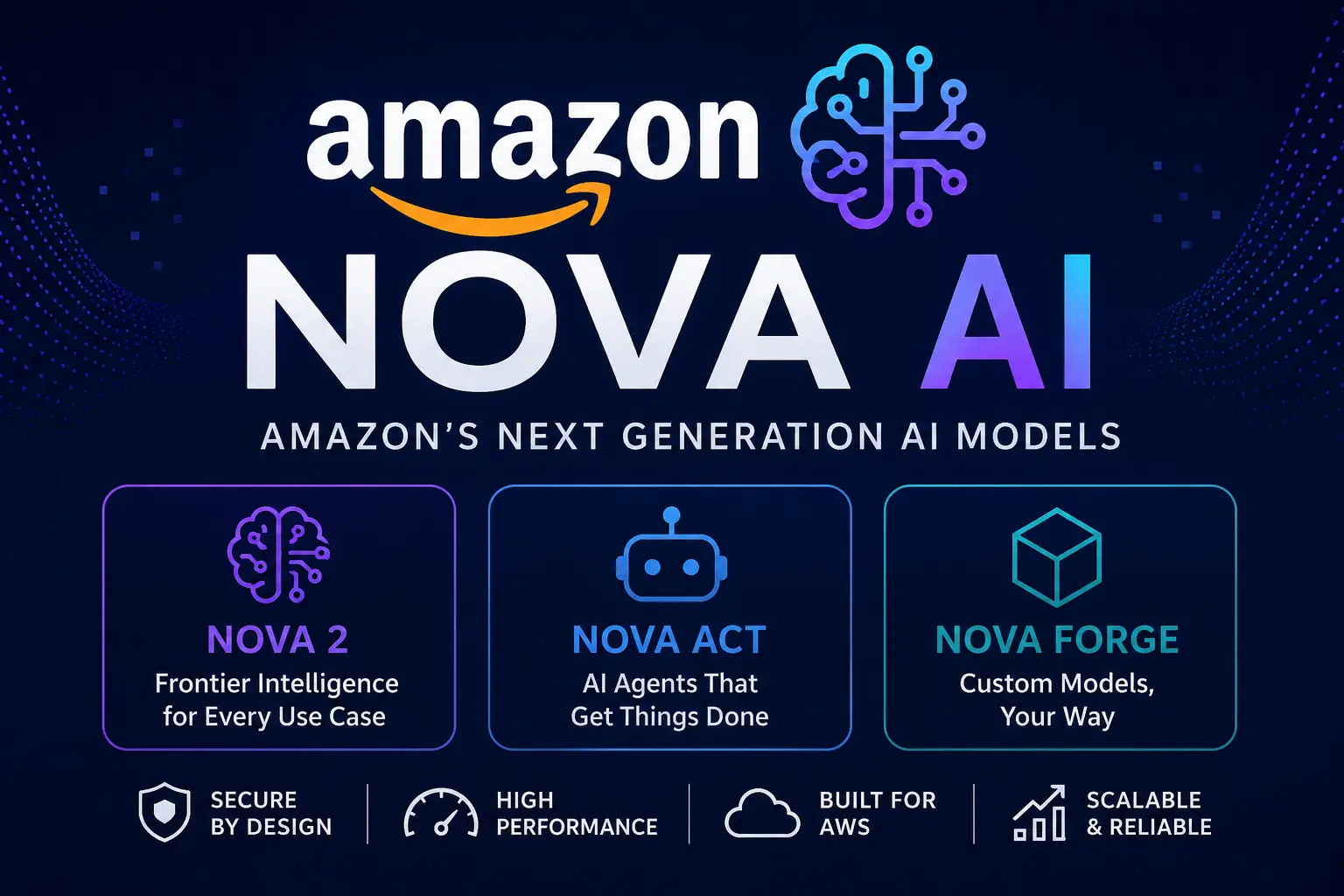
Amazon has been quietly building a much bigger AI ecosystem than many people realise. While ChatGPT, Claude and Gemini often dominate conversations around generative AI, Amazon has taken a different route with Amazon Nova.
Rather than putting everything into one general-purpose chatbot, Amazon Nova is a collection of foundation models and AI services designed around different workloads. That includes everyday reasoning, document processing, multimodal understanding, real-time voice conversations, semantic search, model customisation and browser-based AI agents.
For businesses already working with AWS, this approach is particularly interesting. Nova can sit inside the same cloud environment that companies may already use for databases, applications, security, analytics and machine learning.
But is Amazon Nova actually worth paying attention to, or is it simply another collection of AI models competing for attention?
This guide takes a closer look at what Amazon Nova is, how the different models work, what Nova Act and Nova Forge bring to the table, where the technology makes sense, and what developers should consider before adopting it.
What Is Amazon Nova?
Amazon Nova is Amazon Web Services’ family of generative AI models and AI services.
The platform is designed to handle several types of workloads, including text generation, reasoning, document analysis, video understanding, speech conversations, semantic search and AI agent workflows.
Amazon makes Nova available primarily through Amazon Bedrock, which means developers can integrate the models into applications without having to build and operate the underlying model infrastructure themselves.
The bigger idea is simple: instead of treating AI as a standalone chatbot, Amazon wants Nova to become part of the infrastructure behind business applications.
That distinction matters.
If you are just looking for a tool to write an email or brainstorm ideas, a consumer chatbot may be enough. But if a company wants to process thousands of documents, analyse video, build a customer service assistant, create a voice application or automate browser workflows, the requirements are very different.
Understanding what artificial intelligence is and how modern AI systems work provides useful context here. Amazon Nova is not a single AI personality. It is a collection of specialised foundation models designed to perform different kinds of tasks.
Why Amazon Nova Matters
The AI market has increasingly moved beyond simple text generation.
Modern applications may need to understand:
- Text
- Images
- Documents
- Video
- Audio
- Speech
- Code
- Structured data
- Business information
This is where multimodal AI becomes important.
For anyone learning about the different types of artificial intelligence, Nova is a good example of how modern AI is becoming specialised around particular capabilities rather than simply being one large chatbot.
The models can also be used in applications that combine AI with external information. This makes technologies such as Retrieval-Augmented Generation particularly relevant when companies want AI systems to work with their own documents and knowledge bases.
Amazon Nova 2 Models
Amazon Nova 2 is not one model. It is a family of models with different strengths.
Amazon currently highlights Nova 2 Lite, Nova 2 Pro, Nova 2 Sonic and Nova Multimodal Embeddings, while Nova 2 Omni is also part of the wider Nova 2 development ecosystem.
Amazon Nova 2 Lite
Nova 2 Lite is designed for everyday workloads where businesses need a balance between capability, speed and cost.
It supports multimodal inputs including text, images, video and documents. Amazon also provides features such as extended thinking, web grounding, code interpretation and a context window of up to one million tokens.
That makes Lite particularly interesting for high-volume applications.
Typical examples include:
- Customer support
- Document processing
- Business process automation
- Content analysis
- Video analysis
- AI assistants
- Information extraction
- Agentic workflows
For developers, one of the more useful aspects is the ability to control thinking effort. Not every question needs maximum reasoning. Giving developers more control over that trade-off can help manage latency and costs.
This is closely related to the broader principles behind machine learning, where the practical goal is not simply maximum intelligence, but useful performance under real-world constraints.
Amazon Nova 2 Pro
Nova 2 Pro is aimed at more demanding workloads.
Amazon positions it for complex reasoning, long-range planning and sophisticated agentic tasks. It is also available as a preview model and can be used with Nova Forge for organisations looking to customise models.
Potential applications include:
- Multi-document analysis
- Complex research
- Video reasoning
- Software migration
- Advanced business analysis
- Agentic workflows
- Long-running tasks
The important distinction is that Pro is not simply intended to be “Lite but smarter”. It is designed for situations where a task requires more reasoning and planning.
That makes it potentially useful for enterprise applications where an incorrect answer can be more expensive than a slightly slower response.
Amazon Nova 2 Sonic
Nova 2 Sonic takes a different approach.
Instead of focusing primarily on text, it is designed for real-time speech-to-speech conversations.
Amazon describes it as a conversational model capable of speech understanding and speech generation, with features such as multilingual support, cross-modal interaction and tool invocation. Its context window can extend to one million tokens.
This opens up applications such as:
- Voice customer support
- AI receptionists
- Interactive learning
- Voice assistants
- Telephone-based services
- Real-time conversational applications
The ability to switch between voice and text within the same session is particularly useful for applications where users may start speaking and later need to provide or receive written information.
It also shows how AI assistants are moving beyond traditional chatbot interfaces.
For comparison, Apple’s approach to voice assistance is much more consumer-focused. Our guide to how Siri AI works explains how another major technology company approaches conversational assistance.
Amazon Nova Multimodal Embeddings
Not every AI application needs a chatbot.
Sometimes the real challenge is finding information.
Amazon Nova Multimodal Embeddings is designed for semantic search and retrieval across multiple content types. It can work with text, documents, images, video and audio and map those different formats into a unified embedding space.
Imagine a company with millions of files spread across:
- PDFs
- Product images
- Training videos
- Audio recordings
- Internal documents
- Customer conversations
A conventional keyword search may struggle to connect these different formats.
Multimodal embeddings can help applications understand relationships between them.
This is particularly relevant to AI algorithms and how they work because embeddings form an important part of many modern AI retrieval and recommendation systems.
What Is Amazon Nova 2 Omni?
Nova 2 Omni belongs to Amazon’s broader multimodal model development and is intended to push further into multimodal understanding and generation. AWS documentation describes Nova 2.0 as including Omni capabilities alongside Lite, Pro and Sonic developments.
The appeal of an Omni-style model is obvious.
Instead of forcing developers to build separate pipelines for every modality, the goal is to make it easier for one system to work across different types of information.
That could eventually support workflows involving combinations of:
- Text
- Images
- Audio
- Video
- Documents
This direction fits into the wider development of generative AI, where models are increasingly expected to understand and create more than plain text.
Amazon Nova Act: AI Agents That Use Websites
Nova Act is arguably one of the more interesting parts of the Amazon Nova ecosystem.
Instead of simply answering a question, an AI agent can interact with software.
Nova Act is designed to automate browser-based user interface workflows. Developers can create agents that interact with websites and applications using natural language instructions and Python code.
Think about tasks such as:
- Filling out forms
- Searching websites
- Extracting information
- Performing repetitive QA checks
- Navigating business portals
- Completing routine browser workflows
Amazon says Nova Act is designed for high reliability and reports over 90% reliability for typical browser workflows.
That number should not be interpreted as a guarantee that every website task will succeed. Browser environments change constantly. Pop-ups appear, page layouts move, login systems behave differently and websites can introduce unexpected steps.
Still, the direction is significant.
Traditional automation often depends on rigid scripts. If a webpage changes, the script can break.
AI agents attempt to understand the interface and adapt to changes.
This is one reason agentic AI is becoming such an important part of the industry. Tools such as Manus AI also demonstrate the growing interest in AI systems that can move beyond generating text and actually complete multi-step tasks.
Nova Act vs Traditional Automation
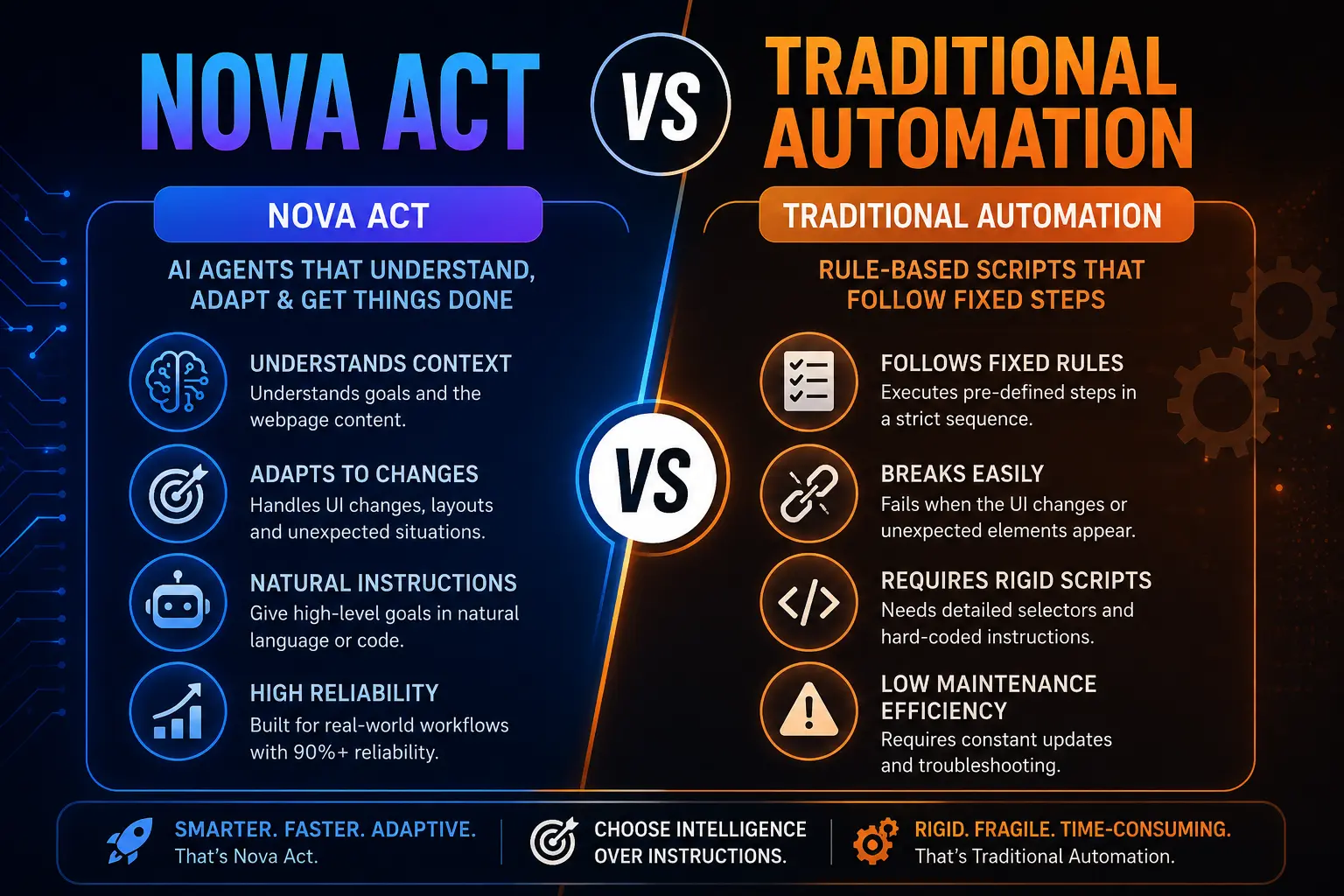
There is an important difference between conventional automation and AI-powered browser agents.
A traditional automation script might effectively say:
“Click this button, enter this value, then click submit.”
An AI agent can instead be given a broader objective:
“Find the relevant customer record, update the requested information and submit the form.”
That makes the system potentially more flexible.
However, it also introduces uncertainty.
A traditional script behaves predictably when the environment remains unchanged. An AI agent makes decisions based on what it sees.
For mission-critical workflows, companies therefore need testing, permissions, monitoring and human escalation.
Amazon’s own responsible AI documentation recommends restricting domains and tools used by Nova Act rather than giving an agent unrestricted access.
Amazon Nova Forge
Nova Forge is aimed at organisations that want deeper control over their AI models.
Rather than simply calling a finished foundation model, Nova Forge gives organisations access to model checkpoints and training workflows. Companies can blend proprietary data with Amazon-curated training data and work across different stages of model development.
This is a very different proposition from using ChatGPT or another consumer-facing AI assistant.
A company might have specialised knowledge that a general model does not understand particularly well.
For example:
A financial organisation could have its own terminology, procedures and internal research.
A manufacturer could have years of technical documentation.
A healthcare organisation could have specialised workflows and domain-specific information.
A large enterprise may want an AI system that understands those requirements more deeply while retaining general reasoning capabilities.
Nova Forge is designed for this type of advanced model customisation.
Does Nova Forge Mean Companies Can Build Their Own GPT?
Not quite.
Building or customising a sophisticated foundation model is still an extremely complex undertaking.
Nova Forge provides infrastructure, checkpoints, training capabilities and tooling. It does not turn model development into a simple drag-and-drop exercise.
Amazon describes features including reinforcement learning, proprietary data integration and responsible AI tooling.
For most small businesses, using an existing model through Amazon Bedrock will probably make more sense.
For large organisations with significant AI workloads and proprietary data, deeper customisation can become much more attractive.
Amazon Nova and AWS Bedrock
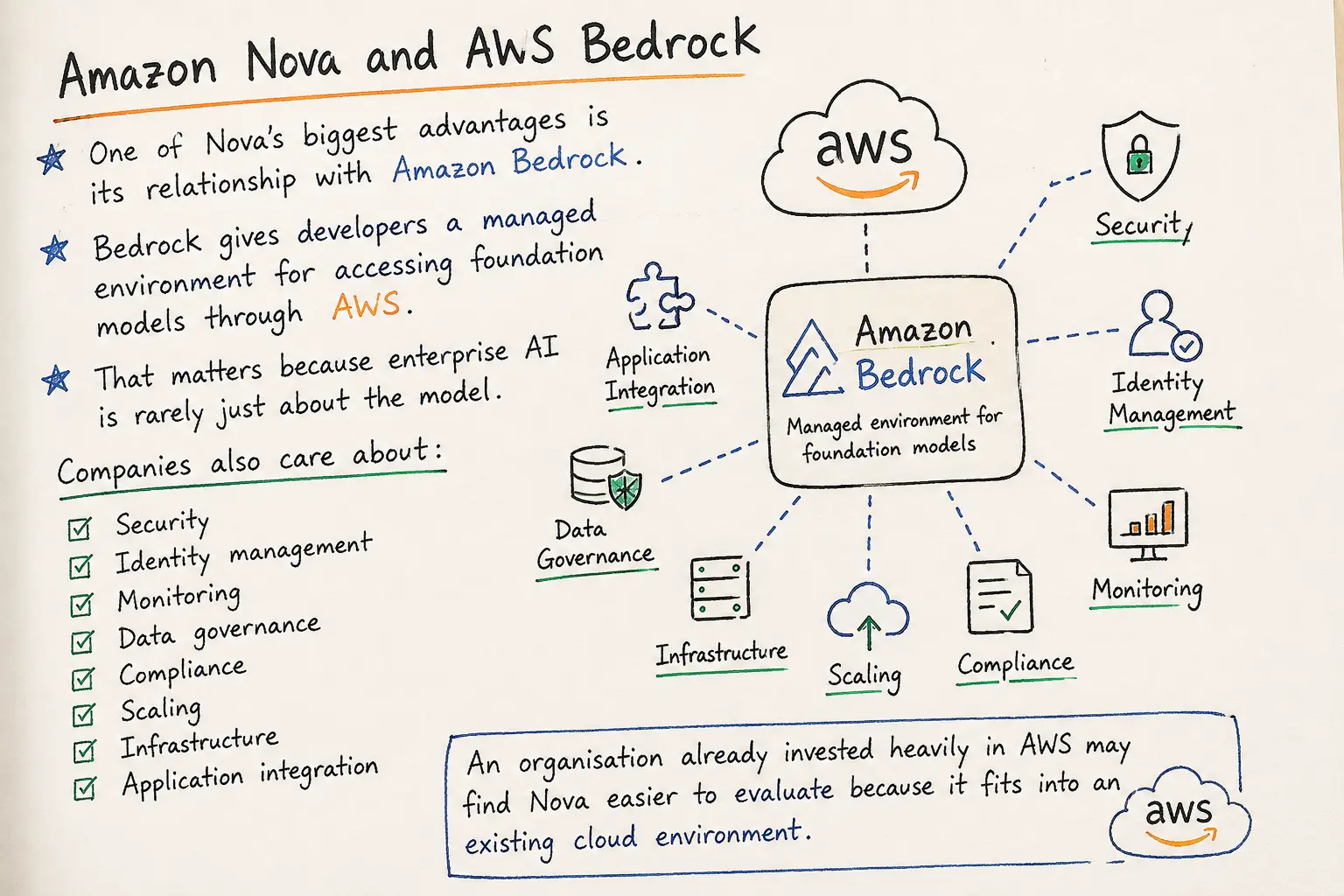
One of Nova’s biggest advantages is its relationship with Amazon Bedrock.
Bedrock gives developers a managed environment for accessing foundation models through AWS.
That matters because enterprise AI is rarely just about the model.
Companies also care about:
- Security
- Identity management
- Monitoring
- Data governance
- Compliance
- Scaling
- Infrastructure
- Application integration
An organisation already invested heavily in AWS may find Nova easier to evaluate because it fits into an existing cloud environment.
This is one of the major differences between using an AI chatbot personally and deploying AI inside a company.
For example, someone learning ChatGPT may primarily care about response quality and usability.
An enterprise developer may instead ask:
“How do I integrate this with our existing systems?”
That is the market Amazon is targeting.
What Can Amazon Nova Be Used For?
There is no single “best” Nova use case. Its usefulness depends on which model and service you choose.
Customer Support
Nova can support customer service systems that need to understand customer questions, retrieve information and produce responses.
Voice applications can also use Nova 2 Sonic for conversational interactions.
For a broader look at the business side of this technology, see our guide to AI customer support, including benefits, use cases and best practices.
Document Analysis
Large companies often have enormous collections of documents.
Nova 2 Lite can process complex documents and extract information from PDFs, tables and other formats.
Combined with RAG, this can become a powerful internal knowledge system.
Video Understanding
AI can be used to analyse long video files, identify events and produce summaries.
This could be useful for:
- Training
- Security analysis
- Media
- Sports
- Education
- Corporate communications
AI video tools are developing rapidly too. Our comparison of the best AI video editing tools in 2026 looks at another side of this rapidly expanding market.
Software Development
Advanced reasoning models can assist with code analysis, migration planning, debugging and software-related tasks.
Developers interested in the broader AI coding ecosystem may also want to see our Xiaomi MiMo Code review and the guide to DevOps course and certification providers in 2026.
Search and Knowledge Discovery
Nova Multimodal Embeddings could be useful when an organisation needs semantic search across multiple types of information.
Instead of searching only for exact words, an application can retrieve content based on meaning and relationships.
This is one of the foundations behind modern enterprise knowledge systems.
Amazon Nova for Business
Amazon’s enterprise focus is perhaps the most important part of Nova.
AI becomes much more interesting to businesses when it can be connected to existing operations.
For example, an online retailer might combine AI with:
- Customer support
- Product information
- Inventory systems
- Logistics
- Sales data
- Internal documentation
AI could then become part of the workflow rather than simply a separate assistant.
This is already happening across industries. Our guide to AI logistics for e-commerce explores how artificial intelligence is being applied to logistics and online retail.
AI is also increasingly involved in areas that may not immediately look like traditional technology. For example, AI-powered beauty technology shows how recommendation systems, computer vision and personalisation are changing consumer experiences.
Amazon Nova for Research and Knowledge Work
Researchers and analysts are another natural audience.
Long-context models can work with large quantities of information without forcing users to break everything into small pieces.
A research workflow might involve:
- Uploading a collection of documents.
- Asking the model to identify important themes.
- Comparing conflicting information.
- Extracting structured findings.
- Generating a research summary.
- Using external tools or web grounding where appropriate.
- Reviewing the final output manually.
The key word here is “review”.
AI can speed up research, but that does not mean every generated conclusion should be accepted without verification.
The same principle applies when using Claude AI, Kimi AI or other advanced AI systems.
Amazon Nova and AI Agents
The development of Nova Act reflects a much larger change in artificial intelligence.
Early generative AI mainly answered questions.
The next generation is increasingly expected to perform tasks.
That means an AI system may need to:
- Understand an objective
- Plan a sequence of actions
- Use tools
- Navigate software
- Recover from problems
- Ask for human help when necessary
- Complete the task
This is closer to an AI worker than a traditional chatbot.
It also raises important questions around permissions and accountability.
The distinction between Narrow AI, AGI and superintelligence becomes useful here. Nova Act is a specialised AI system designed for defined workflows. It should not be confused with artificial general intelligence.
Amazon Nova vs ChatGPT
Amazon Nova and ChatGPT are not exactly the same type of product.
ChatGPT is primarily presented as an end-user AI assistant, although OpenAI also provides developer and enterprise products.
Nova is much more deeply positioned as an AWS infrastructure and model ecosystem.
A simple comparison looks like this:
| Area | Amazon Nova | ChatGPT |
|---|---|---|
| Primary focus | Enterprise AI and developers | AI assistant and platform |
| Cloud integration | Strong AWS integration | OpenAI ecosystem |
| Multimodal AI | Yes | Yes |
| AI agents | Nova Act | Agent capabilities across OpenAI products |
| Model customisation | Nova Forge and AWS tooling | OpenAI platform options |
| Voice | Nova 2 Sonic | Voice capabilities |
| Enterprise infrastructure | AWS | OpenAI enterprise ecosystem |
The right choice depends on the job.
Someone who wants a ready-to-use conversational assistant may prefer ChatGPT.
A company already deeply invested in AWS may find Nova more attractive for application development.
For beginners, our ChatGPT guide for beginners explains the basics of working with AI assistants.
Amazon Nova vs Claude
Claude has built a strong reputation around writing, reasoning, coding and long-context work.
Amazon Nova takes a broader infrastructure-oriented approach.
There is also an important connection between the two ecosystems because Amazon Bedrock supports multiple foundation models, allowing businesses to evaluate different models within the same cloud environment.
If your main interest is understanding Anthropic’s approach, our Claude AI Master Guide goes deeper into its capabilities.
Amazon Nova vs Kimi
Kimi has attracted attention for long-context reasoning, research and coding.
Amazon Nova also places considerable emphasis on large context windows and enterprise workloads.
Our Complete Kimi Guide for 2026 covers Kimi’s features, prompting, coding and research capabilities in more detail.
The larger trend is worth noticing: context length is becoming increasingly important as AI moves from short conversations towards working with complete documents, projects and datasets.
Amazon Nova and Smaller AI Models
One of the interesting things about the current AI market is that bigger does not automatically mean better for every application.
A company processing millions of routine requests may care more about:
- Cost per request
- Latency
- Reliability
- Throughput
- Integration
- Predictability
That is why a model such as Nova 2 Lite can be more useful than a larger model for certain production workloads.
The same principle applies across the AI industry. Developers increasingly select models according to the task rather than choosing the model with the biggest headline benchmark.
Amazon Nova Pricing
Amazon Nova pricing depends on the specific model, service and amount of usage.
AWS generally charges foundation model usage based on factors such as input and output tokens, while other services have their own pricing structures.
Because cloud AI pricing can change, it is better to check current Amazon Bedrock pricing before making a purchasing decision rather than relying on an old comparison.
The economics can be particularly important for applications processing millions of requests.
A difference of a fraction of a cent per request may appear insignificant at small scale. At enterprise scale, it can become a major operating cost.
Is Amazon Nova Free?
Amazon Nova is primarily an AWS service rather than a completely free consumer chatbot.
Some AWS customers may have access to promotional credits or free usage offers, but developers should check the current AWS pricing and eligibility rules before assuming that a Nova application will remain free.
If you are simply experimenting with generative AI, consumer-facing tools may be easier to start with.
If you are building a production application, the calculation changes.
Advantages of Amazon Nova
Strong AWS Integration
For organisations already using AWS, Nova can fit naturally into existing infrastructure.
Large Context Windows
Some Nova models support up to one million tokens of context, which can be valuable for long documents and complex workflows.
Multimodal Capabilities
Nova can work across different information types, including text, images, documents, video and speech depending on the model.
Agent Development
Nova Act gives developers a dedicated route for browser-based automation.
Customisation
Nova Forge gives enterprises considerably deeper control over model development than a conventional chatbot interface.
Enterprise Focus
Security, governance, scalability and cloud infrastructure are central to the Amazon approach.
Potential Disadvantages
AWS Complexity
AWS is powerful, but it can also be intimidating for newcomers.
Someone who simply wants to ask an AI questions may find the Bedrock ecosystem unnecessarily complicated.
Cloud Dependency
Building deeply around AWS can create dependency on the platform.
That is not necessarily a problem, but it should be considered before designing a large AI architecture.
Cost Management
Large-scale AI workloads can become expensive if token consumption, model selection and application architecture are not managed carefully.
AI Reliability
Even advanced models can make mistakes.
This becomes particularly important with agents that are allowed to take actions rather than simply generate text.
Enterprise Orientation
Nova makes the most sense when you are thinking about applications, infrastructure and business workflows. It is not necessarily the best option for someone who just wants a simple AI chat experience.
Amazon Nova and AI Safety
The more powerful an AI system becomes, the more important its boundaries become.
This is especially true for AI agents.
An agent that can browse websites, call tools or interact with business systems potentially has more impact than a chatbot that only produces text.
Amazon provides responsible AI documentation and controls around Nova services. For Nova Act, AWS specifically recommends limiting domains and tools to those required for a workflow.
Businesses should still perform their own testing.
Amazon itself recommends evaluating Nova models against the content and use cases for which they are intended.
That is a useful rule for any AI platform.
Never assume that a strong benchmark automatically means the model is perfect for your particular business.
Amazon Nova in Everyday Applications
The technology may sound enterprise-focused, but the eventual applications can be surprisingly familiar.
Imagine a travel company using AI to understand a customer’s preferences, search internal information, answer questions and help organise an itinerary.
AI is already influencing travel planning, including our guide on AI-powered travel planning for Puerto Vallarta visitors.
A travel assistant could potentially combine text, documents, websites and voice interaction in a single workflow.
Similarly, a customer could use AI while planning an excursion such as a catamaran and snorkel day in Cap Cana.
The technology behind these experiences is becoming increasingly multimodal.
For travellers who prefer conversational planning, our guide to using Claude AI for travel planning explores another example of how AI can support this type of workflow.
Amazon Nova and Content Creation
Nova can also be useful for content-related workflows.
However, the strongest use of enterprise AI is not necessarily producing endless generic articles.
The more interesting applications involve research, summarisation, editing, information extraction and workflow automation.
AI video creation is another rapidly developing area. Tools such as InVideo AI and Kling AI demonstrate how generative AI is expanding into video production.
Similarly, Tripo AI focuses on AI-assisted 3D content generation.
Nova sits in a different part of this ecosystem, with a stronger emphasis on foundation models, enterprise applications and infrastructure.
Amazon Nova and Business Trust
Enterprise AI adoption is not only a technology decision.
Customers need to trust the companies using it.
Businesses need to think about transparency, data handling, security and how AI-generated decisions are reviewed.
Our article on how AI builds business credibility and trust explores this broader relationship between AI and customer confidence.
Leadership matters too.
AI adoption is increasingly becoming a management issue rather than something that belongs exclusively to the IT department. Our guide to AI leadership and how artificial intelligence is transforming decision-making looks at this shift in more detail.
Amazon Nova Across Different Industries
Nova’s capabilities could be applied across a wide range of sectors.
Finance
Financial companies can use AI for document analysis, customer service, research assistance and internal knowledge systems.
Retail
Retailers can combine AI with customer support, product data, search and operational workflows.
Healthcare
Healthcare organisations may use AI for document processing and information retrieval, although sensitive applications require rigorous validation and appropriate safeguards.
Education
Voice assistants, document analysis and interactive learning are potential applications.
Logistics
AI agents and multimodal systems can help businesses manage complex operational information.
Sports
AI can also support analysis and scouting. For example, AI is transforming football talent scouting by helping teams process and analyse large amounts of information.
Smart Homes
The broader smart-home ecosystem is another natural area for AI-powered assistants. Our guide to AI smart homes explores how artificial intelligence is reshaping modern living.
What About Janitor AI?
Not every AI service targets the same audience.
Janitor AI is primarily associated with conversational AI and character-based interactions, while Amazon Nova is designed around foundation models, cloud applications and enterprise workloads.
Comparing them directly therefore does not tell you much about which technology is “better”. They solve fundamentally different problems.
The same applies to specialised systems such as LongCat AI. Our Meituan LongCat AI guide covers another example of the increasingly diverse AI model landscape.
Where Amazon Nova Could Go Next
The most interesting question is not simply how good Nova is today.
It is where the ecosystem goes next.
Amazon has already moved beyond basic text generation into:
- Reasoning
- Speech
- Multimodal understanding
- Embeddings
- AI agents
- Model customisation
- Browser automation
- Enterprise deployment
Nova Forge suggests that Amazon is also interested in giving organisations more control over model development.
Nova Act points towards a future where AI systems can interact with software on behalf of users.
Together, those developments point towards a broader vision: AI becoming part of the operating layer of business applications.
Should You Pay Attention to Amazon Nova?
Amazon Nova is more interesting when you stop thinking of it as “Amazon’s version of ChatGPT”.
That comparison is too narrow.
Nova is really Amazon’s attempt to build a complete AI stack around AWS. It combines foundation models with multimodal processing, speech, embeddings, custom model development and browser-based agents.
Nova 2 Lite makes sense for high-volume workloads where cost and speed matter. Nova 2 Pro targets more complex reasoning and agentic applications. Nova 2 Sonic focuses on real-time voice interaction, while multimodal embeddings address search and retrieval problems. Nova Forge takes the ecosystem deeper into model customisation, and Nova Act moves AI into browser-based task automation.
That does not mean Amazon Nova is automatically the best AI platform.
For individuals, a consumer AI assistant may be much simpler.
For developers, the decision depends on model quality, pricing, latency, tooling and integration requirements.
For businesses already operating heavily on AWS, however, Nova deserves serious consideration.
The most important development may ultimately be Nova Act and Forge rather than another benchmark score. One points towards AI systems that can actually perform software-based tasks, while the other gives enterprises more control over how their models are developed.
That is a much bigger shift than simply producing better chatbot answers.
And as artificial intelligence continues moving from conversational tools towards systems that can reason, retrieve information, use tools and take action, Amazon Nova is positioning itself firmly in that next phase of the AI market.
 ✓
✓
RCN Guide Staff
RCN Guide Staff is the editorial team behind RCNGuide’s coverage of artificial intelligence, machine learning, software, developer tools and emerging technologies. Our team researches technology topics using official documentation, technical resources, product information and relevant industry sources.
We focus on making complex technology easier to understand while reviewing important claims, explaining practical applications and updating articles as products, features and industry standards evolve.
At a Glance
How RCNGuide Researches Technology
Technology changes quickly. Our editorial approach focuses on researching the subject first, identifying reliable information and presenting it in a way that is useful to readers.
Research
We examine official documentation, product information, technical resources and relevant industry material before developing an article.
Evaluate
We consider capabilities, limitations, practical applications, availability and other details that may affect how a technology works in the real world.
Explain
Technical information is organised into clear explanations, examples and practical context so readers can understand the subject without unnecessary complexity.
Update
When important specifications, features, pricing or availability change, we review relevant content and update it where appropriate.
RCNGuide publishes independent technology and AI coverage. Information in this article is provided for educational and informational purposes. Product features, pricing, availability and technical specifications may change over time. Always check the relevant official documentation before making technical, financial or business decisions.
RCNGuide AI Content Policy
AI tools may be used by our editorial team for research assistance, outlining, editing or other supporting tasks. Published content is reviewed and edited by humans before publication. AI-generated material is not treated as a substitute for editorial judgement, source verification or factual review.
Read our AI Content Policy →Spotted an Error?
Technology information can change quickly. If you notice an incorrect statement, outdated specification or missing information, please contact the RCNGuide editorial team so we can review it.
Contact the Editorial Team →Continue Your AI & Technology Research
Go deeper with more RCNGuide explainers, AI guides and technology resources related to this topic.
Keep Exploring AI & Emerging Technology
Discover practical guides, explainers, reviews and analysis covering artificial intelligence, software, machine learning and the technologies shaping the future.
Use the key points in this guide to understand the topic and make more informed decisions.

This guide is researched and edited using relevant documentation, reliable sources and publicly available information.
Was this guide helpful?
Your feedback helps us improve future guides.